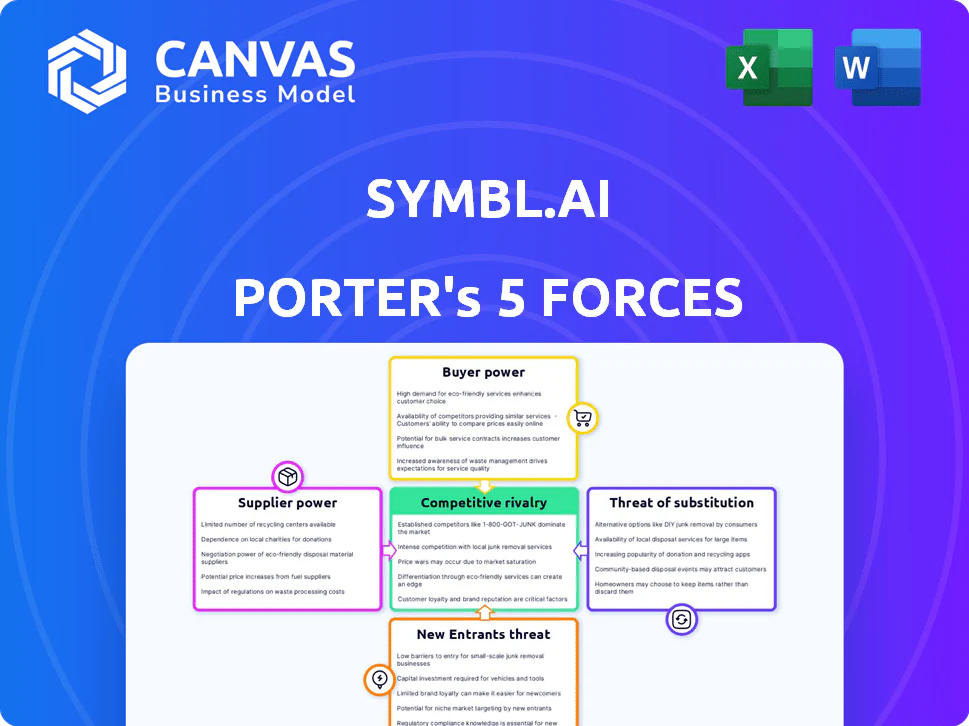
SYMBL.AI PORTER'S FIVE FORCES TEMPLATE RESEARCH
What is included in the product
 Detailed Word Document
Analyzes Symbl.ai's position, competitive pressures, and market dynamics.

 Customizable Excel Spreadsheet
Instantly pinpoint vulnerabilities with data-driven insights.
Same Document Delivered
Symbl.ai Porter's Five Forces Analysis
This preview shows the exact Symbl.ai Porter's Five Forces analysis you'll receive instantly after purchase, providing a comprehensive look at the competitive landscape. It examines the threat of new entrants, bargaining power of suppliers/buyers, and competitive rivalry. The analysis also covers the threat of substitutes and how they influence the industry. Get the complete, ready-to-use document now!

Porter's Five Forces Analysis Template

Go Beyond the Preview—Access the Full Strategic Report
Symbl.ai faces moderate rivalry, with competitors offering similar AI-powered conversation intelligence solutions. Buyer power is relatively low due to enterprise-focused contracts. Suppliers, primarily cloud providers, exert moderate influence. The threat of new entrants is also moderate, limited by technical barriers. Substitute products like transcription services pose a moderate threat. This brief snapshot only scratches the surface. Unlock the full Porter's Five Forces Analysis to explore Symbl.ai’s competitive dynamics, market pressures, and strategic advantages in detail.
Suppliers Bargaining Power

Limited number of specialized AI technology suppliers
Symbl.ai's reliance on a few specialized AI tech suppliers boosts supplier power. These suppliers, holding key tech and APIs, gain leverage in price talks. Limited alternatives mean Symbl.ai might face higher costs. This dynamic could affect Symbl.ai's profitability, as seen in the 2024 tech sector's pricing trends.
High dependence on cloud service providers
Symbl.ai's dependence on cloud services, such as AWS, Azure, and Google Cloud, gives cloud providers substantial bargaining power. These providers, controlling a large market share, dictate pricing and service terms. In 2024, AWS held about 32% of the cloud infrastructure market, Azure 23%, and Google Cloud 11%. This limits Symbl.ai's ability to negotiate favorable terms.

Potential for supplier consolidation
The tech sector witnesses supplier consolidation, including AI firm acquisitions. Fewer suppliers could mean stronger bargaining power for them. This might result in price increases for companies such as Symbl.ai. Recent data shows a 15% rise in AI tech acquisition costs in 2024.

Suppliers with proprietary data or algorithms
Suppliers with proprietary data or unique algorithms hold considerable power. Symbl.ai's dependency on AI models and data for conversational intelligence makes it vulnerable. If critical suppliers control exclusive or superior resources, they can influence Symbl.ai's operations. This can affect costs and innovation. The industry's reliance on specialized AI components further concentrates supplier power.
- In 2024, the AI software market was valued at $117.3 billion.
- Companies like OpenAI and Google have significant control over foundational AI models.
- Proprietary datasets give suppliers an edge in pricing and terms.
- Symbl.ai's success hinges on its ability to manage these supplier relationships effectively.
Need for ongoing integration with third-party services
Symbl.ai's reliance on third-party services like communication platforms and cloud providers introduces supplier bargaining power. These providers, offering essential functionalities, can influence Symbl.ai through API changes or pricing adjustments. Such dependencies can affect Symbl.ai's operational costs and service delivery, impacting profitability. For instance, in 2024, companies spent an average of $150,000 on cloud services.
- Integration with third-party services is crucial for Symbl.ai's operations.
- Changes in API or terms by these providers can affect Symbl.ai's services.
- Supplier bargaining power can influence operational costs.
- Dependence on external providers impacts profitability.
Supplier Power Dynamics: A Look at AI Tech Dependencies
Symbl.ai faces supplier power challenges due to AI tech and cloud service dependencies. Key AI tech suppliers and cloud providers like AWS, Azure, and Google Cloud hold significant bargaining power, impacting pricing and terms. In 2024, the AI software market was valued at $117.3 billion, highlighting the stakes.
| Supplier Type | Impact on Symbl.ai | 2024 Data |
|---|---|---|
| AI Tech Suppliers | Pricing, tech access | 15% rise in AI tech acquisition costs |
| Cloud Providers | Pricing, service terms | AWS 32%, Azure 23%, Google Cloud 11% market share |
| Third-Party Services | API changes, costs | Average $150,000 spent on cloud services |
Customers Bargaining Power

Wide range of potential customers in various industries
Symbl.ai's customer base spans customer support, sales, healthcare, and finance. This broad reach dilutes the impact of any single industry. In 2024, the conversational AI market is projected to hit $15.7 billion, highlighting diverse opportunities. This reduces the risk of over-reliance on one customer segment for Symbl.ai.
Customers have access to multiple conversational AI platforms
The conversational AI market is expanding, giving customers choices beyond Symbl.ai. This broad access to alternatives boosts customer bargaining power. They can compare and select the best fit, influencing pricing and features. For example, the global conversational AI market was valued at $6.8 billion in 2023 and is projected to reach $18.8 billion by 2028.

Price sensitivity among small and medium enterprises
Symbl.ai's customer base includes small and medium enterprises (SMEs), which are often more price-sensitive than larger clients. This sensitivity can pressure pricing, particularly with usage-based models. In 2024, SMEs represented 35% of tech spending, highlighting their significance. Competitive pricing is crucial to retain these clients. A 2024 study showed that 60% of SMEs switch vendors for better prices.

Demand for customizable solutions allows for negotiation leverage
Customers' demand for bespoke solutions can significantly enhance their bargaining power. Customization requests often lead to negotiations over features and pricing. This dynamic gives customers more control over the final product, especially in a competitive market. For example, in 2024, the market for AI-driven solutions saw a 15% increase in demand for tailored services.
- Customization drives negotiation.
- Customers seek specific features.
- Pricing structures become flexible.
- Market competition intensifies.
Customers can leverage open-source alternatives
Customers now have more power due to open-source AI. They can use these free tools instead of paying for commercial services like Symbl.ai. This increases their options and control. Those with tech skills can create their own solutions, boosting their influence. The open-source market is growing; in 2024, it was valued at over $50 billion.
- Open-source tools offer free alternatives to commercial APIs.
- Technical customers can build their own solutions.
- This increases customer bargaining power.
- The open-source market was worth over $50B in 2024.
Customer Power in Conversational AI
Symbl.ai's diverse customer base, including SMEs, faces growing bargaining power. Customers gain leverage with open-source AI and market alternatives. Customization demands further intensify price and feature negotiations. The conversational AI market is set to reach $18.8B by 2028, which increases customer choice.
| Factor | Impact | Data (2024) |
|---|---|---|
| Market Competition | Higher customer choice | Conversational AI Market: $15.7B |
| Customer Base | SME price sensitivity | SMEs: 35% of tech spending |
| Open Source AI | Free Alternatives | Open Source Market: $50B+ |
Rivalry Among Competitors

Growing conversational AI market
The conversational AI market is booming, with projections exceeding $15 billion by 2024. This rapid expansion draws in many competitors, increasing rivalry. Companies like Google and Microsoft are heavily investing, intensifying the battle for market dominance. Smaller firms, too, are vying for a piece of the pie, creating a dynamic competitive landscape.
Presence of established tech giants
Established tech giants like Google, Microsoft, and AWS compete fiercely. They possess vast resources and customer bases. These firms offer similar conversational AI solutions. This intensifies rivalry, challenging Symbl.ai's market position. In 2024, Microsoft invested billions in AI, signaling aggressive competition.

Numerous active competitors
Symbl.ai faces fierce competition. Numerous rivals, from startups to giants, offer similar conversational AI solutions. This crowded field intensifies rivalry, forcing Symbl.ai to differentiate. The market's competitive nature is highlighted by a 2024 report estimating the conversational AI market at $15.7 billion, with strong growth expected.

Differentiation through specialized features and developer focus
Symbl.ai faces intense competition, particularly from rivals also emphasizing developer-friendly tools and specialized features. Its differentiation lies in its developer-first strategy and advanced AI models, such as Nebula, which provide deep conversational insights. This competitive landscape demands continuous innovation and clear communication of Symbl.ai's unique value. For 2024, the market for conversational AI is projected to reach $18.8 billion, with significant growth expected.
- Market size of conversational AI in 2024: $18.8 billion.
- Focus on developer-friendly tools.
- Continuous innovation needed.
- Unique value proposition.
Pricing and usage-based models
Competitive dynamics in the conversational AI API market are significantly shaped by pricing strategies. Symbl.ai, like its competitors, employs usage-based pricing, where costs vary depending on API consumption. The competitiveness of Symbl.ai's pricing model directly impacts its market position, influencing customer acquisition and retention. Pricing models need to be both attractive and profitable.
- Symbl.ai's pricing starts at $0.0006 per minute of audio processed.
- Competitors like AssemblyAI offer similar services, with pricing also based on usage.
- Pricing strategies are crucial for attracting and retaining customers in the competitive market.
Conversational AI Market Heats Up!
The conversational AI market is highly competitive, with Symbl.ai facing numerous rivals. This rivalry is intensified by the presence of major tech companies like Google and Microsoft. Pricing strategies and developer-friendly tools are key differentiators in this crowded market. The market size in 2024 is estimated at $18.8 billion.
| Aspect | Details | Impact on Symbl.ai |
|---|---|---|
| Key Competitors | Google, Microsoft, AWS, AssemblyAI | Increased pressure to innovate and differentiate. |
| Differentiation | Developer-first approach, specialized features like Nebula. | Helps Symbl.ai stand out, but requires clear communication. |
| Pricing | Usage-based, starting at $0.0006 per minute. | Impacts customer acquisition and retention. |
SYMBL.AI PORTER'S FIVE FORCES TEMPLATE RESEARCH
What is included in the product
Detailed Word Document
Analyzes Symbl.ai's position, competitive pressures, and market dynamics.
Customizable Excel Spreadsheet
Instantly pinpoint vulnerabilities with data-driven insights.
Same Document Delivered
Symbl.ai Porter's Five Forces Analysis
This preview shows the exact Symbl.ai Porter's Five Forces analysis you'll receive instantly after purchase, providing a comprehensive look at the competitive landscape. It examines the threat of new entrants, bargaining power of suppliers/buyers, and competitive rivalry. The analysis also covers the threat of substitutes and how they influence the industry. Get the complete, ready-to-use document now!
Porter's Five Forces Analysis Template
Go Beyond the Preview—Access the Full Strategic Report
Symbl.ai faces moderate rivalry, with competitors offering similar AI-powered conversation intelligence solutions. Buyer power is relatively low due to enterprise-focused contracts. Suppliers, primarily cloud providers, exert moderate influence. The threat of new entrants is also moderate, limited by technical barriers. Substitute products like transcription services pose a moderate threat. This brief snapshot only scratches the surface. Unlock the full Porter's Five Forces Analysis to explore Symbl.ai’s competitive dynamics, market pressures, and strategic advantages in detail.
Suppliers Bargaining Power
Limited number of specialized AI technology suppliers
Symbl.ai's reliance on a few specialized AI tech suppliers boosts supplier power. These suppliers, holding key tech and APIs, gain leverage in price talks. Limited alternatives mean Symbl.ai might face higher costs. This dynamic could affect Symbl.ai's profitability, as seen in the 2024 tech sector's pricing trends.
High dependence on cloud service providers
Symbl.ai's dependence on cloud services, such as AWS, Azure, and Google Cloud, gives cloud providers substantial bargaining power. These providers, controlling a large market share, dictate pricing and service terms. In 2024, AWS held about 32% of the cloud infrastructure market, Azure 23%, and Google Cloud 11%. This limits Symbl.ai's ability to negotiate favorable terms.
Potential for supplier consolidation
The tech sector witnesses supplier consolidation, including AI firm acquisitions. Fewer suppliers could mean stronger bargaining power for them. This might result in price increases for companies such as Symbl.ai. Recent data shows a 15% rise in AI tech acquisition costs in 2024.
Suppliers with proprietary data or algorithms
Suppliers with proprietary data or unique algorithms hold considerable power. Symbl.ai's dependency on AI models and data for conversational intelligence makes it vulnerable. If critical suppliers control exclusive or superior resources, they can influence Symbl.ai's operations. This can affect costs and innovation. The industry's reliance on specialized AI components further concentrates supplier power.
- In 2024, the AI software market was valued at $117.3 billion.
- Companies like OpenAI and Google have significant control over foundational AI models.
- Proprietary datasets give suppliers an edge in pricing and terms.
- Symbl.ai's success hinges on its ability to manage these supplier relationships effectively.
Need for ongoing integration with third-party services
Symbl.ai's reliance on third-party services like communication platforms and cloud providers introduces supplier bargaining power. These providers, offering essential functionalities, can influence Symbl.ai through API changes or pricing adjustments. Such dependencies can affect Symbl.ai's operational costs and service delivery, impacting profitability. For instance, in 2024, companies spent an average of $150,000 on cloud services.
- Integration with third-party services is crucial for Symbl.ai's operations.
- Changes in API or terms by these providers can affect Symbl.ai's services.
- Supplier bargaining power can influence operational costs.
- Dependence on external providers impacts profitability.
Supplier Power Dynamics: A Look at AI Tech Dependencies
Symbl.ai faces supplier power challenges due to AI tech and cloud service dependencies. Key AI tech suppliers and cloud providers like AWS, Azure, and Google Cloud hold significant bargaining power, impacting pricing and terms. In 2024, the AI software market was valued at $117.3 billion, highlighting the stakes.
| Supplier Type | Impact on Symbl.ai | 2024 Data |
|---|---|---|
| AI Tech Suppliers | Pricing, tech access | 15% rise in AI tech acquisition costs |
| Cloud Providers | Pricing, service terms | AWS 32%, Azure 23%, Google Cloud 11% market share |
| Third-Party Services | API changes, costs | Average $150,000 spent on cloud services |
Customers Bargaining Power
Wide range of potential customers in various industries
Symbl.ai's customer base spans customer support, sales, healthcare, and finance. This broad reach dilutes the impact of any single industry. In 2024, the conversational AI market is projected to hit $15.7 billion, highlighting diverse opportunities. This reduces the risk of over-reliance on one customer segment for Symbl.ai.
Customers have access to multiple conversational AI platforms
The conversational AI market is expanding, giving customers choices beyond Symbl.ai. This broad access to alternatives boosts customer bargaining power. They can compare and select the best fit, influencing pricing and features. For example, the global conversational AI market was valued at $6.8 billion in 2023 and is projected to reach $18.8 billion by 2028.
Price sensitivity among small and medium enterprises
Symbl.ai's customer base includes small and medium enterprises (SMEs), which are often more price-sensitive than larger clients. This sensitivity can pressure pricing, particularly with usage-based models. In 2024, SMEs represented 35% of tech spending, highlighting their significance. Competitive pricing is crucial to retain these clients. A 2024 study showed that 60% of SMEs switch vendors for better prices.
Demand for customizable solutions allows for negotiation leverage
Customers' demand for bespoke solutions can significantly enhance their bargaining power. Customization requests often lead to negotiations over features and pricing. This dynamic gives customers more control over the final product, especially in a competitive market. For example, in 2024, the market for AI-driven solutions saw a 15% increase in demand for tailored services.
- Customization drives negotiation.
- Customers seek specific features.
- Pricing structures become flexible.
- Market competition intensifies.
Customers can leverage open-source alternatives
Customers now have more power due to open-source AI. They can use these free tools instead of paying for commercial services like Symbl.ai. This increases their options and control. Those with tech skills can create their own solutions, boosting their influence. The open-source market is growing; in 2024, it was valued at over $50 billion.
- Open-source tools offer free alternatives to commercial APIs.
- Technical customers can build their own solutions.
- This increases customer bargaining power.
- The open-source market was worth over $50B in 2024.
Customer Power in Conversational AI
Symbl.ai's diverse customer base, including SMEs, faces growing bargaining power. Customers gain leverage with open-source AI and market alternatives. Customization demands further intensify price and feature negotiations. The conversational AI market is set to reach $18.8B by 2028, which increases customer choice.
| Factor | Impact | Data (2024) |
|---|---|---|
| Market Competition | Higher customer choice | Conversational AI Market: $15.7B |
| Customer Base | SME price sensitivity | SMEs: 35% of tech spending |
| Open Source AI | Free Alternatives | Open Source Market: $50B+ |
Rivalry Among Competitors
Growing conversational AI market
The conversational AI market is booming, with projections exceeding $15 billion by 2024. This rapid expansion draws in many competitors, increasing rivalry. Companies like Google and Microsoft are heavily investing, intensifying the battle for market dominance. Smaller firms, too, are vying for a piece of the pie, creating a dynamic competitive landscape.
Presence of established tech giants
Established tech giants like Google, Microsoft, and AWS compete fiercely. They possess vast resources and customer bases. These firms offer similar conversational AI solutions. This intensifies rivalry, challenging Symbl.ai's market position. In 2024, Microsoft invested billions in AI, signaling aggressive competition.
Numerous active competitors
Symbl.ai faces fierce competition. Numerous rivals, from startups to giants, offer similar conversational AI solutions. This crowded field intensifies rivalry, forcing Symbl.ai to differentiate. The market's competitive nature is highlighted by a 2024 report estimating the conversational AI market at $15.7 billion, with strong growth expected.
Differentiation through specialized features and developer focus
Symbl.ai faces intense competition, particularly from rivals also emphasizing developer-friendly tools and specialized features. Its differentiation lies in its developer-first strategy and advanced AI models, such as Nebula, which provide deep conversational insights. This competitive landscape demands continuous innovation and clear communication of Symbl.ai's unique value. For 2024, the market for conversational AI is projected to reach $18.8 billion, with significant growth expected.
- Market size of conversational AI in 2024: $18.8 billion.
- Focus on developer-friendly tools.
- Continuous innovation needed.
- Unique value proposition.
Pricing and usage-based models
Competitive dynamics in the conversational AI API market are significantly shaped by pricing strategies. Symbl.ai, like its competitors, employs usage-based pricing, where costs vary depending on API consumption. The competitiveness of Symbl.ai's pricing model directly impacts its market position, influencing customer acquisition and retention. Pricing models need to be both attractive and profitable.
- Symbl.ai's pricing starts at $0.0006 per minute of audio processed.
- Competitors like AssemblyAI offer similar services, with pricing also based on usage.
- Pricing strategies are crucial for attracting and retaining customers in the competitive market.
Conversational AI Market Heats Up!
The conversational AI market is highly competitive, with Symbl.ai facing numerous rivals. This rivalry is intensified by the presence of major tech companies like Google and Microsoft. Pricing strategies and developer-friendly tools are key differentiators in this crowded market. The market size in 2024 is estimated at $18.8 billion.
| Aspect | Details | Impact on Symbl.ai |
|---|---|---|
| Key Competitors | Google, Microsoft, AWS, AssemblyAI | Increased pressure to innovate and differentiate. |
| Differentiation | Developer-first approach, specialized features like Nebula. | Helps Symbl.ai stand out, but requires clear communication. |
| Pricing | Usage-based, starting at $0.0006 per minute. | Impacts customer acquisition and retention. |
Product Information
Product Information
Shipping & Returns
Shipping & Returns
Description
What is included in the product
Detailed Word Document
Analyzes Symbl.ai's position, competitive pressures, and market dynamics.
Customizable Excel Spreadsheet
Instantly pinpoint vulnerabilities with data-driven insights.
Same Document Delivered
Symbl.ai Porter's Five Forces Analysis
This preview shows the exact Symbl.ai Porter's Five Forces analysis you'll receive instantly after purchase, providing a comprehensive look at the competitive landscape. It examines the threat of new entrants, bargaining power of suppliers/buyers, and competitive rivalry. The analysis also covers the threat of substitutes and how they influence the industry. Get the complete, ready-to-use document now!
Porter's Five Forces Analysis Template
Go Beyond the Preview—Access the Full Strategic Report
Symbl.ai faces moderate rivalry, with competitors offering similar AI-powered conversation intelligence solutions. Buyer power is relatively low due to enterprise-focused contracts. Suppliers, primarily cloud providers, exert moderate influence. The threat of new entrants is also moderate, limited by technical barriers. Substitute products like transcription services pose a moderate threat. This brief snapshot only scratches the surface. Unlock the full Porter's Five Forces Analysis to explore Symbl.ai’s competitive dynamics, market pressures, and strategic advantages in detail.
Suppliers Bargaining Power
Limited number of specialized AI technology suppliers
Symbl.ai's reliance on a few specialized AI tech suppliers boosts supplier power. These suppliers, holding key tech and APIs, gain leverage in price talks. Limited alternatives mean Symbl.ai might face higher costs. This dynamic could affect Symbl.ai's profitability, as seen in the 2024 tech sector's pricing trends.
High dependence on cloud service providers
Symbl.ai's dependence on cloud services, such as AWS, Azure, and Google Cloud, gives cloud providers substantial bargaining power. These providers, controlling a large market share, dictate pricing and service terms. In 2024, AWS held about 32% of the cloud infrastructure market, Azure 23%, and Google Cloud 11%. This limits Symbl.ai's ability to negotiate favorable terms.
Potential for supplier consolidation
The tech sector witnesses supplier consolidation, including AI firm acquisitions. Fewer suppliers could mean stronger bargaining power for them. This might result in price increases for companies such as Symbl.ai. Recent data shows a 15% rise in AI tech acquisition costs in 2024.
Suppliers with proprietary data or algorithms
Suppliers with proprietary data or unique algorithms hold considerable power. Symbl.ai's dependency on AI models and data for conversational intelligence makes it vulnerable. If critical suppliers control exclusive or superior resources, they can influence Symbl.ai's operations. This can affect costs and innovation. The industry's reliance on specialized AI components further concentrates supplier power.
- In 2024, the AI software market was valued at $117.3 billion.
- Companies like OpenAI and Google have significant control over foundational AI models.
- Proprietary datasets give suppliers an edge in pricing and terms.
- Symbl.ai's success hinges on its ability to manage these supplier relationships effectively.
Need for ongoing integration with third-party services
Symbl.ai's reliance on third-party services like communication platforms and cloud providers introduces supplier bargaining power. These providers, offering essential functionalities, can influence Symbl.ai through API changes or pricing adjustments. Such dependencies can affect Symbl.ai's operational costs and service delivery, impacting profitability. For instance, in 2024, companies spent an average of $150,000 on cloud services.
- Integration with third-party services is crucial for Symbl.ai's operations.
- Changes in API or terms by these providers can affect Symbl.ai's services.
- Supplier bargaining power can influence operational costs.
- Dependence on external providers impacts profitability.
Supplier Power Dynamics: A Look at AI Tech Dependencies
Symbl.ai faces supplier power challenges due to AI tech and cloud service dependencies. Key AI tech suppliers and cloud providers like AWS, Azure, and Google Cloud hold significant bargaining power, impacting pricing and terms. In 2024, the AI software market was valued at $117.3 billion, highlighting the stakes.
| Supplier Type | Impact on Symbl.ai | 2024 Data |
|---|---|---|
| AI Tech Suppliers | Pricing, tech access | 15% rise in AI tech acquisition costs |
| Cloud Providers | Pricing, service terms | AWS 32%, Azure 23%, Google Cloud 11% market share |
| Third-Party Services | API changes, costs | Average $150,000 spent on cloud services |
Customers Bargaining Power
Wide range of potential customers in various industries
Symbl.ai's customer base spans customer support, sales, healthcare, and finance. This broad reach dilutes the impact of any single industry. In 2024, the conversational AI market is projected to hit $15.7 billion, highlighting diverse opportunities. This reduces the risk of over-reliance on one customer segment for Symbl.ai.
Customers have access to multiple conversational AI platforms
The conversational AI market is expanding, giving customers choices beyond Symbl.ai. This broad access to alternatives boosts customer bargaining power. They can compare and select the best fit, influencing pricing and features. For example, the global conversational AI market was valued at $6.8 billion in 2023 and is projected to reach $18.8 billion by 2028.
Price sensitivity among small and medium enterprises
Symbl.ai's customer base includes small and medium enterprises (SMEs), which are often more price-sensitive than larger clients. This sensitivity can pressure pricing, particularly with usage-based models. In 2024, SMEs represented 35% of tech spending, highlighting their significance. Competitive pricing is crucial to retain these clients. A 2024 study showed that 60% of SMEs switch vendors for better prices.
Demand for customizable solutions allows for negotiation leverage
Customers' demand for bespoke solutions can significantly enhance their bargaining power. Customization requests often lead to negotiations over features and pricing. This dynamic gives customers more control over the final product, especially in a competitive market. For example, in 2024, the market for AI-driven solutions saw a 15% increase in demand for tailored services.
- Customization drives negotiation.
- Customers seek specific features.
- Pricing structures become flexible.
- Market competition intensifies.
Customers can leverage open-source alternatives
Customers now have more power due to open-source AI. They can use these free tools instead of paying for commercial services like Symbl.ai. This increases their options and control. Those with tech skills can create their own solutions, boosting their influence. The open-source market is growing; in 2024, it was valued at over $50 billion.
- Open-source tools offer free alternatives to commercial APIs.
- Technical customers can build their own solutions.
- This increases customer bargaining power.
- The open-source market was worth over $50B in 2024.
Customer Power in Conversational AI
Symbl.ai's diverse customer base, including SMEs, faces growing bargaining power. Customers gain leverage with open-source AI and market alternatives. Customization demands further intensify price and feature negotiations. The conversational AI market is set to reach $18.8B by 2028, which increases customer choice.
| Factor | Impact | Data (2024) |
|---|---|---|
| Market Competition | Higher customer choice | Conversational AI Market: $15.7B |
| Customer Base | SME price sensitivity | SMEs: 35% of tech spending |
| Open Source AI | Free Alternatives | Open Source Market: $50B+ |
Rivalry Among Competitors
Growing conversational AI market
The conversational AI market is booming, with projections exceeding $15 billion by 2024. This rapid expansion draws in many competitors, increasing rivalry. Companies like Google and Microsoft are heavily investing, intensifying the battle for market dominance. Smaller firms, too, are vying for a piece of the pie, creating a dynamic competitive landscape.
Presence of established tech giants
Established tech giants like Google, Microsoft, and AWS compete fiercely. They possess vast resources and customer bases. These firms offer similar conversational AI solutions. This intensifies rivalry, challenging Symbl.ai's market position. In 2024, Microsoft invested billions in AI, signaling aggressive competition.
Numerous active competitors
Symbl.ai faces fierce competition. Numerous rivals, from startups to giants, offer similar conversational AI solutions. This crowded field intensifies rivalry, forcing Symbl.ai to differentiate. The market's competitive nature is highlighted by a 2024 report estimating the conversational AI market at $15.7 billion, with strong growth expected.
Differentiation through specialized features and developer focus
Symbl.ai faces intense competition, particularly from rivals also emphasizing developer-friendly tools and specialized features. Its differentiation lies in its developer-first strategy and advanced AI models, such as Nebula, which provide deep conversational insights. This competitive landscape demands continuous innovation and clear communication of Symbl.ai's unique value. For 2024, the market for conversational AI is projected to reach $18.8 billion, with significant growth expected.
- Market size of conversational AI in 2024: $18.8 billion.
- Focus on developer-friendly tools.
- Continuous innovation needed.
- Unique value proposition.
Pricing and usage-based models
Competitive dynamics in the conversational AI API market are significantly shaped by pricing strategies. Symbl.ai, like its competitors, employs usage-based pricing, where costs vary depending on API consumption. The competitiveness of Symbl.ai's pricing model directly impacts its market position, influencing customer acquisition and retention. Pricing models need to be both attractive and profitable.
- Symbl.ai's pricing starts at $0.0006 per minute of audio processed.
- Competitors like AssemblyAI offer similar services, with pricing also based on usage.
- Pricing strategies are crucial for attracting and retaining customers in the competitive market.
Conversational AI Market Heats Up!
The conversational AI market is highly competitive, with Symbl.ai facing numerous rivals. This rivalry is intensified by the presence of major tech companies like Google and Microsoft. Pricing strategies and developer-friendly tools are key differentiators in this crowded market. The market size in 2024 is estimated at $18.8 billion.
| Aspect | Details | Impact on Symbl.ai |
|---|---|---|
| Key Competitors | Google, Microsoft, AWS, AssemblyAI | Increased pressure to innovate and differentiate. |
| Differentiation | Developer-first approach, specialized features like Nebula. | Helps Symbl.ai stand out, but requires clear communication. |
| Pricing | Usage-based, starting at $0.0006 per minute. | Impacts customer acquisition and retention. |











