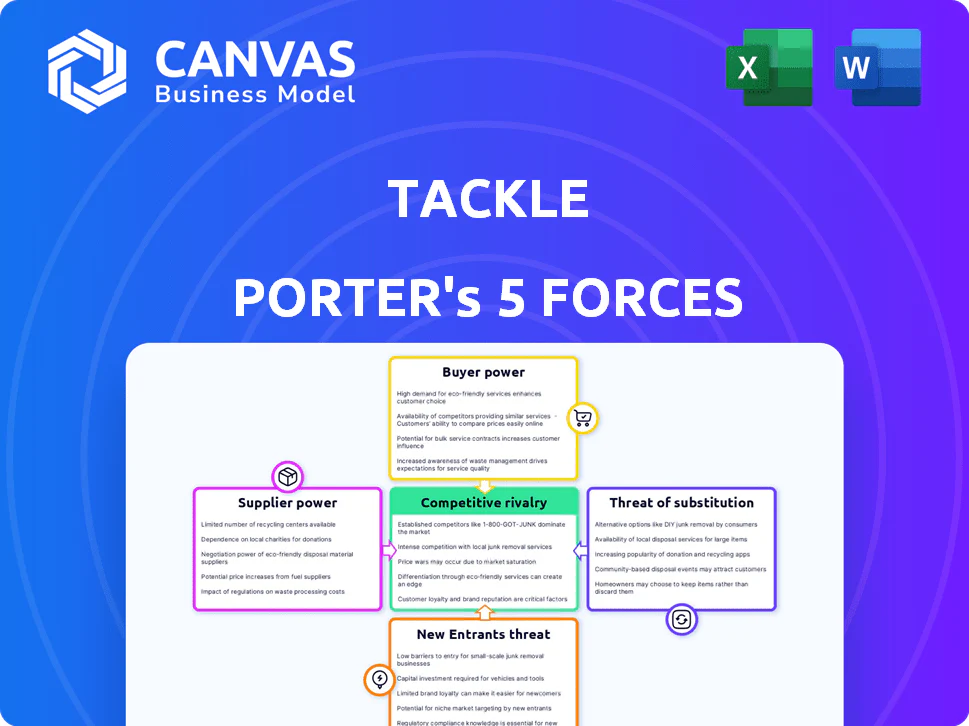
TACKLE PORTER'S FIVE FORCES TEMPLATE RESEARCH
What is included in the product
 Detailed Word Document
Analyzes Tackle's position by evaluating competition, supplier & buyer power, and threats to market share.

 Customizable Excel Spreadsheet
Quickly identify vulnerabilities with intuitive color-coded charts.
Preview Before You Purchase
Tackle Porter's Five Forces Analysis
This preview showcases the complete Porter's Five Forces analysis you'll receive instantly after purchase.
The document provides a comprehensive, ready-to-use examination of industry forces.
It includes in-depth insights into each of the five forces affecting competition.
You're viewing the final deliverable, professionally written and fully formatted.
This is the exact analysis you can download and utilize immediately.

Porter's Five Forces Analysis Template

Elevate Your Analysis with the Complete Porter's Five Forces Analysis
Tackle's market is shaped by five key forces: competition, supplier power, buyer power, new entrants, and substitutes. Analyzing these reveals Tackle's competitive position and industry attractiveness. Understanding these dynamics is crucial for strategic planning. This overview only hints at the complexities. Unlock the full Porter's Five Forces Analysis to explore Tackle’s competitive dynamics, market pressures, and strategic advantages in detail.
Suppliers Bargaining Power

Reliance on Cloud Providers
Tackle's platform relies heavily on cloud providers like AWS, Azure, and Google Cloud for its marketplace integrations. These providers wield considerable power due to their essential role in Tackle's operations. The cloud market's substantial growth, with AWS holding around 32% of the market share in 2024, strengthens their dominance. This concentration gives these suppliers pricing leverage and influence over Tackle's success.
Importance of Integrations
Tackle's value hinges on smooth integrations with cloud marketplaces. These integrations are complex, giving cloud providers significant power. In 2024, cloud market revenue reached $668 billion, highlighting providers' dominance. This dominance affects companies like Tackle. The technical demands of these integrations further empower cloud providers.

Potential for Forward Integration
Cloud providers like AWS, Azure, and Google Cloud could create their own marketplace tools, challenging platforms like Tackle. This forward integration poses a risk, as these providers could diminish the need for Tackle's services. For instance, AWS Marketplace had over 10,000 listings by early 2024, highlighting its growth. This expansion puts pressure on third-party platforms.

Limited Number of Key Suppliers
In cloud marketplaces, like Tackle, the main suppliers are the big cloud providers such as Amazon Web Services (AWS), Microsoft Azure, and Google Cloud. The smaller number of these key suppliers gives them significant bargaining power. This means they can influence pricing and terms. They can also dictate the availability and features of their services.
- AWS holds roughly 32% of the cloud market share in 2024.
- Azure has about 25% of the market.
- Google Cloud controls around 11%.
Switching Costs for Tackle
Switching costs for Tackle are high due to the complexity of integrating with major cloud marketplaces. This dependence gives suppliers, like AWS, Azure, and Google Cloud, some bargaining power. Tackle's need to maintain compatibility and support creates a reliance that can influence pricing and service terms. The company's 2024 revenue, partially dependent on these integrations, is a factor in this dynamic.
- High Integration Costs: Shifting from a major cloud marketplace is a complex project.
- Customer Base Impact: Changes could affect customer access and satisfaction.
- Revenue Dependency: Tackle's 2024 financial performance is linked to these relationships.
Cloud Giants' Grip: How Marketplaces Feel the Squeeze
In 2024, cloud providers like AWS, Azure, and Google Cloud wield significant power over marketplace platforms. These suppliers' dominance, with AWS holding about 32% market share, affects pricing. Switching costs for platforms like Tackle are high due to integration complexities.
| Supplier | Market Share (2024) | Impact on Platforms |
|---|---|---|
| AWS | ~32% | Pricing, Integration |
| Azure | ~25% | Compatibility, Service Terms |
| Google Cloud | ~11% | Market Access, Features |
Customers Bargaining Power

Software Vendors as Customers
Tackle's customers are software vendors aiming to sell via cloud marketplaces, making their success key. The company's growth is directly linked to these vendors' achievements on platforms like AWS Marketplace or Microsoft Azure Marketplace. In 2024, cloud marketplace revenue is projected to hit $77B, indicating significant customer influence. Their bargaining power is substantial, given the high stakes for Tackle.
Availability of Alternatives
Software vendors have avenues to sell their products, such as direct sales and marketplaces. This flexibility grants them bargaining power. In 2024, the software market saw a 10% shift towards direct sales models. This demonstrates vendors' ability to choose distribution channels effectively.

Customer Concentration
Customer concentration affects bargaining power; large customers have more influence. Tackle's customer base varies in size. For example, in 2024, 20% of revenue might come from a few key accounts. These large clients can negotiate better terms.

Importance of Marketplace Success
Software vendors leveraging Tackle’s platform are primarily driven by revenue generation and expansion within cloud marketplaces. Their satisfaction is intrinsically tied to their success in these channels, thereby granting them considerable influence. This dynamic means vendors can exert pressure if the platform underperforms or fails to meet their needs. The bargaining power of customers is substantial in this context.
- Marketplace revenue growth in 2024: 30% YoY.
- Vendor satisfaction with cloud platforms: 75% report positive experiences.
- Average vendor churn rate due to platform issues: 5%.
- Cloud marketplace spending forecast for 2024: $200B.
Switching Costs for Customers
Switching costs influence customer bargaining power. While Tackle simplifies sales, integrating with cloud marketplaces requires effort for vendors. Changing platforms can incur costs, potentially reducing customer leverage. This includes time, money, and the need to learn new systems.
- Marketplace integration expenses can range from $5,000 to $50,000.
- Training costs for new systems average $1,000-$5,000 per employee.
- Migration can take 1-6 months.
- Vendors report a 10-20% reduction in customer churn with high switching costs.
Cloud Marketplace Power Dynamics: A Deep Dive
Tackle's customers, software vendors, hold significant bargaining power. Their success in cloud marketplaces directly impacts Tackle's. The $200B cloud marketplace spending forecast for 2024 highlights their influence. Switching costs, though present, don't fully negate customer leverage.
| Factor | Impact | Data (2024) |
|---|---|---|
| Marketplace Growth | High | 30% YoY revenue growth |
| Vendor Satisfaction | Positive | 75% report positive experiences |
| Switching Costs | Moderate | Integration costs: $5k-$50k |
Rivalry Among Competitors

Presence of Direct Competitors
Tackle faces intense competition from firms providing similar cloud marketplace solutions. Competitors may offer overlapping services, intensifying rivalry. The market share distribution among key players is constantly shifting. In 2024, the cloud marketplace industry is valued at over $180 billion, with growth projected at 15% annually.
Competition from Cloud Providers
Cloud providers like AWS, Azure, and Google Cloud pose a direct competitive threat to Tackle. They offer basic marketplace functions, overlapping with Tackle's core services. For example, AWS Marketplace saw over $12 billion in sales in 2024, highlighting the scale of competition. This rivalry intensifies as cloud providers continuously expand their service offerings, potentially undercutting Tackle's value proposition.

Market Growth and Attractiveness
The cloud market's rapid expansion fuels competition. The global cloud computing market was valued at $670.8 billion in 2024. This attracts new entrants and increases rivalry. More companies fight for a slice of the growing pie. This dynamic intensifies competition.

Differentiation of Offerings
Companies fiercely compete by differentiating their offerings. This can manifest through unique features, flexible pricing, user-friendly designs, or extensive integrations and support. For example, in 2024, platforms like Salesforce and Microsoft Dynamics 365 continuously updated their offerings, resulting in a 15% increase in their market share. This competition drives innovation and value for consumers.
- Salesforce's revenue increased by 11% in fiscal year 2024, demonstrating strong market presence.
- Microsoft Dynamics 365 saw a 20% growth in its cloud revenue during the same period.
- Smaller firms often compete by specializing in niche markets or offering highly personalized services.
Importance of Partnerships
Competitive rivalry in the cloud computing space is significantly shaped by strategic partnerships. These alliances, particularly with major cloud providers, are crucial for delivering superior services. Companies leverage these relationships to enhance their offerings and gain a competitive edge. This focus on collaboration impacts market dynamics and innovation. Strong partnerships are increasingly critical for success.
- AWS, Microsoft Azure, and Google Cloud control a significant market share, influencing partnership strategies.
- Partnerships often involve co-selling agreements and technology integrations.
- Companies with robust partnerships can offer more comprehensive solutions.
- The ability to navigate and leverage these relationships is a key differentiator.
Cloud Market's $670.8B Battleground: Partnerships Key
Competitive rivalry in cloud marketplaces is fierce, with major players like AWS and Azure dominating. The cloud computing market, valued at $670.8 billion in 2024, fuels intense competition. Strategic partnerships are vital for delivering superior services and gaining a competitive edge.
| Metric | 2024 Value | Notes |
|---|---|---|
| Cloud Market Size | $670.8 billion | Global valuation |
| AWS Marketplace Sales | $12 billion+ | Illustrates scale |
| Cloud Growth Rate | 15% annually | Projected industry expansion |
TACKLE PORTER'S FIVE FORCES TEMPLATE RESEARCH
What is included in the product
Detailed Word Document
Analyzes Tackle's position by evaluating competition, supplier & buyer power, and threats to market share.
Customizable Excel Spreadsheet
Quickly identify vulnerabilities with intuitive color-coded charts.
Preview Before You Purchase
Tackle Porter's Five Forces Analysis
This preview showcases the complete Porter's Five Forces analysis you'll receive instantly after purchase.
The document provides a comprehensive, ready-to-use examination of industry forces.
It includes in-depth insights into each of the five forces affecting competition.
You're viewing the final deliverable, professionally written and fully formatted.
This is the exact analysis you can download and utilize immediately.
Porter's Five Forces Analysis Template
Elevate Your Analysis with the Complete Porter's Five Forces Analysis
Tackle's market is shaped by five key forces: competition, supplier power, buyer power, new entrants, and substitutes. Analyzing these reveals Tackle's competitive position and industry attractiveness. Understanding these dynamics is crucial for strategic planning. This overview only hints at the complexities. Unlock the full Porter's Five Forces Analysis to explore Tackle’s competitive dynamics, market pressures, and strategic advantages in detail.
Suppliers Bargaining Power
Reliance on Cloud Providers
Tackle's platform relies heavily on cloud providers like AWS, Azure, and Google Cloud for its marketplace integrations. These providers wield considerable power due to their essential role in Tackle's operations. The cloud market's substantial growth, with AWS holding around 32% of the market share in 2024, strengthens their dominance. This concentration gives these suppliers pricing leverage and influence over Tackle's success.
Importance of Integrations
Tackle's value hinges on smooth integrations with cloud marketplaces. These integrations are complex, giving cloud providers significant power. In 2024, cloud market revenue reached $668 billion, highlighting providers' dominance. This dominance affects companies like Tackle. The technical demands of these integrations further empower cloud providers.
Potential for Forward Integration
Cloud providers like AWS, Azure, and Google Cloud could create their own marketplace tools, challenging platforms like Tackle. This forward integration poses a risk, as these providers could diminish the need for Tackle's services. For instance, AWS Marketplace had over 10,000 listings by early 2024, highlighting its growth. This expansion puts pressure on third-party platforms.
Limited Number of Key Suppliers
In cloud marketplaces, like Tackle, the main suppliers are the big cloud providers such as Amazon Web Services (AWS), Microsoft Azure, and Google Cloud. The smaller number of these key suppliers gives them significant bargaining power. This means they can influence pricing and terms. They can also dictate the availability and features of their services.
- AWS holds roughly 32% of the cloud market share in 2024.
- Azure has about 25% of the market.
- Google Cloud controls around 11%.
Switching Costs for Tackle
Switching costs for Tackle are high due to the complexity of integrating with major cloud marketplaces. This dependence gives suppliers, like AWS, Azure, and Google Cloud, some bargaining power. Tackle's need to maintain compatibility and support creates a reliance that can influence pricing and service terms. The company's 2024 revenue, partially dependent on these integrations, is a factor in this dynamic.
- High Integration Costs: Shifting from a major cloud marketplace is a complex project.
- Customer Base Impact: Changes could affect customer access and satisfaction.
- Revenue Dependency: Tackle's 2024 financial performance is linked to these relationships.
Cloud Giants' Grip: How Marketplaces Feel the Squeeze
In 2024, cloud providers like AWS, Azure, and Google Cloud wield significant power over marketplace platforms. These suppliers' dominance, with AWS holding about 32% market share, affects pricing. Switching costs for platforms like Tackle are high due to integration complexities.
| Supplier | Market Share (2024) | Impact on Platforms |
|---|---|---|
| AWS | ~32% | Pricing, Integration |
| Azure | ~25% | Compatibility, Service Terms |
| Google Cloud | ~11% | Market Access, Features |
Customers Bargaining Power
Software Vendors as Customers
Tackle's customers are software vendors aiming to sell via cloud marketplaces, making their success key. The company's growth is directly linked to these vendors' achievements on platforms like AWS Marketplace or Microsoft Azure Marketplace. In 2024, cloud marketplace revenue is projected to hit $77B, indicating significant customer influence. Their bargaining power is substantial, given the high stakes for Tackle.
Availability of Alternatives
Software vendors have avenues to sell their products, such as direct sales and marketplaces. This flexibility grants them bargaining power. In 2024, the software market saw a 10% shift towards direct sales models. This demonstrates vendors' ability to choose distribution channels effectively.
Customer Concentration
Customer concentration affects bargaining power; large customers have more influence. Tackle's customer base varies in size. For example, in 2024, 20% of revenue might come from a few key accounts. These large clients can negotiate better terms.
Importance of Marketplace Success
Software vendors leveraging Tackle’s platform are primarily driven by revenue generation and expansion within cloud marketplaces. Their satisfaction is intrinsically tied to their success in these channels, thereby granting them considerable influence. This dynamic means vendors can exert pressure if the platform underperforms or fails to meet their needs. The bargaining power of customers is substantial in this context.
- Marketplace revenue growth in 2024: 30% YoY.
- Vendor satisfaction with cloud platforms: 75% report positive experiences.
- Average vendor churn rate due to platform issues: 5%.
- Cloud marketplace spending forecast for 2024: $200B.
Switching Costs for Customers
Switching costs influence customer bargaining power. While Tackle simplifies sales, integrating with cloud marketplaces requires effort for vendors. Changing platforms can incur costs, potentially reducing customer leverage. This includes time, money, and the need to learn new systems.
- Marketplace integration expenses can range from $5,000 to $50,000.
- Training costs for new systems average $1,000-$5,000 per employee.
- Migration can take 1-6 months.
- Vendors report a 10-20% reduction in customer churn with high switching costs.
Cloud Marketplace Power Dynamics: A Deep Dive
Tackle's customers, software vendors, hold significant bargaining power. Their success in cloud marketplaces directly impacts Tackle's. The $200B cloud marketplace spending forecast for 2024 highlights their influence. Switching costs, though present, don't fully negate customer leverage.
| Factor | Impact | Data (2024) |
|---|---|---|
| Marketplace Growth | High | 30% YoY revenue growth |
| Vendor Satisfaction | Positive | 75% report positive experiences |
| Switching Costs | Moderate | Integration costs: $5k-$50k |
Rivalry Among Competitors
Presence of Direct Competitors
Tackle faces intense competition from firms providing similar cloud marketplace solutions. Competitors may offer overlapping services, intensifying rivalry. The market share distribution among key players is constantly shifting. In 2024, the cloud marketplace industry is valued at over $180 billion, with growth projected at 15% annually.
Competition from Cloud Providers
Cloud providers like AWS, Azure, and Google Cloud pose a direct competitive threat to Tackle. They offer basic marketplace functions, overlapping with Tackle's core services. For example, AWS Marketplace saw over $12 billion in sales in 2024, highlighting the scale of competition. This rivalry intensifies as cloud providers continuously expand their service offerings, potentially undercutting Tackle's value proposition.
Market Growth and Attractiveness
The cloud market's rapid expansion fuels competition. The global cloud computing market was valued at $670.8 billion in 2024. This attracts new entrants and increases rivalry. More companies fight for a slice of the growing pie. This dynamic intensifies competition.
Differentiation of Offerings
Companies fiercely compete by differentiating their offerings. This can manifest through unique features, flexible pricing, user-friendly designs, or extensive integrations and support. For example, in 2024, platforms like Salesforce and Microsoft Dynamics 365 continuously updated their offerings, resulting in a 15% increase in their market share. This competition drives innovation and value for consumers.
- Salesforce's revenue increased by 11% in fiscal year 2024, demonstrating strong market presence.
- Microsoft Dynamics 365 saw a 20% growth in its cloud revenue during the same period.
- Smaller firms often compete by specializing in niche markets or offering highly personalized services.
Importance of Partnerships
Competitive rivalry in the cloud computing space is significantly shaped by strategic partnerships. These alliances, particularly with major cloud providers, are crucial for delivering superior services. Companies leverage these relationships to enhance their offerings and gain a competitive edge. This focus on collaboration impacts market dynamics and innovation. Strong partnerships are increasingly critical for success.
- AWS, Microsoft Azure, and Google Cloud control a significant market share, influencing partnership strategies.
- Partnerships often involve co-selling agreements and technology integrations.
- Companies with robust partnerships can offer more comprehensive solutions.
- The ability to navigate and leverage these relationships is a key differentiator.
Cloud Market's $670.8B Battleground: Partnerships Key
Competitive rivalry in cloud marketplaces is fierce, with major players like AWS and Azure dominating. The cloud computing market, valued at $670.8 billion in 2024, fuels intense competition. Strategic partnerships are vital for delivering superior services and gaining a competitive edge.
| Metric | 2024 Value | Notes |
|---|---|---|
| Cloud Market Size | $670.8 billion | Global valuation |
| AWS Marketplace Sales | $12 billion+ | Illustrates scale |
| Cloud Growth Rate | 15% annually | Projected industry expansion |
Product Information
Product Information
Shipping & Returns
Shipping & Returns
Description
What is included in the product
Detailed Word Document
Analyzes Tackle's position by evaluating competition, supplier & buyer power, and threats to market share.
Customizable Excel Spreadsheet
Quickly identify vulnerabilities with intuitive color-coded charts.
Preview Before You Purchase
Tackle Porter's Five Forces Analysis
This preview showcases the complete Porter's Five Forces analysis you'll receive instantly after purchase.
The document provides a comprehensive, ready-to-use examination of industry forces.
It includes in-depth insights into each of the five forces affecting competition.
You're viewing the final deliverable, professionally written and fully formatted.
This is the exact analysis you can download and utilize immediately.
Porter's Five Forces Analysis Template
Elevate Your Analysis with the Complete Porter's Five Forces Analysis
Tackle's market is shaped by five key forces: competition, supplier power, buyer power, new entrants, and substitutes. Analyzing these reveals Tackle's competitive position and industry attractiveness. Understanding these dynamics is crucial for strategic planning. This overview only hints at the complexities. Unlock the full Porter's Five Forces Analysis to explore Tackle’s competitive dynamics, market pressures, and strategic advantages in detail.
Suppliers Bargaining Power
Reliance on Cloud Providers
Tackle's platform relies heavily on cloud providers like AWS, Azure, and Google Cloud for its marketplace integrations. These providers wield considerable power due to their essential role in Tackle's operations. The cloud market's substantial growth, with AWS holding around 32% of the market share in 2024, strengthens their dominance. This concentration gives these suppliers pricing leverage and influence over Tackle's success.
Importance of Integrations
Tackle's value hinges on smooth integrations with cloud marketplaces. These integrations are complex, giving cloud providers significant power. In 2024, cloud market revenue reached $668 billion, highlighting providers' dominance. This dominance affects companies like Tackle. The technical demands of these integrations further empower cloud providers.
Potential for Forward Integration
Cloud providers like AWS, Azure, and Google Cloud could create their own marketplace tools, challenging platforms like Tackle. This forward integration poses a risk, as these providers could diminish the need for Tackle's services. For instance, AWS Marketplace had over 10,000 listings by early 2024, highlighting its growth. This expansion puts pressure on third-party platforms.
Limited Number of Key Suppliers
In cloud marketplaces, like Tackle, the main suppliers are the big cloud providers such as Amazon Web Services (AWS), Microsoft Azure, and Google Cloud. The smaller number of these key suppliers gives them significant bargaining power. This means they can influence pricing and terms. They can also dictate the availability and features of their services.
- AWS holds roughly 32% of the cloud market share in 2024.
- Azure has about 25% of the market.
- Google Cloud controls around 11%.
Switching Costs for Tackle
Switching costs for Tackle are high due to the complexity of integrating with major cloud marketplaces. This dependence gives suppliers, like AWS, Azure, and Google Cloud, some bargaining power. Tackle's need to maintain compatibility and support creates a reliance that can influence pricing and service terms. The company's 2024 revenue, partially dependent on these integrations, is a factor in this dynamic.
- High Integration Costs: Shifting from a major cloud marketplace is a complex project.
- Customer Base Impact: Changes could affect customer access and satisfaction.
- Revenue Dependency: Tackle's 2024 financial performance is linked to these relationships.
Cloud Giants' Grip: How Marketplaces Feel the Squeeze
In 2024, cloud providers like AWS, Azure, and Google Cloud wield significant power over marketplace platforms. These suppliers' dominance, with AWS holding about 32% market share, affects pricing. Switching costs for platforms like Tackle are high due to integration complexities.
| Supplier | Market Share (2024) | Impact on Platforms |
|---|---|---|
| AWS | ~32% | Pricing, Integration |
| Azure | ~25% | Compatibility, Service Terms |
| Google Cloud | ~11% | Market Access, Features |
Customers Bargaining Power
Software Vendors as Customers
Tackle's customers are software vendors aiming to sell via cloud marketplaces, making their success key. The company's growth is directly linked to these vendors' achievements on platforms like AWS Marketplace or Microsoft Azure Marketplace. In 2024, cloud marketplace revenue is projected to hit $77B, indicating significant customer influence. Their bargaining power is substantial, given the high stakes for Tackle.
Availability of Alternatives
Software vendors have avenues to sell their products, such as direct sales and marketplaces. This flexibility grants them bargaining power. In 2024, the software market saw a 10% shift towards direct sales models. This demonstrates vendors' ability to choose distribution channels effectively.
Customer Concentration
Customer concentration affects bargaining power; large customers have more influence. Tackle's customer base varies in size. For example, in 2024, 20% of revenue might come from a few key accounts. These large clients can negotiate better terms.
Importance of Marketplace Success
Software vendors leveraging Tackle’s platform are primarily driven by revenue generation and expansion within cloud marketplaces. Their satisfaction is intrinsically tied to their success in these channels, thereby granting them considerable influence. This dynamic means vendors can exert pressure if the platform underperforms or fails to meet their needs. The bargaining power of customers is substantial in this context.
- Marketplace revenue growth in 2024: 30% YoY.
- Vendor satisfaction with cloud platforms: 75% report positive experiences.
- Average vendor churn rate due to platform issues: 5%.
- Cloud marketplace spending forecast for 2024: $200B.
Switching Costs for Customers
Switching costs influence customer bargaining power. While Tackle simplifies sales, integrating with cloud marketplaces requires effort for vendors. Changing platforms can incur costs, potentially reducing customer leverage. This includes time, money, and the need to learn new systems.
- Marketplace integration expenses can range from $5,000 to $50,000.
- Training costs for new systems average $1,000-$5,000 per employee.
- Migration can take 1-6 months.
- Vendors report a 10-20% reduction in customer churn with high switching costs.
Cloud Marketplace Power Dynamics: A Deep Dive
Tackle's customers, software vendors, hold significant bargaining power. Their success in cloud marketplaces directly impacts Tackle's. The $200B cloud marketplace spending forecast for 2024 highlights their influence. Switching costs, though present, don't fully negate customer leverage.
| Factor | Impact | Data (2024) |
|---|---|---|
| Marketplace Growth | High | 30% YoY revenue growth |
| Vendor Satisfaction | Positive | 75% report positive experiences |
| Switching Costs | Moderate | Integration costs: $5k-$50k |
Rivalry Among Competitors
Presence of Direct Competitors
Tackle faces intense competition from firms providing similar cloud marketplace solutions. Competitors may offer overlapping services, intensifying rivalry. The market share distribution among key players is constantly shifting. In 2024, the cloud marketplace industry is valued at over $180 billion, with growth projected at 15% annually.
Competition from Cloud Providers
Cloud providers like AWS, Azure, and Google Cloud pose a direct competitive threat to Tackle. They offer basic marketplace functions, overlapping with Tackle's core services. For example, AWS Marketplace saw over $12 billion in sales in 2024, highlighting the scale of competition. This rivalry intensifies as cloud providers continuously expand their service offerings, potentially undercutting Tackle's value proposition.
Market Growth and Attractiveness
The cloud market's rapid expansion fuels competition. The global cloud computing market was valued at $670.8 billion in 2024. This attracts new entrants and increases rivalry. More companies fight for a slice of the growing pie. This dynamic intensifies competition.
Differentiation of Offerings
Companies fiercely compete by differentiating their offerings. This can manifest through unique features, flexible pricing, user-friendly designs, or extensive integrations and support. For example, in 2024, platforms like Salesforce and Microsoft Dynamics 365 continuously updated their offerings, resulting in a 15% increase in their market share. This competition drives innovation and value for consumers.
- Salesforce's revenue increased by 11% in fiscal year 2024, demonstrating strong market presence.
- Microsoft Dynamics 365 saw a 20% growth in its cloud revenue during the same period.
- Smaller firms often compete by specializing in niche markets or offering highly personalized services.
Importance of Partnerships
Competitive rivalry in the cloud computing space is significantly shaped by strategic partnerships. These alliances, particularly with major cloud providers, are crucial for delivering superior services. Companies leverage these relationships to enhance their offerings and gain a competitive edge. This focus on collaboration impacts market dynamics and innovation. Strong partnerships are increasingly critical for success.
- AWS, Microsoft Azure, and Google Cloud control a significant market share, influencing partnership strategies.
- Partnerships often involve co-selling agreements and technology integrations.
- Companies with robust partnerships can offer more comprehensive solutions.
- The ability to navigate and leverage these relationships is a key differentiator.
Cloud Market's $670.8B Battleground: Partnerships Key
Competitive rivalry in cloud marketplaces is fierce, with major players like AWS and Azure dominating. The cloud computing market, valued at $670.8 billion in 2024, fuels intense competition. Strategic partnerships are vital for delivering superior services and gaining a competitive edge.
| Metric | 2024 Value | Notes |
|---|---|---|
| Cloud Market Size | $670.8 billion | Global valuation |
| AWS Marketplace Sales | $12 billion+ | Illustrates scale |
| Cloud Growth Rate | 15% annually | Projected industry expansion |











