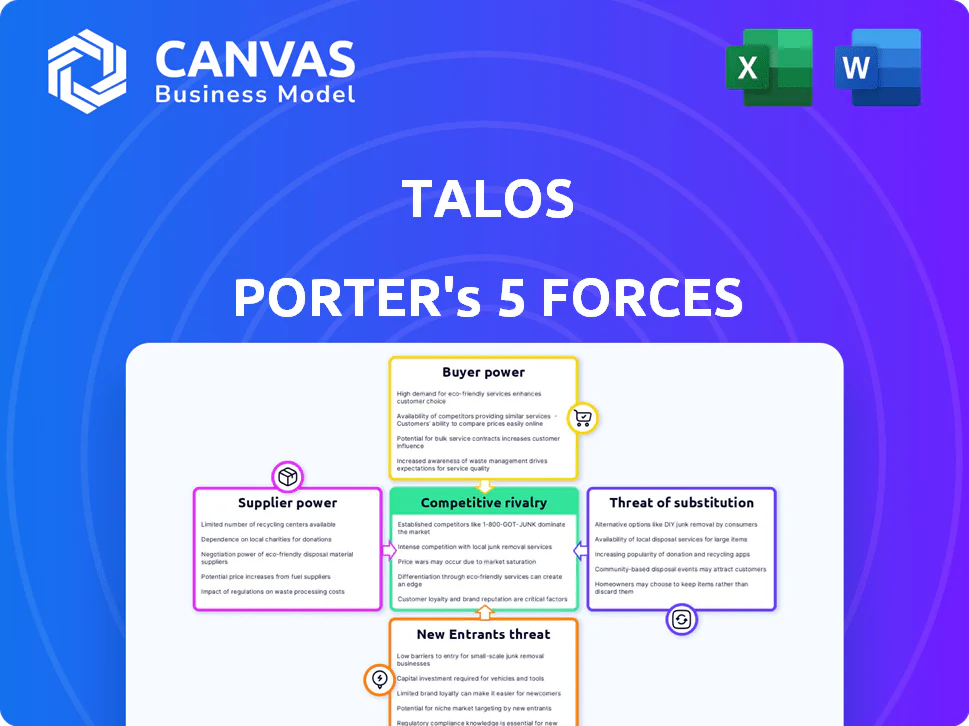
TALOS PORTER'S FIVE FORCES TEMPLATE RESEARCH
What is included in the product
 Detailed Word Document
Analyzes Talos' competitive environment, highlighting market entry risks and influences on pricing.

 Customizable Excel Spreadsheet
Visualize pressure instantly with a dynamic spider/radar chart.
Preview the Actual Deliverable
Talos Porter's Five Forces Analysis
This preview showcases the complete Talos Porter's Five Forces Analysis. The document you see is identical to what you'll receive instantly after your purchase. It's a fully realized analysis, ready for your review and application. No hidden content or alterations, just the complete, ready-to-use document. The file is delivered in a professional format for immediate access and usability.

Porter's Five Forces Analysis Template

Elevate Your Analysis with the Complete Porter's Five Forces Analysis
Talos faces a complex competitive landscape. Supplier power, driven by specialized tech providers, presents a moderate challenge. Buyer power, however, is somewhat limited due to its niche market. The threat of new entrants is also moderate. Rivalry among existing firms is fierce. Finally, the threat of substitutes is low.
Unlock the full Porter's Five Forces Analysis to explore Talos’s competitive dynamics, market pressures, and strategic advantages in detail.
Suppliers Bargaining Power

Reliance on Technology Providers
Talos, a tech platform, depends on cloud and data providers. The power of these suppliers is shaped by their concentration and importance. In 2024, the cloud services market, key for Talos, saw Amazon Web Services, Microsoft Azure, and Google Cloud Platform holding a combined 65% market share, indicating supplier concentration. Limited AI tech suppliers in finance boost their leverage. The financial AI market is expected to reach $30 billion by the end of 2024, with a few key players controlling the specialized tech.
Liquidity Providers and Market Makers
Talos leverages a network of liquidity providers, including exchanges and OTC desks. The breadth of these sources affects Talos's pricing and execution capabilities. Clients' bilateral negotiations with providers indicate some supplier power. In 2024, the crypto OTC market saw an average daily volume of $2 billion, highlighting the importance of these providers.

Custodial Service Providers
Talos, offering digital asset custody, relies on custodial service providers. The limited number of reputable institutional custodians, such as Hex Trust, impacts Talos's service offerings. This dependence gives custodians some bargaining power. In 2024, the digital asset custody market was valued at $2.6 billion, projected to reach $7.4 billion by 2029.

Data and Analytics Providers
Data and analytics providers hold significant bargaining power because their data is essential for informed trading decisions. These suppliers include firms like Refinitiv, which reported over $6.6 billion in revenues in 2023. The quality and uniqueness of the data they offer directly influence the effectiveness of trading strategies and portfolio management. Access to real-time and historical data is crucial for all market participants.
- Refinitiv's 2023 revenue: over $6.6 billion.
- Data quality directly impacts trading strategy success.
- Real-time data is crucial for trading decisions.
- Unique data offerings increase supplier power.
Specialized Software and Tools
Talos, like other financial firms, depends on specialized software and tools. These tools are critical for charting, risk management, and data analysis. Providers of these niche solutions wield bargaining power, particularly if their products are essential and have no easy alternatives. For instance, in 2024, the market for financial risk management software was valued at over $10 billion globally. Talos's purchase of Cloudwall underscores the value of these specialized capabilities.
- Market size: The global financial risk management software market was valued at over $10 billion in 2024.
- Cloudwall Acquisition: Talos's strategic move to acquire Cloudwall.
- Essential Tools: Critical for charting, risk management, and data analysis.
Supplier Power Dynamics: A Look at Key Players
Supplier power varies based on market concentration and service importance. Cloud and data providers, like AWS, Azure, and Google, hold significant power due to their market share. Specialized tech and data providers also have leverage, especially with essential, unique offerings.
| Supplier Type | Market Share/Value (2024) | Impact on Talos |
|---|---|---|
| Cloud Services | AWS, Azure, Google: 65% | Pricing, service availability |
| Financial AI Tech | $30 billion market | Innovation, tech costs |
| Data Providers | Refinitiv Revenue: $6.6B (2023) | Trading strategy effectiveness |
Customers Bargaining Power

Institutional Clients' Sophistication
Talos's institutional clients, including asset managers and hedge funds, wield substantial bargaining power due to their sophisticated trading strategies. These clients, responsible for significant trading volumes, demand the best execution and reliable, comprehensive solutions. For instance, institutional trading volumes on crypto exchanges reached $1.2 trillion in 2024, highlighting their influence. Their focus on factors like execution and reliability further amplifies their leverage.
Availability of Alternative Platforms
Institutional clients wield considerable bargaining power due to readily available alternatives. They can easily shift to other platforms or access liquidity from different providers, enhancing their leverage. In 2024, the digital asset market saw over 500 trading platforms. Talos focuses on differentiation through its integrated platform and extensive connectivity. This helps mitigate the risk of clients switching for better terms.

Demand for Integrated Solutions
Institutional clients increasingly demand comprehensive platforms. These platforms bundle trading, lending, custody, and portfolio management. Providers offering integrated solutions reduce the need for multiple vendors. This could lower bargaining power for specific services, but raises it for the integrated product. In 2024, demand for such all-in-one solutions surged, with a 30% increase in adoption by institutional investors.

Regulatory and Compliance Needs
Institutional clients, facing rigorous regulatory demands, wield significant bargaining power. Their preference for platforms ensuring compliance and regulatory security impacts provider selection. Platforms offering robust compliance features and integrations with regulated entities gain an edge. For instance, in 2024, firms spent billions on compliance technology, highlighting the importance of these tools.
- Compliance costs in the financial sector increased by an estimated 15% in 2024.
- The demand for RegTech solutions grew by over 20% in 2024, reflecting the need for advanced compliance tools.
- Platforms with strong compliance features saw a 10-15% increase in institutional client acquisition in 2024.
- Regulatory fines and penalties for non-compliance reached record highs in 2024, further driving the need for robust solutions.
Customization and White-Labeling Demands
Some institutional clients, especially those in the financial sector, often demand tailored or white-label solutions. This need significantly influences Talos's appeal and the negotiation power of these clients. White-labeling allows clients to offer services under their brand, increasing their leverage. For example, in 2024, the demand for customizable crypto solutions grew by 15% among institutional investors.
- Customization needs boost client leverage.
- White-labeling demands further increase this power.
- In 2024, the need for customization grew.
Crypto Trading Dynamics: Institutional Client Power
Institutional clients of Talos, such as asset managers and hedge funds, have strong bargaining power due to their trading volume and sophisticated strategies. They have many platform options and can easily switch to others, which increases their leverage. The demand for integrated platforms that include trading, lending, and custody also affects their negotiation power.
| Aspect | Impact | 2024 Data |
|---|---|---|
| Trading Volume | Influences bargaining power | Institutional crypto trading: $1.2T |
| Platform Alternatives | Increases leverage | 500+ trading platforms |
| Compliance Needs | Dictates platform choice | RegTech demand grew by 20% |
Rivalry Among Competitors

Number and Diversity of Competitors
The institutional digital asset tech market is competitive. Multiple platforms and service providers vie for market share. Competitors include trading platforms, liquidity aggregators, and custody services. Data from 2024 shows increased competition, with over 50 firms. This drives innovation and potential for lower costs.
Differentiation and Specialization
Competitive rivalry in the digital asset trading space sees firms like Talos differentiating through advanced tech. Talos focuses on institutional-grade infrastructure, setting it apart from competitors. A 2024 report showed that institutional trading platforms saw a 30% growth in trading volume. This emphasis on specialized services intensifies competition.

Focus on Institutional Clients
The institutional crypto technology market is a battlefield. Competition is fierce among specialized firms. In 2024, institutional crypto trading volumes reached billions monthly. This demands top-tier technology and service. Talos, alongside rivals, vies for these high-value clients.

Technological Innovation and Speed
Technological innovation is crucial in the digital asset market, driving intense competition. Firms vie on platform development speed, integration capabilities, and the release of new features. This includes advanced risk management and portfolio analytics to attract users. For example, in 2024, companies invested heavily in blockchain tech, with spending projected to reach $19 billion globally.
- Rapid technological advancements demand quick adaptation.
- Speed in feature implementation is a key differentiator.
- Integration capabilities enhance user experience and appeal.
- New features, like analytics, provide competitive edges.
Partnerships and Ecosystem Building
Competitive rivalry in the digital asset trading space intensifies through strategic partnerships. Competitors build ecosystems with exchanges and custodians to offer comprehensive services. Talos, for instance, has cultivated a wide network of providers. This approach is crucial for attracting institutional investors. These partnerships help establish market dominance and increase user adoption.
- Talos's platform supports trading across 50+ venues.
- In 2024, the crypto market saw over $1 trillion in trading volume.
- Partnerships are key for regulatory compliance.
- Ecosystem strength affects platform valuation.
Digital Asset Market Heats Up: Trillions Traded!
Competitive rivalry in the institutional digital asset market is intense. Numerous firms compete, focusing on tech and partnerships. Trading volumes in 2024 reached trillions, fueling competition. This drives innovation and service enhancements.
| Aspect | Details | 2024 Data |
|---|---|---|
| Market Growth | Institutional trading volume | >$1 trillion |
| Tech Investment | Global blockchain spending | $19 billion |
| Partnerships | Talos's venue support | 50+ venues |
TALOS PORTER'S FIVE FORCES TEMPLATE RESEARCH
What is included in the product
Detailed Word Document
Analyzes Talos' competitive environment, highlighting market entry risks and influences on pricing.
Customizable Excel Spreadsheet
Visualize pressure instantly with a dynamic spider/radar chart.
Preview the Actual Deliverable
Talos Porter's Five Forces Analysis
This preview showcases the complete Talos Porter's Five Forces Analysis. The document you see is identical to what you'll receive instantly after your purchase. It's a fully realized analysis, ready for your review and application. No hidden content or alterations, just the complete, ready-to-use document. The file is delivered in a professional format for immediate access and usability.
Porter's Five Forces Analysis Template
Elevate Your Analysis with the Complete Porter's Five Forces Analysis
Talos faces a complex competitive landscape. Supplier power, driven by specialized tech providers, presents a moderate challenge. Buyer power, however, is somewhat limited due to its niche market. The threat of new entrants is also moderate. Rivalry among existing firms is fierce. Finally, the threat of substitutes is low.
Unlock the full Porter's Five Forces Analysis to explore Talos’s competitive dynamics, market pressures, and strategic advantages in detail.
Suppliers Bargaining Power
Reliance on Technology Providers
Talos, a tech platform, depends on cloud and data providers. The power of these suppliers is shaped by their concentration and importance. In 2024, the cloud services market, key for Talos, saw Amazon Web Services, Microsoft Azure, and Google Cloud Platform holding a combined 65% market share, indicating supplier concentration. Limited AI tech suppliers in finance boost their leverage. The financial AI market is expected to reach $30 billion by the end of 2024, with a few key players controlling the specialized tech.
Liquidity Providers and Market Makers
Talos leverages a network of liquidity providers, including exchanges and OTC desks. The breadth of these sources affects Talos's pricing and execution capabilities. Clients' bilateral negotiations with providers indicate some supplier power. In 2024, the crypto OTC market saw an average daily volume of $2 billion, highlighting the importance of these providers.
Custodial Service Providers
Talos, offering digital asset custody, relies on custodial service providers. The limited number of reputable institutional custodians, such as Hex Trust, impacts Talos's service offerings. This dependence gives custodians some bargaining power. In 2024, the digital asset custody market was valued at $2.6 billion, projected to reach $7.4 billion by 2029.
Data and Analytics Providers
Data and analytics providers hold significant bargaining power because their data is essential for informed trading decisions. These suppliers include firms like Refinitiv, which reported over $6.6 billion in revenues in 2023. The quality and uniqueness of the data they offer directly influence the effectiveness of trading strategies and portfolio management. Access to real-time and historical data is crucial for all market participants.
- Refinitiv's 2023 revenue: over $6.6 billion.
- Data quality directly impacts trading strategy success.
- Real-time data is crucial for trading decisions.
- Unique data offerings increase supplier power.
Specialized Software and Tools
Talos, like other financial firms, depends on specialized software and tools. These tools are critical for charting, risk management, and data analysis. Providers of these niche solutions wield bargaining power, particularly if their products are essential and have no easy alternatives. For instance, in 2024, the market for financial risk management software was valued at over $10 billion globally. Talos's purchase of Cloudwall underscores the value of these specialized capabilities.
- Market size: The global financial risk management software market was valued at over $10 billion in 2024.
- Cloudwall Acquisition: Talos's strategic move to acquire Cloudwall.
- Essential Tools: Critical for charting, risk management, and data analysis.
Supplier Power Dynamics: A Look at Key Players
Supplier power varies based on market concentration and service importance. Cloud and data providers, like AWS, Azure, and Google, hold significant power due to their market share. Specialized tech and data providers also have leverage, especially with essential, unique offerings.
| Supplier Type | Market Share/Value (2024) | Impact on Talos |
|---|---|---|
| Cloud Services | AWS, Azure, Google: 65% | Pricing, service availability |
| Financial AI Tech | $30 billion market | Innovation, tech costs |
| Data Providers | Refinitiv Revenue: $6.6B (2023) | Trading strategy effectiveness |
Customers Bargaining Power
Institutional Clients' Sophistication
Talos's institutional clients, including asset managers and hedge funds, wield substantial bargaining power due to their sophisticated trading strategies. These clients, responsible for significant trading volumes, demand the best execution and reliable, comprehensive solutions. For instance, institutional trading volumes on crypto exchanges reached $1.2 trillion in 2024, highlighting their influence. Their focus on factors like execution and reliability further amplifies their leverage.
Availability of Alternative Platforms
Institutional clients wield considerable bargaining power due to readily available alternatives. They can easily shift to other platforms or access liquidity from different providers, enhancing their leverage. In 2024, the digital asset market saw over 500 trading platforms. Talos focuses on differentiation through its integrated platform and extensive connectivity. This helps mitigate the risk of clients switching for better terms.
Demand for Integrated Solutions
Institutional clients increasingly demand comprehensive platforms. These platforms bundle trading, lending, custody, and portfolio management. Providers offering integrated solutions reduce the need for multiple vendors. This could lower bargaining power for specific services, but raises it for the integrated product. In 2024, demand for such all-in-one solutions surged, with a 30% increase in adoption by institutional investors.
Regulatory and Compliance Needs
Institutional clients, facing rigorous regulatory demands, wield significant bargaining power. Their preference for platforms ensuring compliance and regulatory security impacts provider selection. Platforms offering robust compliance features and integrations with regulated entities gain an edge. For instance, in 2024, firms spent billions on compliance technology, highlighting the importance of these tools.
- Compliance costs in the financial sector increased by an estimated 15% in 2024.
- The demand for RegTech solutions grew by over 20% in 2024, reflecting the need for advanced compliance tools.
- Platforms with strong compliance features saw a 10-15% increase in institutional client acquisition in 2024.
- Regulatory fines and penalties for non-compliance reached record highs in 2024, further driving the need for robust solutions.
Customization and White-Labeling Demands
Some institutional clients, especially those in the financial sector, often demand tailored or white-label solutions. This need significantly influences Talos's appeal and the negotiation power of these clients. White-labeling allows clients to offer services under their brand, increasing their leverage. For example, in 2024, the demand for customizable crypto solutions grew by 15% among institutional investors.
- Customization needs boost client leverage.
- White-labeling demands further increase this power.
- In 2024, the need for customization grew.
Crypto Trading Dynamics: Institutional Client Power
Institutional clients of Talos, such as asset managers and hedge funds, have strong bargaining power due to their trading volume and sophisticated strategies. They have many platform options and can easily switch to others, which increases their leverage. The demand for integrated platforms that include trading, lending, and custody also affects their negotiation power.
| Aspect | Impact | 2024 Data |
|---|---|---|
| Trading Volume | Influences bargaining power | Institutional crypto trading: $1.2T |
| Platform Alternatives | Increases leverage | 500+ trading platforms |
| Compliance Needs | Dictates platform choice | RegTech demand grew by 20% |
Rivalry Among Competitors
Number and Diversity of Competitors
The institutional digital asset tech market is competitive. Multiple platforms and service providers vie for market share. Competitors include trading platforms, liquidity aggregators, and custody services. Data from 2024 shows increased competition, with over 50 firms. This drives innovation and potential for lower costs.
Differentiation and Specialization
Competitive rivalry in the digital asset trading space sees firms like Talos differentiating through advanced tech. Talos focuses on institutional-grade infrastructure, setting it apart from competitors. A 2024 report showed that institutional trading platforms saw a 30% growth in trading volume. This emphasis on specialized services intensifies competition.
Focus on Institutional Clients
The institutional crypto technology market is a battlefield. Competition is fierce among specialized firms. In 2024, institutional crypto trading volumes reached billions monthly. This demands top-tier technology and service. Talos, alongside rivals, vies for these high-value clients.
Technological Innovation and Speed
Technological innovation is crucial in the digital asset market, driving intense competition. Firms vie on platform development speed, integration capabilities, and the release of new features. This includes advanced risk management and portfolio analytics to attract users. For example, in 2024, companies invested heavily in blockchain tech, with spending projected to reach $19 billion globally.
- Rapid technological advancements demand quick adaptation.
- Speed in feature implementation is a key differentiator.
- Integration capabilities enhance user experience and appeal.
- New features, like analytics, provide competitive edges.
Partnerships and Ecosystem Building
Competitive rivalry in the digital asset trading space intensifies through strategic partnerships. Competitors build ecosystems with exchanges and custodians to offer comprehensive services. Talos, for instance, has cultivated a wide network of providers. This approach is crucial for attracting institutional investors. These partnerships help establish market dominance and increase user adoption.
- Talos's platform supports trading across 50+ venues.
- In 2024, the crypto market saw over $1 trillion in trading volume.
- Partnerships are key for regulatory compliance.
- Ecosystem strength affects platform valuation.
Digital Asset Market Heats Up: Trillions Traded!
Competitive rivalry in the institutional digital asset market is intense. Numerous firms compete, focusing on tech and partnerships. Trading volumes in 2024 reached trillions, fueling competition. This drives innovation and service enhancements.
| Aspect | Details | 2024 Data |
|---|---|---|
| Market Growth | Institutional trading volume | >$1 trillion |
| Tech Investment | Global blockchain spending | $19 billion |
| Partnerships | Talos's venue support | 50+ venues |
Product Information
Product Information
Shipping & Returns
Shipping & Returns
Description
What is included in the product
Detailed Word Document
Analyzes Talos' competitive environment, highlighting market entry risks and influences on pricing.
Customizable Excel Spreadsheet
Visualize pressure instantly with a dynamic spider/radar chart.
Preview the Actual Deliverable
Talos Porter's Five Forces Analysis
This preview showcases the complete Talos Porter's Five Forces Analysis. The document you see is identical to what you'll receive instantly after your purchase. It's a fully realized analysis, ready for your review and application. No hidden content or alterations, just the complete, ready-to-use document. The file is delivered in a professional format for immediate access and usability.
Porter's Five Forces Analysis Template
Elevate Your Analysis with the Complete Porter's Five Forces Analysis
Talos faces a complex competitive landscape. Supplier power, driven by specialized tech providers, presents a moderate challenge. Buyer power, however, is somewhat limited due to its niche market. The threat of new entrants is also moderate. Rivalry among existing firms is fierce. Finally, the threat of substitutes is low.
Unlock the full Porter's Five Forces Analysis to explore Talos’s competitive dynamics, market pressures, and strategic advantages in detail.
Suppliers Bargaining Power
Reliance on Technology Providers
Talos, a tech platform, depends on cloud and data providers. The power of these suppliers is shaped by their concentration and importance. In 2024, the cloud services market, key for Talos, saw Amazon Web Services, Microsoft Azure, and Google Cloud Platform holding a combined 65% market share, indicating supplier concentration. Limited AI tech suppliers in finance boost their leverage. The financial AI market is expected to reach $30 billion by the end of 2024, with a few key players controlling the specialized tech.
Liquidity Providers and Market Makers
Talos leverages a network of liquidity providers, including exchanges and OTC desks. The breadth of these sources affects Talos's pricing and execution capabilities. Clients' bilateral negotiations with providers indicate some supplier power. In 2024, the crypto OTC market saw an average daily volume of $2 billion, highlighting the importance of these providers.
Custodial Service Providers
Talos, offering digital asset custody, relies on custodial service providers. The limited number of reputable institutional custodians, such as Hex Trust, impacts Talos's service offerings. This dependence gives custodians some bargaining power. In 2024, the digital asset custody market was valued at $2.6 billion, projected to reach $7.4 billion by 2029.
Data and Analytics Providers
Data and analytics providers hold significant bargaining power because their data is essential for informed trading decisions. These suppliers include firms like Refinitiv, which reported over $6.6 billion in revenues in 2023. The quality and uniqueness of the data they offer directly influence the effectiveness of trading strategies and portfolio management. Access to real-time and historical data is crucial for all market participants.
- Refinitiv's 2023 revenue: over $6.6 billion.
- Data quality directly impacts trading strategy success.
- Real-time data is crucial for trading decisions.
- Unique data offerings increase supplier power.
Specialized Software and Tools
Talos, like other financial firms, depends on specialized software and tools. These tools are critical for charting, risk management, and data analysis. Providers of these niche solutions wield bargaining power, particularly if their products are essential and have no easy alternatives. For instance, in 2024, the market for financial risk management software was valued at over $10 billion globally. Talos's purchase of Cloudwall underscores the value of these specialized capabilities.
- Market size: The global financial risk management software market was valued at over $10 billion in 2024.
- Cloudwall Acquisition: Talos's strategic move to acquire Cloudwall.
- Essential Tools: Critical for charting, risk management, and data analysis.
Supplier Power Dynamics: A Look at Key Players
Supplier power varies based on market concentration and service importance. Cloud and data providers, like AWS, Azure, and Google, hold significant power due to their market share. Specialized tech and data providers also have leverage, especially with essential, unique offerings.
| Supplier Type | Market Share/Value (2024) | Impact on Talos |
|---|---|---|
| Cloud Services | AWS, Azure, Google: 65% | Pricing, service availability |
| Financial AI Tech | $30 billion market | Innovation, tech costs |
| Data Providers | Refinitiv Revenue: $6.6B (2023) | Trading strategy effectiveness |
Customers Bargaining Power
Institutional Clients' Sophistication
Talos's institutional clients, including asset managers and hedge funds, wield substantial bargaining power due to their sophisticated trading strategies. These clients, responsible for significant trading volumes, demand the best execution and reliable, comprehensive solutions. For instance, institutional trading volumes on crypto exchanges reached $1.2 trillion in 2024, highlighting their influence. Their focus on factors like execution and reliability further amplifies their leverage.
Availability of Alternative Platforms
Institutional clients wield considerable bargaining power due to readily available alternatives. They can easily shift to other platforms or access liquidity from different providers, enhancing their leverage. In 2024, the digital asset market saw over 500 trading platforms. Talos focuses on differentiation through its integrated platform and extensive connectivity. This helps mitigate the risk of clients switching for better terms.
Demand for Integrated Solutions
Institutional clients increasingly demand comprehensive platforms. These platforms bundle trading, lending, custody, and portfolio management. Providers offering integrated solutions reduce the need for multiple vendors. This could lower bargaining power for specific services, but raises it for the integrated product. In 2024, demand for such all-in-one solutions surged, with a 30% increase in adoption by institutional investors.
Regulatory and Compliance Needs
Institutional clients, facing rigorous regulatory demands, wield significant bargaining power. Their preference for platforms ensuring compliance and regulatory security impacts provider selection. Platforms offering robust compliance features and integrations with regulated entities gain an edge. For instance, in 2024, firms spent billions on compliance technology, highlighting the importance of these tools.
- Compliance costs in the financial sector increased by an estimated 15% in 2024.
- The demand for RegTech solutions grew by over 20% in 2024, reflecting the need for advanced compliance tools.
- Platforms with strong compliance features saw a 10-15% increase in institutional client acquisition in 2024.
- Regulatory fines and penalties for non-compliance reached record highs in 2024, further driving the need for robust solutions.
Customization and White-Labeling Demands
Some institutional clients, especially those in the financial sector, often demand tailored or white-label solutions. This need significantly influences Talos's appeal and the negotiation power of these clients. White-labeling allows clients to offer services under their brand, increasing their leverage. For example, in 2024, the demand for customizable crypto solutions grew by 15% among institutional investors.
- Customization needs boost client leverage.
- White-labeling demands further increase this power.
- In 2024, the need for customization grew.
Crypto Trading Dynamics: Institutional Client Power
Institutional clients of Talos, such as asset managers and hedge funds, have strong bargaining power due to their trading volume and sophisticated strategies. They have many platform options and can easily switch to others, which increases their leverage. The demand for integrated platforms that include trading, lending, and custody also affects their negotiation power.
| Aspect | Impact | 2024 Data |
|---|---|---|
| Trading Volume | Influences bargaining power | Institutional crypto trading: $1.2T |
| Platform Alternatives | Increases leverage | 500+ trading platforms |
| Compliance Needs | Dictates platform choice | RegTech demand grew by 20% |
Rivalry Among Competitors
Number and Diversity of Competitors
The institutional digital asset tech market is competitive. Multiple platforms and service providers vie for market share. Competitors include trading platforms, liquidity aggregators, and custody services. Data from 2024 shows increased competition, with over 50 firms. This drives innovation and potential for lower costs.
Differentiation and Specialization
Competitive rivalry in the digital asset trading space sees firms like Talos differentiating through advanced tech. Talos focuses on institutional-grade infrastructure, setting it apart from competitors. A 2024 report showed that institutional trading platforms saw a 30% growth in trading volume. This emphasis on specialized services intensifies competition.
Focus on Institutional Clients
The institutional crypto technology market is a battlefield. Competition is fierce among specialized firms. In 2024, institutional crypto trading volumes reached billions monthly. This demands top-tier technology and service. Talos, alongside rivals, vies for these high-value clients.
Technological Innovation and Speed
Technological innovation is crucial in the digital asset market, driving intense competition. Firms vie on platform development speed, integration capabilities, and the release of new features. This includes advanced risk management and portfolio analytics to attract users. For example, in 2024, companies invested heavily in blockchain tech, with spending projected to reach $19 billion globally.
- Rapid technological advancements demand quick adaptation.
- Speed in feature implementation is a key differentiator.
- Integration capabilities enhance user experience and appeal.
- New features, like analytics, provide competitive edges.
Partnerships and Ecosystem Building
Competitive rivalry in the digital asset trading space intensifies through strategic partnerships. Competitors build ecosystems with exchanges and custodians to offer comprehensive services. Talos, for instance, has cultivated a wide network of providers. This approach is crucial for attracting institutional investors. These partnerships help establish market dominance and increase user adoption.
- Talos's platform supports trading across 50+ venues.
- In 2024, the crypto market saw over $1 trillion in trading volume.
- Partnerships are key for regulatory compliance.
- Ecosystem strength affects platform valuation.
Digital Asset Market Heats Up: Trillions Traded!
Competitive rivalry in the institutional digital asset market is intense. Numerous firms compete, focusing on tech and partnerships. Trading volumes in 2024 reached trillions, fueling competition. This drives innovation and service enhancements.
| Aspect | Details | 2024 Data |
|---|---|---|
| Market Growth | Institutional trading volume | >$1 trillion |
| Tech Investment | Global blockchain spending | $19 billion |
| Partnerships | Talos's venue support | 50+ venues |











