TAMARA PORTER'S FIVE FORCES TEMPLATE RESEARCH

Go Beyond the Preview-Access the Full Strategic Report
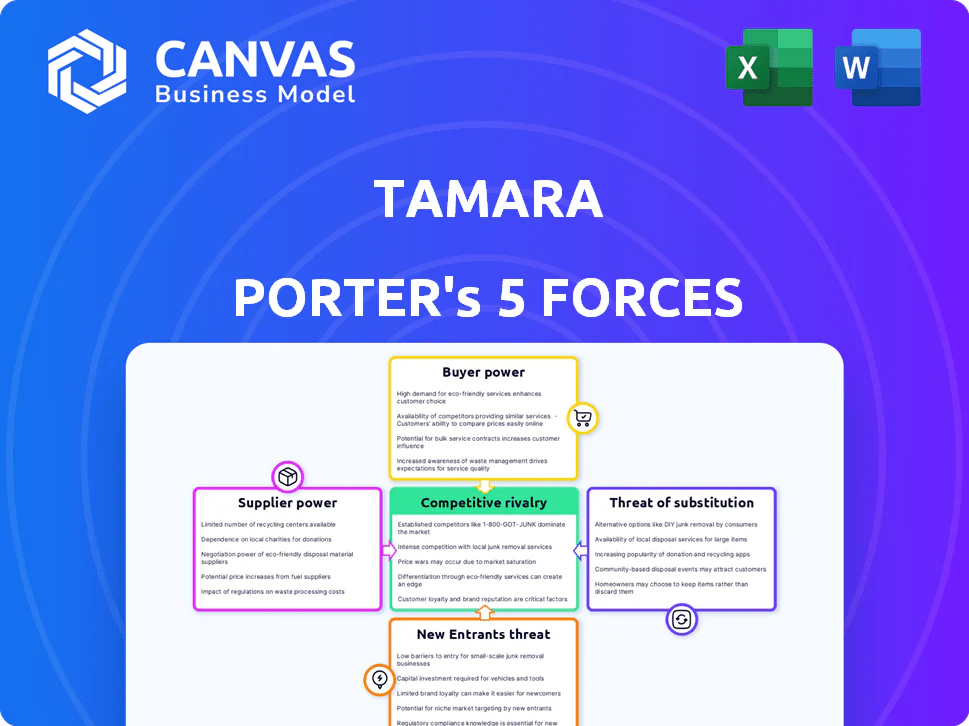
Tamara's Five Forces snapshot highlights competitive intensity, supplier and buyer leverage, substitute threats, and entry barriers-revealing where pressure points and advantages lie; this brief overview teases deeper, quantified ratings and strategic implications. Unlock the full Porter's Five Forces Analysis to get force-by-force scores, visuals, and actionable recommendations tailored to Tamara.
Suppliers Bargaining Power

Access to Wholesale Capital and Debt Financing
Tamaraplus (Tamara) depends on external creditors-Goldman Sachs and Saudi regional banks-for wholesale capital; in FY2025 Tamara drew roughly $600m in debt lines to fund interest-free BNPL loans, so suppliers hold high bargaining power.
If global or GCC liquidity tightens, lenders can push rates up; a 100-200bp rise would cut Tamara's net interest margin and could erase 30-60% of FY2025 operating profit.
Regulatory Oversight from SAMA
SAMA (Saudi Central Bank) is the de facto supplier of Tamara's license to operate, and its 2025 rules-raising minimum capital ratios to SAR 200m and enforcing Saudi data residency with 100% local storage-force Tamara to align products, capital structure, and tech spend, giving SAMA decisive leverage over Tamara's strategy and costs.

Cloud Infrastructure and Cybersecurity Providers
Tamara's platform runs on cloud giants (AWS, Google Cloud) which expanded Saudi Arabia data centers; in 2025 AWS and Google Cloud account for ~55% of regional cloud market, giving suppliers moderate-high power due to costly migration and downtime risks for high-frequency payments.
Specialized AI fraud vendors (real-time scoring) are critical; losing them could spike Tamara's credit losses-industry fraud-detection SLAs reduce fraud by ~40%, and replacing real-time pipelines can cost $2-5M and 3-6 months in 2025.

Payment Processing Networks
Payment networks Visa, Mastercard, and Saudi Arabia's Mada control the rails Tamara uses for installments and repayments, giving them high supplier power because they connect to consumers' primary bank accounts.
In 2025 these networks collected global card fees averaging 1.4-2.5% per transaction, so any fee increase would materially raise Tamara's cost of funds and margins.
Few scalable alternatives exist for reliable, cross-border, real-time processing, making Tamara vulnerable to fee and routing changes.
- Relies on Visa/Mastercard/Mada rails
- Network fees ~1.4-2.5% in 2025
- Direct impact on Tamara margins
- Limited large-scale alternatives
Top-Tier FinTech Engineering Talent
In Riyadh's 2026 tech market, the shortage of senior engineers and data scientists gives suppliers strong bargaining power; Tamara competes with government projects and unicorns like Tabby for a talent pool under 20,000 specialised hires nationwide.
Turnover and salary pressure-average senior software pay up ~18% y/y to SAR 420k in 2025-raise operating costs and delay feature rollouts, hurting time-to-market and margins.
- Talent pool <20,000 specialised hires (KSA, 2026)
- Senior pay ~SAR 420,000 (2025, +18% y/y)
- Competition: government programs, Tabby, other fintechs
- Impact: higher Opex, slower product delivery
Suppliers Squeeze Margins: High Fees, Cloud Dominance, Rising Pay & Capital Rules
Suppliers exert high bargaining power: Tamara drew ~$600m debt lines in FY2025; card network fees 1.4-2.5% (2025); AWS/Google ~55% regional cloud share (2025); senior engineer pay ~SAR420k (+18% y/y, 2025); replacing fraud systems costs $2-5m and 3-6 months; SAMA rules (2025) raise capital to SAR200m.
| Supplier | Key 2025 metric |
|---|---|
| Debt lines | $600m |
| Card fees | 1.4-2.5% |
| Cloud share | ~55% |
| Senior pay | SAR420k |
| SAMA capital | SAR200m |
What is included in the product
 Detailed Word Document
Concise Five Forces review for Tamara that maps competitive rivalry, buyer and supplier power, threat of substitutes and new entrants, highlighting disruptive pressures and strategic levers to protect margins and market share.

 Customizable Excel Spreadsheet
One-sheet Five Forces snapshot that turns complex competitive dynamics into instant, actionable insight-ideal for rapid decisions and crisp boardroom slides.
Customers Bargaining Power

Merchant Concentration Among Retail Giants
Large retailers like Jarir Bookstore and H&M drove roughly 38% of Tamara's 2025 GMV of SAR 9.6 billion (USD 2.56bn), giving them strong bargaining power to demand lower merchant discount rates and thinner margins from Tamara.
The loss of a single anchor merchant could cut Tamara's active merchant GMV share by ~12-18% and reduce its 2025 transaction data inflow used for credit decisions.
Low Consumer Switching Costs
For the individual shopper, switching from Tamara to rivals like Tabby or bank BNPL is effectively free, and with GCC consumers carrying 3-5 payment apps on average (Visa 2024), Tamara faces weak stickiness.
This forces Tamara to spend heavily on marketing-Tamara reported SAR 220m (2025 FY) in sales & marketing-plus loyalty promos to retain users.

High Sensitivity to Fees and Transparency
By 2026, Saudi consumers reject hidden fees: 68% say transparency drives choice per a 2025 YouGov/Kantar study, so if Tamara raises late fees or adds consumer charges, migration to clearer BNPL rivals or cards is likely.

Demand for Integrated Shopping Experiences
Customers now expect an integrated shopping ecosystem-discovery, personalized discounts, seamless returns-not just a pay-later button, shifting bargaining power toward users.
Tamara must keep investing in app features beyond lending to act as a shopping concierge; failure risks churn versus wallets from Amazon and Apple that commanded ~50% US mobile wallet share in 2025.
In 2025 Tamara's retention falls if UX lags: benchmark shows 20-30% higher churn when discovery/personalization scores lag rivals by 1σ.
- Customers demand discovery, discounts, returns
- Tamara must invest in concierge features
- Big-wallet UX dominance (≈50% share) raises exit risk
- UX gap correlates with 20-30% higher churn
Bargaining Power of Small and Medium Enterprises
Individual SMEs have limited bargaining power, but collectively they drove 42% of Tamara's GMV in FY2025 (SAR 6.3bn of SAR 15bn), making them central to growth.
SMEs now demand all-in-one tools-credit, marketing, analytics-and 58% say they'd switch if Tamara lacks these features.
If Tamara omits value-added services, SMEs can defect to payment aggregators offering BNPL as a secondary feature, eroding margins and merchant retention.
- FY2025 SME share: 42% GMV (SAR 6.3bn)
- 58% SMEs likely to switch without integrated tools
- Risk: BNPL commoditization by payment aggregators
High customer power: SMEs drive 42% of GMV; transparency, churn & SAR220m marketing force change
Customers hold high bargaining power: 38% of Tamara's 2025 GMV (SAR 3.65bn of SAR 9.6bn) from large retailers, SMEs 42% (SAR 6.3bn of SAR 15bn) drive volume, and low switching costs plus 2025 SAR 220m marketing spend and 20-30% churn sensitivity force product and fee transparency investments.
| Metric | 2025 value |
|---|---|
| GMV-large retailers | SAR 3.65bn (38%) |
| SME GMV share | SAR 6.3bn (42%) |
| Sales & marketing | SAR 220m |
Preview the Actual Deliverable
Tamara Porter's Five Forces Analysis
This preview shows the exact Tamara Porter's Five Forces Analysis you'll receive immediately after purchase-no placeholders or mockups, fully formatted and ready to use.

Original: $10.00
-65%$10.00
$3.50TAMARA PORTER'S FIVE FORCES TEMPLATE RESEARCH
Go Beyond the Preview-Access the Full Strategic Report
Tamara's Five Forces snapshot highlights competitive intensity, supplier and buyer leverage, substitute threats, and entry barriers-revealing where pressure points and advantages lie; this brief overview teases deeper, quantified ratings and strategic implications. Unlock the full Porter's Five Forces Analysis to get force-by-force scores, visuals, and actionable recommendations tailored to Tamara.
Suppliers Bargaining Power
Access to Wholesale Capital and Debt Financing
Tamaraplus (Tamara) depends on external creditors-Goldman Sachs and Saudi regional banks-for wholesale capital; in FY2025 Tamara drew roughly $600m in debt lines to fund interest-free BNPL loans, so suppliers hold high bargaining power.
If global or GCC liquidity tightens, lenders can push rates up; a 100-200bp rise would cut Tamara's net interest margin and could erase 30-60% of FY2025 operating profit.
Regulatory Oversight from SAMA
SAMA (Saudi Central Bank) is the de facto supplier of Tamara's license to operate, and its 2025 rules-raising minimum capital ratios to SAR 200m and enforcing Saudi data residency with 100% local storage-force Tamara to align products, capital structure, and tech spend, giving SAMA decisive leverage over Tamara's strategy and costs.
Cloud Infrastructure and Cybersecurity Providers
Tamara's platform runs on cloud giants (AWS, Google Cloud) which expanded Saudi Arabia data centers; in 2025 AWS and Google Cloud account for ~55% of regional cloud market, giving suppliers moderate-high power due to costly migration and downtime risks for high-frequency payments.
Specialized AI fraud vendors (real-time scoring) are critical; losing them could spike Tamara's credit losses-industry fraud-detection SLAs reduce fraud by ~40%, and replacing real-time pipelines can cost $2-5M and 3-6 months in 2025.
Payment Processing Networks
Payment networks Visa, Mastercard, and Saudi Arabia's Mada control the rails Tamara uses for installments and repayments, giving them high supplier power because they connect to consumers' primary bank accounts.
In 2025 these networks collected global card fees averaging 1.4-2.5% per transaction, so any fee increase would materially raise Tamara's cost of funds and margins.
Few scalable alternatives exist for reliable, cross-border, real-time processing, making Tamara vulnerable to fee and routing changes.
- Relies on Visa/Mastercard/Mada rails
- Network fees ~1.4-2.5% in 2025
- Direct impact on Tamara margins
- Limited large-scale alternatives
Top-Tier FinTech Engineering Talent
In Riyadh's 2026 tech market, the shortage of senior engineers and data scientists gives suppliers strong bargaining power; Tamara competes with government projects and unicorns like Tabby for a talent pool under 20,000 specialised hires nationwide.
Turnover and salary pressure-average senior software pay up ~18% y/y to SAR 420k in 2025-raise operating costs and delay feature rollouts, hurting time-to-market and margins.
- Talent pool <20,000 specialised hires (KSA, 2026)
- Senior pay ~SAR 420,000 (2025, +18% y/y)
- Competition: government programs, Tabby, other fintechs
- Impact: higher Opex, slower product delivery
Suppliers Squeeze Margins: High Fees, Cloud Dominance, Rising Pay & Capital Rules
Suppliers exert high bargaining power: Tamara drew ~$600m debt lines in FY2025; card network fees 1.4-2.5% (2025); AWS/Google ~55% regional cloud share (2025); senior engineer pay ~SAR420k (+18% y/y, 2025); replacing fraud systems costs $2-5m and 3-6 months; SAMA rules (2025) raise capital to SAR200m.
| Supplier | Key 2025 metric |
|---|---|
| Debt lines | $600m |
| Card fees | 1.4-2.5% |
| Cloud share | ~55% |
| Senior pay | SAR420k |
| SAMA capital | SAR200m |
What is included in the product
Detailed Word Document
Concise Five Forces review for Tamara that maps competitive rivalry, buyer and supplier power, threat of substitutes and new entrants, highlighting disruptive pressures and strategic levers to protect margins and market share.
Customizable Excel Spreadsheet
One-sheet Five Forces snapshot that turns complex competitive dynamics into instant, actionable insight-ideal for rapid decisions and crisp boardroom slides.
Customers Bargaining Power
Merchant Concentration Among Retail Giants
Large retailers like Jarir Bookstore and H&M drove roughly 38% of Tamara's 2025 GMV of SAR 9.6 billion (USD 2.56bn), giving them strong bargaining power to demand lower merchant discount rates and thinner margins from Tamara.
The loss of a single anchor merchant could cut Tamara's active merchant GMV share by ~12-18% and reduce its 2025 transaction data inflow used for credit decisions.
Low Consumer Switching Costs
For the individual shopper, switching from Tamara to rivals like Tabby or bank BNPL is effectively free, and with GCC consumers carrying 3-5 payment apps on average (Visa 2024), Tamara faces weak stickiness.
This forces Tamara to spend heavily on marketing-Tamara reported SAR 220m (2025 FY) in sales & marketing-plus loyalty promos to retain users.
High Sensitivity to Fees and Transparency
By 2026, Saudi consumers reject hidden fees: 68% say transparency drives choice per a 2025 YouGov/Kantar study, so if Tamara raises late fees or adds consumer charges, migration to clearer BNPL rivals or cards is likely.
Demand for Integrated Shopping Experiences
Customers now expect an integrated shopping ecosystem-discovery, personalized discounts, seamless returns-not just a pay-later button, shifting bargaining power toward users.
Tamara must keep investing in app features beyond lending to act as a shopping concierge; failure risks churn versus wallets from Amazon and Apple that commanded ~50% US mobile wallet share in 2025.
In 2025 Tamara's retention falls if UX lags: benchmark shows 20-30% higher churn when discovery/personalization scores lag rivals by 1σ.
- Customers demand discovery, discounts, returns
- Tamara must invest in concierge features
- Big-wallet UX dominance (≈50% share) raises exit risk
- UX gap correlates with 20-30% higher churn
Bargaining Power of Small and Medium Enterprises
Individual SMEs have limited bargaining power, but collectively they drove 42% of Tamara's GMV in FY2025 (SAR 6.3bn of SAR 15bn), making them central to growth.
SMEs now demand all-in-one tools-credit, marketing, analytics-and 58% say they'd switch if Tamara lacks these features.
If Tamara omits value-added services, SMEs can defect to payment aggregators offering BNPL as a secondary feature, eroding margins and merchant retention.
- FY2025 SME share: 42% GMV (SAR 6.3bn)
- 58% SMEs likely to switch without integrated tools
- Risk: BNPL commoditization by payment aggregators
High customer power: SMEs drive 42% of GMV; transparency, churn & SAR220m marketing force change
Customers hold high bargaining power: 38% of Tamara's 2025 GMV (SAR 3.65bn of SAR 9.6bn) from large retailers, SMEs 42% (SAR 6.3bn of SAR 15bn) drive volume, and low switching costs plus 2025 SAR 220m marketing spend and 20-30% churn sensitivity force product and fee transparency investments.
| Metric | 2025 value |
|---|---|
| GMV-large retailers | SAR 3.65bn (38%) |
| SME GMV share | SAR 6.3bn (42%) |
| Sales & marketing | SAR 220m |
Preview the Actual Deliverable
Tamara Porter's Five Forces Analysis
This preview shows the exact Tamara Porter's Five Forces Analysis you'll receive immediately after purchase-no placeholders or mockups, fully formatted and ready to use.
Product Information
Product Information
Shipping & Returns
Shipping & Returns
Description
Go Beyond the Preview-Access the Full Strategic Report
Tamara's Five Forces snapshot highlights competitive intensity, supplier and buyer leverage, substitute threats, and entry barriers-revealing where pressure points and advantages lie; this brief overview teases deeper, quantified ratings and strategic implications. Unlock the full Porter's Five Forces Analysis to get force-by-force scores, visuals, and actionable recommendations tailored to Tamara.
Suppliers Bargaining Power
Access to Wholesale Capital and Debt Financing
Tamaraplus (Tamara) depends on external creditors-Goldman Sachs and Saudi regional banks-for wholesale capital; in FY2025 Tamara drew roughly $600m in debt lines to fund interest-free BNPL loans, so suppliers hold high bargaining power.
If global or GCC liquidity tightens, lenders can push rates up; a 100-200bp rise would cut Tamara's net interest margin and could erase 30-60% of FY2025 operating profit.
Regulatory Oversight from SAMA
SAMA (Saudi Central Bank) is the de facto supplier of Tamara's license to operate, and its 2025 rules-raising minimum capital ratios to SAR 200m and enforcing Saudi data residency with 100% local storage-force Tamara to align products, capital structure, and tech spend, giving SAMA decisive leverage over Tamara's strategy and costs.
Cloud Infrastructure and Cybersecurity Providers
Tamara's platform runs on cloud giants (AWS, Google Cloud) which expanded Saudi Arabia data centers; in 2025 AWS and Google Cloud account for ~55% of regional cloud market, giving suppliers moderate-high power due to costly migration and downtime risks for high-frequency payments.
Specialized AI fraud vendors (real-time scoring) are critical; losing them could spike Tamara's credit losses-industry fraud-detection SLAs reduce fraud by ~40%, and replacing real-time pipelines can cost $2-5M and 3-6 months in 2025.
Payment Processing Networks
Payment networks Visa, Mastercard, and Saudi Arabia's Mada control the rails Tamara uses for installments and repayments, giving them high supplier power because they connect to consumers' primary bank accounts.
In 2025 these networks collected global card fees averaging 1.4-2.5% per transaction, so any fee increase would materially raise Tamara's cost of funds and margins.
Few scalable alternatives exist for reliable, cross-border, real-time processing, making Tamara vulnerable to fee and routing changes.
- Relies on Visa/Mastercard/Mada rails
- Network fees ~1.4-2.5% in 2025
- Direct impact on Tamara margins
- Limited large-scale alternatives
Top-Tier FinTech Engineering Talent
In Riyadh's 2026 tech market, the shortage of senior engineers and data scientists gives suppliers strong bargaining power; Tamara competes with government projects and unicorns like Tabby for a talent pool under 20,000 specialised hires nationwide.
Turnover and salary pressure-average senior software pay up ~18% y/y to SAR 420k in 2025-raise operating costs and delay feature rollouts, hurting time-to-market and margins.
- Talent pool <20,000 specialised hires (KSA, 2026)
- Senior pay ~SAR 420,000 (2025, +18% y/y)
- Competition: government programs, Tabby, other fintechs
- Impact: higher Opex, slower product delivery
Suppliers Squeeze Margins: High Fees, Cloud Dominance, Rising Pay & Capital Rules
Suppliers exert high bargaining power: Tamara drew ~$600m debt lines in FY2025; card network fees 1.4-2.5% (2025); AWS/Google ~55% regional cloud share (2025); senior engineer pay ~SAR420k (+18% y/y, 2025); replacing fraud systems costs $2-5m and 3-6 months; SAMA rules (2025) raise capital to SAR200m.
| Supplier | Key 2025 metric |
|---|---|
| Debt lines | $600m |
| Card fees | 1.4-2.5% |
| Cloud share | ~55% |
| Senior pay | SAR420k |
| SAMA capital | SAR200m |
What is included in the product
Detailed Word Document
Concise Five Forces review for Tamara that maps competitive rivalry, buyer and supplier power, threat of substitutes and new entrants, highlighting disruptive pressures and strategic levers to protect margins and market share.
Customizable Excel Spreadsheet
One-sheet Five Forces snapshot that turns complex competitive dynamics into instant, actionable insight-ideal for rapid decisions and crisp boardroom slides.
Customers Bargaining Power
Merchant Concentration Among Retail Giants
Large retailers like Jarir Bookstore and H&M drove roughly 38% of Tamara's 2025 GMV of SAR 9.6 billion (USD 2.56bn), giving them strong bargaining power to demand lower merchant discount rates and thinner margins from Tamara.
The loss of a single anchor merchant could cut Tamara's active merchant GMV share by ~12-18% and reduce its 2025 transaction data inflow used for credit decisions.
Low Consumer Switching Costs
For the individual shopper, switching from Tamara to rivals like Tabby or bank BNPL is effectively free, and with GCC consumers carrying 3-5 payment apps on average (Visa 2024), Tamara faces weak stickiness.
This forces Tamara to spend heavily on marketing-Tamara reported SAR 220m (2025 FY) in sales & marketing-plus loyalty promos to retain users.
High Sensitivity to Fees and Transparency
By 2026, Saudi consumers reject hidden fees: 68% say transparency drives choice per a 2025 YouGov/Kantar study, so if Tamara raises late fees or adds consumer charges, migration to clearer BNPL rivals or cards is likely.
Demand for Integrated Shopping Experiences
Customers now expect an integrated shopping ecosystem-discovery, personalized discounts, seamless returns-not just a pay-later button, shifting bargaining power toward users.
Tamara must keep investing in app features beyond lending to act as a shopping concierge; failure risks churn versus wallets from Amazon and Apple that commanded ~50% US mobile wallet share in 2025.
In 2025 Tamara's retention falls if UX lags: benchmark shows 20-30% higher churn when discovery/personalization scores lag rivals by 1σ.
- Customers demand discovery, discounts, returns
- Tamara must invest in concierge features
- Big-wallet UX dominance (≈50% share) raises exit risk
- UX gap correlates with 20-30% higher churn
Bargaining Power of Small and Medium Enterprises
Individual SMEs have limited bargaining power, but collectively they drove 42% of Tamara's GMV in FY2025 (SAR 6.3bn of SAR 15bn), making them central to growth.
SMEs now demand all-in-one tools-credit, marketing, analytics-and 58% say they'd switch if Tamara lacks these features.
If Tamara omits value-added services, SMEs can defect to payment aggregators offering BNPL as a secondary feature, eroding margins and merchant retention.
- FY2025 SME share: 42% GMV (SAR 6.3bn)
- 58% SMEs likely to switch without integrated tools
- Risk: BNPL commoditization by payment aggregators
High customer power: SMEs drive 42% of GMV; transparency, churn & SAR220m marketing force change
Customers hold high bargaining power: 38% of Tamara's 2025 GMV (SAR 3.65bn of SAR 9.6bn) from large retailers, SMEs 42% (SAR 6.3bn of SAR 15bn) drive volume, and low switching costs plus 2025 SAR 220m marketing spend and 20-30% churn sensitivity force product and fee transparency investments.
| Metric | 2025 value |
|---|---|
| GMV-large retailers | SAR 3.65bn (38%) |
| SME GMV share | SAR 6.3bn (42%) |
| Sales & marketing | SAR 220m |
Preview the Actual Deliverable
Tamara Porter's Five Forces Analysis
This preview shows the exact Tamara Porter's Five Forces Analysis you'll receive immediately after purchase-no placeholders or mockups, fully formatted and ready to use.











