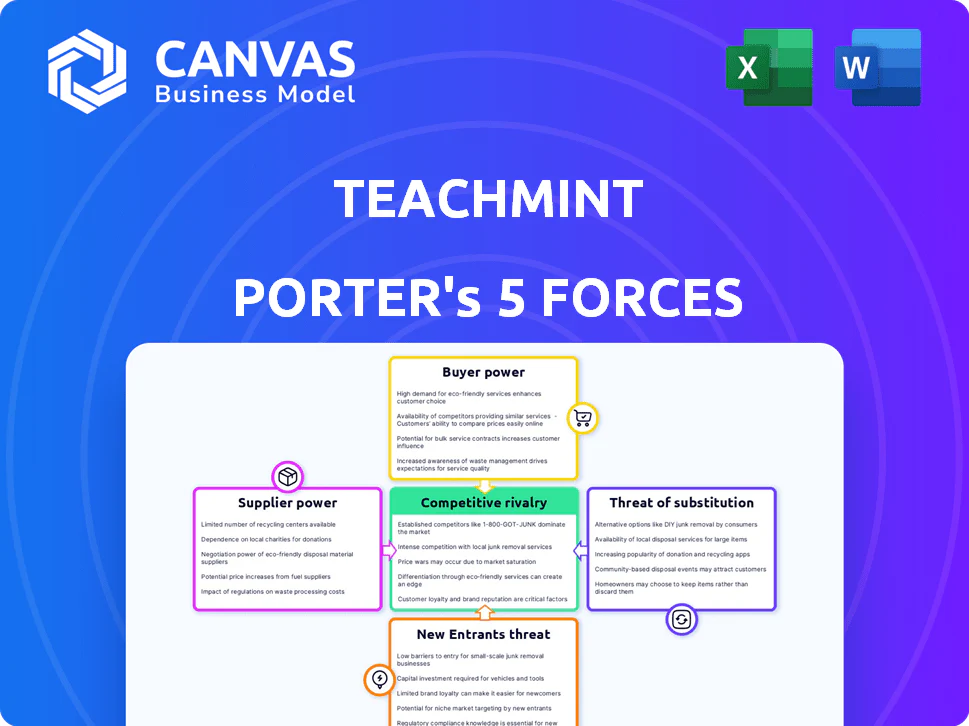
TEACHMINT PORTER'S FIVE FORCES TEMPLATE RESEARCH
What is included in the product
 Detailed Word Document
Analyzes Teachmint's competitive landscape, evaluating suppliers, buyers, and new market threats.

 Customizable Excel Spreadsheet
Instantly visualize the strategic landscape with dynamic, easy-to-interpret charts.
Preview Before You Purchase
Teachmint Porter's Five Forces Analysis
This is the complete Porter's Five Forces analysis of Teachmint. The document displayed here is the same analysis you'll receive—fully comprehensive and ready for immediate use.

Porter's Five Forces Analysis Template

Go Beyond the Preview—Access the Full Strategic Report
Teachmint faces competition from various EdTech platforms and established educational institutions. Buyer power is moderate, influenced by the availability of alternative learning solutions. Supplier power, mainly driven by content creators, is also a factor. The threat of new entrants, particularly from well-funded startups, poses a risk. Substitute threats, such as offline tutoring, must be considered.
Unlock key insights into Teachmint’s industry forces—from buyer power to substitute threats—and use this knowledge to inform strategy or investment decisions.
Suppliers Bargaining Power

Technology Providers
Teachmint's dependence on tech suppliers, like cloud providers, influences its operations. Supplier power hinges on alternatives and switching costs. In 2024, cloud spending hit $670 billion globally, showing supplier influence. If alternatives are plentiful, like AWS, Azure, and Google Cloud, supplier power is moderate. High switching costs, due to data migration or specialized services, increase supplier power.
Content Providers
Content providers' power varies with content uniqueness. Teachmint uses content libraries, but competition lowers provider influence. If content is common, power is weak. For example, the global e-learning market was valued at $325 billion in 2023, showing many options.

Hardware Manufacturers
Teachmint's IFPs mean it depends on hardware manufacturers, impacting supplier bargaining power. This power hinges on factors like manufacturer numbers, component standardization, and order volume. For instance, the global IFP market was valued at $2.8 billion in 2024. Standardization of components can lower supplier power.

Payment Gateway Providers
Teachmint depends on payment gateway providers for its freemium and subscription models. These providers' power hinges on fees, reliability, and ease of integration. High fees or complex integration can increase supplier power. In 2024, payment processing fees averaged 2.9% plus $0.30 per transaction for many providers.
- Fee structures significantly impact Teachmint's profitability, especially with high transaction volumes.
- Reliability of payment gateways is crucial for uninterrupted service.
- Ease of integration and switching affects Teachmint's flexibility and costs.
- Competition among providers can help Teachmint negotiate better terms.
Talent Pool
The talent pool significantly affects Teachmint's operational costs and ability to innovate. A limited supply of skilled software developers and product managers strengthens their bargaining power. This can lead to increased salary demands and higher recruitment expenses for Teachmint. The tech industry's competition for talent is intense.
- In 2024, the average salary for software developers in India rose by 15%.
- Recruitment costs in the tech sector increased by 10% due to talent scarcity.
- Teachmint needs to invest in employee retention.
- The company must focus on its employer branding.
Teachmint's Supplier Power Dynamics Unveiled
Teachmint faces supplier power from various sources. Cloud providers, like AWS, Azure, and Google Cloud, wield influence. IFP manufacturers also impact Teachmint's operations. Payment gateways and talent pools further affect bargaining dynamics.
| Supplier | Impact | 2024 Data |
|---|---|---|
| Cloud Providers | High due to essential services | Global cloud spending: $670B |
| IFP Manufacturers | Moderate, depends on component standardization | Global IFP market: $2.8B |
| Payment Gateways | Moderate, depends on fees | Avg. fees: 2.9% + $0.30/transaction |
Customers Bargaining Power

Individual Educators and Tutors
Individual educators and tutors represent a key customer segment for Teachmint, frequently utilizing the free or entry-level paid plans. Their bargaining power is generally low because of the abundant supply of educators and the ease of switching to competitors. For instance, in 2024, platforms like Zoom and Google Meet saw a 15% increase in educators using their free services, showing readily available alternatives. This competition limits Teachmint's ability to dictate terms to this segment.
Educational Institutions
Educational institutions like schools and colleges are crucial Teachmint customers, potentially seeking premium features. Their bargaining power is notable, especially for larger institutions, as they represent substantial revenue. For example, in 2024, the educational technology market hit $252 billion globally. They can negotiate pricing and terms.

Students and Parents
Students and parents, though indirect users, shape Teachmint's success. Their preferences impact platform adoption; positive experiences drive satisfaction. Feedback on features indirectly pressures Teachmint. In 2024, the online education market reached $139.5 billion globally, showing student and parent influence.

Price Sensitivity
Customers in the education sector, including individual educators and institutions, often show price sensitivity. Teachmint's freemium model attempts to counter this by offering basic features for free. The presence of free or low-cost alternatives enhances customer bargaining power, especially concerning paid subscriptions.
- In 2024, the global EdTech market was valued at over $120 billion.
- Freemium models are common, with up to 70% of users opting for free versions.
- Competition from free platforms like Google Classroom impacts pricing strategies.
Availability of Alternatives
The abundance of alternatives in online education, such as Coursera, Udemy, and Google Classroom, boosts customer power. This allows customers to compare services and pricing easily. Dissatisfied users can readily switch, applying pressure on platforms to offer competitive terms. The market dynamics ensure platforms must continually improve to retain users.
- According to HolonIQ, the global education market is projected to reach $10 trillion by 2030.
- In 2024, the online education market saw a 15% growth.
- Customer churn rates in online education can be as high as 30% annually.
Teachmint's Customer Power Dynamics: A Breakdown
Teachmint's customers include educators, institutions, and students, each with varied bargaining power. Individual educators have low power due to many alternatives, such as Zoom and Google Meet. Institutions, especially larger ones, wield more influence, capable of negotiating terms. Student and parent preferences also shape Teachmint's success.
| Customer Segment | Bargaining Power | Impact on Teachmint |
|---|---|---|
| Individual Educators | Low | Price-sensitive, easily switch |
| Educational Institutions | Moderate to High | Influence pricing, demand features |
| Students/Parents | Indirect | Shape platform adoption, feedback |
Rivalry Among Competitors

Numerous EdTech Platforms
The EdTech market is fiercely competitive. Teachmint battles rivals with overlapping services. 2024 saw over 10,000 EdTech startups globally. This includes giants and fresh entrants. This intense rivalry pressures pricing and innovation.
Diverse Competitor Offerings
Teachmint faces stiff competition from rivals offering varied solutions. These range from comprehensive learning platforms to specialized test prep tools. This competitive landscape demands constant innovation. For instance, the global e-learning market was valued at $250 billion in 2024, highlighting the scale and rivalry.

Presence of Large, Well-Funded Players
Teachmint faces intense competition from giants like Byju's and Unacademy, well-funded rivals with substantial market shares. These competitors, backed by billions in funding, can outspend Teachmint on marketing and acquisitions. In 2024, Byju's raised $250 million to stay competitive. This financial muscle allows for aggressive expansion and product innovation, intensifying the rivalry.

Differentiation and Niche Markets
Competitive rivalry in the edtech sector involves many players, yet some carve out niches. Teachmint distinguishes itself by integrating tools for various educational providers. This specialization is key to its market approach. For instance, the global edtech market was valued at $106.6 billion in 2023.
- Teachmint's focus is on integrated solutions.
- Differentiation helps in a competitive market.
- The edtech market is large and growing.
- Niche strategies can create advantages.
Pricing Strategies
Competitive rivalry in pricing strategies is fierce. Competitors use freemium, subscription, and enterprise solutions. Teachmint must compete on price while showcasing value. For example, the global e-learning market was valued at $250 billion in 2024.
- Freemium models offer basic features for free, aiming to convert users to paid plans.
- Subscription plans provide tiered access, varying in features and price points.
- Customized enterprise solutions cater to specific business needs, often at higher prices.
- Teachmint's pricing needs to balance competitiveness with the value it provides.
EdTech's $250B Arena: Competition Heats Up!
Teachmint operates in a hyper-competitive edtech landscape, with over 10,000 startups globally as of 2024. This intense rivalry drives pricing pressures and the need for constant innovation. The global e-learning market reached $250 billion in 2024, highlighting the scale.
| Aspect | Details | Impact on Teachmint |
|---|---|---|
| Market Size (2024) | $250 billion (e-learning) | Indicates large market, high competition |
| Number of EdTech Startups (2024) | Over 10,000 | Intensifies competition, innovation pressure |
| Byju's Funding (2024) | $250 million | Highlights financial muscle of competitors |
Original: $10.00
-65%$10.00
$3.50TEACHMINT PORTER'S FIVE FORCES TEMPLATE RESEARCH
What is included in the product
Detailed Word Document
Analyzes Teachmint's competitive landscape, evaluating suppliers, buyers, and new market threats.
Customizable Excel Spreadsheet
Instantly visualize the strategic landscape with dynamic, easy-to-interpret charts.
Preview Before You Purchase
Teachmint Porter's Five Forces Analysis
This is the complete Porter's Five Forces analysis of Teachmint. The document displayed here is the same analysis you'll receive—fully comprehensive and ready for immediate use.
Porter's Five Forces Analysis Template
Go Beyond the Preview—Access the Full Strategic Report
Teachmint faces competition from various EdTech platforms and established educational institutions. Buyer power is moderate, influenced by the availability of alternative learning solutions. Supplier power, mainly driven by content creators, is also a factor. The threat of new entrants, particularly from well-funded startups, poses a risk. Substitute threats, such as offline tutoring, must be considered.
Unlock key insights into Teachmint’s industry forces—from buyer power to substitute threats—and use this knowledge to inform strategy or investment decisions.
Suppliers Bargaining Power
Technology Providers
Teachmint's dependence on tech suppliers, like cloud providers, influences its operations. Supplier power hinges on alternatives and switching costs. In 2024, cloud spending hit $670 billion globally, showing supplier influence. If alternatives are plentiful, like AWS, Azure, and Google Cloud, supplier power is moderate. High switching costs, due to data migration or specialized services, increase supplier power.
Content Providers
Content providers' power varies with content uniqueness. Teachmint uses content libraries, but competition lowers provider influence. If content is common, power is weak. For example, the global e-learning market was valued at $325 billion in 2023, showing many options.
Hardware Manufacturers
Teachmint's IFPs mean it depends on hardware manufacturers, impacting supplier bargaining power. This power hinges on factors like manufacturer numbers, component standardization, and order volume. For instance, the global IFP market was valued at $2.8 billion in 2024. Standardization of components can lower supplier power.
Payment Gateway Providers
Teachmint depends on payment gateway providers for its freemium and subscription models. These providers' power hinges on fees, reliability, and ease of integration. High fees or complex integration can increase supplier power. In 2024, payment processing fees averaged 2.9% plus $0.30 per transaction for many providers.
- Fee structures significantly impact Teachmint's profitability, especially with high transaction volumes.
- Reliability of payment gateways is crucial for uninterrupted service.
- Ease of integration and switching affects Teachmint's flexibility and costs.
- Competition among providers can help Teachmint negotiate better terms.
Talent Pool
The talent pool significantly affects Teachmint's operational costs and ability to innovate. A limited supply of skilled software developers and product managers strengthens their bargaining power. This can lead to increased salary demands and higher recruitment expenses for Teachmint. The tech industry's competition for talent is intense.
- In 2024, the average salary for software developers in India rose by 15%.
- Recruitment costs in the tech sector increased by 10% due to talent scarcity.
- Teachmint needs to invest in employee retention.
- The company must focus on its employer branding.
Teachmint's Supplier Power Dynamics Unveiled
Teachmint faces supplier power from various sources. Cloud providers, like AWS, Azure, and Google Cloud, wield influence. IFP manufacturers also impact Teachmint's operations. Payment gateways and talent pools further affect bargaining dynamics.
| Supplier | Impact | 2024 Data |
|---|---|---|
| Cloud Providers | High due to essential services | Global cloud spending: $670B |
| IFP Manufacturers | Moderate, depends on component standardization | Global IFP market: $2.8B |
| Payment Gateways | Moderate, depends on fees | Avg. fees: 2.9% + $0.30/transaction |
Customers Bargaining Power
Individual Educators and Tutors
Individual educators and tutors represent a key customer segment for Teachmint, frequently utilizing the free or entry-level paid plans. Their bargaining power is generally low because of the abundant supply of educators and the ease of switching to competitors. For instance, in 2024, platforms like Zoom and Google Meet saw a 15% increase in educators using their free services, showing readily available alternatives. This competition limits Teachmint's ability to dictate terms to this segment.
Educational Institutions
Educational institutions like schools and colleges are crucial Teachmint customers, potentially seeking premium features. Their bargaining power is notable, especially for larger institutions, as they represent substantial revenue. For example, in 2024, the educational technology market hit $252 billion globally. They can negotiate pricing and terms.
Students and Parents
Students and parents, though indirect users, shape Teachmint's success. Their preferences impact platform adoption; positive experiences drive satisfaction. Feedback on features indirectly pressures Teachmint. In 2024, the online education market reached $139.5 billion globally, showing student and parent influence.
Price Sensitivity
Customers in the education sector, including individual educators and institutions, often show price sensitivity. Teachmint's freemium model attempts to counter this by offering basic features for free. The presence of free or low-cost alternatives enhances customer bargaining power, especially concerning paid subscriptions.
- In 2024, the global EdTech market was valued at over $120 billion.
- Freemium models are common, with up to 70% of users opting for free versions.
- Competition from free platforms like Google Classroom impacts pricing strategies.
Availability of Alternatives
The abundance of alternatives in online education, such as Coursera, Udemy, and Google Classroom, boosts customer power. This allows customers to compare services and pricing easily. Dissatisfied users can readily switch, applying pressure on platforms to offer competitive terms. The market dynamics ensure platforms must continually improve to retain users.
- According to HolonIQ, the global education market is projected to reach $10 trillion by 2030.
- In 2024, the online education market saw a 15% growth.
- Customer churn rates in online education can be as high as 30% annually.
Teachmint's Customer Power Dynamics: A Breakdown
Teachmint's customers include educators, institutions, and students, each with varied bargaining power. Individual educators have low power due to many alternatives, such as Zoom and Google Meet. Institutions, especially larger ones, wield more influence, capable of negotiating terms. Student and parent preferences also shape Teachmint's success.
| Customer Segment | Bargaining Power | Impact on Teachmint |
|---|---|---|
| Individual Educators | Low | Price-sensitive, easily switch |
| Educational Institutions | Moderate to High | Influence pricing, demand features |
| Students/Parents | Indirect | Shape platform adoption, feedback |
Rivalry Among Competitors
Numerous EdTech Platforms
The EdTech market is fiercely competitive. Teachmint battles rivals with overlapping services. 2024 saw over 10,000 EdTech startups globally. This includes giants and fresh entrants. This intense rivalry pressures pricing and innovation.
Diverse Competitor Offerings
Teachmint faces stiff competition from rivals offering varied solutions. These range from comprehensive learning platforms to specialized test prep tools. This competitive landscape demands constant innovation. For instance, the global e-learning market was valued at $250 billion in 2024, highlighting the scale and rivalry.
Presence of Large, Well-Funded Players
Teachmint faces intense competition from giants like Byju's and Unacademy, well-funded rivals with substantial market shares. These competitors, backed by billions in funding, can outspend Teachmint on marketing and acquisitions. In 2024, Byju's raised $250 million to stay competitive. This financial muscle allows for aggressive expansion and product innovation, intensifying the rivalry.
Differentiation and Niche Markets
Competitive rivalry in the edtech sector involves many players, yet some carve out niches. Teachmint distinguishes itself by integrating tools for various educational providers. This specialization is key to its market approach. For instance, the global edtech market was valued at $106.6 billion in 2023.
- Teachmint's focus is on integrated solutions.
- Differentiation helps in a competitive market.
- The edtech market is large and growing.
- Niche strategies can create advantages.
Pricing Strategies
Competitive rivalry in pricing strategies is fierce. Competitors use freemium, subscription, and enterprise solutions. Teachmint must compete on price while showcasing value. For example, the global e-learning market was valued at $250 billion in 2024.
- Freemium models offer basic features for free, aiming to convert users to paid plans.
- Subscription plans provide tiered access, varying in features and price points.
- Customized enterprise solutions cater to specific business needs, often at higher prices.
- Teachmint's pricing needs to balance competitiveness with the value it provides.
EdTech's $250B Arena: Competition Heats Up!
Teachmint operates in a hyper-competitive edtech landscape, with over 10,000 startups globally as of 2024. This intense rivalry drives pricing pressures and the need for constant innovation. The global e-learning market reached $250 billion in 2024, highlighting the scale.
| Aspect | Details | Impact on Teachmint |
|---|---|---|
| Market Size (2024) | $250 billion (e-learning) | Indicates large market, high competition |
| Number of EdTech Startups (2024) | Over 10,000 | Intensifies competition, innovation pressure |
| Byju's Funding (2024) | $250 million | Highlights financial muscle of competitors |
Product Information
Product Information
Shipping & Returns
Shipping & Returns
Description
What is included in the product
Detailed Word Document
Analyzes Teachmint's competitive landscape, evaluating suppliers, buyers, and new market threats.
Customizable Excel Spreadsheet
Instantly visualize the strategic landscape with dynamic, easy-to-interpret charts.
Preview Before You Purchase
Teachmint Porter's Five Forces Analysis
This is the complete Porter's Five Forces analysis of Teachmint. The document displayed here is the same analysis you'll receive—fully comprehensive and ready for immediate use.
Porter's Five Forces Analysis Template
Go Beyond the Preview—Access the Full Strategic Report
Teachmint faces competition from various EdTech platforms and established educational institutions. Buyer power is moderate, influenced by the availability of alternative learning solutions. Supplier power, mainly driven by content creators, is also a factor. The threat of new entrants, particularly from well-funded startups, poses a risk. Substitute threats, such as offline tutoring, must be considered.
Unlock key insights into Teachmint’s industry forces—from buyer power to substitute threats—and use this knowledge to inform strategy or investment decisions.
Suppliers Bargaining Power
Technology Providers
Teachmint's dependence on tech suppliers, like cloud providers, influences its operations. Supplier power hinges on alternatives and switching costs. In 2024, cloud spending hit $670 billion globally, showing supplier influence. If alternatives are plentiful, like AWS, Azure, and Google Cloud, supplier power is moderate. High switching costs, due to data migration or specialized services, increase supplier power.
Content Providers
Content providers' power varies with content uniqueness. Teachmint uses content libraries, but competition lowers provider influence. If content is common, power is weak. For example, the global e-learning market was valued at $325 billion in 2023, showing many options.
Hardware Manufacturers
Teachmint's IFPs mean it depends on hardware manufacturers, impacting supplier bargaining power. This power hinges on factors like manufacturer numbers, component standardization, and order volume. For instance, the global IFP market was valued at $2.8 billion in 2024. Standardization of components can lower supplier power.
Payment Gateway Providers
Teachmint depends on payment gateway providers for its freemium and subscription models. These providers' power hinges on fees, reliability, and ease of integration. High fees or complex integration can increase supplier power. In 2024, payment processing fees averaged 2.9% plus $0.30 per transaction for many providers.
- Fee structures significantly impact Teachmint's profitability, especially with high transaction volumes.
- Reliability of payment gateways is crucial for uninterrupted service.
- Ease of integration and switching affects Teachmint's flexibility and costs.
- Competition among providers can help Teachmint negotiate better terms.
Talent Pool
The talent pool significantly affects Teachmint's operational costs and ability to innovate. A limited supply of skilled software developers and product managers strengthens their bargaining power. This can lead to increased salary demands and higher recruitment expenses for Teachmint. The tech industry's competition for talent is intense.
- In 2024, the average salary for software developers in India rose by 15%.
- Recruitment costs in the tech sector increased by 10% due to talent scarcity.
- Teachmint needs to invest in employee retention.
- The company must focus on its employer branding.
Teachmint's Supplier Power Dynamics Unveiled
Teachmint faces supplier power from various sources. Cloud providers, like AWS, Azure, and Google Cloud, wield influence. IFP manufacturers also impact Teachmint's operations. Payment gateways and talent pools further affect bargaining dynamics.
| Supplier | Impact | 2024 Data |
|---|---|---|
| Cloud Providers | High due to essential services | Global cloud spending: $670B |
| IFP Manufacturers | Moderate, depends on component standardization | Global IFP market: $2.8B |
| Payment Gateways | Moderate, depends on fees | Avg. fees: 2.9% + $0.30/transaction |
Customers Bargaining Power
Individual Educators and Tutors
Individual educators and tutors represent a key customer segment for Teachmint, frequently utilizing the free or entry-level paid plans. Their bargaining power is generally low because of the abundant supply of educators and the ease of switching to competitors. For instance, in 2024, platforms like Zoom and Google Meet saw a 15% increase in educators using their free services, showing readily available alternatives. This competition limits Teachmint's ability to dictate terms to this segment.
Educational Institutions
Educational institutions like schools and colleges are crucial Teachmint customers, potentially seeking premium features. Their bargaining power is notable, especially for larger institutions, as they represent substantial revenue. For example, in 2024, the educational technology market hit $252 billion globally. They can negotiate pricing and terms.
Students and Parents
Students and parents, though indirect users, shape Teachmint's success. Their preferences impact platform adoption; positive experiences drive satisfaction. Feedback on features indirectly pressures Teachmint. In 2024, the online education market reached $139.5 billion globally, showing student and parent influence.
Price Sensitivity
Customers in the education sector, including individual educators and institutions, often show price sensitivity. Teachmint's freemium model attempts to counter this by offering basic features for free. The presence of free or low-cost alternatives enhances customer bargaining power, especially concerning paid subscriptions.
- In 2024, the global EdTech market was valued at over $120 billion.
- Freemium models are common, with up to 70% of users opting for free versions.
- Competition from free platforms like Google Classroom impacts pricing strategies.
Availability of Alternatives
The abundance of alternatives in online education, such as Coursera, Udemy, and Google Classroom, boosts customer power. This allows customers to compare services and pricing easily. Dissatisfied users can readily switch, applying pressure on platforms to offer competitive terms. The market dynamics ensure platforms must continually improve to retain users.
- According to HolonIQ, the global education market is projected to reach $10 trillion by 2030.
- In 2024, the online education market saw a 15% growth.
- Customer churn rates in online education can be as high as 30% annually.
Teachmint's Customer Power Dynamics: A Breakdown
Teachmint's customers include educators, institutions, and students, each with varied bargaining power. Individual educators have low power due to many alternatives, such as Zoom and Google Meet. Institutions, especially larger ones, wield more influence, capable of negotiating terms. Student and parent preferences also shape Teachmint's success.
| Customer Segment | Bargaining Power | Impact on Teachmint |
|---|---|---|
| Individual Educators | Low | Price-sensitive, easily switch |
| Educational Institutions | Moderate to High | Influence pricing, demand features |
| Students/Parents | Indirect | Shape platform adoption, feedback |
Rivalry Among Competitors
Numerous EdTech Platforms
The EdTech market is fiercely competitive. Teachmint battles rivals with overlapping services. 2024 saw over 10,000 EdTech startups globally. This includes giants and fresh entrants. This intense rivalry pressures pricing and innovation.
Diverse Competitor Offerings
Teachmint faces stiff competition from rivals offering varied solutions. These range from comprehensive learning platforms to specialized test prep tools. This competitive landscape demands constant innovation. For instance, the global e-learning market was valued at $250 billion in 2024, highlighting the scale and rivalry.
Presence of Large, Well-Funded Players
Teachmint faces intense competition from giants like Byju's and Unacademy, well-funded rivals with substantial market shares. These competitors, backed by billions in funding, can outspend Teachmint on marketing and acquisitions. In 2024, Byju's raised $250 million to stay competitive. This financial muscle allows for aggressive expansion and product innovation, intensifying the rivalry.
Differentiation and Niche Markets
Competitive rivalry in the edtech sector involves many players, yet some carve out niches. Teachmint distinguishes itself by integrating tools for various educational providers. This specialization is key to its market approach. For instance, the global edtech market was valued at $106.6 billion in 2023.
- Teachmint's focus is on integrated solutions.
- Differentiation helps in a competitive market.
- The edtech market is large and growing.
- Niche strategies can create advantages.
Pricing Strategies
Competitive rivalry in pricing strategies is fierce. Competitors use freemium, subscription, and enterprise solutions. Teachmint must compete on price while showcasing value. For example, the global e-learning market was valued at $250 billion in 2024.
- Freemium models offer basic features for free, aiming to convert users to paid plans.
- Subscription plans provide tiered access, varying in features and price points.
- Customized enterprise solutions cater to specific business needs, often at higher prices.
- Teachmint's pricing needs to balance competitiveness with the value it provides.
EdTech's $250B Arena: Competition Heats Up!
Teachmint operates in a hyper-competitive edtech landscape, with over 10,000 startups globally as of 2024. This intense rivalry drives pricing pressures and the need for constant innovation. The global e-learning market reached $250 billion in 2024, highlighting the scale.
| Aspect | Details | Impact on Teachmint |
|---|---|---|
| Market Size (2024) | $250 billion (e-learning) | Indicates large market, high competition |
| Number of EdTech Startups (2024) | Over 10,000 | Intensifies competition, innovation pressure |
| Byju's Funding (2024) | $250 million | Highlights financial muscle of competitors |











