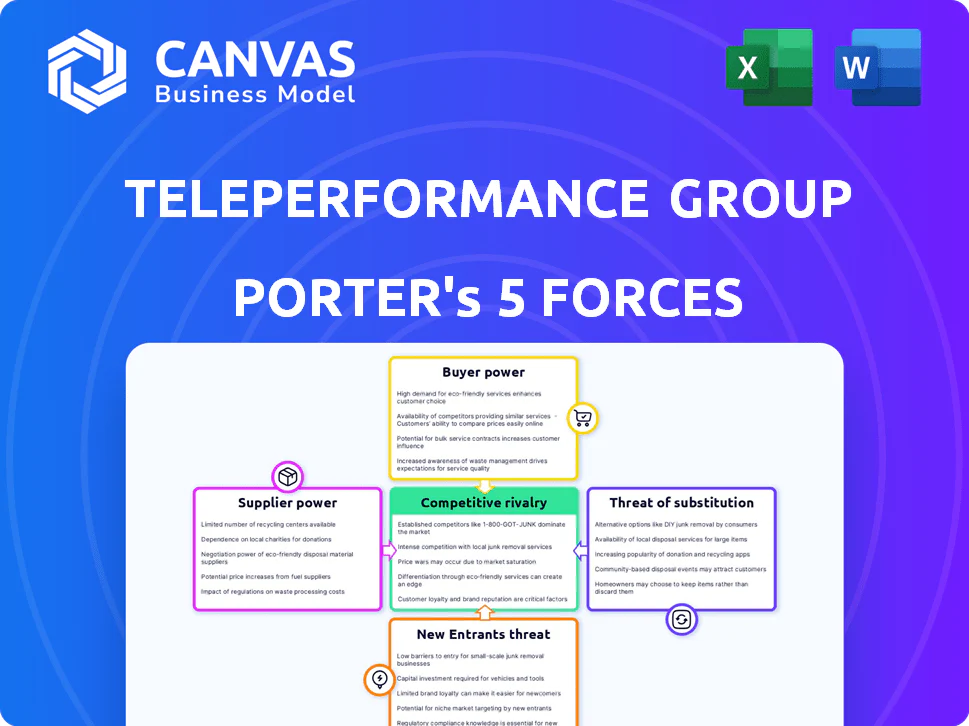
TELEPERFORMANCE GROUP PORTER'S FIVE FORCES TEMPLATE RESEARCH

Don't Miss the Bigger Picture
Teleperformance faces intense buyer pressure from large corporate clients, moderate supplier leverage due to global labor pools, high threat from digital automation and low-cost entrants, and rivalry amplified by scale-driven competitors-yet its global footprint and diversified services offer resilience; this brief snapshot only scratches the surface. Unlock the full Porter's Five Forces Analysis to explore Teleperformance Group's competitive dynamics, market pressures, and strategic advantages in detail.
Suppliers Bargaining Power

Labor Market Dependency and Wage Inflation
As of March 2026, labor is Teleperformance Group's largest supplier, with personnel costs historically at 65-70% of operating expenses and 410,000+ employees worldwide.
Heavy exposure to wage inflation and mandates in India and the Philippines drives sensitivity: a 5% national minimum-wage rise there could lift global labor expense by ~2.5 percentage points.
Teleperformance offsets some risk-90% of sites hold Great Place to Work certification-but collective bargaining and union activity across major hubs still pose meaningful margin pressure.
Strategic AI and Cloud Infrastructure Partnerships
The shift to an AI-first model concentrates supplier power among AWS, Microsoft Azure, Google Cloud and niche vendors like Ema and Parloa, who provide security and scale; Teleperformance Group's €100 million 2025 AI partnership program shows dependence on these suppliers.
High switching costs for core AI infrastructure and the specialized, agentic AI tools limit alternatives, giving suppliers leverage; global cloud market grew 22% in 2025 to €520 billion, tightening bargaining positions.

Real Estate and Hybrid Work Flexibility
Teleperformance Group's move to 50% remote work cuts landlords' bargaining power, since sites in 90+ countries no longer command full demand; geographic spread prevents any single lessor from wielding material leverage. Still, leases are a meaningful cash outflow: 2024 net free cash flow was €1,084 million calculated after lease obligations, showing real estate costs remain significant.

Concentration of Specialized Language Talent
In high-value segments like LanguageLine Solutions, certified interpreters form a concentrated, niche supplier group; Teleperformance competed for ~20,000+ professional interpreters globally in 2025, raising supplier leverage versus general agents.
Scarcity forces Teleperformance to offer premium pay and benefits-reports show interpreter hourly rates up 8-12% in 2025-to avoid service disruption and protect market leadership.
- Limited pool: ~20,000+ certified interpreters (2025)
- Higher pay: interpreter rates +8-12% (2025)
- Supplier leverage: niche skills > general agents
- Action: maintain competitive comp to secure continuity
Hardware and Global IT Procurement
Teleperformance Group's global scale gives it strong buyer power over hardware and IT suppliers, centralizing procurement for ~420,000 workstations (2025) to secure volume discounts and priority supply.
This scale helps absorb cost inflation and supports recurring EBITA margins of 14.6-15.0% in FY2025 despite rising labor and energy costs.
- Centralized buying: ~420,000 seats (FY2025)
- EBITA: 14.6-15.0% (FY2025)
- Volume discounts: materially lower per-unit hardware cost vs. SMB rivals
High supplier influence: labor-heavy costs, cloud concentration, +8-12% interpreter rates
Suppliers (labor, cloud, niche interpreters) hold moderate-to-high power: labor = 65-70% of opex with 410,000+ employees (2025); cloud concentration (AWS/Microsoft/Google) after €100m AI program (2025); ~20,000 certified interpreters with rates +8-12% (2025); centralized procurement for ~420,000 seats supports EBITA 14.6-15.0% (FY2025).
| Metric | 2025 |
|---|---|
| Employees | 410,000+ |
| Labor opex | 65-70% |
| AI program | €100m |
| Interpreters | ~20,000 |
| Interpreter rate rise | +8-12% |
| Workstations | ~420,000 |
| EBITA | 14.6-15.0% |
What is included in the product
 Detailed Word Document
Tailored exclusively for Teleperformance Group, this Porter's Five Forces overview uncovers competitive intensity, buyer and supplier power, threats from new entrants and substitutes, and highlights disruptive trends and market entry barriers shaping its profitability.

 Customizable Excel Spreadsheet
Concise Porter's Five Forces for Teleperformance-spot supplier, buyer, and competitive pressures at a glance to accelerate strategic decisions and risk mitigation.
Customers Bargaining Power

Concentration of Fortune 500 Enterprise Clients
Teleperformance serves ~1,200 core clients, many Fortune 500 firms whose large procurement teams press for lower prices and tougher SLAs, concentrating revenue risk in a few accounts.
The early‑2025 loss of the UK visa services contract contributed to a -2.4% drop in Specialized Services revenue, showing how a single contract can dent top‑line figures.
This client concentration empowers buyers to demand annual productivity gains-Teleperformance reported targeted productivity savings of €120m in FY2025-plus tighter renewal terms and price resets.
Low Switching Costs for Standardized Services
In commoditized customer-care, low switching costs let clients move volumes between BPOs like Concentrix and Foundever; Teleperformance lost 2.1% organic revenue in mature markets in FY2025 where standard services dominate.
To counter churn, Teleperformance's Future Forward push embeds TP.ai FAB across workflows; by FY2025 TP.ai supported 18% of group revenues (€1.1bn of €6.1bn), raising integration complexity.
These AI links increase exit costs via proprietary data, custom models, and SLA-tied KPIs, making volumetric moves more disruptive and costly for clients.

Demand for Outcome-Based Pricing Models
As of 2026 clients shift from cost-per-hour to outcome-based pricing, with 42% of Teleperformance Group's large contracts now tied to KPIs like CSAT and churn reduction, per 2025 contract reviews; this increases customers' bargaining power.
Buyers link payments to measurable results-examples: 10-15% fee rebates if CSAT dips below targets-pushing Teleperformance to accept more operational risk.
Outcome-linking concentrates revenue variability: Teleperformance reported 18% of 2025 revenue contingent on performance clauses, raising earnings volatility.

Vertical-Specific Expertise as a Retention Tool
Customers in regulated sectors like healthcare and financial services face high switching costs due to compliance, certifications, and security-reducing their bargaining power and creating stickiness for Teleperformance Group.
Over 75% of Teleperformance Group's 2025 revenue comes from these verticals (2025 revenue €8.6bn; >€6.45bn from regulated sectors), so re‑certifying a new vendor is costly and slow.
Teleperformance Group deepens vertical expertise-compliance controls, data security, certified processes-positioning itself as a strategic partner rather than a replaceable vendor.
- 75%+ revenue from regulated verticals (€6.45bn of €8.6bn, 2025)
- High recertification costs raise switching barriers
- Vertical expertise increases client retention and margin stability
Macroeconomic Sensitivity and Budget Constraints
The volatile 2026 macro environment tightened customer budgets, raising buyer leverage as clients delay projects; Teleperformance Group cut 2025 revenue growth guidance to 1-2%, signaling weaker demand and tougher pricing talks.
To protect volumes, Teleperformance must offer steeper discounts or bundle free AI features-pressure that could compress 2026 margins versus the 2024 adjusted operating margin of ~7.8%.
- 2025 guidance: +1-2% revenue growth
- Buyer leverage: delayed project ramps, tighter budgets
- Response: deeper discounts or free AI add-ons
- Margin risk: downside from 7.8% operating margin benchmark
High client concentration and KPI‑linked pay create mixed leverage-75% regulated revenue
High client concentration (≈1,200 core clients) and outcome‑linked contracts give buyers strong leverage-42% of large contracts tied to KPIs and 18% of 2025 revenue (€1.55bn of €8.6bn) contingent on performance-while 75%+ revenue from regulated verticals (€6.45bn) raises switching costs, creating a mixed bargaining landscape.
| Metric | 2025 |
|---|---|
| Group revenue | €8.6bn |
| Revenue contingent on KPIs | €1.55bn (18%) |
| Revenue from regulated verticals | €6.45bn (75%+) |
| TP.ai supported revenue | €1.1bn (18% of €6.1bn specialty) |
What You See Is What You Get
Teleperformance Group Porter's Five Forces Analysis
This preview shows the exact Porter's Five Forces analysis of Teleperformance Group you'll receive immediately after purchase-no surprises, no placeholders.
The document displayed here is the part of the full version you'll get-fully formatted and ready for download and use the moment you buy.
You're looking at the actual deliverable; once you complete your purchase, you'll get instant access to this exact file, ready for immediate application.

Original: $10.00
-65%$10.00
$3.50TELEPERFORMANCE GROUP PORTER'S FIVE FORCES TEMPLATE RESEARCH
Don't Miss the Bigger Picture
Teleperformance faces intense buyer pressure from large corporate clients, moderate supplier leverage due to global labor pools, high threat from digital automation and low-cost entrants, and rivalry amplified by scale-driven competitors-yet its global footprint and diversified services offer resilience; this brief snapshot only scratches the surface. Unlock the full Porter's Five Forces Analysis to explore Teleperformance Group's competitive dynamics, market pressures, and strategic advantages in detail.
Suppliers Bargaining Power
Labor Market Dependency and Wage Inflation
As of March 2026, labor is Teleperformance Group's largest supplier, with personnel costs historically at 65-70% of operating expenses and 410,000+ employees worldwide.
Heavy exposure to wage inflation and mandates in India and the Philippines drives sensitivity: a 5% national minimum-wage rise there could lift global labor expense by ~2.5 percentage points.
Teleperformance offsets some risk-90% of sites hold Great Place to Work certification-but collective bargaining and union activity across major hubs still pose meaningful margin pressure.
Strategic AI and Cloud Infrastructure Partnerships
The shift to an AI-first model concentrates supplier power among AWS, Microsoft Azure, Google Cloud and niche vendors like Ema and Parloa, who provide security and scale; Teleperformance Group's €100 million 2025 AI partnership program shows dependence on these suppliers.
High switching costs for core AI infrastructure and the specialized, agentic AI tools limit alternatives, giving suppliers leverage; global cloud market grew 22% in 2025 to €520 billion, tightening bargaining positions.
Real Estate and Hybrid Work Flexibility
Teleperformance Group's move to 50% remote work cuts landlords' bargaining power, since sites in 90+ countries no longer command full demand; geographic spread prevents any single lessor from wielding material leverage. Still, leases are a meaningful cash outflow: 2024 net free cash flow was €1,084 million calculated after lease obligations, showing real estate costs remain significant.
Concentration of Specialized Language Talent
In high-value segments like LanguageLine Solutions, certified interpreters form a concentrated, niche supplier group; Teleperformance competed for ~20,000+ professional interpreters globally in 2025, raising supplier leverage versus general agents.
Scarcity forces Teleperformance to offer premium pay and benefits-reports show interpreter hourly rates up 8-12% in 2025-to avoid service disruption and protect market leadership.
- Limited pool: ~20,000+ certified interpreters (2025)
- Higher pay: interpreter rates +8-12% (2025)
- Supplier leverage: niche skills > general agents
- Action: maintain competitive comp to secure continuity
Hardware and Global IT Procurement
Teleperformance Group's global scale gives it strong buyer power over hardware and IT suppliers, centralizing procurement for ~420,000 workstations (2025) to secure volume discounts and priority supply.
This scale helps absorb cost inflation and supports recurring EBITA margins of 14.6-15.0% in FY2025 despite rising labor and energy costs.
- Centralized buying: ~420,000 seats (FY2025)
- EBITA: 14.6-15.0% (FY2025)
- Volume discounts: materially lower per-unit hardware cost vs. SMB rivals
High supplier influence: labor-heavy costs, cloud concentration, +8-12% interpreter rates
Suppliers (labor, cloud, niche interpreters) hold moderate-to-high power: labor = 65-70% of opex with 410,000+ employees (2025); cloud concentration (AWS/Microsoft/Google) after €100m AI program (2025); ~20,000 certified interpreters with rates +8-12% (2025); centralized procurement for ~420,000 seats supports EBITA 14.6-15.0% (FY2025).
| Metric | 2025 |
|---|---|
| Employees | 410,000+ |
| Labor opex | 65-70% |
| AI program | €100m |
| Interpreters | ~20,000 |
| Interpreter rate rise | +8-12% |
| Workstations | ~420,000 |
| EBITA | 14.6-15.0% |
What is included in the product
Detailed Word Document
Tailored exclusively for Teleperformance Group, this Porter's Five Forces overview uncovers competitive intensity, buyer and supplier power, threats from new entrants and substitutes, and highlights disruptive trends and market entry barriers shaping its profitability.
Customizable Excel Spreadsheet
Concise Porter's Five Forces for Teleperformance-spot supplier, buyer, and competitive pressures at a glance to accelerate strategic decisions and risk mitigation.
Customers Bargaining Power
Concentration of Fortune 500 Enterprise Clients
Teleperformance serves ~1,200 core clients, many Fortune 500 firms whose large procurement teams press for lower prices and tougher SLAs, concentrating revenue risk in a few accounts.
The early‑2025 loss of the UK visa services contract contributed to a -2.4% drop in Specialized Services revenue, showing how a single contract can dent top‑line figures.
This client concentration empowers buyers to demand annual productivity gains-Teleperformance reported targeted productivity savings of €120m in FY2025-plus tighter renewal terms and price resets.
Low Switching Costs for Standardized Services
In commoditized customer-care, low switching costs let clients move volumes between BPOs like Concentrix and Foundever; Teleperformance lost 2.1% organic revenue in mature markets in FY2025 where standard services dominate.
To counter churn, Teleperformance's Future Forward push embeds TP.ai FAB across workflows; by FY2025 TP.ai supported 18% of group revenues (€1.1bn of €6.1bn), raising integration complexity.
These AI links increase exit costs via proprietary data, custom models, and SLA-tied KPIs, making volumetric moves more disruptive and costly for clients.
Demand for Outcome-Based Pricing Models
As of 2026 clients shift from cost-per-hour to outcome-based pricing, with 42% of Teleperformance Group's large contracts now tied to KPIs like CSAT and churn reduction, per 2025 contract reviews; this increases customers' bargaining power.
Buyers link payments to measurable results-examples: 10-15% fee rebates if CSAT dips below targets-pushing Teleperformance to accept more operational risk.
Outcome-linking concentrates revenue variability: Teleperformance reported 18% of 2025 revenue contingent on performance clauses, raising earnings volatility.
Vertical-Specific Expertise as a Retention Tool
Customers in regulated sectors like healthcare and financial services face high switching costs due to compliance, certifications, and security-reducing their bargaining power and creating stickiness for Teleperformance Group.
Over 75% of Teleperformance Group's 2025 revenue comes from these verticals (2025 revenue €8.6bn; >€6.45bn from regulated sectors), so re‑certifying a new vendor is costly and slow.
Teleperformance Group deepens vertical expertise-compliance controls, data security, certified processes-positioning itself as a strategic partner rather than a replaceable vendor.
- 75%+ revenue from regulated verticals (€6.45bn of €8.6bn, 2025)
- High recertification costs raise switching barriers
- Vertical expertise increases client retention and margin stability
Macroeconomic Sensitivity and Budget Constraints
The volatile 2026 macro environment tightened customer budgets, raising buyer leverage as clients delay projects; Teleperformance Group cut 2025 revenue growth guidance to 1-2%, signaling weaker demand and tougher pricing talks.
To protect volumes, Teleperformance must offer steeper discounts or bundle free AI features-pressure that could compress 2026 margins versus the 2024 adjusted operating margin of ~7.8%.
- 2025 guidance: +1-2% revenue growth
- Buyer leverage: delayed project ramps, tighter budgets
- Response: deeper discounts or free AI add-ons
- Margin risk: downside from 7.8% operating margin benchmark
High client concentration and KPI‑linked pay create mixed leverage-75% regulated revenue
High client concentration (≈1,200 core clients) and outcome‑linked contracts give buyers strong leverage-42% of large contracts tied to KPIs and 18% of 2025 revenue (€1.55bn of €8.6bn) contingent on performance-while 75%+ revenue from regulated verticals (€6.45bn) raises switching costs, creating a mixed bargaining landscape.
| Metric | 2025 |
|---|---|
| Group revenue | €8.6bn |
| Revenue contingent on KPIs | €1.55bn (18%) |
| Revenue from regulated verticals | €6.45bn (75%+) |
| TP.ai supported revenue | €1.1bn (18% of €6.1bn specialty) |
What You See Is What You Get
Teleperformance Group Porter's Five Forces Analysis
This preview shows the exact Porter's Five Forces analysis of Teleperformance Group you'll receive immediately after purchase-no surprises, no placeholders.
The document displayed here is the part of the full version you'll get-fully formatted and ready for download and use the moment you buy.
You're looking at the actual deliverable; once you complete your purchase, you'll get instant access to this exact file, ready for immediate application.
Product Information
Product Information
Shipping & Returns
Shipping & Returns
Description
Don't Miss the Bigger Picture
Teleperformance faces intense buyer pressure from large corporate clients, moderate supplier leverage due to global labor pools, high threat from digital automation and low-cost entrants, and rivalry amplified by scale-driven competitors-yet its global footprint and diversified services offer resilience; this brief snapshot only scratches the surface. Unlock the full Porter's Five Forces Analysis to explore Teleperformance Group's competitive dynamics, market pressures, and strategic advantages in detail.
Suppliers Bargaining Power
Labor Market Dependency and Wage Inflation
As of March 2026, labor is Teleperformance Group's largest supplier, with personnel costs historically at 65-70% of operating expenses and 410,000+ employees worldwide.
Heavy exposure to wage inflation and mandates in India and the Philippines drives sensitivity: a 5% national minimum-wage rise there could lift global labor expense by ~2.5 percentage points.
Teleperformance offsets some risk-90% of sites hold Great Place to Work certification-but collective bargaining and union activity across major hubs still pose meaningful margin pressure.
Strategic AI and Cloud Infrastructure Partnerships
The shift to an AI-first model concentrates supplier power among AWS, Microsoft Azure, Google Cloud and niche vendors like Ema and Parloa, who provide security and scale; Teleperformance Group's €100 million 2025 AI partnership program shows dependence on these suppliers.
High switching costs for core AI infrastructure and the specialized, agentic AI tools limit alternatives, giving suppliers leverage; global cloud market grew 22% in 2025 to €520 billion, tightening bargaining positions.
Real Estate and Hybrid Work Flexibility
Teleperformance Group's move to 50% remote work cuts landlords' bargaining power, since sites in 90+ countries no longer command full demand; geographic spread prevents any single lessor from wielding material leverage. Still, leases are a meaningful cash outflow: 2024 net free cash flow was €1,084 million calculated after lease obligations, showing real estate costs remain significant.
Concentration of Specialized Language Talent
In high-value segments like LanguageLine Solutions, certified interpreters form a concentrated, niche supplier group; Teleperformance competed for ~20,000+ professional interpreters globally in 2025, raising supplier leverage versus general agents.
Scarcity forces Teleperformance to offer premium pay and benefits-reports show interpreter hourly rates up 8-12% in 2025-to avoid service disruption and protect market leadership.
- Limited pool: ~20,000+ certified interpreters (2025)
- Higher pay: interpreter rates +8-12% (2025)
- Supplier leverage: niche skills > general agents
- Action: maintain competitive comp to secure continuity
Hardware and Global IT Procurement
Teleperformance Group's global scale gives it strong buyer power over hardware and IT suppliers, centralizing procurement for ~420,000 workstations (2025) to secure volume discounts and priority supply.
This scale helps absorb cost inflation and supports recurring EBITA margins of 14.6-15.0% in FY2025 despite rising labor and energy costs.
- Centralized buying: ~420,000 seats (FY2025)
- EBITA: 14.6-15.0% (FY2025)
- Volume discounts: materially lower per-unit hardware cost vs. SMB rivals
High supplier influence: labor-heavy costs, cloud concentration, +8-12% interpreter rates
Suppliers (labor, cloud, niche interpreters) hold moderate-to-high power: labor = 65-70% of opex with 410,000+ employees (2025); cloud concentration (AWS/Microsoft/Google) after €100m AI program (2025); ~20,000 certified interpreters with rates +8-12% (2025); centralized procurement for ~420,000 seats supports EBITA 14.6-15.0% (FY2025).
| Metric | 2025 |
|---|---|
| Employees | 410,000+ |
| Labor opex | 65-70% |
| AI program | €100m |
| Interpreters | ~20,000 |
| Interpreter rate rise | +8-12% |
| Workstations | ~420,000 |
| EBITA | 14.6-15.0% |
What is included in the product
Detailed Word Document
Tailored exclusively for Teleperformance Group, this Porter's Five Forces overview uncovers competitive intensity, buyer and supplier power, threats from new entrants and substitutes, and highlights disruptive trends and market entry barriers shaping its profitability.
Customizable Excel Spreadsheet
Concise Porter's Five Forces for Teleperformance-spot supplier, buyer, and competitive pressures at a glance to accelerate strategic decisions and risk mitigation.
Customers Bargaining Power
Concentration of Fortune 500 Enterprise Clients
Teleperformance serves ~1,200 core clients, many Fortune 500 firms whose large procurement teams press for lower prices and tougher SLAs, concentrating revenue risk in a few accounts.
The early‑2025 loss of the UK visa services contract contributed to a -2.4% drop in Specialized Services revenue, showing how a single contract can dent top‑line figures.
This client concentration empowers buyers to demand annual productivity gains-Teleperformance reported targeted productivity savings of €120m in FY2025-plus tighter renewal terms and price resets.
Low Switching Costs for Standardized Services
In commoditized customer-care, low switching costs let clients move volumes between BPOs like Concentrix and Foundever; Teleperformance lost 2.1% organic revenue in mature markets in FY2025 where standard services dominate.
To counter churn, Teleperformance's Future Forward push embeds TP.ai FAB across workflows; by FY2025 TP.ai supported 18% of group revenues (€1.1bn of €6.1bn), raising integration complexity.
These AI links increase exit costs via proprietary data, custom models, and SLA-tied KPIs, making volumetric moves more disruptive and costly for clients.
Demand for Outcome-Based Pricing Models
As of 2026 clients shift from cost-per-hour to outcome-based pricing, with 42% of Teleperformance Group's large contracts now tied to KPIs like CSAT and churn reduction, per 2025 contract reviews; this increases customers' bargaining power.
Buyers link payments to measurable results-examples: 10-15% fee rebates if CSAT dips below targets-pushing Teleperformance to accept more operational risk.
Outcome-linking concentrates revenue variability: Teleperformance reported 18% of 2025 revenue contingent on performance clauses, raising earnings volatility.
Vertical-Specific Expertise as a Retention Tool
Customers in regulated sectors like healthcare and financial services face high switching costs due to compliance, certifications, and security-reducing their bargaining power and creating stickiness for Teleperformance Group.
Over 75% of Teleperformance Group's 2025 revenue comes from these verticals (2025 revenue €8.6bn; >€6.45bn from regulated sectors), so re‑certifying a new vendor is costly and slow.
Teleperformance Group deepens vertical expertise-compliance controls, data security, certified processes-positioning itself as a strategic partner rather than a replaceable vendor.
- 75%+ revenue from regulated verticals (€6.45bn of €8.6bn, 2025)
- High recertification costs raise switching barriers
- Vertical expertise increases client retention and margin stability
Macroeconomic Sensitivity and Budget Constraints
The volatile 2026 macro environment tightened customer budgets, raising buyer leverage as clients delay projects; Teleperformance Group cut 2025 revenue growth guidance to 1-2%, signaling weaker demand and tougher pricing talks.
To protect volumes, Teleperformance must offer steeper discounts or bundle free AI features-pressure that could compress 2026 margins versus the 2024 adjusted operating margin of ~7.8%.
- 2025 guidance: +1-2% revenue growth
- Buyer leverage: delayed project ramps, tighter budgets
- Response: deeper discounts or free AI add-ons
- Margin risk: downside from 7.8% operating margin benchmark
High client concentration and KPI‑linked pay create mixed leverage-75% regulated revenue
High client concentration (≈1,200 core clients) and outcome‑linked contracts give buyers strong leverage-42% of large contracts tied to KPIs and 18% of 2025 revenue (€1.55bn of €8.6bn) contingent on performance-while 75%+ revenue from regulated verticals (€6.45bn) raises switching costs, creating a mixed bargaining landscape.
| Metric | 2025 |
|---|---|
| Group revenue | €8.6bn |
| Revenue contingent on KPIs | €1.55bn (18%) |
| Revenue from regulated verticals | €6.45bn (75%+) |
| TP.ai supported revenue | €1.1bn (18% of €6.1bn specialty) |
What You See Is What You Get
Teleperformance Group Porter's Five Forces Analysis
This preview shows the exact Porter's Five Forces analysis of Teleperformance Group you'll receive immediately after purchase-no surprises, no placeholders.
The document displayed here is the part of the full version you'll get-fully formatted and ready for download and use the moment you buy.
You're looking at the actual deliverable; once you complete your purchase, you'll get instant access to this exact file, ready for immediate application.











