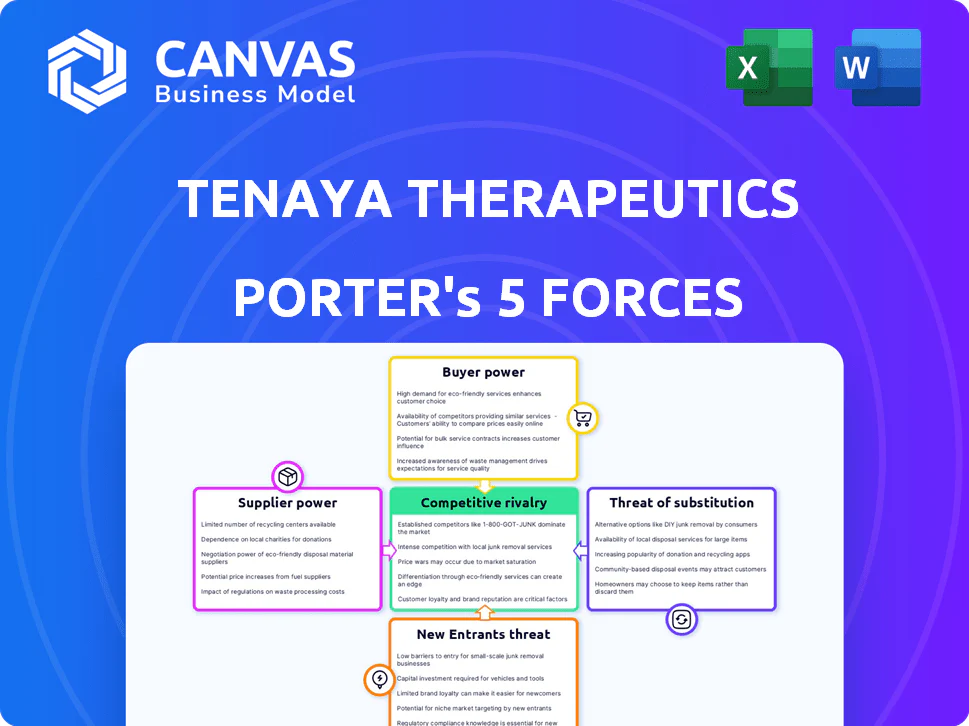
TENAYA THERAPEUTICS PORTER'S FIVE FORCES TEMPLATE RESEARCH
What is included in the product
 Detailed Word Document
Analyzes Tenaya's competitive environment, assessing threats, opportunities, and industry dynamics.

 Customizable Excel Spreadsheet
Customize pressure levels to assess competitive dynamics affecting Tenaya Therapeutics.
What You See Is What You Get
Tenaya Therapeutics Porter's Five Forces Analysis
This preview details Tenaya Therapeutics' Porter's Five Forces analysis, examining industry rivalry, threat of new entrants, bargaining power of suppliers/buyers, and threat of substitutes. It provides a comprehensive overview, assessing market dynamics, competitive landscape, and potential strategic implications for the company.

Porter's Five Forces Analysis Template

Elevate Your Analysis with the Complete Porter's Five Forces Analysis
Analyzing Tenaya Therapeutics through Porter's Five Forces reveals a complex competitive landscape, especially regarding the threat of substitutes due to the evolving biotech industry. Buyer power is moderate, influenced by healthcare providers and payers negotiating prices. The threat of new entrants is substantial, with many companies entering the market. However, supplier power is relatively low due to a variety of suppliers. Competition is intense, driven by existing players in the heart disease space.
This brief snapshot only scratches the surface. Unlock the full Porter's Five Forces Analysis to explore Tenaya Therapeutics’s competitive dynamics, market pressures, and strategic advantages in detail.
Suppliers Bargaining Power

Specialized Reagents and Materials
Tenaya Therapeutics heavily depends on specialized suppliers for gene therapy components. These suppliers, providing reagents and vectors, wield considerable power. They can influence pricing and supply terms due to the uniqueness of their products. This is a critical factor, especially given the high costs of research and development in 2024, with average R&D spending in biotech reaching $1.5 billion.
Manufacturing Capabilities
Tenaya Therapeutics' reliance on specialized manufacturing processes for gene therapies means they could be at the mercy of suppliers. As of late 2024, the gene therapy CMO market is competitive, but capacity constraints exist. The bargaining power of these suppliers depends on their expertise and facility availability. The cost of goods sold (COGS) for gene therapies can be high, with manufacturing contributing significantly.

Access to proprietary Technology
Tenaya Therapeutics' reliance on suppliers with proprietary technology, such as those providing gene therapy vectors, can be significant. These suppliers possess leverage due to their unique offerings. In 2024, the cost of gene therapy manufacturing increased by 15%, highlighting the impact of supplier pricing. Negotiations are crucial, as licensing costs can affect Tenaya's R&D budget.

Reliance on Single Source Suppliers
Tenaya Therapeutics' reliance on single-source suppliers significantly elevates supplier bargaining power. This is especially true in gene therapy, where specialized materials are often limited. A single supplier can dictate terms like pricing and supply schedules, potentially affecting Tenaya's operational costs and timelines. This vulnerability is common in biotech, where 70% of clinical trials face delays due to supply chain issues.
- Limited Alternatives: Few alternative suppliers for critical inputs.
- Impact on Costs: Supplier power directly affects Tenaya's cost of goods sold.
- Supply Chain Risk: Disruptions from a single supplier can halt production.
- Specialized Inputs: Reliance is higher for unique gene therapy components.
Quality and Regulatory Compliance
Tenaya Therapeutics' suppliers face stringent quality and regulatory demands, especially in pharmaceutical development. Suppliers with excellent compliance records and top-notch products can exert significant bargaining power. Switching suppliers is costly, potentially delaying projects and requiring extensive validation. The FDA's rigorous standards, as reflected in a 2024 report, emphasize supplier quality.
- FDA inspections in 2024 resulted in over 1,000 warning letters to pharmaceutical suppliers.
- Approximately 60% of pharmaceutical manufacturing sites are subject to regular audits.
- The average cost of switching suppliers in the pharmaceutical industry is estimated at $2 million.
- The cost of regulatory non-compliance can exceed $10 million.
Supplier Power Squeezes Gene Therapy Costs
Tenaya Therapeutics faces considerable supplier bargaining power, particularly for specialized gene therapy components. This power is amplified by limited alternatives and the high costs of switching suppliers, which can reach $2 million. In 2024, the gene therapy manufacturing costs increased by 15%, underscoring supplier impact.
| Factor | Impact | Data (2024) |
|---|---|---|
| Supplier Specialization | High Bargaining Power | Gene therapy manufacturing cost increase: 15% |
| Limited Alternatives | Increased Dependency | 70% of clinical trials face supply chain delays |
| Regulatory Compliance | Stringent Requirements | FDA issued over 1,000 warning letters |
Customers Bargaining Power

Limited Customer Base Initially
Tenaya Therapeutics faces limited customer bargaining power initially. As a clinical-stage biotech, its early 'customers' are trial participants and potential partners like large pharmaceutical companies. These partners, with their resources, might influence deal terms. In 2024, biotech partnerships saw an average upfront payment of $30 million.
Patient Advocacy Groups
Patient advocacy groups, like the American Heart Association, significantly influence patient access to therapies. These groups champion patient needs, impacting public opinion and regulatory pathways. For instance, the AHA invested over $4.5 million in research grants in 2024. Their ability to shape perceptions represents substantial customer power, affecting Tenaya's market access and strategy.

Healthcare Payers and Providers
Once Tenaya's therapies hit the market, healthcare payers and large hospital systems will be key customers. These entities, including insurance companies and government programs, wield considerable bargaining power. They influence formulary placement, reimbursement rates, and treatment protocols. In 2024, the U.S. healthcare spending reached $4.8 trillion, highlighting the financial stakes involved. This gives payers leverage to negotiate favorable terms.

Clinical Trial Sites and Investigators
Clinical trial sites and investigators wield influence over Tenaya Therapeutics. Hospitals and research institutions, essential for trial execution, can impact timelines. Their efficiency in patient enrollment directly affects Tenaya's drug development. Delays can lead to increased costs and market entry setbacks.
- In 2024, clinical trial delays cost pharmaceutical companies an average of $2 million to $8 million per day.
- The success rate of clinical trials is approximately 10-15%.
- Efficient trial sites can accelerate timelines, potentially saving Tenaya millions.
Physician and Specialist Adoption
The adoption of Tenaya Therapeutics' therapies heavily relies on physicians and specialists. Their decisions to prescribe Tenaya's treatments are influenced by factors like treatment familiarity and clinical data. Physician acceptance is a critical aspect of customer power in the pharmaceutical industry. As of late 2024, successful drug launches often see 60-80% of initial prescriptions coming from specialists.
- Physician education and marketing efforts significantly shape prescribing behavior.
- Clinical trial outcomes and real-world data are key drivers of adoption.
- Perceived value, including efficacy and safety, influences specialist decisions.
- The competitive landscape affects physician choices among available treatments.
Customer Power Dynamics: A Lifecycle View
Tenaya's customer bargaining power varies across its lifecycle. Initially, partners and trial participants hold some sway. Later, payers and hospital systems gain significant leverage. Physicians also influence adoption, shaping market success.
| Customer Group | Bargaining Power | Impact on Tenaya |
|---|---|---|
| Partners | Moderate | Deal terms, upfront payments |
| Payers/Hospitals | High | Reimbursement, formulary placement |
| Physicians | Moderate | Prescription decisions, adoption rates |
Rivalry Among Competitors

Presence of Established Pharmaceutical Companies
The cardiovascular market is a battlefield of established giants. Companies like Pfizer and Novartis command huge resources. In 2024, Pfizer's cardiovascular drug sales exceeded $3 billion. This deepens the competitive pressure on newcomers like Tenaya.
Numerous Competitors in Biotechnology
Tenaya Therapeutics faces fierce competition in the biotech industry. With many companies developing novel therapies, rivalry is high. In 2024, the biotech market saw over 700 public companies. This intense competition affects market share and pricing strategies.

Rapid Pace of Innovation
The genetic and cellular therapy field is rapidly changing. Competitors constantly introduce new tech and candidates, making the landscape very competitive. Tenaya must keep up with these advancements to stay relevant. In 2024, the gene therapy market was valued at $5.6 billion, with rapid growth expected. Staying ahead demands continuous innovation and strategic investment.

Product Pipeline and Clinical Trial Success
The success of competitors' clinical trials and their product pipeline progress significantly impacts rivalry within the therapeutics market. Positive clinical trial data from rival companies can shift market dynamics, influencing investor confidence and potentially affecting Tenaya's stock performance. For example, in 2024, several companies, including CRISPR Therapeutics and Vertex Pharmaceuticals, reported positive Phase 3 trial results for their gene editing therapies, thus intensifying competition. This success can influence the valuation of Tenaya and other companies within the same therapeutic area.
- Successful clinical trials by competitors can lead to increased market share.
- Positive data can lead to changes in investor sentiment.
- Rivalry is intensified by advancements in product pipelines.
- Competition for funding and resources is heightened.
Intellectual Property Landscape
The biotech industry's intricate intellectual property (IP) environment, with many patents and applications, fuels intense rivalry. Tenaya Therapeutics faces competition related to its IP, potentially resulting in legal battles or the need for licensing. Competitors' patents can obstruct market entry or necessitate costly agreements, influencing Tenaya's strategic choices. In 2024, biotech patent litigation cases increased by 15%, highlighting the significance of IP in the industry.
- Patent disputes are common, with an average cost of $5 million per case.
- Licensing fees can significantly impact profitability, potentially costing millions.
- Competitors' IP can delay product launches and market access.
- The complex IP landscape necessitates continuous monitoring and strategic planning.
Cardiovascular Market Heats Up: $3B Sales in 2024!
Competitive rivalry in Tenaya's market is intense, driven by established giants and numerous biotech firms. Successful clinical trials and IP battles significantly impact market dynamics. In 2024, the cardiovascular market saw over $3 billion in sales from key players, heightening the pressure.
| Aspect | Impact | 2024 Data |
|---|---|---|
| Market Share | Influenced by trial success | Gene therapy market: $5.6B |
| Investor Sentiment | Changes with positive data | Biotech patent litigation up 15% |
| IP Landscape | Complex, leading to legal battles | Avg. cost of patent case: $5M |
Original: $10.00
-65%$10.00
$3.50TENAYA THERAPEUTICS PORTER'S FIVE FORCES TEMPLATE RESEARCH
What is included in the product
Detailed Word Document
Analyzes Tenaya's competitive environment, assessing threats, opportunities, and industry dynamics.
Customizable Excel Spreadsheet
Customize pressure levels to assess competitive dynamics affecting Tenaya Therapeutics.
What You See Is What You Get
Tenaya Therapeutics Porter's Five Forces Analysis
This preview details Tenaya Therapeutics' Porter's Five Forces analysis, examining industry rivalry, threat of new entrants, bargaining power of suppliers/buyers, and threat of substitutes. It provides a comprehensive overview, assessing market dynamics, competitive landscape, and potential strategic implications for the company.
Porter's Five Forces Analysis Template
Elevate Your Analysis with the Complete Porter's Five Forces Analysis
Analyzing Tenaya Therapeutics through Porter's Five Forces reveals a complex competitive landscape, especially regarding the threat of substitutes due to the evolving biotech industry. Buyer power is moderate, influenced by healthcare providers and payers negotiating prices. The threat of new entrants is substantial, with many companies entering the market. However, supplier power is relatively low due to a variety of suppliers. Competition is intense, driven by existing players in the heart disease space.
This brief snapshot only scratches the surface. Unlock the full Porter's Five Forces Analysis to explore Tenaya Therapeutics’s competitive dynamics, market pressures, and strategic advantages in detail.
Suppliers Bargaining Power
Specialized Reagents and Materials
Tenaya Therapeutics heavily depends on specialized suppliers for gene therapy components. These suppliers, providing reagents and vectors, wield considerable power. They can influence pricing and supply terms due to the uniqueness of their products. This is a critical factor, especially given the high costs of research and development in 2024, with average R&D spending in biotech reaching $1.5 billion.
Manufacturing Capabilities
Tenaya Therapeutics' reliance on specialized manufacturing processes for gene therapies means they could be at the mercy of suppliers. As of late 2024, the gene therapy CMO market is competitive, but capacity constraints exist. The bargaining power of these suppliers depends on their expertise and facility availability. The cost of goods sold (COGS) for gene therapies can be high, with manufacturing contributing significantly.
Access to proprietary Technology
Tenaya Therapeutics' reliance on suppliers with proprietary technology, such as those providing gene therapy vectors, can be significant. These suppliers possess leverage due to their unique offerings. In 2024, the cost of gene therapy manufacturing increased by 15%, highlighting the impact of supplier pricing. Negotiations are crucial, as licensing costs can affect Tenaya's R&D budget.
Reliance on Single Source Suppliers
Tenaya Therapeutics' reliance on single-source suppliers significantly elevates supplier bargaining power. This is especially true in gene therapy, where specialized materials are often limited. A single supplier can dictate terms like pricing and supply schedules, potentially affecting Tenaya's operational costs and timelines. This vulnerability is common in biotech, where 70% of clinical trials face delays due to supply chain issues.
- Limited Alternatives: Few alternative suppliers for critical inputs.
- Impact on Costs: Supplier power directly affects Tenaya's cost of goods sold.
- Supply Chain Risk: Disruptions from a single supplier can halt production.
- Specialized Inputs: Reliance is higher for unique gene therapy components.
Quality and Regulatory Compliance
Tenaya Therapeutics' suppliers face stringent quality and regulatory demands, especially in pharmaceutical development. Suppliers with excellent compliance records and top-notch products can exert significant bargaining power. Switching suppliers is costly, potentially delaying projects and requiring extensive validation. The FDA's rigorous standards, as reflected in a 2024 report, emphasize supplier quality.
- FDA inspections in 2024 resulted in over 1,000 warning letters to pharmaceutical suppliers.
- Approximately 60% of pharmaceutical manufacturing sites are subject to regular audits.
- The average cost of switching suppliers in the pharmaceutical industry is estimated at $2 million.
- The cost of regulatory non-compliance can exceed $10 million.
Supplier Power Squeezes Gene Therapy Costs
Tenaya Therapeutics faces considerable supplier bargaining power, particularly for specialized gene therapy components. This power is amplified by limited alternatives and the high costs of switching suppliers, which can reach $2 million. In 2024, the gene therapy manufacturing costs increased by 15%, underscoring supplier impact.
| Factor | Impact | Data (2024) |
|---|---|---|
| Supplier Specialization | High Bargaining Power | Gene therapy manufacturing cost increase: 15% |
| Limited Alternatives | Increased Dependency | 70% of clinical trials face supply chain delays |
| Regulatory Compliance | Stringent Requirements | FDA issued over 1,000 warning letters |
Customers Bargaining Power
Limited Customer Base Initially
Tenaya Therapeutics faces limited customer bargaining power initially. As a clinical-stage biotech, its early 'customers' are trial participants and potential partners like large pharmaceutical companies. These partners, with their resources, might influence deal terms. In 2024, biotech partnerships saw an average upfront payment of $30 million.
Patient Advocacy Groups
Patient advocacy groups, like the American Heart Association, significantly influence patient access to therapies. These groups champion patient needs, impacting public opinion and regulatory pathways. For instance, the AHA invested over $4.5 million in research grants in 2024. Their ability to shape perceptions represents substantial customer power, affecting Tenaya's market access and strategy.
Healthcare Payers and Providers
Once Tenaya's therapies hit the market, healthcare payers and large hospital systems will be key customers. These entities, including insurance companies and government programs, wield considerable bargaining power. They influence formulary placement, reimbursement rates, and treatment protocols. In 2024, the U.S. healthcare spending reached $4.8 trillion, highlighting the financial stakes involved. This gives payers leverage to negotiate favorable terms.
Clinical Trial Sites and Investigators
Clinical trial sites and investigators wield influence over Tenaya Therapeutics. Hospitals and research institutions, essential for trial execution, can impact timelines. Their efficiency in patient enrollment directly affects Tenaya's drug development. Delays can lead to increased costs and market entry setbacks.
- In 2024, clinical trial delays cost pharmaceutical companies an average of $2 million to $8 million per day.
- The success rate of clinical trials is approximately 10-15%.
- Efficient trial sites can accelerate timelines, potentially saving Tenaya millions.
Physician and Specialist Adoption
The adoption of Tenaya Therapeutics' therapies heavily relies on physicians and specialists. Their decisions to prescribe Tenaya's treatments are influenced by factors like treatment familiarity and clinical data. Physician acceptance is a critical aspect of customer power in the pharmaceutical industry. As of late 2024, successful drug launches often see 60-80% of initial prescriptions coming from specialists.
- Physician education and marketing efforts significantly shape prescribing behavior.
- Clinical trial outcomes and real-world data are key drivers of adoption.
- Perceived value, including efficacy and safety, influences specialist decisions.
- The competitive landscape affects physician choices among available treatments.
Customer Power Dynamics: A Lifecycle View
Tenaya's customer bargaining power varies across its lifecycle. Initially, partners and trial participants hold some sway. Later, payers and hospital systems gain significant leverage. Physicians also influence adoption, shaping market success.
| Customer Group | Bargaining Power | Impact on Tenaya |
|---|---|---|
| Partners | Moderate | Deal terms, upfront payments |
| Payers/Hospitals | High | Reimbursement, formulary placement |
| Physicians | Moderate | Prescription decisions, adoption rates |
Rivalry Among Competitors
Presence of Established Pharmaceutical Companies
The cardiovascular market is a battlefield of established giants. Companies like Pfizer and Novartis command huge resources. In 2024, Pfizer's cardiovascular drug sales exceeded $3 billion. This deepens the competitive pressure on newcomers like Tenaya.
Numerous Competitors in Biotechnology
Tenaya Therapeutics faces fierce competition in the biotech industry. With many companies developing novel therapies, rivalry is high. In 2024, the biotech market saw over 700 public companies. This intense competition affects market share and pricing strategies.
Rapid Pace of Innovation
The genetic and cellular therapy field is rapidly changing. Competitors constantly introduce new tech and candidates, making the landscape very competitive. Tenaya must keep up with these advancements to stay relevant. In 2024, the gene therapy market was valued at $5.6 billion, with rapid growth expected. Staying ahead demands continuous innovation and strategic investment.
Product Pipeline and Clinical Trial Success
The success of competitors' clinical trials and their product pipeline progress significantly impacts rivalry within the therapeutics market. Positive clinical trial data from rival companies can shift market dynamics, influencing investor confidence and potentially affecting Tenaya's stock performance. For example, in 2024, several companies, including CRISPR Therapeutics and Vertex Pharmaceuticals, reported positive Phase 3 trial results for their gene editing therapies, thus intensifying competition. This success can influence the valuation of Tenaya and other companies within the same therapeutic area.
- Successful clinical trials by competitors can lead to increased market share.
- Positive data can lead to changes in investor sentiment.
- Rivalry is intensified by advancements in product pipelines.
- Competition for funding and resources is heightened.
Intellectual Property Landscape
The biotech industry's intricate intellectual property (IP) environment, with many patents and applications, fuels intense rivalry. Tenaya Therapeutics faces competition related to its IP, potentially resulting in legal battles or the need for licensing. Competitors' patents can obstruct market entry or necessitate costly agreements, influencing Tenaya's strategic choices. In 2024, biotech patent litigation cases increased by 15%, highlighting the significance of IP in the industry.
- Patent disputes are common, with an average cost of $5 million per case.
- Licensing fees can significantly impact profitability, potentially costing millions.
- Competitors' IP can delay product launches and market access.
- The complex IP landscape necessitates continuous monitoring and strategic planning.
Cardiovascular Market Heats Up: $3B Sales in 2024!
Competitive rivalry in Tenaya's market is intense, driven by established giants and numerous biotech firms. Successful clinical trials and IP battles significantly impact market dynamics. In 2024, the cardiovascular market saw over $3 billion in sales from key players, heightening the pressure.
| Aspect | Impact | 2024 Data |
|---|---|---|
| Market Share | Influenced by trial success | Gene therapy market: $5.6B |
| Investor Sentiment | Changes with positive data | Biotech patent litigation up 15% |
| IP Landscape | Complex, leading to legal battles | Avg. cost of patent case: $5M |
Product Information
Product Information
Shipping & Returns
Shipping & Returns
Description
What is included in the product
Detailed Word Document
Analyzes Tenaya's competitive environment, assessing threats, opportunities, and industry dynamics.
Customizable Excel Spreadsheet
Customize pressure levels to assess competitive dynamics affecting Tenaya Therapeutics.
What You See Is What You Get
Tenaya Therapeutics Porter's Five Forces Analysis
This preview details Tenaya Therapeutics' Porter's Five Forces analysis, examining industry rivalry, threat of new entrants, bargaining power of suppliers/buyers, and threat of substitutes. It provides a comprehensive overview, assessing market dynamics, competitive landscape, and potential strategic implications for the company.
Porter's Five Forces Analysis Template
Elevate Your Analysis with the Complete Porter's Five Forces Analysis
Analyzing Tenaya Therapeutics through Porter's Five Forces reveals a complex competitive landscape, especially regarding the threat of substitutes due to the evolving biotech industry. Buyer power is moderate, influenced by healthcare providers and payers negotiating prices. The threat of new entrants is substantial, with many companies entering the market. However, supplier power is relatively low due to a variety of suppliers. Competition is intense, driven by existing players in the heart disease space.
This brief snapshot only scratches the surface. Unlock the full Porter's Five Forces Analysis to explore Tenaya Therapeutics’s competitive dynamics, market pressures, and strategic advantages in detail.
Suppliers Bargaining Power
Specialized Reagents and Materials
Tenaya Therapeutics heavily depends on specialized suppliers for gene therapy components. These suppliers, providing reagents and vectors, wield considerable power. They can influence pricing and supply terms due to the uniqueness of their products. This is a critical factor, especially given the high costs of research and development in 2024, with average R&D spending in biotech reaching $1.5 billion.
Manufacturing Capabilities
Tenaya Therapeutics' reliance on specialized manufacturing processes for gene therapies means they could be at the mercy of suppliers. As of late 2024, the gene therapy CMO market is competitive, but capacity constraints exist. The bargaining power of these suppliers depends on their expertise and facility availability. The cost of goods sold (COGS) for gene therapies can be high, with manufacturing contributing significantly.
Access to proprietary Technology
Tenaya Therapeutics' reliance on suppliers with proprietary technology, such as those providing gene therapy vectors, can be significant. These suppliers possess leverage due to their unique offerings. In 2024, the cost of gene therapy manufacturing increased by 15%, highlighting the impact of supplier pricing. Negotiations are crucial, as licensing costs can affect Tenaya's R&D budget.
Reliance on Single Source Suppliers
Tenaya Therapeutics' reliance on single-source suppliers significantly elevates supplier bargaining power. This is especially true in gene therapy, where specialized materials are often limited. A single supplier can dictate terms like pricing and supply schedules, potentially affecting Tenaya's operational costs and timelines. This vulnerability is common in biotech, where 70% of clinical trials face delays due to supply chain issues.
- Limited Alternatives: Few alternative suppliers for critical inputs.
- Impact on Costs: Supplier power directly affects Tenaya's cost of goods sold.
- Supply Chain Risk: Disruptions from a single supplier can halt production.
- Specialized Inputs: Reliance is higher for unique gene therapy components.
Quality and Regulatory Compliance
Tenaya Therapeutics' suppliers face stringent quality and regulatory demands, especially in pharmaceutical development. Suppliers with excellent compliance records and top-notch products can exert significant bargaining power. Switching suppliers is costly, potentially delaying projects and requiring extensive validation. The FDA's rigorous standards, as reflected in a 2024 report, emphasize supplier quality.
- FDA inspections in 2024 resulted in over 1,000 warning letters to pharmaceutical suppliers.
- Approximately 60% of pharmaceutical manufacturing sites are subject to regular audits.
- The average cost of switching suppliers in the pharmaceutical industry is estimated at $2 million.
- The cost of regulatory non-compliance can exceed $10 million.
Supplier Power Squeezes Gene Therapy Costs
Tenaya Therapeutics faces considerable supplier bargaining power, particularly for specialized gene therapy components. This power is amplified by limited alternatives and the high costs of switching suppliers, which can reach $2 million. In 2024, the gene therapy manufacturing costs increased by 15%, underscoring supplier impact.
| Factor | Impact | Data (2024) |
|---|---|---|
| Supplier Specialization | High Bargaining Power | Gene therapy manufacturing cost increase: 15% |
| Limited Alternatives | Increased Dependency | 70% of clinical trials face supply chain delays |
| Regulatory Compliance | Stringent Requirements | FDA issued over 1,000 warning letters |
Customers Bargaining Power
Limited Customer Base Initially
Tenaya Therapeutics faces limited customer bargaining power initially. As a clinical-stage biotech, its early 'customers' are trial participants and potential partners like large pharmaceutical companies. These partners, with their resources, might influence deal terms. In 2024, biotech partnerships saw an average upfront payment of $30 million.
Patient Advocacy Groups
Patient advocacy groups, like the American Heart Association, significantly influence patient access to therapies. These groups champion patient needs, impacting public opinion and regulatory pathways. For instance, the AHA invested over $4.5 million in research grants in 2024. Their ability to shape perceptions represents substantial customer power, affecting Tenaya's market access and strategy.
Healthcare Payers and Providers
Once Tenaya's therapies hit the market, healthcare payers and large hospital systems will be key customers. These entities, including insurance companies and government programs, wield considerable bargaining power. They influence formulary placement, reimbursement rates, and treatment protocols. In 2024, the U.S. healthcare spending reached $4.8 trillion, highlighting the financial stakes involved. This gives payers leverage to negotiate favorable terms.
Clinical Trial Sites and Investigators
Clinical trial sites and investigators wield influence over Tenaya Therapeutics. Hospitals and research institutions, essential for trial execution, can impact timelines. Their efficiency in patient enrollment directly affects Tenaya's drug development. Delays can lead to increased costs and market entry setbacks.
- In 2024, clinical trial delays cost pharmaceutical companies an average of $2 million to $8 million per day.
- The success rate of clinical trials is approximately 10-15%.
- Efficient trial sites can accelerate timelines, potentially saving Tenaya millions.
Physician and Specialist Adoption
The adoption of Tenaya Therapeutics' therapies heavily relies on physicians and specialists. Their decisions to prescribe Tenaya's treatments are influenced by factors like treatment familiarity and clinical data. Physician acceptance is a critical aspect of customer power in the pharmaceutical industry. As of late 2024, successful drug launches often see 60-80% of initial prescriptions coming from specialists.
- Physician education and marketing efforts significantly shape prescribing behavior.
- Clinical trial outcomes and real-world data are key drivers of adoption.
- Perceived value, including efficacy and safety, influences specialist decisions.
- The competitive landscape affects physician choices among available treatments.
Customer Power Dynamics: A Lifecycle View
Tenaya's customer bargaining power varies across its lifecycle. Initially, partners and trial participants hold some sway. Later, payers and hospital systems gain significant leverage. Physicians also influence adoption, shaping market success.
| Customer Group | Bargaining Power | Impact on Tenaya |
|---|---|---|
| Partners | Moderate | Deal terms, upfront payments |
| Payers/Hospitals | High | Reimbursement, formulary placement |
| Physicians | Moderate | Prescription decisions, adoption rates |
Rivalry Among Competitors
Presence of Established Pharmaceutical Companies
The cardiovascular market is a battlefield of established giants. Companies like Pfizer and Novartis command huge resources. In 2024, Pfizer's cardiovascular drug sales exceeded $3 billion. This deepens the competitive pressure on newcomers like Tenaya.
Numerous Competitors in Biotechnology
Tenaya Therapeutics faces fierce competition in the biotech industry. With many companies developing novel therapies, rivalry is high. In 2024, the biotech market saw over 700 public companies. This intense competition affects market share and pricing strategies.
Rapid Pace of Innovation
The genetic and cellular therapy field is rapidly changing. Competitors constantly introduce new tech and candidates, making the landscape very competitive. Tenaya must keep up with these advancements to stay relevant. In 2024, the gene therapy market was valued at $5.6 billion, with rapid growth expected. Staying ahead demands continuous innovation and strategic investment.
Product Pipeline and Clinical Trial Success
The success of competitors' clinical trials and their product pipeline progress significantly impacts rivalry within the therapeutics market. Positive clinical trial data from rival companies can shift market dynamics, influencing investor confidence and potentially affecting Tenaya's stock performance. For example, in 2024, several companies, including CRISPR Therapeutics and Vertex Pharmaceuticals, reported positive Phase 3 trial results for their gene editing therapies, thus intensifying competition. This success can influence the valuation of Tenaya and other companies within the same therapeutic area.
- Successful clinical trials by competitors can lead to increased market share.
- Positive data can lead to changes in investor sentiment.
- Rivalry is intensified by advancements in product pipelines.
- Competition for funding and resources is heightened.
Intellectual Property Landscape
The biotech industry's intricate intellectual property (IP) environment, with many patents and applications, fuels intense rivalry. Tenaya Therapeutics faces competition related to its IP, potentially resulting in legal battles or the need for licensing. Competitors' patents can obstruct market entry or necessitate costly agreements, influencing Tenaya's strategic choices. In 2024, biotech patent litigation cases increased by 15%, highlighting the significance of IP in the industry.
- Patent disputes are common, with an average cost of $5 million per case.
- Licensing fees can significantly impact profitability, potentially costing millions.
- Competitors' IP can delay product launches and market access.
- The complex IP landscape necessitates continuous monitoring and strategic planning.
Cardiovascular Market Heats Up: $3B Sales in 2024!
Competitive rivalry in Tenaya's market is intense, driven by established giants and numerous biotech firms. Successful clinical trials and IP battles significantly impact market dynamics. In 2024, the cardiovascular market saw over $3 billion in sales from key players, heightening the pressure.
| Aspect | Impact | 2024 Data |
|---|---|---|
| Market Share | Influenced by trial success | Gene therapy market: $5.6B |
| Investor Sentiment | Changes with positive data | Biotech patent litigation up 15% |
| IP Landscape | Complex, leading to legal battles | Avg. cost of patent case: $5M |











