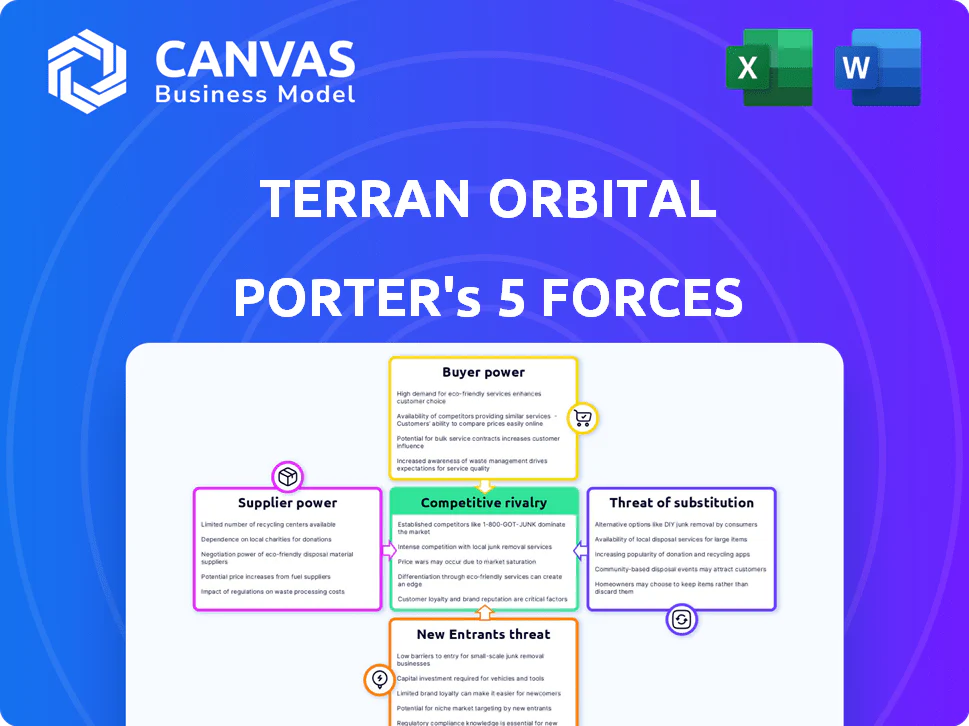
TERRAN ORBITAL PORTER'S FIVE FORCES TEMPLATE RESEARCH
What is included in the product
 Detailed Word Document
Analyzes Terran Orbital's position by evaluating competitive forces.

 Customizable Excel Spreadsheet
Instantly identify competitive threats with color-coded impact levels.
Full Version Awaits
Terran Orbital Porter's Five Forces Analysis
This preview shows the exact Porter's Five Forces analysis you'll receive immediately after purchase. It examines rivalry, new entrants, substitutes, suppliers, and buyers within Terran Orbital's landscape. The document provides a detailed assessment of each force influencing the company's strategic positioning. You will get full access to this comprehensive report.

Porter's Five Forces Analysis Template

A Must-Have Tool for Decision-Makers
Terran Orbital faces moderate rivalry, influenced by established players and emerging space companies. Supplier power is notable, given the specialized components needed. Buyer power fluctuates based on contract types and government involvement. The threat of new entrants is moderate due to high capital costs. Substitute products, like in-house satellite development, present a limited threat.
Ready to move beyond the basics? Get a full strategic breakdown of Terran Orbital’s market position, competitive intensity, and external threats—all in one powerful analysis.
Suppliers Bargaining Power

Concentrated Supply of Critical Components
Terran Orbital depends on unique parts for its satellites. A small group of suppliers for these vital components gives them leverage. This may cause increased expenses and possible setbacks if a supplier has problems or favors other clients. For example, in 2024, the company's reliance on a few key vendors for specific electronics affected its operational efficiency.
Proprietary Technology Held by Suppliers
Some suppliers possess proprietary tech or IP vital for Terran Orbital's satellite designs. This boosts supplier power, as switching suppliers is tough. For example, in 2024, a key component supplier could dictate terms due to its unique tech, impacting Terran Orbital's costs. This situation could lead to higher prices and less favorable contract terms.

Supplier's Financial Stability and Production Capacity
Supplier's financial stability and production capacity are critical factors for Terran Orbital. A financially unstable supplier or one unable to scale production can disrupt Terran Orbital's operations. In 2024, supply chain issues, including those affecting satellite components, have caused delays. For instance, a shortage of specific semiconductors has impacted satellite manufacturing timelines.

Long-Term Supplier Relationships and Partnerships
Terran Orbital's strategic alliances, such as those with Lockheed Martin, and collaborations with Hanwha Systems, impact supplier dynamics. These partnerships can influence supplier power. Strong, long-term relationships may reduce supplier bargaining power. This is achieved through negotiated agreements and mutual dependencies.
- Lockheed Martin's 2024 revenue reached approximately $69 billion.
- Hanwha Systems' 2023 revenue was around $1.7 billion.
- Terran Orbital's 2023 revenue was about $115 million.
- Partnerships can secure favorable supply terms.
Availability of Substitute Materials or Components
The ability to find alternative materials or components is a crucial factor in managing supplier power for Terran Orbital. If Terran Orbital has multiple options for sourcing similar components or can switch to different materials, it weakens the suppliers' leverage. This flexibility allows Terran Orbital to negotiate better prices and terms. For example, in 2024, the aerospace industry saw a 7% increase in the use of composite materials, providing alternative options for traditional metal components.
- Diversification of Suppliers: Having multiple suppliers reduces dependency.
- Material Substitutes: Using alternative materials can decrease reliance.
- Negotiating Strength: Increased options lead to better terms.
- Industry Trends: The use of composites is growing.
Supplier Power Dynamics Impacting Operations
Terran Orbital faces supplier power challenges due to reliance on unique component providers. These suppliers, holding proprietary tech, can dictate terms, affecting costs. Supply chain issues, like semiconductor shortages, have caused delays, as seen in 2024. Strategic partnerships and alternative sourcing strategies help manage supplier leverage.
| Factor | Impact | 2024 Data |
|---|---|---|
| Supplier Concentration | High dependency | Key component vendors held significant leverage. |
| Proprietary Technology | Limits alternatives | Unique tech dictated terms, impacting costs. |
| Supply Chain Disruptions | Operational delays | Semiconductor shortages delayed manufacturing. |
Customers Bargaining Power

Concentration of Major Customers
Terran Orbital's main clients are the U.S. government and its allies. A few large customers, like the Space Development Agency (SDA) and Lockheed Martin, have significant influence. This concentration gives these customers strong bargaining power. They can affect prices, contract terms, and delivery timelines. In 2024, Terran Orbital secured a $2.4 billion contract with the SDA.
Government Procurement Processes and Regulations
Terran Orbital's dealings with government agencies expose it to substantial customer power. Government procurement involves complex processes, strict regulations, and potential contract terminations. These elements empower government entities to dictate terms.

Customer's In-House Capabilities
Large customers, like the U.S. Department of Defense, could build satellites internally, boosting their leverage. This capability gives them an alternative to Terran Orbital. In 2024, the DoD's budget for space-related activities was roughly $40 billion, indicating significant in-house development potential.

Demand for Customized Solutions
Terran Orbital faces customer bargaining power due to the demand for customized satellite solutions. Clients in aerospace and defense seek tailored designs for specific missions. This necessitates Terran Orbital's flexibility to meet unique needs. The company's ability to adapt directly impacts its profitability. In 2024, the satellite manufacturing market was valued at $13.7 billion, with customization driving significant portions of revenue.
- Customization Needs: Clients require tailored designs.
- Flexibility Demand: Terran Orbital must adapt.
- Market Impact: Affects profitability and revenue.
- 2024 Market Value: $13.7 billion.
Budgetary Constraints and Funding Cycles of Customers
Government and defense budgets are key for Terran Orbital, and these can change, affecting demand for satellite services. This can cause delays or modifications in contracts. Customers' funding cycles and budget limitations can increase their ability to negotiate favorable terms and pricing. The U.S. defense budget for 2024 was around $886 billion, which impacts companies like Terran Orbital. Changes in this budget directly affect their projects.
- Defense budgets' fluctuations influence satellite service demand.
- Customer funding cycles may lead to contract adjustments.
- Budgetary restrictions increase customer negotiating leverage.
- The 2024 U.S. defense budget was approximately $886B.
Government Contracts Shape Satellite Company's Destiny
Terran Orbital's key customers, including the U.S. government, wield significant bargaining power, influencing contract terms. The Space Development Agency's $2.4 billion contract in 2024 highlights this influence. Government procurement processes and potential in-house capabilities further amplify customer leverage.
| Aspect | Impact | 2024 Data |
|---|---|---|
| Customer Concentration | High bargaining power | SDA contract: $2.4B |
| Government Influence | Dictates terms | DoD space budget: ~$40B |
| Customization Needs | Affects profitability | Satellite market: $13.7B |
Rivalry Among Competitors

Presence of Established Aerospace and Defense Primes
The satellite manufacturing market is dominated by established aerospace and defense primes. These giants possess extensive resources, decades of experience, and strong customer relationships. For instance, Lockheed Martin and Boeing, key players, reported combined 2024 revenue of over $150 billion. Their ability to handle large, intricate satellite programs poses a significant competitive challenge to Terran Orbital.
Emergence of New Space Companies and Startups
The 'New Space' sector, including startups like SpaceX and Rocket Lab, is intensifying competition. These companies offer innovative solutions, challenging established players. According to 2024 data, SpaceX's Starlink has over 6,000 satellites in orbit, increasing rivalry in satellite-based services. Their quicker development can drive costs down.

Price Competition and Cost Efficiency
Competition in the satellite market is fierce, with companies battling on price and cost-efficiency. Terran Orbital must use efficient manufacturing and modular designs. In 2024, the satellite market's value was ~$366B, showing growth. This environment demands cost-effective solutions. Terran Orbital's strategy is critical.

Technological Advancements and Innovation
The satellite technology sector experiences swift technological progress. To stay competitive, companies like Terran Orbital must constantly innovate and invest in R&D. This includes offering advanced capabilities for improved satellite performance. According to a 2024 report, R&D spending in the space sector is up 15% year-over-year.
- Terran Orbital's 2023 R&D expenses: $60 million.
- Industry average R&D investment: 12-18% of revenue.
- Key innovation areas: AI, miniaturization, and propulsion.
- Impact: Enhanced satellite lifespan and data processing.
Differentiation through End-to-End Solutions
Companies offering complete satellite solutions, like Terran Orbital, stand out. This integrated approach, from building to operating satellites, is a key differentiator. Terran Orbital's business model focuses on offering these comprehensive services. This strategy strengthens its competitive position in the market.
- Terran Orbital's revenue in Q3 2023 was $35.5 million.
- They have a backlog of $2.3 billion as of November 2023.
- The company aims to capture a significant portion of the growing space market.
- Their end-to-end solutions cater to diverse customer needs.
Satellite Manufacturing: A Competitive Landscape
Competitive rivalry in satellite manufacturing is intense, with established giants and innovative startups competing. Established firms like Lockheed Martin and Boeing, with over $150 billion in combined 2024 revenue, offer formidable competition. SpaceX's Starlink, with over 6,000 satellites, is also a major player.
The market's value was ~$366B in 2024, driving a focus on cost-efficiency and innovation. Terran Orbital must continuously invest in R&D to stay competitive. Their 2023 R&D expenses were $60 million, with the industry average R&D investment being 12-18% of revenue.
Offering comprehensive solutions is a key differentiator. Terran Orbital's Q3 2023 revenue was $35.5 million, with a backlog of $2.3 billion as of November 2023. This strategy helps them compete in the growing space market.
| Company | 2024 Revenue (est.) | Key Strategy |
|---|---|---|
| Lockheed Martin/Boeing | $150B+ | Large-scale programs |
| SpaceX | N/A (private) | Rapid deployment |
| Terran Orbital | ~$150M | End-to-end solutions |
TERRAN ORBITAL PORTER'S FIVE FORCES TEMPLATE RESEARCH
What is included in the product
Detailed Word Document
Analyzes Terran Orbital's position by evaluating competitive forces.
Customizable Excel Spreadsheet
Instantly identify competitive threats with color-coded impact levels.
Full Version Awaits
Terran Orbital Porter's Five Forces Analysis
This preview shows the exact Porter's Five Forces analysis you'll receive immediately after purchase. It examines rivalry, new entrants, substitutes, suppliers, and buyers within Terran Orbital's landscape. The document provides a detailed assessment of each force influencing the company's strategic positioning. You will get full access to this comprehensive report.
Porter's Five Forces Analysis Template
A Must-Have Tool for Decision-Makers
Terran Orbital faces moderate rivalry, influenced by established players and emerging space companies. Supplier power is notable, given the specialized components needed. Buyer power fluctuates based on contract types and government involvement. The threat of new entrants is moderate due to high capital costs. Substitute products, like in-house satellite development, present a limited threat.
Ready to move beyond the basics? Get a full strategic breakdown of Terran Orbital’s market position, competitive intensity, and external threats—all in one powerful analysis.
Suppliers Bargaining Power
Concentrated Supply of Critical Components
Terran Orbital depends on unique parts for its satellites. A small group of suppliers for these vital components gives them leverage. This may cause increased expenses and possible setbacks if a supplier has problems or favors other clients. For example, in 2024, the company's reliance on a few key vendors for specific electronics affected its operational efficiency.
Proprietary Technology Held by Suppliers
Some suppliers possess proprietary tech or IP vital for Terran Orbital's satellite designs. This boosts supplier power, as switching suppliers is tough. For example, in 2024, a key component supplier could dictate terms due to its unique tech, impacting Terran Orbital's costs. This situation could lead to higher prices and less favorable contract terms.
Supplier's Financial Stability and Production Capacity
Supplier's financial stability and production capacity are critical factors for Terran Orbital. A financially unstable supplier or one unable to scale production can disrupt Terran Orbital's operations. In 2024, supply chain issues, including those affecting satellite components, have caused delays. For instance, a shortage of specific semiconductors has impacted satellite manufacturing timelines.
Long-Term Supplier Relationships and Partnerships
Terran Orbital's strategic alliances, such as those with Lockheed Martin, and collaborations with Hanwha Systems, impact supplier dynamics. These partnerships can influence supplier power. Strong, long-term relationships may reduce supplier bargaining power. This is achieved through negotiated agreements and mutual dependencies.
- Lockheed Martin's 2024 revenue reached approximately $69 billion.
- Hanwha Systems' 2023 revenue was around $1.7 billion.
- Terran Orbital's 2023 revenue was about $115 million.
- Partnerships can secure favorable supply terms.
Availability of Substitute Materials or Components
The ability to find alternative materials or components is a crucial factor in managing supplier power for Terran Orbital. If Terran Orbital has multiple options for sourcing similar components or can switch to different materials, it weakens the suppliers' leverage. This flexibility allows Terran Orbital to negotiate better prices and terms. For example, in 2024, the aerospace industry saw a 7% increase in the use of composite materials, providing alternative options for traditional metal components.
- Diversification of Suppliers: Having multiple suppliers reduces dependency.
- Material Substitutes: Using alternative materials can decrease reliance.
- Negotiating Strength: Increased options lead to better terms.
- Industry Trends: The use of composites is growing.
Supplier Power Dynamics Impacting Operations
Terran Orbital faces supplier power challenges due to reliance on unique component providers. These suppliers, holding proprietary tech, can dictate terms, affecting costs. Supply chain issues, like semiconductor shortages, have caused delays, as seen in 2024. Strategic partnerships and alternative sourcing strategies help manage supplier leverage.
| Factor | Impact | 2024 Data |
|---|---|---|
| Supplier Concentration | High dependency | Key component vendors held significant leverage. |
| Proprietary Technology | Limits alternatives | Unique tech dictated terms, impacting costs. |
| Supply Chain Disruptions | Operational delays | Semiconductor shortages delayed manufacturing. |
Customers Bargaining Power
Concentration of Major Customers
Terran Orbital's main clients are the U.S. government and its allies. A few large customers, like the Space Development Agency (SDA) and Lockheed Martin, have significant influence. This concentration gives these customers strong bargaining power. They can affect prices, contract terms, and delivery timelines. In 2024, Terran Orbital secured a $2.4 billion contract with the SDA.
Government Procurement Processes and Regulations
Terran Orbital's dealings with government agencies expose it to substantial customer power. Government procurement involves complex processes, strict regulations, and potential contract terminations. These elements empower government entities to dictate terms.
Customer's In-House Capabilities
Large customers, like the U.S. Department of Defense, could build satellites internally, boosting their leverage. This capability gives them an alternative to Terran Orbital. In 2024, the DoD's budget for space-related activities was roughly $40 billion, indicating significant in-house development potential.
Demand for Customized Solutions
Terran Orbital faces customer bargaining power due to the demand for customized satellite solutions. Clients in aerospace and defense seek tailored designs for specific missions. This necessitates Terran Orbital's flexibility to meet unique needs. The company's ability to adapt directly impacts its profitability. In 2024, the satellite manufacturing market was valued at $13.7 billion, with customization driving significant portions of revenue.
- Customization Needs: Clients require tailored designs.
- Flexibility Demand: Terran Orbital must adapt.
- Market Impact: Affects profitability and revenue.
- 2024 Market Value: $13.7 billion.
Budgetary Constraints and Funding Cycles of Customers
Government and defense budgets are key for Terran Orbital, and these can change, affecting demand for satellite services. This can cause delays or modifications in contracts. Customers' funding cycles and budget limitations can increase their ability to negotiate favorable terms and pricing. The U.S. defense budget for 2024 was around $886 billion, which impacts companies like Terran Orbital. Changes in this budget directly affect their projects.
- Defense budgets' fluctuations influence satellite service demand.
- Customer funding cycles may lead to contract adjustments.
- Budgetary restrictions increase customer negotiating leverage.
- The 2024 U.S. defense budget was approximately $886B.
Government Contracts Shape Satellite Company's Destiny
Terran Orbital's key customers, including the U.S. government, wield significant bargaining power, influencing contract terms. The Space Development Agency's $2.4 billion contract in 2024 highlights this influence. Government procurement processes and potential in-house capabilities further amplify customer leverage.
| Aspect | Impact | 2024 Data |
|---|---|---|
| Customer Concentration | High bargaining power | SDA contract: $2.4B |
| Government Influence | Dictates terms | DoD space budget: ~$40B |
| Customization Needs | Affects profitability | Satellite market: $13.7B |
Rivalry Among Competitors
Presence of Established Aerospace and Defense Primes
The satellite manufacturing market is dominated by established aerospace and defense primes. These giants possess extensive resources, decades of experience, and strong customer relationships. For instance, Lockheed Martin and Boeing, key players, reported combined 2024 revenue of over $150 billion. Their ability to handle large, intricate satellite programs poses a significant competitive challenge to Terran Orbital.
Emergence of New Space Companies and Startups
The 'New Space' sector, including startups like SpaceX and Rocket Lab, is intensifying competition. These companies offer innovative solutions, challenging established players. According to 2024 data, SpaceX's Starlink has over 6,000 satellites in orbit, increasing rivalry in satellite-based services. Their quicker development can drive costs down.
Price Competition and Cost Efficiency
Competition in the satellite market is fierce, with companies battling on price and cost-efficiency. Terran Orbital must use efficient manufacturing and modular designs. In 2024, the satellite market's value was ~$366B, showing growth. This environment demands cost-effective solutions. Terran Orbital's strategy is critical.
Technological Advancements and Innovation
The satellite technology sector experiences swift technological progress. To stay competitive, companies like Terran Orbital must constantly innovate and invest in R&D. This includes offering advanced capabilities for improved satellite performance. According to a 2024 report, R&D spending in the space sector is up 15% year-over-year.
- Terran Orbital's 2023 R&D expenses: $60 million.
- Industry average R&D investment: 12-18% of revenue.
- Key innovation areas: AI, miniaturization, and propulsion.
- Impact: Enhanced satellite lifespan and data processing.
Differentiation through End-to-End Solutions
Companies offering complete satellite solutions, like Terran Orbital, stand out. This integrated approach, from building to operating satellites, is a key differentiator. Terran Orbital's business model focuses on offering these comprehensive services. This strategy strengthens its competitive position in the market.
- Terran Orbital's revenue in Q3 2023 was $35.5 million.
- They have a backlog of $2.3 billion as of November 2023.
- The company aims to capture a significant portion of the growing space market.
- Their end-to-end solutions cater to diverse customer needs.
Satellite Manufacturing: A Competitive Landscape
Competitive rivalry in satellite manufacturing is intense, with established giants and innovative startups competing. Established firms like Lockheed Martin and Boeing, with over $150 billion in combined 2024 revenue, offer formidable competition. SpaceX's Starlink, with over 6,000 satellites, is also a major player.
The market's value was ~$366B in 2024, driving a focus on cost-efficiency and innovation. Terran Orbital must continuously invest in R&D to stay competitive. Their 2023 R&D expenses were $60 million, with the industry average R&D investment being 12-18% of revenue.
Offering comprehensive solutions is a key differentiator. Terran Orbital's Q3 2023 revenue was $35.5 million, with a backlog of $2.3 billion as of November 2023. This strategy helps them compete in the growing space market.
| Company | 2024 Revenue (est.) | Key Strategy |
|---|---|---|
| Lockheed Martin/Boeing | $150B+ | Large-scale programs |
| SpaceX | N/A (private) | Rapid deployment |
| Terran Orbital | ~$150M | End-to-end solutions |
Product Information
Product Information
Shipping & Returns
Shipping & Returns
Description
What is included in the product
Detailed Word Document
Analyzes Terran Orbital's position by evaluating competitive forces.
Customizable Excel Spreadsheet
Instantly identify competitive threats with color-coded impact levels.
Full Version Awaits
Terran Orbital Porter's Five Forces Analysis
This preview shows the exact Porter's Five Forces analysis you'll receive immediately after purchase. It examines rivalry, new entrants, substitutes, suppliers, and buyers within Terran Orbital's landscape. The document provides a detailed assessment of each force influencing the company's strategic positioning. You will get full access to this comprehensive report.
Porter's Five Forces Analysis Template
A Must-Have Tool for Decision-Makers
Terran Orbital faces moderate rivalry, influenced by established players and emerging space companies. Supplier power is notable, given the specialized components needed. Buyer power fluctuates based on contract types and government involvement. The threat of new entrants is moderate due to high capital costs. Substitute products, like in-house satellite development, present a limited threat.
Ready to move beyond the basics? Get a full strategic breakdown of Terran Orbital’s market position, competitive intensity, and external threats—all in one powerful analysis.
Suppliers Bargaining Power
Concentrated Supply of Critical Components
Terran Orbital depends on unique parts for its satellites. A small group of suppliers for these vital components gives them leverage. This may cause increased expenses and possible setbacks if a supplier has problems or favors other clients. For example, in 2024, the company's reliance on a few key vendors for specific electronics affected its operational efficiency.
Proprietary Technology Held by Suppliers
Some suppliers possess proprietary tech or IP vital for Terran Orbital's satellite designs. This boosts supplier power, as switching suppliers is tough. For example, in 2024, a key component supplier could dictate terms due to its unique tech, impacting Terran Orbital's costs. This situation could lead to higher prices and less favorable contract terms.
Supplier's Financial Stability and Production Capacity
Supplier's financial stability and production capacity are critical factors for Terran Orbital. A financially unstable supplier or one unable to scale production can disrupt Terran Orbital's operations. In 2024, supply chain issues, including those affecting satellite components, have caused delays. For instance, a shortage of specific semiconductors has impacted satellite manufacturing timelines.
Long-Term Supplier Relationships and Partnerships
Terran Orbital's strategic alliances, such as those with Lockheed Martin, and collaborations with Hanwha Systems, impact supplier dynamics. These partnerships can influence supplier power. Strong, long-term relationships may reduce supplier bargaining power. This is achieved through negotiated agreements and mutual dependencies.
- Lockheed Martin's 2024 revenue reached approximately $69 billion.
- Hanwha Systems' 2023 revenue was around $1.7 billion.
- Terran Orbital's 2023 revenue was about $115 million.
- Partnerships can secure favorable supply terms.
Availability of Substitute Materials or Components
The ability to find alternative materials or components is a crucial factor in managing supplier power for Terran Orbital. If Terran Orbital has multiple options for sourcing similar components or can switch to different materials, it weakens the suppliers' leverage. This flexibility allows Terran Orbital to negotiate better prices and terms. For example, in 2024, the aerospace industry saw a 7% increase in the use of composite materials, providing alternative options for traditional metal components.
- Diversification of Suppliers: Having multiple suppliers reduces dependency.
- Material Substitutes: Using alternative materials can decrease reliance.
- Negotiating Strength: Increased options lead to better terms.
- Industry Trends: The use of composites is growing.
Supplier Power Dynamics Impacting Operations
Terran Orbital faces supplier power challenges due to reliance on unique component providers. These suppliers, holding proprietary tech, can dictate terms, affecting costs. Supply chain issues, like semiconductor shortages, have caused delays, as seen in 2024. Strategic partnerships and alternative sourcing strategies help manage supplier leverage.
| Factor | Impact | 2024 Data |
|---|---|---|
| Supplier Concentration | High dependency | Key component vendors held significant leverage. |
| Proprietary Technology | Limits alternatives | Unique tech dictated terms, impacting costs. |
| Supply Chain Disruptions | Operational delays | Semiconductor shortages delayed manufacturing. |
Customers Bargaining Power
Concentration of Major Customers
Terran Orbital's main clients are the U.S. government and its allies. A few large customers, like the Space Development Agency (SDA) and Lockheed Martin, have significant influence. This concentration gives these customers strong bargaining power. They can affect prices, contract terms, and delivery timelines. In 2024, Terran Orbital secured a $2.4 billion contract with the SDA.
Government Procurement Processes and Regulations
Terran Orbital's dealings with government agencies expose it to substantial customer power. Government procurement involves complex processes, strict regulations, and potential contract terminations. These elements empower government entities to dictate terms.
Customer's In-House Capabilities
Large customers, like the U.S. Department of Defense, could build satellites internally, boosting their leverage. This capability gives them an alternative to Terran Orbital. In 2024, the DoD's budget for space-related activities was roughly $40 billion, indicating significant in-house development potential.
Demand for Customized Solutions
Terran Orbital faces customer bargaining power due to the demand for customized satellite solutions. Clients in aerospace and defense seek tailored designs for specific missions. This necessitates Terran Orbital's flexibility to meet unique needs. The company's ability to adapt directly impacts its profitability. In 2024, the satellite manufacturing market was valued at $13.7 billion, with customization driving significant portions of revenue.
- Customization Needs: Clients require tailored designs.
- Flexibility Demand: Terran Orbital must adapt.
- Market Impact: Affects profitability and revenue.
- 2024 Market Value: $13.7 billion.
Budgetary Constraints and Funding Cycles of Customers
Government and defense budgets are key for Terran Orbital, and these can change, affecting demand for satellite services. This can cause delays or modifications in contracts. Customers' funding cycles and budget limitations can increase their ability to negotiate favorable terms and pricing. The U.S. defense budget for 2024 was around $886 billion, which impacts companies like Terran Orbital. Changes in this budget directly affect their projects.
- Defense budgets' fluctuations influence satellite service demand.
- Customer funding cycles may lead to contract adjustments.
- Budgetary restrictions increase customer negotiating leverage.
- The 2024 U.S. defense budget was approximately $886B.
Government Contracts Shape Satellite Company's Destiny
Terran Orbital's key customers, including the U.S. government, wield significant bargaining power, influencing contract terms. The Space Development Agency's $2.4 billion contract in 2024 highlights this influence. Government procurement processes and potential in-house capabilities further amplify customer leverage.
| Aspect | Impact | 2024 Data |
|---|---|---|
| Customer Concentration | High bargaining power | SDA contract: $2.4B |
| Government Influence | Dictates terms | DoD space budget: ~$40B |
| Customization Needs | Affects profitability | Satellite market: $13.7B |
Rivalry Among Competitors
Presence of Established Aerospace and Defense Primes
The satellite manufacturing market is dominated by established aerospace and defense primes. These giants possess extensive resources, decades of experience, and strong customer relationships. For instance, Lockheed Martin and Boeing, key players, reported combined 2024 revenue of over $150 billion. Their ability to handle large, intricate satellite programs poses a significant competitive challenge to Terran Orbital.
Emergence of New Space Companies and Startups
The 'New Space' sector, including startups like SpaceX and Rocket Lab, is intensifying competition. These companies offer innovative solutions, challenging established players. According to 2024 data, SpaceX's Starlink has over 6,000 satellites in orbit, increasing rivalry in satellite-based services. Their quicker development can drive costs down.
Price Competition and Cost Efficiency
Competition in the satellite market is fierce, with companies battling on price and cost-efficiency. Terran Orbital must use efficient manufacturing and modular designs. In 2024, the satellite market's value was ~$366B, showing growth. This environment demands cost-effective solutions. Terran Orbital's strategy is critical.
Technological Advancements and Innovation
The satellite technology sector experiences swift technological progress. To stay competitive, companies like Terran Orbital must constantly innovate and invest in R&D. This includes offering advanced capabilities for improved satellite performance. According to a 2024 report, R&D spending in the space sector is up 15% year-over-year.
- Terran Orbital's 2023 R&D expenses: $60 million.
- Industry average R&D investment: 12-18% of revenue.
- Key innovation areas: AI, miniaturization, and propulsion.
- Impact: Enhanced satellite lifespan and data processing.
Differentiation through End-to-End Solutions
Companies offering complete satellite solutions, like Terran Orbital, stand out. This integrated approach, from building to operating satellites, is a key differentiator. Terran Orbital's business model focuses on offering these comprehensive services. This strategy strengthens its competitive position in the market.
- Terran Orbital's revenue in Q3 2023 was $35.5 million.
- They have a backlog of $2.3 billion as of November 2023.
- The company aims to capture a significant portion of the growing space market.
- Their end-to-end solutions cater to diverse customer needs.
Satellite Manufacturing: A Competitive Landscape
Competitive rivalry in satellite manufacturing is intense, with established giants and innovative startups competing. Established firms like Lockheed Martin and Boeing, with over $150 billion in combined 2024 revenue, offer formidable competition. SpaceX's Starlink, with over 6,000 satellites, is also a major player.
The market's value was ~$366B in 2024, driving a focus on cost-efficiency and innovation. Terran Orbital must continuously invest in R&D to stay competitive. Their 2023 R&D expenses were $60 million, with the industry average R&D investment being 12-18% of revenue.
Offering comprehensive solutions is a key differentiator. Terran Orbital's Q3 2023 revenue was $35.5 million, with a backlog of $2.3 billion as of November 2023. This strategy helps them compete in the growing space market.
| Company | 2024 Revenue (est.) | Key Strategy |
|---|---|---|
| Lockheed Martin/Boeing | $150B+ | Large-scale programs |
| SpaceX | N/A (private) | Rapid deployment |
| Terran Orbital | ~$150M | End-to-end solutions |











