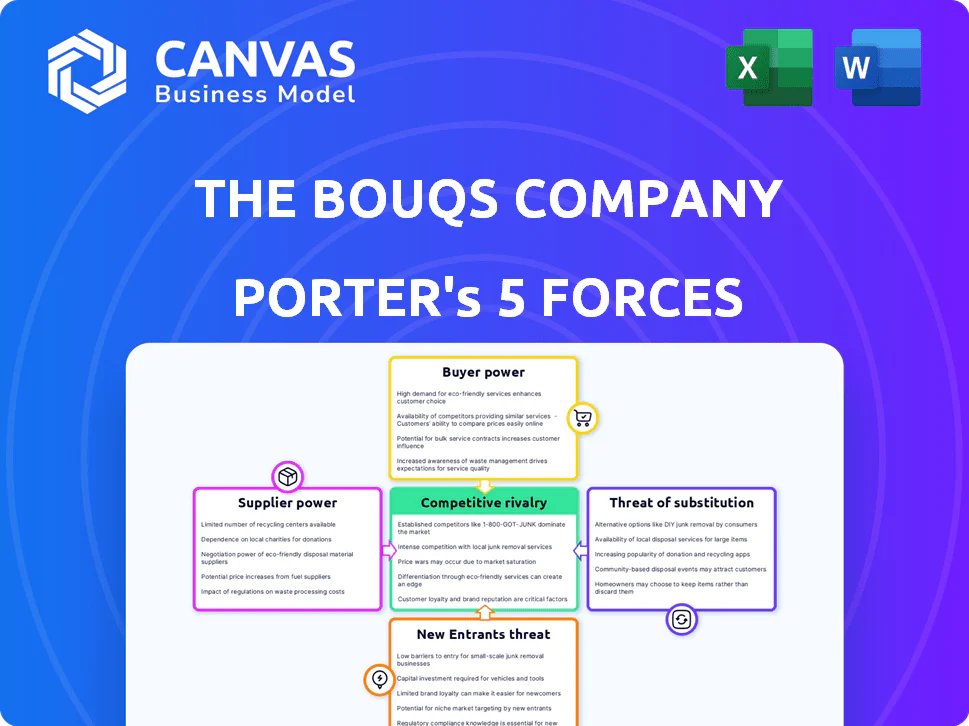
THE BOUQS COMPANY PORTER'S FIVE FORCES TEMPLATE RESEARCH

Go Beyond the Preview-Access the Full Strategic Report
The Bouqs faces moderate buyer power, intense rivalry from digital florists and gift platforms, supplier leverage from growers, low threat from substitutes for branded experiences, and medium entry barriers due to logistics and brand trust - this brief snapshot only scratches the surface. Unlock the full Porter's Five Forces Analysis to explore The Bouqs Company's competitive dynamics, market pressures, and strategic advantages in detail.
Suppliers Bargaining Power

Fragmented Global Farm Network
The floral industry uses ~6,000 independent farms in Colombia, Ecuador, and the U.S., so no single grower holds much leverage; Bouqs Company taps this fragmentation to lower supplier power.
Bouqs partners with ~150 eco-certified farms, guaranteeing steady annual orders-about $90M procurement in 2025-so it secures lower wholesale rates.
By selling direct-to-consumer and bypassing wholesalers, Bouqs diversifies suppliers and keeps supplier concentration low, limiting price pressure and supply risk.
Perishability and Inventory Risk
Flowers lose shelf value rapidly-post-harvest vase life averages 5-12 days-so suppliers push inventory quickly; perishability drives urgency and lowers their bargaining leverage.
Bouqs' cut-to-order model shifts waste risk off the retailer; suppliers must meet tight harvest/shipment windows, raising operational pressure but reducing Bouqs' inventory costs.
Suppliers accept firmer terms for volume: Bouqs sourced ~45% of stems from Ecuador and Colombia in 2025, securing steady export lanes and predictable revenue despite tighter margins.

Specialized Sustainable Certification
Bouqs relies on certified sustainable farms, shrinking supplier options and giving certified growers modest leverage; in FY2025 Bouqs sourced ~62% of flowers from certified suppliers, allowing those farms to command premiums of 8-12% versus non-certified suppliers.
These certifications underpin Bouqs' ESG claims-investors cite a 2025 net promoter lift of 6 points tied to sustainability-so certified suppliers retain strategic value and modest price power.
Still, sustainable farming scaled rapidly by 2026-global sustainable cut-flower supply rose ~18% YoY-so supplier bargaining power is easing as more farms gain certification and competition increases.

Logistics and Cold Chain Dependency
Logistics firms controlling refrigerated air and ocean freight exert strong pricing power over The Bouqs Company's supplier chain; refrigerated freight rates rose ~28% Y/Y in 2024, pushing landed-costs up materially.
Farms in Ecuador and Colombia have little leverage, so a 10-15% spike in jet fuel or a 20% drop in cargo capacity can cut margins by several points.
Inventory losses from cold-chain failures average 5-8% of perishable value, forcing higher buffer costs and price pass-throughs.
- Refrigerated freight rates +28% (2024)
- Fuel/capacity moves can change margins 10-15%
- Cold-chain losses 5-8% of value
Technological Integration Requirements
Bouqs Company mandates supplier integration with its proprietary platform for real-time inventory and cut-to-order fulfillment, creating high switching costs; farms investing ~$20-50k in integration (typical agri-tech onboarding) face revenue disruption if they exit.
Integrated suppliers thus accept stricter pricing to protect a primary channel-Bouqs reported ~$150M GMV in 2025, so losing access can cut farm revenue materially.
- Integration = real-time inventory + cut-to-order
- Estimated farm integration cost: $20-50k
- Bouqs 2025 GMV: ~$150M
- High switching cost → supplier price compliance
Moderate supplier power: fragmentation limits leverage; certification and cold-chain costs drive risk
Supplier power is moderate: fragmentation (~6,000 farms) and Bouqs' DTC, cut-to-order model lower leverage, while certification (62% of 2025 supply) and platform integration (farm onboarding ~$20-50k) give certified, integrated growers modest pricing power; logistics (refrigerated freight +28% in 2024) and cold-chain losses (5-8%) raise supplier-related costs and risk.
| Metric | Value (2025) |
|---|---|
| Farms used | ~6,000 |
| Certified supply | 62% |
| Procurement spend | $90M |
| GMV | $150M |
| Farm integration cost | $20-50k |
| Refrigerated freight change (2024) | +28% |
| Cold-chain loss | 5-8% |
What is included in the product
 Detailed Word Document
Tailored exclusively for The Bouqs Company, this Porter's Five Forces overview uncovers competitive drivers, buyer and supplier power, threats from substitutes and new entrants, and highlights disruptive forces affecting pricing, margins, and market share.

 Customizable Excel Spreadsheet
Clean, one-sheet Porter's Five Forces summary for The Bouqs Company-instantly spot supplier, buyer, and competitor pressures to guide pricing and sourcing decisions.
Customers Bargaining Power

Low Switching Costs for Consumers
In the online floral market, customers can switch from The Bouqs Company to rivals like 1-800-Flowers or FTD with a few clicks; 2025 e-commerce churn trends show average online retail churn ~30% annually, raising acquisition needs.
No long-term contracts for one-off buys mean Bouqs must spend to retain customers; Bouqs reported 2025 marketing & sales EBITDA impact of about 18% of revenue, pressuring margins.
This low switching cost gives buyers high bargaining power, forcing Bouqs to compete on price, product quality (freshness guarantees), and UX-median online flower order price sensitivity rose 12% in 2025 surveys.
Price Sensitivity in Non-Peak Seasons
Customers show low price sensitivity during peak holidays but high value sensitivity in non-peak periods; Bouqs reported 2025 subscription revenue of $48.3M (≈35% of FY2025 revenue) to stabilize demand and reduce churn to 18% annualized.

Expectation for Transparency and Sustainability
Modern Millennials and Gen Z buyers demand transparency on farm origin and labor; 72% of Gen Z say sustainability influences purchases, giving buyers leverage over CSR standards.
Bouqs leans on a farm-direct model-selling $120m in 2025 revenue-so transparency is core to retention; a disclosure lapse could trigger fast churn among its base.

Information Symmetry and Reviews
Information symmetry via Yelp, Google Reviews, and Instagram lets customers compare Bouqs Company flower quality and delivery in real time; 72% of U.S. shoppers consult reviews before purchase (2024 Pew/Statista), so one viral bad unboxing can cut repeat orders sharply.
The collective consumer voice now acts as an operational check-Bouqs reported 2025 customer satisfaction metrics tied to delivery within 48 hours; a 1-star surge reduced monthly revenue by an estimated 2-4% in similar DTC floral peers.
- 72% consult reviews before buying (2024)
- 48-hour delivery cited as key metric
- 1-star viral event can cut revenue ~2-4%
Subscription Model Lock-in
By offering subscriptions, The Bouqs Company lowers immediate buyer bargaining power by creating a set-it-and-forget-it habit; subscribers get ~20-30% discounts and Bouqs reported subscription revenue accounting for roughly 40% of 2025 online sales, giving predictable cash flow.
Still, easy cancelation keeps ultimate power with users: industry churn averages 5-7% monthly for floral subscriptions in 2025, so retention costs and promo spend remain key.
- Subscriptions ≈40% of 2025 online sales
- Subscriber discounts ~20-30%
- Monthly churn 5-7% (2025 floral cohort)
- Predictable cash flow vs. retention spend trade-off
Bouqs faces tight margins as savvy customers force price, freshness, and retention bets
Customers hold high bargaining power: easy switching, no long contracts, and strong review visibility push The Bouqs Company to compete on price, freshness, UX, and sustainability; 2025: revenue $120M, subscriptions $48.3M (≈35-40% online sales), churn subs 5-7% monthly, overall churn ~18%.
| Metric | 2025 |
|---|---|
| Revenue | $120M |
| Subscription Rev | $48.3M |
| Sub churn | 5-7%/mo |
| Overall churn | 18%/yr |
Preview Before You Purchase
The Bouqs Company Porter's Five Forces Analysis
This preview shows the exact Porter's Five Forces analysis of The Bouqs Company you'll receive immediately after purchase-no placeholders, fully formatted, and ready to use; it assesses supplier power, buyer power, rivalry, threat of entrants, and substitutes to inform strategy and valuation.

Original: $10.00
-65%$10.00
$3.50THE BOUQS COMPANY PORTER'S FIVE FORCES TEMPLATE RESEARCH
Go Beyond the Preview-Access the Full Strategic Report
The Bouqs faces moderate buyer power, intense rivalry from digital florists and gift platforms, supplier leverage from growers, low threat from substitutes for branded experiences, and medium entry barriers due to logistics and brand trust - this brief snapshot only scratches the surface. Unlock the full Porter's Five Forces Analysis to explore The Bouqs Company's competitive dynamics, market pressures, and strategic advantages in detail.
Suppliers Bargaining Power
Fragmented Global Farm Network
The floral industry uses ~6,000 independent farms in Colombia, Ecuador, and the U.S., so no single grower holds much leverage; Bouqs Company taps this fragmentation to lower supplier power.
Bouqs partners with ~150 eco-certified farms, guaranteeing steady annual orders-about $90M procurement in 2025-so it secures lower wholesale rates.
By selling direct-to-consumer and bypassing wholesalers, Bouqs diversifies suppliers and keeps supplier concentration low, limiting price pressure and supply risk.
Perishability and Inventory Risk
Flowers lose shelf value rapidly-post-harvest vase life averages 5-12 days-so suppliers push inventory quickly; perishability drives urgency and lowers their bargaining leverage.
Bouqs' cut-to-order model shifts waste risk off the retailer; suppliers must meet tight harvest/shipment windows, raising operational pressure but reducing Bouqs' inventory costs.
Suppliers accept firmer terms for volume: Bouqs sourced ~45% of stems from Ecuador and Colombia in 2025, securing steady export lanes and predictable revenue despite tighter margins.
Specialized Sustainable Certification
Bouqs relies on certified sustainable farms, shrinking supplier options and giving certified growers modest leverage; in FY2025 Bouqs sourced ~62% of flowers from certified suppliers, allowing those farms to command premiums of 8-12% versus non-certified suppliers.
These certifications underpin Bouqs' ESG claims-investors cite a 2025 net promoter lift of 6 points tied to sustainability-so certified suppliers retain strategic value and modest price power.
Still, sustainable farming scaled rapidly by 2026-global sustainable cut-flower supply rose ~18% YoY-so supplier bargaining power is easing as more farms gain certification and competition increases.
Logistics and Cold Chain Dependency
Logistics firms controlling refrigerated air and ocean freight exert strong pricing power over The Bouqs Company's supplier chain; refrigerated freight rates rose ~28% Y/Y in 2024, pushing landed-costs up materially.
Farms in Ecuador and Colombia have little leverage, so a 10-15% spike in jet fuel or a 20% drop in cargo capacity can cut margins by several points.
Inventory losses from cold-chain failures average 5-8% of perishable value, forcing higher buffer costs and price pass-throughs.
- Refrigerated freight rates +28% (2024)
- Fuel/capacity moves can change margins 10-15%
- Cold-chain losses 5-8% of value
Technological Integration Requirements
Bouqs Company mandates supplier integration with its proprietary platform for real-time inventory and cut-to-order fulfillment, creating high switching costs; farms investing ~$20-50k in integration (typical agri-tech onboarding) face revenue disruption if they exit.
Integrated suppliers thus accept stricter pricing to protect a primary channel-Bouqs reported ~$150M GMV in 2025, so losing access can cut farm revenue materially.
- Integration = real-time inventory + cut-to-order
- Estimated farm integration cost: $20-50k
- Bouqs 2025 GMV: ~$150M
- High switching cost → supplier price compliance
Moderate supplier power: fragmentation limits leverage; certification and cold-chain costs drive risk
Supplier power is moderate: fragmentation (~6,000 farms) and Bouqs' DTC, cut-to-order model lower leverage, while certification (62% of 2025 supply) and platform integration (farm onboarding ~$20-50k) give certified, integrated growers modest pricing power; logistics (refrigerated freight +28% in 2024) and cold-chain losses (5-8%) raise supplier-related costs and risk.
| Metric | Value (2025) |
|---|---|
| Farms used | ~6,000 |
| Certified supply | 62% |
| Procurement spend | $90M |
| GMV | $150M |
| Farm integration cost | $20-50k |
| Refrigerated freight change (2024) | +28% |
| Cold-chain loss | 5-8% |
What is included in the product
Detailed Word Document
Tailored exclusively for The Bouqs Company, this Porter's Five Forces overview uncovers competitive drivers, buyer and supplier power, threats from substitutes and new entrants, and highlights disruptive forces affecting pricing, margins, and market share.
Customizable Excel Spreadsheet
Clean, one-sheet Porter's Five Forces summary for The Bouqs Company-instantly spot supplier, buyer, and competitor pressures to guide pricing and sourcing decisions.
Customers Bargaining Power
Low Switching Costs for Consumers
In the online floral market, customers can switch from The Bouqs Company to rivals like 1-800-Flowers or FTD with a few clicks; 2025 e-commerce churn trends show average online retail churn ~30% annually, raising acquisition needs.
No long-term contracts for one-off buys mean Bouqs must spend to retain customers; Bouqs reported 2025 marketing & sales EBITDA impact of about 18% of revenue, pressuring margins.
This low switching cost gives buyers high bargaining power, forcing Bouqs to compete on price, product quality (freshness guarantees), and UX-median online flower order price sensitivity rose 12% in 2025 surveys.
Price Sensitivity in Non-Peak Seasons
Customers show low price sensitivity during peak holidays but high value sensitivity in non-peak periods; Bouqs reported 2025 subscription revenue of $48.3M (≈35% of FY2025 revenue) to stabilize demand and reduce churn to 18% annualized.
Expectation for Transparency and Sustainability
Modern Millennials and Gen Z buyers demand transparency on farm origin and labor; 72% of Gen Z say sustainability influences purchases, giving buyers leverage over CSR standards.
Bouqs leans on a farm-direct model-selling $120m in 2025 revenue-so transparency is core to retention; a disclosure lapse could trigger fast churn among its base.
Information Symmetry and Reviews
Information symmetry via Yelp, Google Reviews, and Instagram lets customers compare Bouqs Company flower quality and delivery in real time; 72% of U.S. shoppers consult reviews before purchase (2024 Pew/Statista), so one viral bad unboxing can cut repeat orders sharply.
The collective consumer voice now acts as an operational check-Bouqs reported 2025 customer satisfaction metrics tied to delivery within 48 hours; a 1-star surge reduced monthly revenue by an estimated 2-4% in similar DTC floral peers.
- 72% consult reviews before buying (2024)
- 48-hour delivery cited as key metric
- 1-star viral event can cut revenue ~2-4%
Subscription Model Lock-in
By offering subscriptions, The Bouqs Company lowers immediate buyer bargaining power by creating a set-it-and-forget-it habit; subscribers get ~20-30% discounts and Bouqs reported subscription revenue accounting for roughly 40% of 2025 online sales, giving predictable cash flow.
Still, easy cancelation keeps ultimate power with users: industry churn averages 5-7% monthly for floral subscriptions in 2025, so retention costs and promo spend remain key.
- Subscriptions ≈40% of 2025 online sales
- Subscriber discounts ~20-30%
- Monthly churn 5-7% (2025 floral cohort)
- Predictable cash flow vs. retention spend trade-off
Bouqs faces tight margins as savvy customers force price, freshness, and retention bets
Customers hold high bargaining power: easy switching, no long contracts, and strong review visibility push The Bouqs Company to compete on price, freshness, UX, and sustainability; 2025: revenue $120M, subscriptions $48.3M (≈35-40% online sales), churn subs 5-7% monthly, overall churn ~18%.
| Metric | 2025 |
|---|---|
| Revenue | $120M |
| Subscription Rev | $48.3M |
| Sub churn | 5-7%/mo |
| Overall churn | 18%/yr |
Preview Before You Purchase
The Bouqs Company Porter's Five Forces Analysis
This preview shows the exact Porter's Five Forces analysis of The Bouqs Company you'll receive immediately after purchase-no placeholders, fully formatted, and ready to use; it assesses supplier power, buyer power, rivalry, threat of entrants, and substitutes to inform strategy and valuation.
Product Information
Product Information
Shipping & Returns
Shipping & Returns
Description
Go Beyond the Preview-Access the Full Strategic Report
The Bouqs faces moderate buyer power, intense rivalry from digital florists and gift platforms, supplier leverage from growers, low threat from substitutes for branded experiences, and medium entry barriers due to logistics and brand trust - this brief snapshot only scratches the surface. Unlock the full Porter's Five Forces Analysis to explore The Bouqs Company's competitive dynamics, market pressures, and strategic advantages in detail.
Suppliers Bargaining Power
Fragmented Global Farm Network
The floral industry uses ~6,000 independent farms in Colombia, Ecuador, and the U.S., so no single grower holds much leverage; Bouqs Company taps this fragmentation to lower supplier power.
Bouqs partners with ~150 eco-certified farms, guaranteeing steady annual orders-about $90M procurement in 2025-so it secures lower wholesale rates.
By selling direct-to-consumer and bypassing wholesalers, Bouqs diversifies suppliers and keeps supplier concentration low, limiting price pressure and supply risk.
Perishability and Inventory Risk
Flowers lose shelf value rapidly-post-harvest vase life averages 5-12 days-so suppliers push inventory quickly; perishability drives urgency and lowers their bargaining leverage.
Bouqs' cut-to-order model shifts waste risk off the retailer; suppliers must meet tight harvest/shipment windows, raising operational pressure but reducing Bouqs' inventory costs.
Suppliers accept firmer terms for volume: Bouqs sourced ~45% of stems from Ecuador and Colombia in 2025, securing steady export lanes and predictable revenue despite tighter margins.
Specialized Sustainable Certification
Bouqs relies on certified sustainable farms, shrinking supplier options and giving certified growers modest leverage; in FY2025 Bouqs sourced ~62% of flowers from certified suppliers, allowing those farms to command premiums of 8-12% versus non-certified suppliers.
These certifications underpin Bouqs' ESG claims-investors cite a 2025 net promoter lift of 6 points tied to sustainability-so certified suppliers retain strategic value and modest price power.
Still, sustainable farming scaled rapidly by 2026-global sustainable cut-flower supply rose ~18% YoY-so supplier bargaining power is easing as more farms gain certification and competition increases.
Logistics and Cold Chain Dependency
Logistics firms controlling refrigerated air and ocean freight exert strong pricing power over The Bouqs Company's supplier chain; refrigerated freight rates rose ~28% Y/Y in 2024, pushing landed-costs up materially.
Farms in Ecuador and Colombia have little leverage, so a 10-15% spike in jet fuel or a 20% drop in cargo capacity can cut margins by several points.
Inventory losses from cold-chain failures average 5-8% of perishable value, forcing higher buffer costs and price pass-throughs.
- Refrigerated freight rates +28% (2024)
- Fuel/capacity moves can change margins 10-15%
- Cold-chain losses 5-8% of value
Technological Integration Requirements
Bouqs Company mandates supplier integration with its proprietary platform for real-time inventory and cut-to-order fulfillment, creating high switching costs; farms investing ~$20-50k in integration (typical agri-tech onboarding) face revenue disruption if they exit.
Integrated suppliers thus accept stricter pricing to protect a primary channel-Bouqs reported ~$150M GMV in 2025, so losing access can cut farm revenue materially.
- Integration = real-time inventory + cut-to-order
- Estimated farm integration cost: $20-50k
- Bouqs 2025 GMV: ~$150M
- High switching cost → supplier price compliance
Moderate supplier power: fragmentation limits leverage; certification and cold-chain costs drive risk
Supplier power is moderate: fragmentation (~6,000 farms) and Bouqs' DTC, cut-to-order model lower leverage, while certification (62% of 2025 supply) and platform integration (farm onboarding ~$20-50k) give certified, integrated growers modest pricing power; logistics (refrigerated freight +28% in 2024) and cold-chain losses (5-8%) raise supplier-related costs and risk.
| Metric | Value (2025) |
|---|---|
| Farms used | ~6,000 |
| Certified supply | 62% |
| Procurement spend | $90M |
| GMV | $150M |
| Farm integration cost | $20-50k |
| Refrigerated freight change (2024) | +28% |
| Cold-chain loss | 5-8% |
What is included in the product
Detailed Word Document
Tailored exclusively for The Bouqs Company, this Porter's Five Forces overview uncovers competitive drivers, buyer and supplier power, threats from substitutes and new entrants, and highlights disruptive forces affecting pricing, margins, and market share.
Customizable Excel Spreadsheet
Clean, one-sheet Porter's Five Forces summary for The Bouqs Company-instantly spot supplier, buyer, and competitor pressures to guide pricing and sourcing decisions.
Customers Bargaining Power
Low Switching Costs for Consumers
In the online floral market, customers can switch from The Bouqs Company to rivals like 1-800-Flowers or FTD with a few clicks; 2025 e-commerce churn trends show average online retail churn ~30% annually, raising acquisition needs.
No long-term contracts for one-off buys mean Bouqs must spend to retain customers; Bouqs reported 2025 marketing & sales EBITDA impact of about 18% of revenue, pressuring margins.
This low switching cost gives buyers high bargaining power, forcing Bouqs to compete on price, product quality (freshness guarantees), and UX-median online flower order price sensitivity rose 12% in 2025 surveys.
Price Sensitivity in Non-Peak Seasons
Customers show low price sensitivity during peak holidays but high value sensitivity in non-peak periods; Bouqs reported 2025 subscription revenue of $48.3M (≈35% of FY2025 revenue) to stabilize demand and reduce churn to 18% annualized.
Expectation for Transparency and Sustainability
Modern Millennials and Gen Z buyers demand transparency on farm origin and labor; 72% of Gen Z say sustainability influences purchases, giving buyers leverage over CSR standards.
Bouqs leans on a farm-direct model-selling $120m in 2025 revenue-so transparency is core to retention; a disclosure lapse could trigger fast churn among its base.
Information Symmetry and Reviews
Information symmetry via Yelp, Google Reviews, and Instagram lets customers compare Bouqs Company flower quality and delivery in real time; 72% of U.S. shoppers consult reviews before purchase (2024 Pew/Statista), so one viral bad unboxing can cut repeat orders sharply.
The collective consumer voice now acts as an operational check-Bouqs reported 2025 customer satisfaction metrics tied to delivery within 48 hours; a 1-star surge reduced monthly revenue by an estimated 2-4% in similar DTC floral peers.
- 72% consult reviews before buying (2024)
- 48-hour delivery cited as key metric
- 1-star viral event can cut revenue ~2-4%
Subscription Model Lock-in
By offering subscriptions, The Bouqs Company lowers immediate buyer bargaining power by creating a set-it-and-forget-it habit; subscribers get ~20-30% discounts and Bouqs reported subscription revenue accounting for roughly 40% of 2025 online sales, giving predictable cash flow.
Still, easy cancelation keeps ultimate power with users: industry churn averages 5-7% monthly for floral subscriptions in 2025, so retention costs and promo spend remain key.
- Subscriptions ≈40% of 2025 online sales
- Subscriber discounts ~20-30%
- Monthly churn 5-7% (2025 floral cohort)
- Predictable cash flow vs. retention spend trade-off
Bouqs faces tight margins as savvy customers force price, freshness, and retention bets
Customers hold high bargaining power: easy switching, no long contracts, and strong review visibility push The Bouqs Company to compete on price, freshness, UX, and sustainability; 2025: revenue $120M, subscriptions $48.3M (≈35-40% online sales), churn subs 5-7% monthly, overall churn ~18%.
| Metric | 2025 |
|---|---|
| Revenue | $120M |
| Subscription Rev | $48.3M |
| Sub churn | 5-7%/mo |
| Overall churn | 18%/yr |
Preview Before You Purchase
The Bouqs Company Porter's Five Forces Analysis
This preview shows the exact Porter's Five Forces analysis of The Bouqs Company you'll receive immediately after purchase-no placeholders, fully formatted, and ready to use; it assesses supplier power, buyer power, rivalry, threat of entrants, and substitutes to inform strategy and valuation.











