THE HERSHEY COMPANY PORTER'S FIVE FORCES TEMPLATE RESEARCH

Go Beyond the Preview-Access the Full Strategic Report
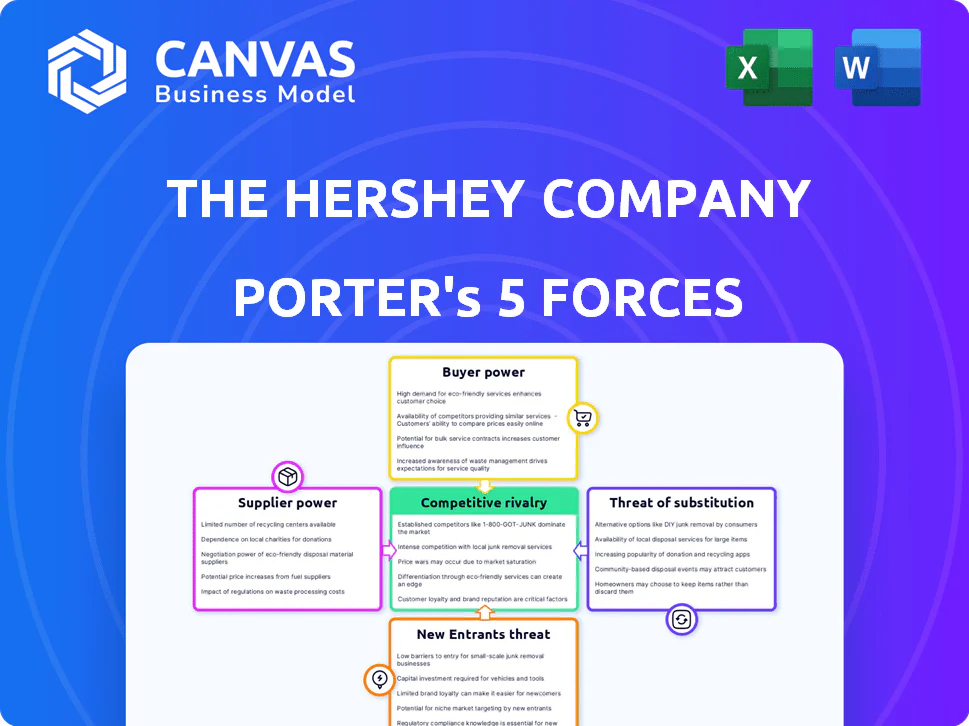
The Hershey Company faces moderate supplier power, high buyer expectations for value and variety, intense rivalry from Mars and Nestlé, low threat of new entrants due to scale and regulation, and a growing substitute threat from healthier snacks and private labels.
This brief snapshot only scratches the surface. Unlock the full Porter's Five Forces Analysis to explore The Hershey Company's competitive dynamics, market pressures, and strategic advantages in detail.
Suppliers Bargaining Power

Cocoa supply concentration
The global cocoa market is >60% concentrated in West Africa (Ivory Coast/Ghana) and Hershey (2025 fiscal cocoa use ~330k tonnes) remains exposed to regional instability and climate shocks, limiting rapid sourcing shifts.
Hershey's 2025 sourcing diversification efforts cover ~25% of volumes, but the company's scale means major processors and traders can push prices after repeated 2024-2026 supply shocks, increasing supplier leverage.
Rising ESG compliance costs
Suppliers are shifting ESG certification and ethical-labor monitoring costs onto Hershey, raising cocoa sourcing expenses by about 6-8%, adding roughly $120-160 million to Hershey's 2025 COGS based on its $2.0 billion cocoa-related spend.
Stricter 2025 deforestation and child-labor rules mean certified beans command a 10-15% premium, reducing Hershey's margin unless it secures large certified suppliers.
Power moves to big, certified suppliers: in 2025 roughly 60% of compliant cocoa supply is controlled by top cooperatives, constraining Hershey's negotiating leverage.

Specialized dairy and sugar inputs
Hershey relies on specific grades of dairy and sugar meeting North American standards, narrowing viable vendors and keeping supplier power moderately high; U.S. sugar tariffs and TRQ limits keep domestic prices ~30-40% above world levels in 2025, raising procurement costs. Fresh dairy logistics favor large cooperatives-Dairy Farmers of America and Saputo supply significant volumes-creating regional dependence and limited substitution. In 2025 Hershey spent approximately $1.2 billion on dairy and $450 million on sugar inputs, concentrating bargaining leverage with a few suppliers. This concentration and transport complexity sustain moderate supplier power in confectionery.

Inflationary pressure on packaging
Rising demand for eco-friendly wrappers keeps sustainable packaging costs high-recycled PET prices rose ~22% in 2025 vs. 2023, pressuring margins for The Hershey Company.
Hershey's long-term contracts with specialist firms (zero-waste, freshness tech) limit supplier switching, raising supplier bargaining power and locking in higher unit costs.
Specialized specs prevent moving to lowest bidders without risking shelf-life and brand trust, so supplier leverage remains elevated.
- Recycled PET up ~22% (2025 vs 2023)
- Long-term specialist contracts = low switching
- Higher unit packaging cost squeezes margins
Logistics and labor leverage
Consolidation in freight and 3PLs lets logistics providers demand higher rates; U.S. trucking capacity tightened in 2025 with driver shortages up ~12% year-over-year, pushing spot rates 8-10% higher, raising Hershey's outbound costs for heavy bulk goods.
Hershey's reliance on concentrated infrastructure means logistics suppliers keep firm pricing even as cocoa and sugar commodity prices eased in 2025, squeezing gross margins on volume-sensitive SKUs.
- Trucking driver shortage: +12% (2025)
- Spot freight rates: +8-10% (2025)
- Higher outbound cost pressure on Hershey gross margins
Suppliers' leverage lifts Hershey costs-cocoa, dairy, sugar and ESG premiums bite
Suppliers hold moderate-to-high power: cocoa concentration in West Africa (~60%) and Hershey's 2025 cocoa use (~330,000 tonnes) limit sourcing shifts; certified-bean premiums (10-15%) and added ESG costs (~6-8%, ~$120-160M on $2.0B cocoa spend) raise COGS; dairy ($1.2B) and sugar ($450M) vendor concentration plus packaging and freight cost inflation sustain supplier leverage.
| Metric | 2025 Value |
|---|---|
| Cocoa use | ~330,000 t |
| Cocoa spend | $2.0B |
| ESG cost add | 6-8% (~$120-160M) |
| Certified premium | 10-15% |
| Dairy spend | $1.2B |
| Sugar spend | $450M |
| Recycled PET change | +22% vs 2023 |
| Trucking driver shortage | +12% |
| Spot freight rates | +8-10% |
What is included in the product
 Detailed Word Document
Tailored exclusively for The Hershey Company, this Porter's Five Forces overview uncovers competitive drivers, buyer/supplier power, barriers to entry, threat of substitutes, and disruptive risks shaping its pricing and profitability.

 Customizable Excel Spreadsheet
A concise Porter's Five Forces snapshot for The Hershey Company-helps you quickly gauge competitive threats and prioritize strategic moves.
Customers Bargaining Power

Retailer consolidation and dominance
Giant retailers Walmart, Target and Amazon accounted for roughly 38% of The Hershey Company's fiscal 2025 net sales (~$3.5bn of $9.2bn), giving them leverage to push lower wholesale prices and higher promotional intensity.
They use shelf-space dominance and slotting fees to extract concessions; Hershey reported promotional spend of about $720m in 2025 to support trade discounts and displays.
In 2026 retailers cut low-velocity SKUs fast, shifting shelf space to higher-margin private label or faster-moving snacks, increasing Hershey's pressure to fund promotions or lose distribution.
Growth of private label brands
As of FY2025, Hershey Company faces rising customer bargaining power as private-label chocolate sales grew to 14% U.S. category share, with retailers offering equivalent taste at 20-30% lower prices; when Hershey's national-price gap exceeds ~25%, consumer switching risk spikes, pressuring gross margins (Hershey FY2025 gross margin 43.1%).

Impact of GLP-1 medications
Widespread GLP-1 adoption through 2025-2026 cut U.S. snack consumption; 2025 Nielsen data show a 6% decline in sugar-snack unit sales while better-for-you snacks rose 12%, shifting the Hershey Company pricing power as health-focused buyers trade down portion size and spend more on functional snacks.

Digital price transparency
Digital price transparency lets shoppers compare a Hershey bar price across retailers in seconds via apps, reducing regional or channel price gaps and squeezing Hershey's gross margins; online price checks contributed to a 1.8% YOY retail price compression in U.S. confectionery in 2025.
Informed buyers switch to the best bundle or discount, raising churn and forcing Hershey to match promotions-Hershey reported trade spend of $1.42 billion in FY2025, reflecting this pricing pressure.
- Real-time price checks erode price variance
- 1.8% U.S. confectionery price compression (2025)
- $1.42B Hershey trade spend in FY2025
Low switching costs for snackers
Low switching costs mean a shopper can swap a Reese's Cup for a competitor's peanut-butter treat or any snack with virtually no friction, so Hershey's pricing power is limited.
Confectionery buys are impulsive and habitual, easily diverted by a coupon, in-store promotion, or a new launch; NielsenIQ found 32% of US snack purchases in 2025 were promotion-driven.
This dynamic places bargaining power with individual shoppers, pressuring margins-Hershey reported 2025 gross margin of 44.2%, reflecting promotional mix.
- Zero switching cost - drives price sensitivity
- 32% US snack purchases promo-driven (NielsenIQ 2025)
- Hershey 2025 gross margin 44.2% - promotional impact
Hershey under retailer squeeze: 38% sales via big-box, heavy promos erode pricing power
Large retailers (Walmart/Target/Amazon) drove ~38% of The Hershey Company FY2025 net sales (~$3.5B of $9.2B), forcing $1.42B trade spend and ~\$720M promotional support; private-label reached 14% U.S. share, online price checks caused 1.8% confectionery price compression (2025), and low switching costs plus 32% promo-driven purchases weaken Hershey's pricing power (FY2025 gross margin ~44.2%).
| Metric | 2025 Value |
|---|---|
| Net sales (FY2025) | $9.2B |
| Top retailers share | 38% (~$3.5B) |
| Trade spend | $1.42B |
| Promotional spend | $720M |
| Private-label U.S. share | 14% |
| Price compression | 1.8% |
| Promo-driven purchases (US) | 32% |
| Gross margin (FY2025) | ~44.2% |
Preview Before You Purchase
The Hershey Company Porter's Five Forces Analysis
This preview shows the exact Porter's Five Forces analysis of The Hershey Company you'll receive immediately after purchase-no surprises or placeholders; it assesses supplier power, buyer power, competitive rivalry, threat of substitutes, and barriers to entry with actionable insights and concise scoring.

Original: $10.00
-65%$10.00
$3.50THE HERSHEY COMPANY PORTER'S FIVE FORCES TEMPLATE RESEARCH
Go Beyond the Preview-Access the Full Strategic Report
The Hershey Company faces moderate supplier power, high buyer expectations for value and variety, intense rivalry from Mars and Nestlé, low threat of new entrants due to scale and regulation, and a growing substitute threat from healthier snacks and private labels.
This brief snapshot only scratches the surface. Unlock the full Porter's Five Forces Analysis to explore The Hershey Company's competitive dynamics, market pressures, and strategic advantages in detail.
Suppliers Bargaining Power
Cocoa supply concentration
The global cocoa market is >60% concentrated in West Africa (Ivory Coast/Ghana) and Hershey (2025 fiscal cocoa use ~330k tonnes) remains exposed to regional instability and climate shocks, limiting rapid sourcing shifts.
Hershey's 2025 sourcing diversification efforts cover ~25% of volumes, but the company's scale means major processors and traders can push prices after repeated 2024-2026 supply shocks, increasing supplier leverage.
Rising ESG compliance costs
Suppliers are shifting ESG certification and ethical-labor monitoring costs onto Hershey, raising cocoa sourcing expenses by about 6-8%, adding roughly $120-160 million to Hershey's 2025 COGS based on its $2.0 billion cocoa-related spend.
Stricter 2025 deforestation and child-labor rules mean certified beans command a 10-15% premium, reducing Hershey's margin unless it secures large certified suppliers.
Power moves to big, certified suppliers: in 2025 roughly 60% of compliant cocoa supply is controlled by top cooperatives, constraining Hershey's negotiating leverage.
Specialized dairy and sugar inputs
Hershey relies on specific grades of dairy and sugar meeting North American standards, narrowing viable vendors and keeping supplier power moderately high; U.S. sugar tariffs and TRQ limits keep domestic prices ~30-40% above world levels in 2025, raising procurement costs. Fresh dairy logistics favor large cooperatives-Dairy Farmers of America and Saputo supply significant volumes-creating regional dependence and limited substitution. In 2025 Hershey spent approximately $1.2 billion on dairy and $450 million on sugar inputs, concentrating bargaining leverage with a few suppliers. This concentration and transport complexity sustain moderate supplier power in confectionery.
Inflationary pressure on packaging
Rising demand for eco-friendly wrappers keeps sustainable packaging costs high-recycled PET prices rose ~22% in 2025 vs. 2023, pressuring margins for The Hershey Company.
Hershey's long-term contracts with specialist firms (zero-waste, freshness tech) limit supplier switching, raising supplier bargaining power and locking in higher unit costs.
Specialized specs prevent moving to lowest bidders without risking shelf-life and brand trust, so supplier leverage remains elevated.
- Recycled PET up ~22% (2025 vs 2023)
- Long-term specialist contracts = low switching
- Higher unit packaging cost squeezes margins
Logistics and labor leverage
Consolidation in freight and 3PLs lets logistics providers demand higher rates; U.S. trucking capacity tightened in 2025 with driver shortages up ~12% year-over-year, pushing spot rates 8-10% higher, raising Hershey's outbound costs for heavy bulk goods.
Hershey's reliance on concentrated infrastructure means logistics suppliers keep firm pricing even as cocoa and sugar commodity prices eased in 2025, squeezing gross margins on volume-sensitive SKUs.
- Trucking driver shortage: +12% (2025)
- Spot freight rates: +8-10% (2025)
- Higher outbound cost pressure on Hershey gross margins
Suppliers' leverage lifts Hershey costs-cocoa, dairy, sugar and ESG premiums bite
Suppliers hold moderate-to-high power: cocoa concentration in West Africa (~60%) and Hershey's 2025 cocoa use (~330,000 tonnes) limit sourcing shifts; certified-bean premiums (10-15%) and added ESG costs (~6-8%, ~$120-160M on $2.0B cocoa spend) raise COGS; dairy ($1.2B) and sugar ($450M) vendor concentration plus packaging and freight cost inflation sustain supplier leverage.
| Metric | 2025 Value |
|---|---|
| Cocoa use | ~330,000 t |
| Cocoa spend | $2.0B |
| ESG cost add | 6-8% (~$120-160M) |
| Certified premium | 10-15% |
| Dairy spend | $1.2B |
| Sugar spend | $450M |
| Recycled PET change | +22% vs 2023 |
| Trucking driver shortage | +12% |
| Spot freight rates | +8-10% |
What is included in the product
Detailed Word Document
Tailored exclusively for The Hershey Company, this Porter's Five Forces overview uncovers competitive drivers, buyer/supplier power, barriers to entry, threat of substitutes, and disruptive risks shaping its pricing and profitability.
Customizable Excel Spreadsheet
A concise Porter's Five Forces snapshot for The Hershey Company-helps you quickly gauge competitive threats and prioritize strategic moves.
Customers Bargaining Power
Retailer consolidation and dominance
Giant retailers Walmart, Target and Amazon accounted for roughly 38% of The Hershey Company's fiscal 2025 net sales (~$3.5bn of $9.2bn), giving them leverage to push lower wholesale prices and higher promotional intensity.
They use shelf-space dominance and slotting fees to extract concessions; Hershey reported promotional spend of about $720m in 2025 to support trade discounts and displays.
In 2026 retailers cut low-velocity SKUs fast, shifting shelf space to higher-margin private label or faster-moving snacks, increasing Hershey's pressure to fund promotions or lose distribution.
Growth of private label brands
As of FY2025, Hershey Company faces rising customer bargaining power as private-label chocolate sales grew to 14% U.S. category share, with retailers offering equivalent taste at 20-30% lower prices; when Hershey's national-price gap exceeds ~25%, consumer switching risk spikes, pressuring gross margins (Hershey FY2025 gross margin 43.1%).
Impact of GLP-1 medications
Widespread GLP-1 adoption through 2025-2026 cut U.S. snack consumption; 2025 Nielsen data show a 6% decline in sugar-snack unit sales while better-for-you snacks rose 12%, shifting the Hershey Company pricing power as health-focused buyers trade down portion size and spend more on functional snacks.
Digital price transparency
Digital price transparency lets shoppers compare a Hershey bar price across retailers in seconds via apps, reducing regional or channel price gaps and squeezing Hershey's gross margins; online price checks contributed to a 1.8% YOY retail price compression in U.S. confectionery in 2025.
Informed buyers switch to the best bundle or discount, raising churn and forcing Hershey to match promotions-Hershey reported trade spend of $1.42 billion in FY2025, reflecting this pricing pressure.
- Real-time price checks erode price variance
- 1.8% U.S. confectionery price compression (2025)
- $1.42B Hershey trade spend in FY2025
Low switching costs for snackers
Low switching costs mean a shopper can swap a Reese's Cup for a competitor's peanut-butter treat or any snack with virtually no friction, so Hershey's pricing power is limited.
Confectionery buys are impulsive and habitual, easily diverted by a coupon, in-store promotion, or a new launch; NielsenIQ found 32% of US snack purchases in 2025 were promotion-driven.
This dynamic places bargaining power with individual shoppers, pressuring margins-Hershey reported 2025 gross margin of 44.2%, reflecting promotional mix.
- Zero switching cost - drives price sensitivity
- 32% US snack purchases promo-driven (NielsenIQ 2025)
- Hershey 2025 gross margin 44.2% - promotional impact
Hershey under retailer squeeze: 38% sales via big-box, heavy promos erode pricing power
Large retailers (Walmart/Target/Amazon) drove ~38% of The Hershey Company FY2025 net sales (~$3.5B of $9.2B), forcing $1.42B trade spend and ~\$720M promotional support; private-label reached 14% U.S. share, online price checks caused 1.8% confectionery price compression (2025), and low switching costs plus 32% promo-driven purchases weaken Hershey's pricing power (FY2025 gross margin ~44.2%).
| Metric | 2025 Value |
|---|---|
| Net sales (FY2025) | $9.2B |
| Top retailers share | 38% (~$3.5B) |
| Trade spend | $1.42B |
| Promotional spend | $720M |
| Private-label U.S. share | 14% |
| Price compression | 1.8% |
| Promo-driven purchases (US) | 32% |
| Gross margin (FY2025) | ~44.2% |
Preview Before You Purchase
The Hershey Company Porter's Five Forces Analysis
This preview shows the exact Porter's Five Forces analysis of The Hershey Company you'll receive immediately after purchase-no surprises or placeholders; it assesses supplier power, buyer power, competitive rivalry, threat of substitutes, and barriers to entry with actionable insights and concise scoring.
Product Information
Product Information
Shipping & Returns
Shipping & Returns
Description
Go Beyond the Preview-Access the Full Strategic Report
The Hershey Company faces moderate supplier power, high buyer expectations for value and variety, intense rivalry from Mars and Nestlé, low threat of new entrants due to scale and regulation, and a growing substitute threat from healthier snacks and private labels.
This brief snapshot only scratches the surface. Unlock the full Porter's Five Forces Analysis to explore The Hershey Company's competitive dynamics, market pressures, and strategic advantages in detail.
Suppliers Bargaining Power
Cocoa supply concentration
The global cocoa market is >60% concentrated in West Africa (Ivory Coast/Ghana) and Hershey (2025 fiscal cocoa use ~330k tonnes) remains exposed to regional instability and climate shocks, limiting rapid sourcing shifts.
Hershey's 2025 sourcing diversification efforts cover ~25% of volumes, but the company's scale means major processors and traders can push prices after repeated 2024-2026 supply shocks, increasing supplier leverage.
Rising ESG compliance costs
Suppliers are shifting ESG certification and ethical-labor monitoring costs onto Hershey, raising cocoa sourcing expenses by about 6-8%, adding roughly $120-160 million to Hershey's 2025 COGS based on its $2.0 billion cocoa-related spend.
Stricter 2025 deforestation and child-labor rules mean certified beans command a 10-15% premium, reducing Hershey's margin unless it secures large certified suppliers.
Power moves to big, certified suppliers: in 2025 roughly 60% of compliant cocoa supply is controlled by top cooperatives, constraining Hershey's negotiating leverage.
Specialized dairy and sugar inputs
Hershey relies on specific grades of dairy and sugar meeting North American standards, narrowing viable vendors and keeping supplier power moderately high; U.S. sugar tariffs and TRQ limits keep domestic prices ~30-40% above world levels in 2025, raising procurement costs. Fresh dairy logistics favor large cooperatives-Dairy Farmers of America and Saputo supply significant volumes-creating regional dependence and limited substitution. In 2025 Hershey spent approximately $1.2 billion on dairy and $450 million on sugar inputs, concentrating bargaining leverage with a few suppliers. This concentration and transport complexity sustain moderate supplier power in confectionery.
Inflationary pressure on packaging
Rising demand for eco-friendly wrappers keeps sustainable packaging costs high-recycled PET prices rose ~22% in 2025 vs. 2023, pressuring margins for The Hershey Company.
Hershey's long-term contracts with specialist firms (zero-waste, freshness tech) limit supplier switching, raising supplier bargaining power and locking in higher unit costs.
Specialized specs prevent moving to lowest bidders without risking shelf-life and brand trust, so supplier leverage remains elevated.
- Recycled PET up ~22% (2025 vs 2023)
- Long-term specialist contracts = low switching
- Higher unit packaging cost squeezes margins
Logistics and labor leverage
Consolidation in freight and 3PLs lets logistics providers demand higher rates; U.S. trucking capacity tightened in 2025 with driver shortages up ~12% year-over-year, pushing spot rates 8-10% higher, raising Hershey's outbound costs for heavy bulk goods.
Hershey's reliance on concentrated infrastructure means logistics suppliers keep firm pricing even as cocoa and sugar commodity prices eased in 2025, squeezing gross margins on volume-sensitive SKUs.
- Trucking driver shortage: +12% (2025)
- Spot freight rates: +8-10% (2025)
- Higher outbound cost pressure on Hershey gross margins
Suppliers' leverage lifts Hershey costs-cocoa, dairy, sugar and ESG premiums bite
Suppliers hold moderate-to-high power: cocoa concentration in West Africa (~60%) and Hershey's 2025 cocoa use (~330,000 tonnes) limit sourcing shifts; certified-bean premiums (10-15%) and added ESG costs (~6-8%, ~$120-160M on $2.0B cocoa spend) raise COGS; dairy ($1.2B) and sugar ($450M) vendor concentration plus packaging and freight cost inflation sustain supplier leverage.
| Metric | 2025 Value |
|---|---|
| Cocoa use | ~330,000 t |
| Cocoa spend | $2.0B |
| ESG cost add | 6-8% (~$120-160M) |
| Certified premium | 10-15% |
| Dairy spend | $1.2B |
| Sugar spend | $450M |
| Recycled PET change | +22% vs 2023 |
| Trucking driver shortage | +12% |
| Spot freight rates | +8-10% |
What is included in the product
Detailed Word Document
Tailored exclusively for The Hershey Company, this Porter's Five Forces overview uncovers competitive drivers, buyer/supplier power, barriers to entry, threat of substitutes, and disruptive risks shaping its pricing and profitability.
Customizable Excel Spreadsheet
A concise Porter's Five Forces snapshot for The Hershey Company-helps you quickly gauge competitive threats and prioritize strategic moves.
Customers Bargaining Power
Retailer consolidation and dominance
Giant retailers Walmart, Target and Amazon accounted for roughly 38% of The Hershey Company's fiscal 2025 net sales (~$3.5bn of $9.2bn), giving them leverage to push lower wholesale prices and higher promotional intensity.
They use shelf-space dominance and slotting fees to extract concessions; Hershey reported promotional spend of about $720m in 2025 to support trade discounts and displays.
In 2026 retailers cut low-velocity SKUs fast, shifting shelf space to higher-margin private label or faster-moving snacks, increasing Hershey's pressure to fund promotions or lose distribution.
Growth of private label brands
As of FY2025, Hershey Company faces rising customer bargaining power as private-label chocolate sales grew to 14% U.S. category share, with retailers offering equivalent taste at 20-30% lower prices; when Hershey's national-price gap exceeds ~25%, consumer switching risk spikes, pressuring gross margins (Hershey FY2025 gross margin 43.1%).
Impact of GLP-1 medications
Widespread GLP-1 adoption through 2025-2026 cut U.S. snack consumption; 2025 Nielsen data show a 6% decline in sugar-snack unit sales while better-for-you snacks rose 12%, shifting the Hershey Company pricing power as health-focused buyers trade down portion size and spend more on functional snacks.
Digital price transparency
Digital price transparency lets shoppers compare a Hershey bar price across retailers in seconds via apps, reducing regional or channel price gaps and squeezing Hershey's gross margins; online price checks contributed to a 1.8% YOY retail price compression in U.S. confectionery in 2025.
Informed buyers switch to the best bundle or discount, raising churn and forcing Hershey to match promotions-Hershey reported trade spend of $1.42 billion in FY2025, reflecting this pricing pressure.
- Real-time price checks erode price variance
- 1.8% U.S. confectionery price compression (2025)
- $1.42B Hershey trade spend in FY2025
Low switching costs for snackers
Low switching costs mean a shopper can swap a Reese's Cup for a competitor's peanut-butter treat or any snack with virtually no friction, so Hershey's pricing power is limited.
Confectionery buys are impulsive and habitual, easily diverted by a coupon, in-store promotion, or a new launch; NielsenIQ found 32% of US snack purchases in 2025 were promotion-driven.
This dynamic places bargaining power with individual shoppers, pressuring margins-Hershey reported 2025 gross margin of 44.2%, reflecting promotional mix.
- Zero switching cost - drives price sensitivity
- 32% US snack purchases promo-driven (NielsenIQ 2025)
- Hershey 2025 gross margin 44.2% - promotional impact
Hershey under retailer squeeze: 38% sales via big-box, heavy promos erode pricing power
Large retailers (Walmart/Target/Amazon) drove ~38% of The Hershey Company FY2025 net sales (~$3.5B of $9.2B), forcing $1.42B trade spend and ~\$720M promotional support; private-label reached 14% U.S. share, online price checks caused 1.8% confectionery price compression (2025), and low switching costs plus 32% promo-driven purchases weaken Hershey's pricing power (FY2025 gross margin ~44.2%).
| Metric | 2025 Value |
|---|---|
| Net sales (FY2025) | $9.2B |
| Top retailers share | 38% (~$3.5B) |
| Trade spend | $1.42B |
| Promotional spend | $720M |
| Private-label U.S. share | 14% |
| Price compression | 1.8% |
| Promo-driven purchases (US) | 32% |
| Gross margin (FY2025) | ~44.2% |
Preview Before You Purchase
The Hershey Company Porter's Five Forces Analysis
This preview shows the exact Porter's Five Forces analysis of The Hershey Company you'll receive immediately after purchase-no surprises or placeholders; it assesses supplier power, buyer power, competitive rivalry, threat of substitutes, and barriers to entry with actionable insights and concise scoring.











