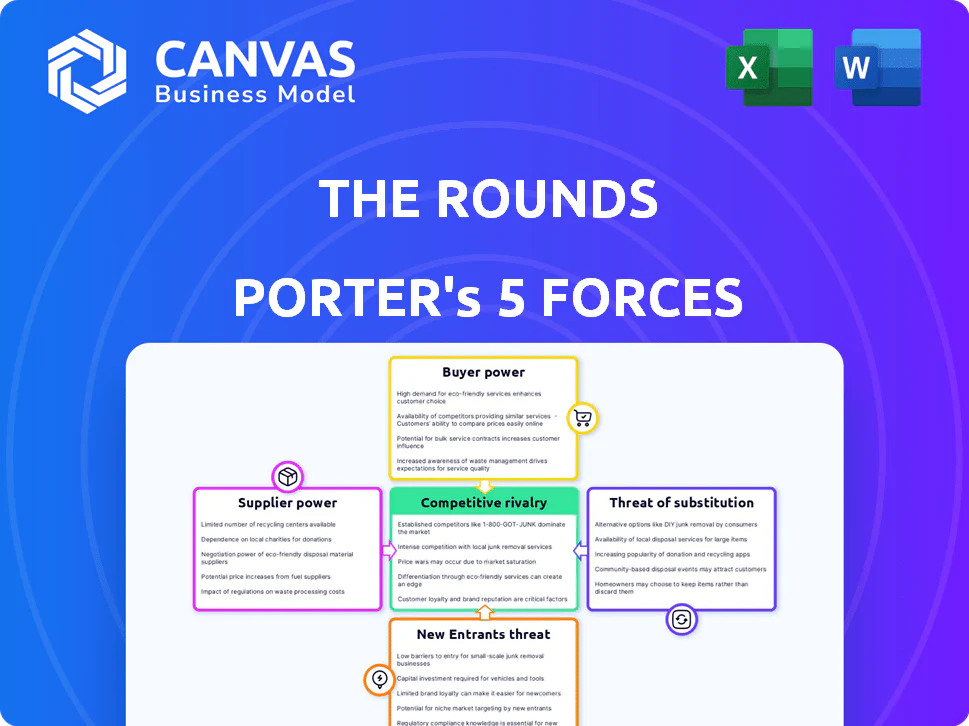
THE ROUNDS PORTER'S FIVE FORCES TEMPLATE RESEARCH
What is included in the product
 Detailed Word Document
Analyzes The Rounds' position within its competitive landscape, addressing threats and market dynamics.

 Customizable Excel Spreadsheet
Instantly visualize competitive forces with a dynamic spider chart—a pain point in understanding market dynamics.
Same Document Delivered
The Rounds Porter's Five Forces Analysis
This is the complete Porter's Five Forces analysis of The Rounds. The preview you see now reflects the entire document, ready for immediate download.

Porter's Five Forces Analysis Template

Don't Miss the Bigger Picture
The Rounds's competitive landscape is shaped by key forces. Analyzing these forces – supplier power, buyer power, competitive rivalry, threat of substitutes, and threat of new entrants – reveals crucial insights. Understanding these dynamics is vital for assessing its long-term viability and strategic positioning. This brief snapshot only scratches the surface. Unlock the full Porter's Five Forces Analysis to explore The Rounds’s competitive dynamics, market pressures, and strategic advantages in detail.
Suppliers Bargaining Power

Availability of alternative suppliers
The Rounds' success hinges on its suppliers, especially for everyday items. The availability of alternative suppliers directly affects their bargaining power. With many suppliers, The Rounds can negotiate better terms. For example, in 2024, the market for common household goods offered numerous suppliers, reducing supplier power.
Uniqueness of products/materials
The Rounds' reliance on reusable packaging, a key differentiator, gives suppliers of these specialized items leverage. If these containers or bulk products are unique or hard to find, suppliers gain power. The market for standardized reusable packaging solutions, still evolving in 2024, affects this dynamic. For example, in 2023, the reusable packaging market was valued at $8.5 billion, showing growth potential, but also competition.

Supplier concentration
If The Rounds relies heavily on a few suppliers, those suppliers gain leverage. Imagine if 80% of The Rounds' packaging comes from one company; that supplier can dictate terms. Diversifying to, say, five suppliers, each providing 20%, diminishes this power. This strategy is key for cost control and supply chain resilience, especially given global economic uncertainties in 2024.

Cost of switching suppliers
The ease with which The Rounds can switch suppliers significantly influences supplier power. High switching costs, like those associated with new contracts or compatibility issues with their reusable system, increase supplier leverage. For instance, changing packaging suppliers could necessitate new equipment, potentially costing The Rounds a considerable sum. In 2024, the average cost to switch business suppliers varied widely, with some changes costing from $5,000 to over $50,000 depending on the industry and the complexity of the switch.
- Significant costs to switch suppliers increase their power.
- Switching packaging suppliers might require new, costly equipment.
- In 2024, supplier switching costs ranged from $5,000 to $50,000+.
- Compatibility issues with the reusable system add to switching costs.
Forward integration threat
Forward integration poses a threat to The Rounds. Suppliers, especially those with strong brands, could enter the zero-waste delivery market directly. This would diminish The Rounds' control over its supply chain. For instance, if a key packaging supplier launched its own delivery service, it would directly compete with The Rounds. This is a real concern, particularly in a market where direct-to-consumer models are growing.
- Forward integration allows suppliers to capture more of the value chain.
- Strong supplier brands can easily attract customers.
- Existing direct-to-consumer channels give suppliers a head start.
- This reduces The Rounds' market share and profit margins.
Supplier Power Dynamics at a Glance
Supplier power at The Rounds depends on alternatives and specialization. If suppliers are numerous, The Rounds gains leverage; if unique, suppliers hold power. Switching costs and forward integration affect this dynamic.
| Factor | Impact | 2024 Data |
|---|---|---|
| Supplier Concentration | High concentration increases supplier power | Top 3 packaging suppliers control ~60% of the market. |
| Switching Costs | High costs boost supplier leverage. | Average switching costs for packaging: $10,000-$40,000. |
| Forward Integration Threat | Suppliers enter the market, reducing The Rounds' control. | Direct-to-consumer market grew by 15% in 2024. |
Customers Bargaining Power

Price sensitivity of customers
The Rounds' pricing strategy significantly impacts customer bargaining power. Customers' willingness to pay more for zero-waste delivery directly affects this. If The Rounds' services are perceived as too costly compared to competitors, customers may demand lower prices or switch to alternatives. In 2024, consumer price sensitivity remains high, influencing purchasing decisions across various sectors.
Availability of alternatives for customers
Customers' bargaining power increases when alternatives are plentiful. In 2024, consumers could choose from traditional grocers, online retailers like Amazon, and sustainable refill services. The ease of switching between these options, like comparing prices on grocery apps, strengthens customer power. This drives companies to compete on price and service. Data from 2024 shows that online grocery sales continue to rise, indicating strong customer alternatives.

Customer concentration
For The Rounds, customer concentration is low because it's a B2C service, so no single customer wields much power. In 2024, the company likely faced the combined power of its customers, who could opt for other delivery services. The collective demand and choices of these customers significantly influence The Rounds' market position and pricing. This dynamic is crucial in shaping its strategies.

Switching costs for customers
The ease with which customers can switch from The Rounds significantly affects their bargaining power. If canceling the service and finding alternatives is straightforward and cheap, customer power increases substantially. In 2024, the subscription-based market saw a churn rate of approximately 30% for services like home delivery, indicating a high degree of customer mobility. This directly impacts The Rounds' ability to set prices and terms.
- Customer churn rates in the home delivery sector reached 30% in 2024.
- Easy cancellation processes empower customers to switch providers.
- High switching costs decrease customer bargaining power.
- Low switching costs increase customer bargaining power.
Customer knowledge and awareness
Customers' knowledge significantly shapes their bargaining power. Those informed about sustainable options and packaging impacts can make value-driven choices, influencing The Rounds. For instance, in 2024, consumer demand for eco-friendly products grew, giving informed customers leverage. This awareness enables advocacy for better practices, directly impacting The Rounds' strategies.
- Growing consumer interest in sustainable packaging.
- Increased access to information via online platforms.
- Ability to switch to competitors.
- Advocacy for better environmental practices.
Customer Power Drives Delivery Shifts
The Rounds faces strong customer bargaining power, especially with easy switching and numerous alternatives. In 2024, home delivery churn hit 30%, highlighting customer mobility. Informed customers, aware of sustainable options, can drive changes.
| Factor | Impact | 2024 Data |
|---|---|---|
| Churn Rate | High bargaining power | 30% in home delivery |
| Alternatives | More choices | Online grocers, competitors |
| Customer Knowledge | Influence on choices | Eco-friendly demand |
Rivalry Among Competitors

Number and intensity of competitors
The Rounds navigates a competitive landscape. It battles against giants like Instacart and DoorDash, alongside other online retailers. The intensity of this rivalry is high due to the numerous competitors vying for market share. In 2024, Instacart controlled roughly 70% of the U.S. grocery delivery market, showing the scale of competition. Aggressive strategies on price, speed, and service define this rivalry.
Market growth rate
The zero-waste and reusable packaging market's growth impacts competitive rivalry. In 2024, this market saw substantial expansion. With the market's growth, companies might prioritize attracting new customers, potentially lessening direct competition. This can lead to less intense rivalry among existing players.

Product differentiation
The Rounds distinguishes itself via its zero-waste system and reusable packaging, setting it apart from traditional retailers. This differentiation impacts rivalry intensity, contingent on customer valuation and competitor replication ease. If customers highly value this, and rivals struggle to imitate it, rivalry is less intense. However, if it's easily copied, competition intensifies. In 2024, the sustainable packaging market is valued at over $300 billion, showing customer demand for this differentiation.

Exit barriers
High exit barriers can significantly impact competitive rivalry. If delivery or retail firms face difficulties in exiting, even when unprofitable, competition intensifies. This can be due to substantial investment in specialized assets, such as reusable packaging or large-scale distribution networks. For example, in 2024, the restaurant industry saw increased competition because of high fixed costs.
- Specialized Assets: Investments in unique, non-transferable assets.
- Long-Term Contracts: Obligations to suppliers that are difficult to break.
- High Fixed Costs: Significant operational expenses that must be covered.
- Government Regulations: Rules and permits that complicate closures.
Diversity of competitors
The Rounds faces intense competition due to the diversity of its rivals. These competitors range from established e-commerce platforms to local sustainable businesses, creating a multifaceted competitive landscape. This variety in business models and strategies results in various forms of rivalry, impacting The Rounds' market position. This can manifest in pricing wars or aggressive marketing campaigns.
- E-commerce sales in the US reached $1.1 trillion in 2023, indicating the scale of competition The Rounds faces.
- Smaller sustainable businesses are growing, with a 15% increase in market share in 2024.
- Competitive pricing is crucial, as a 5% price difference can shift market share significantly.
- Marketing spend is vital; top e-commerce companies spend up to 20% of revenue on marketing.
Grocery Delivery Wars: The Rounds' Competitive Landscape
Competitive rivalry for The Rounds is fierce, with Instacart and DoorDash dominating the grocery delivery market in 2024. The sustainable packaging market's growth and The Rounds' differentiation strategy impact this rivalry. High exit barriers and a diverse competitor base further intensify competition.
| Factor | Impact | Data (2024) |
|---|---|---|
| Market Share | High competition | Instacart: ~70% of U.S. grocery delivery |
| Differentiation | Reduces rivalry if unique | Sustainable packaging market: $300B+ |
| Exit Barriers | Intensifies rivalry | Restaurant industry: increased competition due to fixed costs |
Original: $10.00
-65%$10.00
$3.50THE ROUNDS PORTER'S FIVE FORCES TEMPLATE RESEARCH
What is included in the product
Detailed Word Document
Analyzes The Rounds' position within its competitive landscape, addressing threats and market dynamics.
Customizable Excel Spreadsheet
Instantly visualize competitive forces with a dynamic spider chart—a pain point in understanding market dynamics.
Same Document Delivered
The Rounds Porter's Five Forces Analysis
This is the complete Porter's Five Forces analysis of The Rounds. The preview you see now reflects the entire document, ready for immediate download.
Porter's Five Forces Analysis Template
Don't Miss the Bigger Picture
The Rounds's competitive landscape is shaped by key forces. Analyzing these forces – supplier power, buyer power, competitive rivalry, threat of substitutes, and threat of new entrants – reveals crucial insights. Understanding these dynamics is vital for assessing its long-term viability and strategic positioning. This brief snapshot only scratches the surface. Unlock the full Porter's Five Forces Analysis to explore The Rounds’s competitive dynamics, market pressures, and strategic advantages in detail.
Suppliers Bargaining Power
Availability of alternative suppliers
The Rounds' success hinges on its suppliers, especially for everyday items. The availability of alternative suppliers directly affects their bargaining power. With many suppliers, The Rounds can negotiate better terms. For example, in 2024, the market for common household goods offered numerous suppliers, reducing supplier power.
Uniqueness of products/materials
The Rounds' reliance on reusable packaging, a key differentiator, gives suppliers of these specialized items leverage. If these containers or bulk products are unique or hard to find, suppliers gain power. The market for standardized reusable packaging solutions, still evolving in 2024, affects this dynamic. For example, in 2023, the reusable packaging market was valued at $8.5 billion, showing growth potential, but also competition.
Supplier concentration
If The Rounds relies heavily on a few suppliers, those suppliers gain leverage. Imagine if 80% of The Rounds' packaging comes from one company; that supplier can dictate terms. Diversifying to, say, five suppliers, each providing 20%, diminishes this power. This strategy is key for cost control and supply chain resilience, especially given global economic uncertainties in 2024.
Cost of switching suppliers
The ease with which The Rounds can switch suppliers significantly influences supplier power. High switching costs, like those associated with new contracts or compatibility issues with their reusable system, increase supplier leverage. For instance, changing packaging suppliers could necessitate new equipment, potentially costing The Rounds a considerable sum. In 2024, the average cost to switch business suppliers varied widely, with some changes costing from $5,000 to over $50,000 depending on the industry and the complexity of the switch.
- Significant costs to switch suppliers increase their power.
- Switching packaging suppliers might require new, costly equipment.
- In 2024, supplier switching costs ranged from $5,000 to $50,000+.
- Compatibility issues with the reusable system add to switching costs.
Forward integration threat
Forward integration poses a threat to The Rounds. Suppliers, especially those with strong brands, could enter the zero-waste delivery market directly. This would diminish The Rounds' control over its supply chain. For instance, if a key packaging supplier launched its own delivery service, it would directly compete with The Rounds. This is a real concern, particularly in a market where direct-to-consumer models are growing.
- Forward integration allows suppliers to capture more of the value chain.
- Strong supplier brands can easily attract customers.
- Existing direct-to-consumer channels give suppliers a head start.
- This reduces The Rounds' market share and profit margins.
Supplier Power Dynamics at a Glance
Supplier power at The Rounds depends on alternatives and specialization. If suppliers are numerous, The Rounds gains leverage; if unique, suppliers hold power. Switching costs and forward integration affect this dynamic.
| Factor | Impact | 2024 Data |
|---|---|---|
| Supplier Concentration | High concentration increases supplier power | Top 3 packaging suppliers control ~60% of the market. |
| Switching Costs | High costs boost supplier leverage. | Average switching costs for packaging: $10,000-$40,000. |
| Forward Integration Threat | Suppliers enter the market, reducing The Rounds' control. | Direct-to-consumer market grew by 15% in 2024. |
Customers Bargaining Power
Price sensitivity of customers
The Rounds' pricing strategy significantly impacts customer bargaining power. Customers' willingness to pay more for zero-waste delivery directly affects this. If The Rounds' services are perceived as too costly compared to competitors, customers may demand lower prices or switch to alternatives. In 2024, consumer price sensitivity remains high, influencing purchasing decisions across various sectors.
Availability of alternatives for customers
Customers' bargaining power increases when alternatives are plentiful. In 2024, consumers could choose from traditional grocers, online retailers like Amazon, and sustainable refill services. The ease of switching between these options, like comparing prices on grocery apps, strengthens customer power. This drives companies to compete on price and service. Data from 2024 shows that online grocery sales continue to rise, indicating strong customer alternatives.
Customer concentration
For The Rounds, customer concentration is low because it's a B2C service, so no single customer wields much power. In 2024, the company likely faced the combined power of its customers, who could opt for other delivery services. The collective demand and choices of these customers significantly influence The Rounds' market position and pricing. This dynamic is crucial in shaping its strategies.
Switching costs for customers
The ease with which customers can switch from The Rounds significantly affects their bargaining power. If canceling the service and finding alternatives is straightforward and cheap, customer power increases substantially. In 2024, the subscription-based market saw a churn rate of approximately 30% for services like home delivery, indicating a high degree of customer mobility. This directly impacts The Rounds' ability to set prices and terms.
- Customer churn rates in the home delivery sector reached 30% in 2024.
- Easy cancellation processes empower customers to switch providers.
- High switching costs decrease customer bargaining power.
- Low switching costs increase customer bargaining power.
Customer knowledge and awareness
Customers' knowledge significantly shapes their bargaining power. Those informed about sustainable options and packaging impacts can make value-driven choices, influencing The Rounds. For instance, in 2024, consumer demand for eco-friendly products grew, giving informed customers leverage. This awareness enables advocacy for better practices, directly impacting The Rounds' strategies.
- Growing consumer interest in sustainable packaging.
- Increased access to information via online platforms.
- Ability to switch to competitors.
- Advocacy for better environmental practices.
Customer Power Drives Delivery Shifts
The Rounds faces strong customer bargaining power, especially with easy switching and numerous alternatives. In 2024, home delivery churn hit 30%, highlighting customer mobility. Informed customers, aware of sustainable options, can drive changes.
| Factor | Impact | 2024 Data |
|---|---|---|
| Churn Rate | High bargaining power | 30% in home delivery |
| Alternatives | More choices | Online grocers, competitors |
| Customer Knowledge | Influence on choices | Eco-friendly demand |
Rivalry Among Competitors
Number and intensity of competitors
The Rounds navigates a competitive landscape. It battles against giants like Instacart and DoorDash, alongside other online retailers. The intensity of this rivalry is high due to the numerous competitors vying for market share. In 2024, Instacart controlled roughly 70% of the U.S. grocery delivery market, showing the scale of competition. Aggressive strategies on price, speed, and service define this rivalry.
Market growth rate
The zero-waste and reusable packaging market's growth impacts competitive rivalry. In 2024, this market saw substantial expansion. With the market's growth, companies might prioritize attracting new customers, potentially lessening direct competition. This can lead to less intense rivalry among existing players.
Product differentiation
The Rounds distinguishes itself via its zero-waste system and reusable packaging, setting it apart from traditional retailers. This differentiation impacts rivalry intensity, contingent on customer valuation and competitor replication ease. If customers highly value this, and rivals struggle to imitate it, rivalry is less intense. However, if it's easily copied, competition intensifies. In 2024, the sustainable packaging market is valued at over $300 billion, showing customer demand for this differentiation.
Exit barriers
High exit barriers can significantly impact competitive rivalry. If delivery or retail firms face difficulties in exiting, even when unprofitable, competition intensifies. This can be due to substantial investment in specialized assets, such as reusable packaging or large-scale distribution networks. For example, in 2024, the restaurant industry saw increased competition because of high fixed costs.
- Specialized Assets: Investments in unique, non-transferable assets.
- Long-Term Contracts: Obligations to suppliers that are difficult to break.
- High Fixed Costs: Significant operational expenses that must be covered.
- Government Regulations: Rules and permits that complicate closures.
Diversity of competitors
The Rounds faces intense competition due to the diversity of its rivals. These competitors range from established e-commerce platforms to local sustainable businesses, creating a multifaceted competitive landscape. This variety in business models and strategies results in various forms of rivalry, impacting The Rounds' market position. This can manifest in pricing wars or aggressive marketing campaigns.
- E-commerce sales in the US reached $1.1 trillion in 2023, indicating the scale of competition The Rounds faces.
- Smaller sustainable businesses are growing, with a 15% increase in market share in 2024.
- Competitive pricing is crucial, as a 5% price difference can shift market share significantly.
- Marketing spend is vital; top e-commerce companies spend up to 20% of revenue on marketing.
Grocery Delivery Wars: The Rounds' Competitive Landscape
Competitive rivalry for The Rounds is fierce, with Instacart and DoorDash dominating the grocery delivery market in 2024. The sustainable packaging market's growth and The Rounds' differentiation strategy impact this rivalry. High exit barriers and a diverse competitor base further intensify competition.
| Factor | Impact | Data (2024) |
|---|---|---|
| Market Share | High competition | Instacart: ~70% of U.S. grocery delivery |
| Differentiation | Reduces rivalry if unique | Sustainable packaging market: $300B+ |
| Exit Barriers | Intensifies rivalry | Restaurant industry: increased competition due to fixed costs |
Product Information
Product Information
Shipping & Returns
Shipping & Returns
Description
What is included in the product
Detailed Word Document
Analyzes The Rounds' position within its competitive landscape, addressing threats and market dynamics.
Customizable Excel Spreadsheet
Instantly visualize competitive forces with a dynamic spider chart—a pain point in understanding market dynamics.
Same Document Delivered
The Rounds Porter's Five Forces Analysis
This is the complete Porter's Five Forces analysis of The Rounds. The preview you see now reflects the entire document, ready for immediate download.
Porter's Five Forces Analysis Template
Don't Miss the Bigger Picture
The Rounds's competitive landscape is shaped by key forces. Analyzing these forces – supplier power, buyer power, competitive rivalry, threat of substitutes, and threat of new entrants – reveals crucial insights. Understanding these dynamics is vital for assessing its long-term viability and strategic positioning. This brief snapshot only scratches the surface. Unlock the full Porter's Five Forces Analysis to explore The Rounds’s competitive dynamics, market pressures, and strategic advantages in detail.
Suppliers Bargaining Power
Availability of alternative suppliers
The Rounds' success hinges on its suppliers, especially for everyday items. The availability of alternative suppliers directly affects their bargaining power. With many suppliers, The Rounds can negotiate better terms. For example, in 2024, the market for common household goods offered numerous suppliers, reducing supplier power.
Uniqueness of products/materials
The Rounds' reliance on reusable packaging, a key differentiator, gives suppliers of these specialized items leverage. If these containers or bulk products are unique or hard to find, suppliers gain power. The market for standardized reusable packaging solutions, still evolving in 2024, affects this dynamic. For example, in 2023, the reusable packaging market was valued at $8.5 billion, showing growth potential, but also competition.
Supplier concentration
If The Rounds relies heavily on a few suppliers, those suppliers gain leverage. Imagine if 80% of The Rounds' packaging comes from one company; that supplier can dictate terms. Diversifying to, say, five suppliers, each providing 20%, diminishes this power. This strategy is key for cost control and supply chain resilience, especially given global economic uncertainties in 2024.
Cost of switching suppliers
The ease with which The Rounds can switch suppliers significantly influences supplier power. High switching costs, like those associated with new contracts or compatibility issues with their reusable system, increase supplier leverage. For instance, changing packaging suppliers could necessitate new equipment, potentially costing The Rounds a considerable sum. In 2024, the average cost to switch business suppliers varied widely, with some changes costing from $5,000 to over $50,000 depending on the industry and the complexity of the switch.
- Significant costs to switch suppliers increase their power.
- Switching packaging suppliers might require new, costly equipment.
- In 2024, supplier switching costs ranged from $5,000 to $50,000+.
- Compatibility issues with the reusable system add to switching costs.
Forward integration threat
Forward integration poses a threat to The Rounds. Suppliers, especially those with strong brands, could enter the zero-waste delivery market directly. This would diminish The Rounds' control over its supply chain. For instance, if a key packaging supplier launched its own delivery service, it would directly compete with The Rounds. This is a real concern, particularly in a market where direct-to-consumer models are growing.
- Forward integration allows suppliers to capture more of the value chain.
- Strong supplier brands can easily attract customers.
- Existing direct-to-consumer channels give suppliers a head start.
- This reduces The Rounds' market share and profit margins.
Supplier Power Dynamics at a Glance
Supplier power at The Rounds depends on alternatives and specialization. If suppliers are numerous, The Rounds gains leverage; if unique, suppliers hold power. Switching costs and forward integration affect this dynamic.
| Factor | Impact | 2024 Data |
|---|---|---|
| Supplier Concentration | High concentration increases supplier power | Top 3 packaging suppliers control ~60% of the market. |
| Switching Costs | High costs boost supplier leverage. | Average switching costs for packaging: $10,000-$40,000. |
| Forward Integration Threat | Suppliers enter the market, reducing The Rounds' control. | Direct-to-consumer market grew by 15% in 2024. |
Customers Bargaining Power
Price sensitivity of customers
The Rounds' pricing strategy significantly impacts customer bargaining power. Customers' willingness to pay more for zero-waste delivery directly affects this. If The Rounds' services are perceived as too costly compared to competitors, customers may demand lower prices or switch to alternatives. In 2024, consumer price sensitivity remains high, influencing purchasing decisions across various sectors.
Availability of alternatives for customers
Customers' bargaining power increases when alternatives are plentiful. In 2024, consumers could choose from traditional grocers, online retailers like Amazon, and sustainable refill services. The ease of switching between these options, like comparing prices on grocery apps, strengthens customer power. This drives companies to compete on price and service. Data from 2024 shows that online grocery sales continue to rise, indicating strong customer alternatives.
Customer concentration
For The Rounds, customer concentration is low because it's a B2C service, so no single customer wields much power. In 2024, the company likely faced the combined power of its customers, who could opt for other delivery services. The collective demand and choices of these customers significantly influence The Rounds' market position and pricing. This dynamic is crucial in shaping its strategies.
Switching costs for customers
The ease with which customers can switch from The Rounds significantly affects their bargaining power. If canceling the service and finding alternatives is straightforward and cheap, customer power increases substantially. In 2024, the subscription-based market saw a churn rate of approximately 30% for services like home delivery, indicating a high degree of customer mobility. This directly impacts The Rounds' ability to set prices and terms.
- Customer churn rates in the home delivery sector reached 30% in 2024.
- Easy cancellation processes empower customers to switch providers.
- High switching costs decrease customer bargaining power.
- Low switching costs increase customer bargaining power.
Customer knowledge and awareness
Customers' knowledge significantly shapes their bargaining power. Those informed about sustainable options and packaging impacts can make value-driven choices, influencing The Rounds. For instance, in 2024, consumer demand for eco-friendly products grew, giving informed customers leverage. This awareness enables advocacy for better practices, directly impacting The Rounds' strategies.
- Growing consumer interest in sustainable packaging.
- Increased access to information via online platforms.
- Ability to switch to competitors.
- Advocacy for better environmental practices.
Customer Power Drives Delivery Shifts
The Rounds faces strong customer bargaining power, especially with easy switching and numerous alternatives. In 2024, home delivery churn hit 30%, highlighting customer mobility. Informed customers, aware of sustainable options, can drive changes.
| Factor | Impact | 2024 Data |
|---|---|---|
| Churn Rate | High bargaining power | 30% in home delivery |
| Alternatives | More choices | Online grocers, competitors |
| Customer Knowledge | Influence on choices | Eco-friendly demand |
Rivalry Among Competitors
Number and intensity of competitors
The Rounds navigates a competitive landscape. It battles against giants like Instacart and DoorDash, alongside other online retailers. The intensity of this rivalry is high due to the numerous competitors vying for market share. In 2024, Instacart controlled roughly 70% of the U.S. grocery delivery market, showing the scale of competition. Aggressive strategies on price, speed, and service define this rivalry.
Market growth rate
The zero-waste and reusable packaging market's growth impacts competitive rivalry. In 2024, this market saw substantial expansion. With the market's growth, companies might prioritize attracting new customers, potentially lessening direct competition. This can lead to less intense rivalry among existing players.
Product differentiation
The Rounds distinguishes itself via its zero-waste system and reusable packaging, setting it apart from traditional retailers. This differentiation impacts rivalry intensity, contingent on customer valuation and competitor replication ease. If customers highly value this, and rivals struggle to imitate it, rivalry is less intense. However, if it's easily copied, competition intensifies. In 2024, the sustainable packaging market is valued at over $300 billion, showing customer demand for this differentiation.
Exit barriers
High exit barriers can significantly impact competitive rivalry. If delivery or retail firms face difficulties in exiting, even when unprofitable, competition intensifies. This can be due to substantial investment in specialized assets, such as reusable packaging or large-scale distribution networks. For example, in 2024, the restaurant industry saw increased competition because of high fixed costs.
- Specialized Assets: Investments in unique, non-transferable assets.
- Long-Term Contracts: Obligations to suppliers that are difficult to break.
- High Fixed Costs: Significant operational expenses that must be covered.
- Government Regulations: Rules and permits that complicate closures.
Diversity of competitors
The Rounds faces intense competition due to the diversity of its rivals. These competitors range from established e-commerce platforms to local sustainable businesses, creating a multifaceted competitive landscape. This variety in business models and strategies results in various forms of rivalry, impacting The Rounds' market position. This can manifest in pricing wars or aggressive marketing campaigns.
- E-commerce sales in the US reached $1.1 trillion in 2023, indicating the scale of competition The Rounds faces.
- Smaller sustainable businesses are growing, with a 15% increase in market share in 2024.
- Competitive pricing is crucial, as a 5% price difference can shift market share significantly.
- Marketing spend is vital; top e-commerce companies spend up to 20% of revenue on marketing.
Grocery Delivery Wars: The Rounds' Competitive Landscape
Competitive rivalry for The Rounds is fierce, with Instacart and DoorDash dominating the grocery delivery market in 2024. The sustainable packaging market's growth and The Rounds' differentiation strategy impact this rivalry. High exit barriers and a diverse competitor base further intensify competition.
| Factor | Impact | Data (2024) |
|---|---|---|
| Market Share | High competition | Instacart: ~70% of U.S. grocery delivery |
| Differentiation | Reduces rivalry if unique | Sustainable packaging market: $300B+ |
| Exit Barriers | Intensifies rivalry | Restaurant industry: increased competition due to fixed costs |











