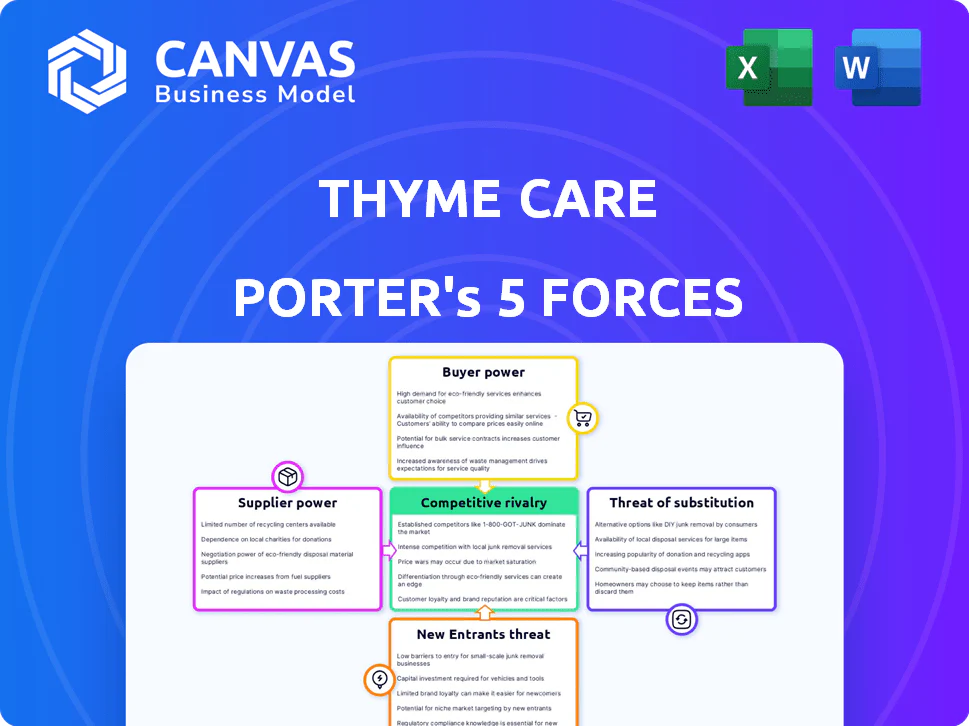
THYME CARE PORTER'S FIVE FORCES TEMPLATE RESEARCH
What is included in the product
 Detailed Word Document
Evaluates control held by suppliers and buyers, and their influence on pricing and profitability.

 Customizable Excel Spreadsheet
Swap in your own data, labels, and notes to reflect current business conditions.
Full Version Awaits
Thyme Care Porter's Five Forces Analysis
This preview presents Thyme Care's Porter's Five Forces analysis. The document meticulously assesses industry dynamics. It analyzes competitive rivalry, supplier power, buyer power, threat of substitutes, and new entrants. The insights here mirror the complete, ready-to-use analysis you'll receive upon purchase.

Porter's Five Forces Analysis Template

From Overview to Strategy Blueprint
Thyme Care faces moderate competitive rivalry in the healthcare navigation space, competing with established players and new entrants. Supplier power is concentrated among large healthcare providers and technology vendors. Buyer power is significant, driven by the negotiation leverage of insurance companies and employers. The threat of substitutes, such as telehealth services, adds pressure. Barriers to entry are relatively low, increasing the threat of new competitors.
This brief snapshot only scratches the surface. Unlock the full Porter's Five Forces Analysis to explore Thyme Care’s competitive dynamics, market pressures, and strategic advantages in detail.
Suppliers Bargaining Power

Suppliers of Technology and Data Analytics
Thyme Care's reliance on technology and data analytics makes its suppliers crucial. The bargaining power of these suppliers hinges on the uniqueness and availability of their offerings. For instance, if specialized software providers have limited competition, they can command higher prices, impacting Thyme Care's costs. In 2024, the healthcare analytics market was valued at $38.2 billion, with a projected CAGR of 15.6% from 2024 to 2032, showing supplier influence.
Suppliers of Healthcare Professionals
Thyme Care's model hinges on oncology nurses and specialists. Their bargaining power depends on demand, location, and retention costs. In 2024, the average oncology nurse salary was roughly $85,000, reflecting their value. A shortage, as projected by the Bureau of Labor Statistics, boosts their influence. This impacts Thyme Care's operational costs.

Suppliers of Clinical Content and Guidelines
Thyme Care's services depend on clinical content and guidelines. Suppliers like medical institutions provide this crucial data. While these suppliers hold some influence, the availability of medical knowledge could limit their power. Access to guidelines is key for evidence-based cancer care.

Suppliers of Support Services
Thyme Care's ability to connect patients with services like rides and bill assistance influences supplier power. The numerous suppliers of these support services, such as transportation companies and financial advisors, generally have dispersed power. Thyme Care benefits from this fragmentation, gaining more negotiating strength due to having multiple service options.
- The U.S. healthcare industry relies on a vast network of suppliers.
- In 2024, the fragmented nature of these suppliers gives companies like Thyme Care leverage.
- This structure allows for cost-effective service procurement.
- The focus is on enhanced patient care and financial efficiency.
Pharmaceutical and Medical Device Suppliers
The pharmaceutical and medical device industries wield considerable bargaining power within the oncology sector. While not direct suppliers to Thyme Care, their pricing affects the overall cost of cancer treatment. This indirect influence is crucial, as Thyme Care seeks to lower these costs. High prices from these suppliers can hinder Thyme Care's ability to achieve its goals.
- In 2024, the U.S. spent over $600 billion on prescription drugs, with oncology drugs being a significant portion.
- Medical device costs also contribute substantially to cancer care expenses, with prices varying widely.
- The bargaining power of these suppliers impacts the financial burden on patients and healthcare providers alike.
Supplier Power Dynamics at Thyme Care
Thyme Care's supplier power varies. Tech and data suppliers have strong influence due to market growth. Nurses and specialists also hold sway, with salaries reflecting their value. Support service suppliers have less power due to fragmentation.
| Supplier Type | Bargaining Power | Impact on Thyme Care |
|---|---|---|
| Tech/Data | High, due to market concentration | Increased costs, innovation |
| Oncology Nurses | Moderate, influenced by demand | Operational costs, service quality |
| Support Services | Low, due to fragmented market | Cost-effective service procurement |
Customers Bargaining Power

Health Plans and Risk-Bearing Entities
Thyme Care's key customers are health plans and risk-bearing organizations. These entities wield considerable bargaining power, managing substantial member bases. They are focused on cutting healthcare costs and improving patient outcomes. In 2024, the average cost of employer-sponsored health insurance rose to over $8,000 annually for individuals, highlighting the pressure to negotiate better rates.
Oncology Groups and Primary Care Groups
Thyme Care collaborates with oncology and primary care groups. Their bargaining power varies based on size and network importance. Larger groups often have more negotiation strength. For instance, in 2024, groups managing a significant patient volume could command better terms. Their perceived value of Thyme Care's services influences this power dynamic.

Patients and Caregivers
Patients and caregivers, though not direct payers, heavily influence Thyme Care's success. Their satisfaction with patient-centric services and feedback directly impacts Thyme Care's reputation. In 2024, patient satisfaction scores in healthcare significantly affected provider ratings. Positive experiences drive referrals and enhance Thyme Care's market position. Negative feedback can lead to service adjustments and reputational damage.

Employers
Employers, acting as indirect customers, significantly influence the healthcare landscape. Their decisions on health plans and care management services are driven by employee health and cost considerations. In 2024, employer-sponsored health insurance covered nearly 157 million Americans, highlighting their substantial market power. This power affects Thyme Care's ability to negotiate pricing and tailor services to meet employer demands.
- Employer-sponsored health insurance covered ~157 million Americans in 2024.
- Employers' focus on cost containment directly impacts healthcare provider choices.
- Thyme Care must align services with employer objectives to secure contracts.
Government Healthcare Agencies
Government healthcare agencies, such as Medicare and Medicaid, wield substantial bargaining power. They influence pricing and service models within the healthcare sector. In 2024, Medicare spending is projected to reach nearly $1 trillion. Medicaid spending is expected to be approximately $800 billion. This power stems from their role as major payers, setting reimbursement rates and imposing regulations.
- Medicare spending expected to be nearly $1 trillion in 2024.
- Medicaid spending is expected to be approximately $800 billion in 2024.
- Government agencies influence pricing and service models in healthcare.
Navigating Customer Power: A Look at Thyme Care's Landscape
Thyme Care faces strong customer bargaining power from health plans and risk-bearing entities, which manage large member bases. These entities prioritize cost reduction, influencing Thyme Care's pricing and service terms. Government agencies, like Medicare and Medicaid, also exert significant influence through reimbursement rates.
| Customer Type | Bargaining Power | Impact on Thyme Care |
|---|---|---|
| Health Plans/Risk-bearing orgs | High | Price pressure, service adjustments |
| Oncology/Primary Care Groups | Variable | Negotiated terms based on size |
| Patients/Caregivers | Indirect, but significant | Reputation, service adjustments |
Rivalry Among Competitors

Direct Competitors in Oncology Care Management
Thyme Care contends with rivals in oncology care management, providing care navigation, symptom management, and resource access. The intensity of competition is shaped by the number and size of competitors, plus how well their services stand out. In 2024, the oncology market is estimated to be worth billions of dollars, with numerous companies vying for market share. Differentiation is crucial to succeed in this crowded landscape.
Fragmented Healthcare System
The U.S. healthcare system's fragmentation poses a competitive challenge. With numerous providers, specialists, and services, patients and payers face a complex landscape. Thyme Care seeks to streamline this experience, yet the system's inherent fragmentation influences competition. In 2024, the U.S. healthcare spending reached $4.8 trillion, highlighting the scale of the market. This complex system impacts Thyme Care's ability to compete effectively.

Traditional Care Coordination Models
Traditional care coordination, found in hospitals and clinics, competes with Thyme Care. These models, though potentially less integrated, offer established services. For instance, in 2024, approximately 60% of hospitals offered some form of care coordination. This existing infrastructure provides an alternative. This impacts Thyme Care's market share.

In-House Capabilities of Health Plans and Provider Groups
Competitive rivalry intensifies as major health plans and oncology groups build internal care management. This strategy reduces reliance on external entities like Thyme Care. For example, UnitedHealth Group's Optum has significantly expanded its care services. Internal development allows for greater control over patient data and care pathways. This direct competition poses a significant challenge to Thyme Care's market share and growth.
- UnitedHealth Group's Optum revenue reached $223.3 billion in 2023, demonstrating significant internal capabilities.
- Internal care models can offer more tailored services, potentially increasing patient satisfaction.
- Direct competition leads to price wars and reduced profit margins.
- Health plans with existing infrastructure have an advantage.
Focus on Value-Based Care
The shift towards value-based care in oncology presents both opportunities and challenges for Thyme Care. This transition increases competition as stakeholders strive to prove cost savings and better patient outcomes. The Centers for Medicare & Medicaid Services (CMS) projects that value-based care models will cover a significant portion of healthcare spending by 2024. This competitive landscape pushes all players to innovate and demonstrate efficiency.
- Value-based care models are expected to cover 50% of healthcare spending by the end of 2024.
- Oncology is a key area for value-based care, with CMS initiatives focusing on bundled payments and quality metrics.
- Thyme Care must compete with other oncology management companies and healthcare providers.
Oncology Care: A Competitive Landscape
Competitive rivalry in oncology care management is intense, driven by numerous competitors and market fragmentation. The U.S. healthcare spending reached $4.8 trillion in 2024, illustrating the market's scale. Internal care models, like UnitedHealth Group's Optum, with $223.3 billion revenue in 2023, pose a direct challenge.
| Factor | Impact | Example |
|---|---|---|
| Market Size | High competition | $4.8T healthcare spending in 2024 |
| Internal Care | Direct competition | Optum's $223.3B revenue (2023) |
| Value-Based Care | Increased rivalry | 50% healthcare spending by 2024 |
Original: $10.00
-65%$10.00
$3.50THYME CARE PORTER'S FIVE FORCES TEMPLATE RESEARCH
What is included in the product
Detailed Word Document
Evaluates control held by suppliers and buyers, and their influence on pricing and profitability.
Customizable Excel Spreadsheet
Swap in your own data, labels, and notes to reflect current business conditions.
Full Version Awaits
Thyme Care Porter's Five Forces Analysis
This preview presents Thyme Care's Porter's Five Forces analysis. The document meticulously assesses industry dynamics. It analyzes competitive rivalry, supplier power, buyer power, threat of substitutes, and new entrants. The insights here mirror the complete, ready-to-use analysis you'll receive upon purchase.
Porter's Five Forces Analysis Template
From Overview to Strategy Blueprint
Thyme Care faces moderate competitive rivalry in the healthcare navigation space, competing with established players and new entrants. Supplier power is concentrated among large healthcare providers and technology vendors. Buyer power is significant, driven by the negotiation leverage of insurance companies and employers. The threat of substitutes, such as telehealth services, adds pressure. Barriers to entry are relatively low, increasing the threat of new competitors.
This brief snapshot only scratches the surface. Unlock the full Porter's Five Forces Analysis to explore Thyme Care’s competitive dynamics, market pressures, and strategic advantages in detail.
Suppliers Bargaining Power
Suppliers of Technology and Data Analytics
Thyme Care's reliance on technology and data analytics makes its suppliers crucial. The bargaining power of these suppliers hinges on the uniqueness and availability of their offerings. For instance, if specialized software providers have limited competition, they can command higher prices, impacting Thyme Care's costs. In 2024, the healthcare analytics market was valued at $38.2 billion, with a projected CAGR of 15.6% from 2024 to 2032, showing supplier influence.
Suppliers of Healthcare Professionals
Thyme Care's model hinges on oncology nurses and specialists. Their bargaining power depends on demand, location, and retention costs. In 2024, the average oncology nurse salary was roughly $85,000, reflecting their value. A shortage, as projected by the Bureau of Labor Statistics, boosts their influence. This impacts Thyme Care's operational costs.
Suppliers of Clinical Content and Guidelines
Thyme Care's services depend on clinical content and guidelines. Suppliers like medical institutions provide this crucial data. While these suppliers hold some influence, the availability of medical knowledge could limit their power. Access to guidelines is key for evidence-based cancer care.
Suppliers of Support Services
Thyme Care's ability to connect patients with services like rides and bill assistance influences supplier power. The numerous suppliers of these support services, such as transportation companies and financial advisors, generally have dispersed power. Thyme Care benefits from this fragmentation, gaining more negotiating strength due to having multiple service options.
- The U.S. healthcare industry relies on a vast network of suppliers.
- In 2024, the fragmented nature of these suppliers gives companies like Thyme Care leverage.
- This structure allows for cost-effective service procurement.
- The focus is on enhanced patient care and financial efficiency.
Pharmaceutical and Medical Device Suppliers
The pharmaceutical and medical device industries wield considerable bargaining power within the oncology sector. While not direct suppliers to Thyme Care, their pricing affects the overall cost of cancer treatment. This indirect influence is crucial, as Thyme Care seeks to lower these costs. High prices from these suppliers can hinder Thyme Care's ability to achieve its goals.
- In 2024, the U.S. spent over $600 billion on prescription drugs, with oncology drugs being a significant portion.
- Medical device costs also contribute substantially to cancer care expenses, with prices varying widely.
- The bargaining power of these suppliers impacts the financial burden on patients and healthcare providers alike.
Supplier Power Dynamics at Thyme Care
Thyme Care's supplier power varies. Tech and data suppliers have strong influence due to market growth. Nurses and specialists also hold sway, with salaries reflecting their value. Support service suppliers have less power due to fragmentation.
| Supplier Type | Bargaining Power | Impact on Thyme Care |
|---|---|---|
| Tech/Data | High, due to market concentration | Increased costs, innovation |
| Oncology Nurses | Moderate, influenced by demand | Operational costs, service quality |
| Support Services | Low, due to fragmented market | Cost-effective service procurement |
Customers Bargaining Power
Health Plans and Risk-Bearing Entities
Thyme Care's key customers are health plans and risk-bearing organizations. These entities wield considerable bargaining power, managing substantial member bases. They are focused on cutting healthcare costs and improving patient outcomes. In 2024, the average cost of employer-sponsored health insurance rose to over $8,000 annually for individuals, highlighting the pressure to negotiate better rates.
Oncology Groups and Primary Care Groups
Thyme Care collaborates with oncology and primary care groups. Their bargaining power varies based on size and network importance. Larger groups often have more negotiation strength. For instance, in 2024, groups managing a significant patient volume could command better terms. Their perceived value of Thyme Care's services influences this power dynamic.
Patients and Caregivers
Patients and caregivers, though not direct payers, heavily influence Thyme Care's success. Their satisfaction with patient-centric services and feedback directly impacts Thyme Care's reputation. In 2024, patient satisfaction scores in healthcare significantly affected provider ratings. Positive experiences drive referrals and enhance Thyme Care's market position. Negative feedback can lead to service adjustments and reputational damage.
Employers
Employers, acting as indirect customers, significantly influence the healthcare landscape. Their decisions on health plans and care management services are driven by employee health and cost considerations. In 2024, employer-sponsored health insurance covered nearly 157 million Americans, highlighting their substantial market power. This power affects Thyme Care's ability to negotiate pricing and tailor services to meet employer demands.
- Employer-sponsored health insurance covered ~157 million Americans in 2024.
- Employers' focus on cost containment directly impacts healthcare provider choices.
- Thyme Care must align services with employer objectives to secure contracts.
Government Healthcare Agencies
Government healthcare agencies, such as Medicare and Medicaid, wield substantial bargaining power. They influence pricing and service models within the healthcare sector. In 2024, Medicare spending is projected to reach nearly $1 trillion. Medicaid spending is expected to be approximately $800 billion. This power stems from their role as major payers, setting reimbursement rates and imposing regulations.
- Medicare spending expected to be nearly $1 trillion in 2024.
- Medicaid spending is expected to be approximately $800 billion in 2024.
- Government agencies influence pricing and service models in healthcare.
Navigating Customer Power: A Look at Thyme Care's Landscape
Thyme Care faces strong customer bargaining power from health plans and risk-bearing entities, which manage large member bases. These entities prioritize cost reduction, influencing Thyme Care's pricing and service terms. Government agencies, like Medicare and Medicaid, also exert significant influence through reimbursement rates.
| Customer Type | Bargaining Power | Impact on Thyme Care |
|---|---|---|
| Health Plans/Risk-bearing orgs | High | Price pressure, service adjustments |
| Oncology/Primary Care Groups | Variable | Negotiated terms based on size |
| Patients/Caregivers | Indirect, but significant | Reputation, service adjustments |
Rivalry Among Competitors
Direct Competitors in Oncology Care Management
Thyme Care contends with rivals in oncology care management, providing care navigation, symptom management, and resource access. The intensity of competition is shaped by the number and size of competitors, plus how well their services stand out. In 2024, the oncology market is estimated to be worth billions of dollars, with numerous companies vying for market share. Differentiation is crucial to succeed in this crowded landscape.
Fragmented Healthcare System
The U.S. healthcare system's fragmentation poses a competitive challenge. With numerous providers, specialists, and services, patients and payers face a complex landscape. Thyme Care seeks to streamline this experience, yet the system's inherent fragmentation influences competition. In 2024, the U.S. healthcare spending reached $4.8 trillion, highlighting the scale of the market. This complex system impacts Thyme Care's ability to compete effectively.
Traditional Care Coordination Models
Traditional care coordination, found in hospitals and clinics, competes with Thyme Care. These models, though potentially less integrated, offer established services. For instance, in 2024, approximately 60% of hospitals offered some form of care coordination. This existing infrastructure provides an alternative. This impacts Thyme Care's market share.
In-House Capabilities of Health Plans and Provider Groups
Competitive rivalry intensifies as major health plans and oncology groups build internal care management. This strategy reduces reliance on external entities like Thyme Care. For example, UnitedHealth Group's Optum has significantly expanded its care services. Internal development allows for greater control over patient data and care pathways. This direct competition poses a significant challenge to Thyme Care's market share and growth.
- UnitedHealth Group's Optum revenue reached $223.3 billion in 2023, demonstrating significant internal capabilities.
- Internal care models can offer more tailored services, potentially increasing patient satisfaction.
- Direct competition leads to price wars and reduced profit margins.
- Health plans with existing infrastructure have an advantage.
Focus on Value-Based Care
The shift towards value-based care in oncology presents both opportunities and challenges for Thyme Care. This transition increases competition as stakeholders strive to prove cost savings and better patient outcomes. The Centers for Medicare & Medicaid Services (CMS) projects that value-based care models will cover a significant portion of healthcare spending by 2024. This competitive landscape pushes all players to innovate and demonstrate efficiency.
- Value-based care models are expected to cover 50% of healthcare spending by the end of 2024.
- Oncology is a key area for value-based care, with CMS initiatives focusing on bundled payments and quality metrics.
- Thyme Care must compete with other oncology management companies and healthcare providers.
Oncology Care: A Competitive Landscape
Competitive rivalry in oncology care management is intense, driven by numerous competitors and market fragmentation. The U.S. healthcare spending reached $4.8 trillion in 2024, illustrating the market's scale. Internal care models, like UnitedHealth Group's Optum, with $223.3 billion revenue in 2023, pose a direct challenge.
| Factor | Impact | Example |
|---|---|---|
| Market Size | High competition | $4.8T healthcare spending in 2024 |
| Internal Care | Direct competition | Optum's $223.3B revenue (2023) |
| Value-Based Care | Increased rivalry | 50% healthcare spending by 2024 |
Product Information
Product Information
Shipping & Returns
Shipping & Returns
Description
What is included in the product
Detailed Word Document
Evaluates control held by suppliers and buyers, and their influence on pricing and profitability.
Customizable Excel Spreadsheet
Swap in your own data, labels, and notes to reflect current business conditions.
Full Version Awaits
Thyme Care Porter's Five Forces Analysis
This preview presents Thyme Care's Porter's Five Forces analysis. The document meticulously assesses industry dynamics. It analyzes competitive rivalry, supplier power, buyer power, threat of substitutes, and new entrants. The insights here mirror the complete, ready-to-use analysis you'll receive upon purchase.
Porter's Five Forces Analysis Template
From Overview to Strategy Blueprint
Thyme Care faces moderate competitive rivalry in the healthcare navigation space, competing with established players and new entrants. Supplier power is concentrated among large healthcare providers and technology vendors. Buyer power is significant, driven by the negotiation leverage of insurance companies and employers. The threat of substitutes, such as telehealth services, adds pressure. Barriers to entry are relatively low, increasing the threat of new competitors.
This brief snapshot only scratches the surface. Unlock the full Porter's Five Forces Analysis to explore Thyme Care’s competitive dynamics, market pressures, and strategic advantages in detail.
Suppliers Bargaining Power
Suppliers of Technology and Data Analytics
Thyme Care's reliance on technology and data analytics makes its suppliers crucial. The bargaining power of these suppliers hinges on the uniqueness and availability of their offerings. For instance, if specialized software providers have limited competition, they can command higher prices, impacting Thyme Care's costs. In 2024, the healthcare analytics market was valued at $38.2 billion, with a projected CAGR of 15.6% from 2024 to 2032, showing supplier influence.
Suppliers of Healthcare Professionals
Thyme Care's model hinges on oncology nurses and specialists. Their bargaining power depends on demand, location, and retention costs. In 2024, the average oncology nurse salary was roughly $85,000, reflecting their value. A shortage, as projected by the Bureau of Labor Statistics, boosts their influence. This impacts Thyme Care's operational costs.
Suppliers of Clinical Content and Guidelines
Thyme Care's services depend on clinical content and guidelines. Suppliers like medical institutions provide this crucial data. While these suppliers hold some influence, the availability of medical knowledge could limit their power. Access to guidelines is key for evidence-based cancer care.
Suppliers of Support Services
Thyme Care's ability to connect patients with services like rides and bill assistance influences supplier power. The numerous suppliers of these support services, such as transportation companies and financial advisors, generally have dispersed power. Thyme Care benefits from this fragmentation, gaining more negotiating strength due to having multiple service options.
- The U.S. healthcare industry relies on a vast network of suppliers.
- In 2024, the fragmented nature of these suppliers gives companies like Thyme Care leverage.
- This structure allows for cost-effective service procurement.
- The focus is on enhanced patient care and financial efficiency.
Pharmaceutical and Medical Device Suppliers
The pharmaceutical and medical device industries wield considerable bargaining power within the oncology sector. While not direct suppliers to Thyme Care, their pricing affects the overall cost of cancer treatment. This indirect influence is crucial, as Thyme Care seeks to lower these costs. High prices from these suppliers can hinder Thyme Care's ability to achieve its goals.
- In 2024, the U.S. spent over $600 billion on prescription drugs, with oncology drugs being a significant portion.
- Medical device costs also contribute substantially to cancer care expenses, with prices varying widely.
- The bargaining power of these suppliers impacts the financial burden on patients and healthcare providers alike.
Supplier Power Dynamics at Thyme Care
Thyme Care's supplier power varies. Tech and data suppliers have strong influence due to market growth. Nurses and specialists also hold sway, with salaries reflecting their value. Support service suppliers have less power due to fragmentation.
| Supplier Type | Bargaining Power | Impact on Thyme Care |
|---|---|---|
| Tech/Data | High, due to market concentration | Increased costs, innovation |
| Oncology Nurses | Moderate, influenced by demand | Operational costs, service quality |
| Support Services | Low, due to fragmented market | Cost-effective service procurement |
Customers Bargaining Power
Health Plans and Risk-Bearing Entities
Thyme Care's key customers are health plans and risk-bearing organizations. These entities wield considerable bargaining power, managing substantial member bases. They are focused on cutting healthcare costs and improving patient outcomes. In 2024, the average cost of employer-sponsored health insurance rose to over $8,000 annually for individuals, highlighting the pressure to negotiate better rates.
Oncology Groups and Primary Care Groups
Thyme Care collaborates with oncology and primary care groups. Their bargaining power varies based on size and network importance. Larger groups often have more negotiation strength. For instance, in 2024, groups managing a significant patient volume could command better terms. Their perceived value of Thyme Care's services influences this power dynamic.
Patients and Caregivers
Patients and caregivers, though not direct payers, heavily influence Thyme Care's success. Their satisfaction with patient-centric services and feedback directly impacts Thyme Care's reputation. In 2024, patient satisfaction scores in healthcare significantly affected provider ratings. Positive experiences drive referrals and enhance Thyme Care's market position. Negative feedback can lead to service adjustments and reputational damage.
Employers
Employers, acting as indirect customers, significantly influence the healthcare landscape. Their decisions on health plans and care management services are driven by employee health and cost considerations. In 2024, employer-sponsored health insurance covered nearly 157 million Americans, highlighting their substantial market power. This power affects Thyme Care's ability to negotiate pricing and tailor services to meet employer demands.
- Employer-sponsored health insurance covered ~157 million Americans in 2024.
- Employers' focus on cost containment directly impacts healthcare provider choices.
- Thyme Care must align services with employer objectives to secure contracts.
Government Healthcare Agencies
Government healthcare agencies, such as Medicare and Medicaid, wield substantial bargaining power. They influence pricing and service models within the healthcare sector. In 2024, Medicare spending is projected to reach nearly $1 trillion. Medicaid spending is expected to be approximately $800 billion. This power stems from their role as major payers, setting reimbursement rates and imposing regulations.
- Medicare spending expected to be nearly $1 trillion in 2024.
- Medicaid spending is expected to be approximately $800 billion in 2024.
- Government agencies influence pricing and service models in healthcare.
Navigating Customer Power: A Look at Thyme Care's Landscape
Thyme Care faces strong customer bargaining power from health plans and risk-bearing entities, which manage large member bases. These entities prioritize cost reduction, influencing Thyme Care's pricing and service terms. Government agencies, like Medicare and Medicaid, also exert significant influence through reimbursement rates.
| Customer Type | Bargaining Power | Impact on Thyme Care |
|---|---|---|
| Health Plans/Risk-bearing orgs | High | Price pressure, service adjustments |
| Oncology/Primary Care Groups | Variable | Negotiated terms based on size |
| Patients/Caregivers | Indirect, but significant | Reputation, service adjustments |
Rivalry Among Competitors
Direct Competitors in Oncology Care Management
Thyme Care contends with rivals in oncology care management, providing care navigation, symptom management, and resource access. The intensity of competition is shaped by the number and size of competitors, plus how well their services stand out. In 2024, the oncology market is estimated to be worth billions of dollars, with numerous companies vying for market share. Differentiation is crucial to succeed in this crowded landscape.
Fragmented Healthcare System
The U.S. healthcare system's fragmentation poses a competitive challenge. With numerous providers, specialists, and services, patients and payers face a complex landscape. Thyme Care seeks to streamline this experience, yet the system's inherent fragmentation influences competition. In 2024, the U.S. healthcare spending reached $4.8 trillion, highlighting the scale of the market. This complex system impacts Thyme Care's ability to compete effectively.
Traditional Care Coordination Models
Traditional care coordination, found in hospitals and clinics, competes with Thyme Care. These models, though potentially less integrated, offer established services. For instance, in 2024, approximately 60% of hospitals offered some form of care coordination. This existing infrastructure provides an alternative. This impacts Thyme Care's market share.
In-House Capabilities of Health Plans and Provider Groups
Competitive rivalry intensifies as major health plans and oncology groups build internal care management. This strategy reduces reliance on external entities like Thyme Care. For example, UnitedHealth Group's Optum has significantly expanded its care services. Internal development allows for greater control over patient data and care pathways. This direct competition poses a significant challenge to Thyme Care's market share and growth.
- UnitedHealth Group's Optum revenue reached $223.3 billion in 2023, demonstrating significant internal capabilities.
- Internal care models can offer more tailored services, potentially increasing patient satisfaction.
- Direct competition leads to price wars and reduced profit margins.
- Health plans with existing infrastructure have an advantage.
Focus on Value-Based Care
The shift towards value-based care in oncology presents both opportunities and challenges for Thyme Care. This transition increases competition as stakeholders strive to prove cost savings and better patient outcomes. The Centers for Medicare & Medicaid Services (CMS) projects that value-based care models will cover a significant portion of healthcare spending by 2024. This competitive landscape pushes all players to innovate and demonstrate efficiency.
- Value-based care models are expected to cover 50% of healthcare spending by the end of 2024.
- Oncology is a key area for value-based care, with CMS initiatives focusing on bundled payments and quality metrics.
- Thyme Care must compete with other oncology management companies and healthcare providers.
Oncology Care: A Competitive Landscape
Competitive rivalry in oncology care management is intense, driven by numerous competitors and market fragmentation. The U.S. healthcare spending reached $4.8 trillion in 2024, illustrating the market's scale. Internal care models, like UnitedHealth Group's Optum, with $223.3 billion revenue in 2023, pose a direct challenge.
| Factor | Impact | Example |
|---|---|---|
| Market Size | High competition | $4.8T healthcare spending in 2024 |
| Internal Care | Direct competition | Optum's $223.3B revenue (2023) |
| Value-Based Care | Increased rivalry | 50% healthcare spending by 2024 |











