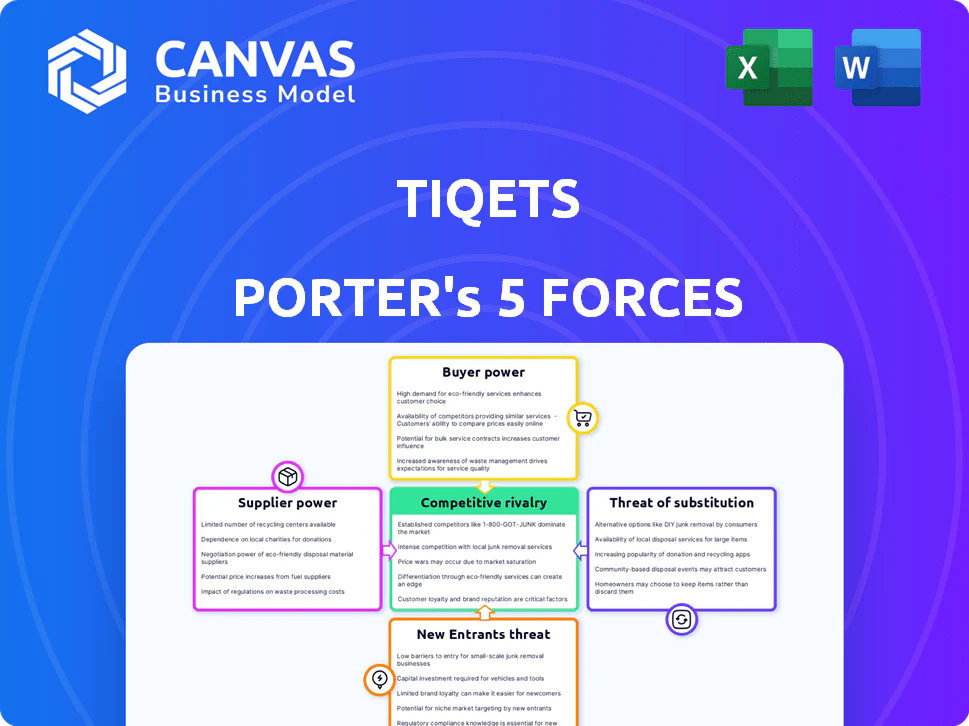
TIQETS PORTER'S FIVE FORCES TEMPLATE RESEARCH
What is included in the product
 Detailed Word Document
Tailored exclusively for Tiqets, analyzing its position within its competitive landscape.

 Customizable Excel Spreadsheet
Easily compare multiple scenarios with duplicate tabs for various market conditions.
Preview the Actual Deliverable
Tiqets Porter's Five Forces Analysis
This is the complete Porter's Five Forces analysis you'll receive. The preview shows the same in-depth document—no hidden sections, no revisions needed. Get instant access to a comprehensive evaluation of Tiqets' competitive landscape. The file is ready for download and immediate use upon purchase. You're getting the final version.

Porter's Five Forces Analysis Template

Go Beyond the Preview—Access the Full Strategic Report
Tiqets faces a dynamic competitive landscape, influenced by both established players and emerging technologies. Buyer power varies across different ticket types and distribution channels, impacting profitability. The threat of new entrants is moderate, with established brands creating barriers. Substitutes, such as direct venue bookings, pose a persistent challenge. Strong supplier relationships are critical to success.
This brief snapshot only scratches the surface. Unlock the full Porter's Five Forces Analysis to explore Tiqets’s competitive dynamics, market pressures, and strategic advantages in detail.
Suppliers Bargaining Power

Dependence on Venues
Tiqets' success is tied to its venue partnerships. Venues with high demand, like the Louvre Museum, have strong bargaining power. In 2024, the top 10% of attractions likely commanded better commission rates. Tiqets needs a diverse portfolio, but popular venues set the terms.
Technology Providers
Tiqets relies on tech providers for its platform, including website and payment processing. A concentration of these providers could lead to higher costs. In 2024, the global payment processing market was valued at approximately $120 billion, showing the potential impact of supplier power. Limited options in key tech areas could increase Tiqets' expenses.

Content and Data Suppliers
Tiqets depends on venues for content like descriptions and availability. In 2024, the global tours and activities market was valued at over $200 billion. The ability to secure this data efficiently affects Tiqets' operational effectiveness. Strong supplier power could increase costs or limit access to quality content.

Payment Gateways
Payment gateways are crucial for online ticket sales, enabling secure transactions. The online ticketing industry depends on these gateways for processing payments, making them vital. High reliance on a few major payment providers gives them leverage over transaction fees and service terms. This can impact the profitability of ticketing platforms.
- In 2024, the global payment processing market is valued at over $100 billion.
- Companies like Stripe and PayPal dominate the payment gateway market.
- Transaction fees can range from 1.5% to 3.5% per transaction.
- Negotiating power is crucial to minimize costs.
Affiliate and Distribution Partners
Tiqets relies on affiliate and distribution partners to broaden its market reach. These partners, crucial for driving traffic and sales, can influence commission rates and marketing support. This dynamic impacts Tiqets' profitability and operational costs. The company’s ability to manage these relationships is vital for sustained growth.
- In 2024, affiliate marketing spending is projected to reach $10.2 billion in the U.S.
- Distribution partners often command a significant portion of revenue, influencing profit margins.
- Successful negotiation with partners directly affects Tiqets' financial performance.
- Effective management of partner relationships is key for long-term sustainability.
Navigating Costs: Key Players in the Tours Market
Venues, especially popular ones, have strong bargaining power, dictating commission rates. Tech and content providers, including payment gateways, also wield influence over costs. In 2024, the global tours and activities market was valued at over $200 billion, highlighting the scale. Tiqets must manage these relationships to control expenses and maintain access.
| Supplier Type | Impact | 2024 Data |
|---|---|---|
| Venues | High commission demands | Top attractions command better rates |
| Tech Providers | Higher platform costs | Payment processing market: $120B |
| Content Suppliers | Content access and cost | Tours & Activities Market: $200B+ |
Customers Bargaining Power

Availability of Alternatives
Customers of Tiqets have many choices for buying tickets, such as booking directly with venues or using other online travel agencies (OTAs). This abundance of alternatives strengthens customer bargaining power. In 2024, the OTA market was worth over $750 billion, showing how many options are available. This gives customers more leverage to negotiate for better deals.
Price Sensitivity
Customers in the travel and leisure sector are highly price-sensitive, consistently seeking the best deals and discounts. Tiqets must offer competitive pricing and demonstrate value to attract and retain customers. This focus on pricing can compress Tiqets' profit margins. For example, in 2024, the average discount offered in the online travel market was around 15-20% to stay competitive.

Access to Information
Customers of Tiqets have significant bargaining power due to easy access to information. Online reviews, social media, and travel blogs provide detailed insights into pricing and service quality. This transparency allows customers to compare offerings and negotiate or switch providers, like the 2024 surge in online travel bookings, which hit $750 billion globally. This shift emphasizes the importance of competitive pricing and service excellence.

Low Switching Costs
Customers of Tiqets, and similar platforms, face low switching costs. Moving between platforms is simple, enhancing customer power. The ease of switching impacts pricing and service demands. This dynamic is crucial for understanding market competition.
- Switching between ticketing platforms involves minimal effort.
- Customers can easily compare prices and features across different providers.
- This ease of comparison increases customer bargaining power.
- In 2024, the global online ticketing market was valued at $48.6 billion.
Demand for Convenience and User Experience
Customers today demand convenience and a great user experience when booking tickets. Platforms that offer easy-to-use interfaces, mobile access, and instant ticket delivery are favored. Failing to meet these expectations can lead to customers switching to competitors, thus increasing customer bargaining power. In 2024, mobile ticketing accounted for over 60% of all digital ticket sales, highlighting the importance of mobile accessibility.
- Mobile ticketing accounted for over 60% of all digital ticket sales in 2024.
- User-friendly interfaces and instant delivery are crucial for customer retention.
- Customer platform choices drive competitive dynamics.
- Convenience directly impacts customer purchasing decisions.
Customer Power: Driving OTA Market Dynamics
Customers wield significant bargaining power due to numerous choices and easy switching. The OTA market reached over $750 billion in 2024, increasing customer leverage. Price sensitivity and access to information, like online reviews, amplify this power. Mobile ticketing, accounting for over 60% of digital sales in 2024, shows the demand for convenience, further influencing customer decisions.
| Aspect | Impact | 2024 Data |
|---|---|---|
| Market Alternatives | Increased Choice | OTA Market: $750B+ |
| Price Sensitivity | Demand for Discounts | Avg. Discount: 15-20% |
| Ease of Switching | Low Switching Costs | Online Ticketing: $48.6B |
Rivalry Among Competitors

Presence of Major OTAs
Major online travel agencies (OTAs) such as Expedia, Booking Holdings, and Airbnb pose significant competition. These giants boast substantial resources and brand recognition. For example, in 2024, Booking Holdings' revenue reached approximately $21.4 billion. Their large customer bases intensify the competitive landscape for Tiqets. This means Tiqets must compete fiercely for visibility and bookings.
Numerous Niche and Local Players
Tiqets faces intense competition from many niche and local players. These platforms specialize in particular attractions or areas. The market's fragmentation boosts rivalry. For example, the global tours and activities market was valued at $183 billion in 2023.

Differentiation and Unique Offerings
Tiqets faces competition through differentiated services like exclusive deals and loyalty programs. Tiqets uses mobile ticketing and skip-the-line access to stand out. In 2024, the global online ticketing market was valued at $48.8 billion, showing strong competition. Tiqets' curated offerings also help set it apart from rivals.

Marketing and Advertising Spend
Marketing and advertising are critical in the online travel and ticketing sector, fueling intense rivalry. Companies like Tiqets compete by significantly investing in these areas to boost visibility and attract users. This constant need for high spending creates a challenging environment, as firms must continuously market themselves to stay relevant. In 2024, the global advertising market is estimated to reach $750 billion, highlighting the scale of spending. This is a key aspect of Porter's Five Forces analysis.
- Advertising costs can represent a large portion of operational expenses for many online travel companies.
- Competition is fierce, with many companies vying for the same customers.
- Marketing strategies include digital ads, social media campaigns, and partnerships.
- The need to stay ahead in marketing pushes for innovation.
Technological Innovation
Technological innovation significantly shapes the online ticketing arena. Continuous advancements drive better user experiences and new features, and efficiency is key. Tiqets must keep up with tech changes to thrive. In 2024, mobile ticketing adoption rose, with 60% of users preferring it. Investment in AI-driven personalization is crucial.
- Mobile Ticketing: 60% user preference in 2024.
- AI Investment: Crucial for personalization.
- Innovation: Vital for competitive advantage.
- User Experience: Constant improvement needed.
Tiqets' Market: Fierce Competition!
Competitive rivalry in Tiqets' market is intense. Major OTAs like Booking Holdings, with 2024 revenue of $21.4B, compete. Niche players and differentiated services add to the competition. Marketing and tech innovation drive rivalry.
| Aspect | Details | Impact |
|---|---|---|
| OTAs | Expedia, Booking Holdings | High competition, resource advantage |
| Niche Players | Local and specialized platforms | Market fragmentation, intense competition |
| Marketing | Advertising spend, digital campaigns | High costs, need for innovation |
Original: $10.00
-65%$10.00
$3.50TIQETS PORTER'S FIVE FORCES TEMPLATE RESEARCH
What is included in the product
Detailed Word Document
Tailored exclusively for Tiqets, analyzing its position within its competitive landscape.
Customizable Excel Spreadsheet
Easily compare multiple scenarios with duplicate tabs for various market conditions.
Preview the Actual Deliverable
Tiqets Porter's Five Forces Analysis
This is the complete Porter's Five Forces analysis you'll receive. The preview shows the same in-depth document—no hidden sections, no revisions needed. Get instant access to a comprehensive evaluation of Tiqets' competitive landscape. The file is ready for download and immediate use upon purchase. You're getting the final version.
Porter's Five Forces Analysis Template
Go Beyond the Preview—Access the Full Strategic Report
Tiqets faces a dynamic competitive landscape, influenced by both established players and emerging technologies. Buyer power varies across different ticket types and distribution channels, impacting profitability. The threat of new entrants is moderate, with established brands creating barriers. Substitutes, such as direct venue bookings, pose a persistent challenge. Strong supplier relationships are critical to success.
This brief snapshot only scratches the surface. Unlock the full Porter's Five Forces Analysis to explore Tiqets’s competitive dynamics, market pressures, and strategic advantages in detail.
Suppliers Bargaining Power
Dependence on Venues
Tiqets' success is tied to its venue partnerships. Venues with high demand, like the Louvre Museum, have strong bargaining power. In 2024, the top 10% of attractions likely commanded better commission rates. Tiqets needs a diverse portfolio, but popular venues set the terms.
Technology Providers
Tiqets relies on tech providers for its platform, including website and payment processing. A concentration of these providers could lead to higher costs. In 2024, the global payment processing market was valued at approximately $120 billion, showing the potential impact of supplier power. Limited options in key tech areas could increase Tiqets' expenses.
Content and Data Suppliers
Tiqets depends on venues for content like descriptions and availability. In 2024, the global tours and activities market was valued at over $200 billion. The ability to secure this data efficiently affects Tiqets' operational effectiveness. Strong supplier power could increase costs or limit access to quality content.
Payment Gateways
Payment gateways are crucial for online ticket sales, enabling secure transactions. The online ticketing industry depends on these gateways for processing payments, making them vital. High reliance on a few major payment providers gives them leverage over transaction fees and service terms. This can impact the profitability of ticketing platforms.
- In 2024, the global payment processing market is valued at over $100 billion.
- Companies like Stripe and PayPal dominate the payment gateway market.
- Transaction fees can range from 1.5% to 3.5% per transaction.
- Negotiating power is crucial to minimize costs.
Affiliate and Distribution Partners
Tiqets relies on affiliate and distribution partners to broaden its market reach. These partners, crucial for driving traffic and sales, can influence commission rates and marketing support. This dynamic impacts Tiqets' profitability and operational costs. The company’s ability to manage these relationships is vital for sustained growth.
- In 2024, affiliate marketing spending is projected to reach $10.2 billion in the U.S.
- Distribution partners often command a significant portion of revenue, influencing profit margins.
- Successful negotiation with partners directly affects Tiqets' financial performance.
- Effective management of partner relationships is key for long-term sustainability.
Navigating Costs: Key Players in the Tours Market
Venues, especially popular ones, have strong bargaining power, dictating commission rates. Tech and content providers, including payment gateways, also wield influence over costs. In 2024, the global tours and activities market was valued at over $200 billion, highlighting the scale. Tiqets must manage these relationships to control expenses and maintain access.
| Supplier Type | Impact | 2024 Data |
|---|---|---|
| Venues | High commission demands | Top attractions command better rates |
| Tech Providers | Higher platform costs | Payment processing market: $120B |
| Content Suppliers | Content access and cost | Tours & Activities Market: $200B+ |
Customers Bargaining Power
Availability of Alternatives
Customers of Tiqets have many choices for buying tickets, such as booking directly with venues or using other online travel agencies (OTAs). This abundance of alternatives strengthens customer bargaining power. In 2024, the OTA market was worth over $750 billion, showing how many options are available. This gives customers more leverage to negotiate for better deals.
Price Sensitivity
Customers in the travel and leisure sector are highly price-sensitive, consistently seeking the best deals and discounts. Tiqets must offer competitive pricing and demonstrate value to attract and retain customers. This focus on pricing can compress Tiqets' profit margins. For example, in 2024, the average discount offered in the online travel market was around 15-20% to stay competitive.
Access to Information
Customers of Tiqets have significant bargaining power due to easy access to information. Online reviews, social media, and travel blogs provide detailed insights into pricing and service quality. This transparency allows customers to compare offerings and negotiate or switch providers, like the 2024 surge in online travel bookings, which hit $750 billion globally. This shift emphasizes the importance of competitive pricing and service excellence.
Low Switching Costs
Customers of Tiqets, and similar platforms, face low switching costs. Moving between platforms is simple, enhancing customer power. The ease of switching impacts pricing and service demands. This dynamic is crucial for understanding market competition.
- Switching between ticketing platforms involves minimal effort.
- Customers can easily compare prices and features across different providers.
- This ease of comparison increases customer bargaining power.
- In 2024, the global online ticketing market was valued at $48.6 billion.
Demand for Convenience and User Experience
Customers today demand convenience and a great user experience when booking tickets. Platforms that offer easy-to-use interfaces, mobile access, and instant ticket delivery are favored. Failing to meet these expectations can lead to customers switching to competitors, thus increasing customer bargaining power. In 2024, mobile ticketing accounted for over 60% of all digital ticket sales, highlighting the importance of mobile accessibility.
- Mobile ticketing accounted for over 60% of all digital ticket sales in 2024.
- User-friendly interfaces and instant delivery are crucial for customer retention.
- Customer platform choices drive competitive dynamics.
- Convenience directly impacts customer purchasing decisions.
Customer Power: Driving OTA Market Dynamics
Customers wield significant bargaining power due to numerous choices and easy switching. The OTA market reached over $750 billion in 2024, increasing customer leverage. Price sensitivity and access to information, like online reviews, amplify this power. Mobile ticketing, accounting for over 60% of digital sales in 2024, shows the demand for convenience, further influencing customer decisions.
| Aspect | Impact | 2024 Data |
|---|---|---|
| Market Alternatives | Increased Choice | OTA Market: $750B+ |
| Price Sensitivity | Demand for Discounts | Avg. Discount: 15-20% |
| Ease of Switching | Low Switching Costs | Online Ticketing: $48.6B |
Rivalry Among Competitors
Presence of Major OTAs
Major online travel agencies (OTAs) such as Expedia, Booking Holdings, and Airbnb pose significant competition. These giants boast substantial resources and brand recognition. For example, in 2024, Booking Holdings' revenue reached approximately $21.4 billion. Their large customer bases intensify the competitive landscape for Tiqets. This means Tiqets must compete fiercely for visibility and bookings.
Numerous Niche and Local Players
Tiqets faces intense competition from many niche and local players. These platforms specialize in particular attractions or areas. The market's fragmentation boosts rivalry. For example, the global tours and activities market was valued at $183 billion in 2023.
Differentiation and Unique Offerings
Tiqets faces competition through differentiated services like exclusive deals and loyalty programs. Tiqets uses mobile ticketing and skip-the-line access to stand out. In 2024, the global online ticketing market was valued at $48.8 billion, showing strong competition. Tiqets' curated offerings also help set it apart from rivals.
Marketing and Advertising Spend
Marketing and advertising are critical in the online travel and ticketing sector, fueling intense rivalry. Companies like Tiqets compete by significantly investing in these areas to boost visibility and attract users. This constant need for high spending creates a challenging environment, as firms must continuously market themselves to stay relevant. In 2024, the global advertising market is estimated to reach $750 billion, highlighting the scale of spending. This is a key aspect of Porter's Five Forces analysis.
- Advertising costs can represent a large portion of operational expenses for many online travel companies.
- Competition is fierce, with many companies vying for the same customers.
- Marketing strategies include digital ads, social media campaigns, and partnerships.
- The need to stay ahead in marketing pushes for innovation.
Technological Innovation
Technological innovation significantly shapes the online ticketing arena. Continuous advancements drive better user experiences and new features, and efficiency is key. Tiqets must keep up with tech changes to thrive. In 2024, mobile ticketing adoption rose, with 60% of users preferring it. Investment in AI-driven personalization is crucial.
- Mobile Ticketing: 60% user preference in 2024.
- AI Investment: Crucial for personalization.
- Innovation: Vital for competitive advantage.
- User Experience: Constant improvement needed.
Tiqets' Market: Fierce Competition!
Competitive rivalry in Tiqets' market is intense. Major OTAs like Booking Holdings, with 2024 revenue of $21.4B, compete. Niche players and differentiated services add to the competition. Marketing and tech innovation drive rivalry.
| Aspect | Details | Impact |
|---|---|---|
| OTAs | Expedia, Booking Holdings | High competition, resource advantage |
| Niche Players | Local and specialized platforms | Market fragmentation, intense competition |
| Marketing | Advertising spend, digital campaigns | High costs, need for innovation |
Product Information
Product Information
Shipping & Returns
Shipping & Returns
Description
What is included in the product
Detailed Word Document
Tailored exclusively for Tiqets, analyzing its position within its competitive landscape.
Customizable Excel Spreadsheet
Easily compare multiple scenarios with duplicate tabs for various market conditions.
Preview the Actual Deliverable
Tiqets Porter's Five Forces Analysis
This is the complete Porter's Five Forces analysis you'll receive. The preview shows the same in-depth document—no hidden sections, no revisions needed. Get instant access to a comprehensive evaluation of Tiqets' competitive landscape. The file is ready for download and immediate use upon purchase. You're getting the final version.
Porter's Five Forces Analysis Template
Go Beyond the Preview—Access the Full Strategic Report
Tiqets faces a dynamic competitive landscape, influenced by both established players and emerging technologies. Buyer power varies across different ticket types and distribution channels, impacting profitability. The threat of new entrants is moderate, with established brands creating barriers. Substitutes, such as direct venue bookings, pose a persistent challenge. Strong supplier relationships are critical to success.
This brief snapshot only scratches the surface. Unlock the full Porter's Five Forces Analysis to explore Tiqets’s competitive dynamics, market pressures, and strategic advantages in detail.
Suppliers Bargaining Power
Dependence on Venues
Tiqets' success is tied to its venue partnerships. Venues with high demand, like the Louvre Museum, have strong bargaining power. In 2024, the top 10% of attractions likely commanded better commission rates. Tiqets needs a diverse portfolio, but popular venues set the terms.
Technology Providers
Tiqets relies on tech providers for its platform, including website and payment processing. A concentration of these providers could lead to higher costs. In 2024, the global payment processing market was valued at approximately $120 billion, showing the potential impact of supplier power. Limited options in key tech areas could increase Tiqets' expenses.
Content and Data Suppliers
Tiqets depends on venues for content like descriptions and availability. In 2024, the global tours and activities market was valued at over $200 billion. The ability to secure this data efficiently affects Tiqets' operational effectiveness. Strong supplier power could increase costs or limit access to quality content.
Payment Gateways
Payment gateways are crucial for online ticket sales, enabling secure transactions. The online ticketing industry depends on these gateways for processing payments, making them vital. High reliance on a few major payment providers gives them leverage over transaction fees and service terms. This can impact the profitability of ticketing platforms.
- In 2024, the global payment processing market is valued at over $100 billion.
- Companies like Stripe and PayPal dominate the payment gateway market.
- Transaction fees can range from 1.5% to 3.5% per transaction.
- Negotiating power is crucial to minimize costs.
Affiliate and Distribution Partners
Tiqets relies on affiliate and distribution partners to broaden its market reach. These partners, crucial for driving traffic and sales, can influence commission rates and marketing support. This dynamic impacts Tiqets' profitability and operational costs. The company’s ability to manage these relationships is vital for sustained growth.
- In 2024, affiliate marketing spending is projected to reach $10.2 billion in the U.S.
- Distribution partners often command a significant portion of revenue, influencing profit margins.
- Successful negotiation with partners directly affects Tiqets' financial performance.
- Effective management of partner relationships is key for long-term sustainability.
Navigating Costs: Key Players in the Tours Market
Venues, especially popular ones, have strong bargaining power, dictating commission rates. Tech and content providers, including payment gateways, also wield influence over costs. In 2024, the global tours and activities market was valued at over $200 billion, highlighting the scale. Tiqets must manage these relationships to control expenses and maintain access.
| Supplier Type | Impact | 2024 Data |
|---|---|---|
| Venues | High commission demands | Top attractions command better rates |
| Tech Providers | Higher platform costs | Payment processing market: $120B |
| Content Suppliers | Content access and cost | Tours & Activities Market: $200B+ |
Customers Bargaining Power
Availability of Alternatives
Customers of Tiqets have many choices for buying tickets, such as booking directly with venues or using other online travel agencies (OTAs). This abundance of alternatives strengthens customer bargaining power. In 2024, the OTA market was worth over $750 billion, showing how many options are available. This gives customers more leverage to negotiate for better deals.
Price Sensitivity
Customers in the travel and leisure sector are highly price-sensitive, consistently seeking the best deals and discounts. Tiqets must offer competitive pricing and demonstrate value to attract and retain customers. This focus on pricing can compress Tiqets' profit margins. For example, in 2024, the average discount offered in the online travel market was around 15-20% to stay competitive.
Access to Information
Customers of Tiqets have significant bargaining power due to easy access to information. Online reviews, social media, and travel blogs provide detailed insights into pricing and service quality. This transparency allows customers to compare offerings and negotiate or switch providers, like the 2024 surge in online travel bookings, which hit $750 billion globally. This shift emphasizes the importance of competitive pricing and service excellence.
Low Switching Costs
Customers of Tiqets, and similar platforms, face low switching costs. Moving between platforms is simple, enhancing customer power. The ease of switching impacts pricing and service demands. This dynamic is crucial for understanding market competition.
- Switching between ticketing platforms involves minimal effort.
- Customers can easily compare prices and features across different providers.
- This ease of comparison increases customer bargaining power.
- In 2024, the global online ticketing market was valued at $48.6 billion.
Demand for Convenience and User Experience
Customers today demand convenience and a great user experience when booking tickets. Platforms that offer easy-to-use interfaces, mobile access, and instant ticket delivery are favored. Failing to meet these expectations can lead to customers switching to competitors, thus increasing customer bargaining power. In 2024, mobile ticketing accounted for over 60% of all digital ticket sales, highlighting the importance of mobile accessibility.
- Mobile ticketing accounted for over 60% of all digital ticket sales in 2024.
- User-friendly interfaces and instant delivery are crucial for customer retention.
- Customer platform choices drive competitive dynamics.
- Convenience directly impacts customer purchasing decisions.
Customer Power: Driving OTA Market Dynamics
Customers wield significant bargaining power due to numerous choices and easy switching. The OTA market reached over $750 billion in 2024, increasing customer leverage. Price sensitivity and access to information, like online reviews, amplify this power. Mobile ticketing, accounting for over 60% of digital sales in 2024, shows the demand for convenience, further influencing customer decisions.
| Aspect | Impact | 2024 Data |
|---|---|---|
| Market Alternatives | Increased Choice | OTA Market: $750B+ |
| Price Sensitivity | Demand for Discounts | Avg. Discount: 15-20% |
| Ease of Switching | Low Switching Costs | Online Ticketing: $48.6B |
Rivalry Among Competitors
Presence of Major OTAs
Major online travel agencies (OTAs) such as Expedia, Booking Holdings, and Airbnb pose significant competition. These giants boast substantial resources and brand recognition. For example, in 2024, Booking Holdings' revenue reached approximately $21.4 billion. Their large customer bases intensify the competitive landscape for Tiqets. This means Tiqets must compete fiercely for visibility and bookings.
Numerous Niche and Local Players
Tiqets faces intense competition from many niche and local players. These platforms specialize in particular attractions or areas. The market's fragmentation boosts rivalry. For example, the global tours and activities market was valued at $183 billion in 2023.
Differentiation and Unique Offerings
Tiqets faces competition through differentiated services like exclusive deals and loyalty programs. Tiqets uses mobile ticketing and skip-the-line access to stand out. In 2024, the global online ticketing market was valued at $48.8 billion, showing strong competition. Tiqets' curated offerings also help set it apart from rivals.
Marketing and Advertising Spend
Marketing and advertising are critical in the online travel and ticketing sector, fueling intense rivalry. Companies like Tiqets compete by significantly investing in these areas to boost visibility and attract users. This constant need for high spending creates a challenging environment, as firms must continuously market themselves to stay relevant. In 2024, the global advertising market is estimated to reach $750 billion, highlighting the scale of spending. This is a key aspect of Porter's Five Forces analysis.
- Advertising costs can represent a large portion of operational expenses for many online travel companies.
- Competition is fierce, with many companies vying for the same customers.
- Marketing strategies include digital ads, social media campaigns, and partnerships.
- The need to stay ahead in marketing pushes for innovation.
Technological Innovation
Technological innovation significantly shapes the online ticketing arena. Continuous advancements drive better user experiences and new features, and efficiency is key. Tiqets must keep up with tech changes to thrive. In 2024, mobile ticketing adoption rose, with 60% of users preferring it. Investment in AI-driven personalization is crucial.
- Mobile Ticketing: 60% user preference in 2024.
- AI Investment: Crucial for personalization.
- Innovation: Vital for competitive advantage.
- User Experience: Constant improvement needed.
Tiqets' Market: Fierce Competition!
Competitive rivalry in Tiqets' market is intense. Major OTAs like Booking Holdings, with 2024 revenue of $21.4B, compete. Niche players and differentiated services add to the competition. Marketing and tech innovation drive rivalry.
| Aspect | Details | Impact |
|---|---|---|
| OTAs | Expedia, Booking Holdings | High competition, resource advantage |
| Niche Players | Local and specialized platforms | Market fragmentation, intense competition |
| Marketing | Advertising spend, digital campaigns | High costs, need for innovation |











