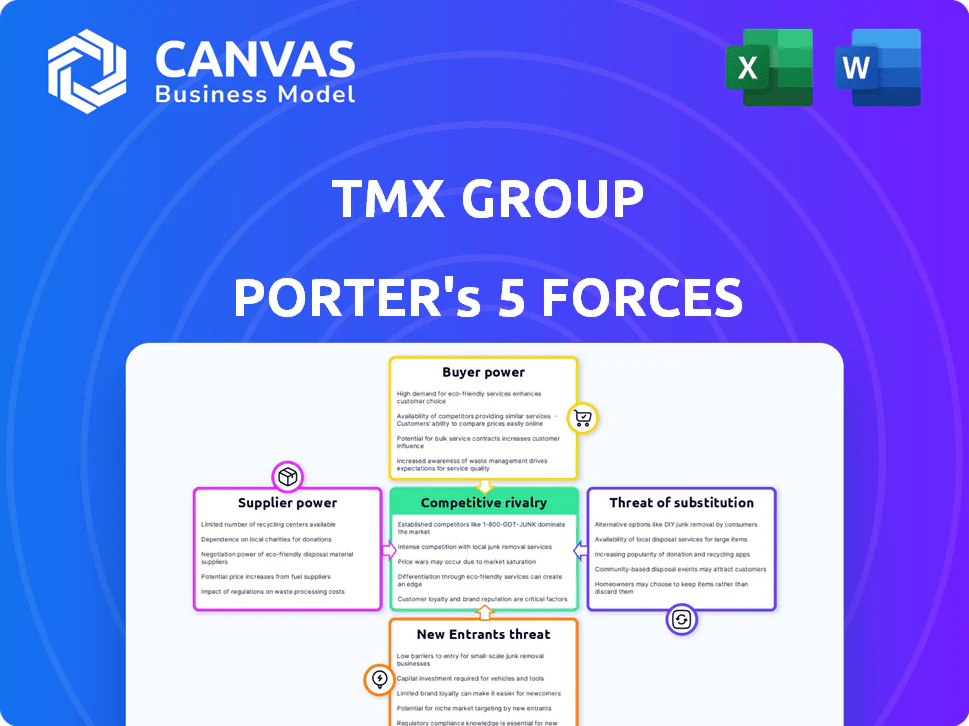
TMX GROUP PORTER'S FIVE FORCES TEMPLATE RESEARCH
What is included in the product
 Detailed Word Document
Tailored exclusively for TMX Group, analyzing its position within its competitive landscape.

 Customizable Excel Spreadsheet
Easily compare force scores side-by-side, illuminating key competitive threats.
Same Document Delivered
TMX Group Porter's Five Forces Analysis
This preview is the complete TMX Group Porter's Five Forces analysis you'll receive. It explores competitive rivalry, supplier power, buyer power, threat of substitutes, and threat of new entrants. The analysis includes concise explanations and relevant assessments. You're seeing the finalized, fully-formatted document—ready for immediate download and use after purchase.

Porter's Five Forces Analysis Template

From Overview to Strategy Blueprint
TMX Group faces intense rivalry in the financial exchange market. Buyer power is moderate, influenced by institutional investors. The threat of new entrants remains low due to high barriers. Substitute products pose a moderate threat. Supplier power, primarily technology providers, is also moderate.
This brief snapshot only scratches the surface. Unlock the full Porter's Five Forces Analysis to explore TMX Group’s competitive dynamics, market pressures, and strategic advantages in detail.
Suppliers Bargaining Power

Technology Providers
TMX Group depends on technology providers for its trading, clearing, and data systems. The power of suppliers hinges on tech uniqueness and alternatives. In 2024, IT spending in financial services is projected to exceed $700 billion globally. Limited alternatives increase supplier power, impacting TMX's costs.
Data Providers
TMX Group relies heavily on data providers for its financial data offerings. The bargaining power of these suppliers hinges on data exclusivity and breadth. In 2024, TMX Group's data and analytics revenue reached $281.5 million. Comprehensive data sources are key for TMX's competitive edge.

Connectivity Providers
TMX Group relies heavily on connectivity providers for its operations. The dependability of these services is crucial for smooth market function. Supplier power hinges on infrastructure control and market competition. In 2024, TMX Group's costs for data and network services were significant.

Real Estate and Facilities Management
TMX Group's reliance on real estate and facilities management suppliers influences its operations. The availability of suitable properties and specialized service providers impacts the bargaining power of these suppliers. Limited options can increase supplier power, potentially affecting costs and operational flexibility. In 2024, TMX Group's operating expenses included significant costs related to property, plant, and equipment, reflecting the importance of these suppliers.
- Real estate costs are a key expense for TMX Group, impacting profitability.
- Specialized service providers for data centers and exchanges have significant influence.
- Concentration of suitable properties can increase supplier bargaining power.
- TMX Group's 2024 financial reports detail these facility-related expenses.
Human Capital
TMX Group's success hinges on skilled employees. The competition for talent in finance, tech, and compliance impacts its operations. This demand grants employees leverage in negotiations. In 2024, the average salary for a financial analyst in Toronto, where TMX is based, was about $85,000 CAD.
- Key roles include software developers and regulatory experts.
- Employee bargaining power affects labor costs and retention rates.
- TMX must offer competitive compensation and benefits to attract and keep talent.
- The company's ability to adapt to changing labor market conditions is crucial.
Supplier Power Dynamics at TMX Group
TMX Group's suppliers' power varies by sector. Tech suppliers' hold is high due to uniqueness. Data providers' influence is tied to data breadth. Real estate and labor markets also affect costs.
| Supplier Type | Bargaining Power Factor | 2024 Impact on TMX |
|---|---|---|
| Technology | Uniqueness & Alternatives | IT spend: $700B+ globally |
| Data Providers | Data Exclusivity | $281.5M data revenue |
| Real Estate | Property Availability | Significant facility costs |
Customers Bargaining Power

Institutional Investors and Trading Firms
Institutional investors and high-frequency trading firms are major players on TMX Group's exchanges. They account for a large share of trading volume, giving them leverage. For example, in 2024, institutional trading could represent over 60% of the total volume. This allows them to negotiate fees and request specialized services, impacting TMX Group's revenue.
Listed Companies
Companies listing on TMX Group's exchanges have options, enhancing their bargaining power. In 2024, global exchanges compete fiercely for listings, offering competitive terms. This competition influences fees and compliance demands. For example, in 2024, the TSX saw 150 new listings, showing the ongoing competition among listing venues.

Data Consumers
Financial institutions and data analysis firms wield varying bargaining power over TMX Group's data. Their influence hinges on data needs and alternative sources. TMX Group's acquisition of VettaFi in 2024 strengthened its data offerings. In Q3 2024, TMX Group's revenue from data services was CAD 119.6 million.

Clearing and Settlement Participants
Banks and financial institutions, key users of TMX Group's clearing and settlement services, wield some bargaining power, especially concerning transaction volumes. Their influence is amplified by the presence of alternative clearing houses. For instance, in 2024, the total value of equity trades cleared by TMX reached $3.5 trillion. This substantial volume gives these institutions leverage. Competition from other clearing services also keeps TMX responsive to user needs.
- Volume Dependency: High transaction volumes from major banks grant significant bargaining power.
- Alternative Availability: The presence of other clearing houses limits TMX's pricing and service flexibility.
- Service Demands: Users can negotiate for better terms or demand specific service improvements.
- Market Dynamics: Changes in market conditions can shift the balance of power between TMX and its users.
Government and Regulatory Bodies
Government and regulatory bodies significantly impact TMX Group's operations. These entities, though not direct customers, shape the business through rules and policies. TMX Group actively interacts with these bodies to navigate the regulatory landscape. This engagement is crucial for compliance and strategic planning. The regulatory environment directly affects market operations and financial reporting standards.
- TMX Group follows regulations set by bodies like the Ontario Securities Commission (OSC).
- In 2024, compliance costs for financial institutions have increased by an estimated 10%.
- TMX Group's engagement includes lobbying and providing data to inform policy.
- Changes in regulations can impact trading volumes and market structure.
Customer Bargaining Power Dynamics: A Segmented View
TMX Group's customer bargaining power varies across different segments. Institutional investors and high-frequency traders leverage their trading volumes to negotiate fees. Listing companies benefit from exchange competition, influencing terms. Data users and clearing service clients also hold varying degrees of influence.
| Customer Segment | Bargaining Power | Factors Influencing Power |
|---|---|---|
| Institutional Investors | High | Trading volume, fee negotiations |
| Listing Companies | Moderate | Exchange competition, listing fees |
| Data Users | Moderate | Data needs, alternative sources |
| Clearing Service Clients | Moderate | Transaction volumes, alternative clearing houses |
Rivalry Among Competitors

Other Stock Exchanges
TMX Group competes with exchanges like Nasdaq and NYSE. In 2024, Nasdaq's market cap was around $28 trillion, showing strong rivalry. These exchanges vie for listings, volume, and data revenue. Competition impacts TMX's market share and profitability. This rivalry forces TMX to innovate and offer competitive services.
Alternative Trading Systems (ATS)
Alternative Trading Systems (ATS) compete with traditional exchanges like TMX Group by offering different trading venues. ATSs intensify competition for order flow, potentially impacting TMX Group's market share. In 2024, ATSs handled a significant portion of equity trading volume, around 40% in the US, showing their impact. This rivalry pressures TMX Group to innovate and maintain competitive pricing to retain and attract traders.

Other Clearing Houses
TMX Group faces competition from other clearing houses globally. For instance, the Depository Trust & Clearing Corporation (DTCC) in the U.S. handles trillions of dollars in transactions annually. Competition intensifies as these entities offer services across various asset classes. This rivalry can impact TMX Group's pricing and market share, especially for international participants. In 2024, DTCC processed over $2.5 quadrillion in securities transactions.

Financial Data and Analytics Providers
The financial data and analytics market is highly competitive, featuring many firms offering similar data products and services. TMX Group competes with major players like Refinitiv and Bloomberg, each vying for market share. TMX Group's strategy includes acquisitions, such as VettaFi, to bolster its competitive standing and expand its offerings. This enhances its capabilities in providing diversified financial data solutions.
- Market competition includes Refinitiv and Bloomberg.
- TMX Group's acquisitions aim to strengthen its position.
- VettaFi enhances TMX Group's data capabilities.
- The goal is to offer diverse financial solutions.
New Technologies and Business Models
Technological advancements, like blockchain and decentralized finance (DeFi), pose a threat to TMX Group's traditional exchange and clearinghouse models. New competitors could emerge, leveraging these technologies to offer alternative trading platforms. This increases competitive rivalry within the financial services sector. The rise of fintech startups adds to the intensity of this competition, challenging established players like TMX Group.
- Blockchain technology adoption in financial services is projected to reach $20 billion by 2024.
- DeFi's total value locked (TVL) in protocols reached a peak of over $250 billion in 2021.
- Fintech funding globally was $191.7 billion in 2021, indicating strong competition.
TMX Group's Competitive Landscape: Key Players & Impacts
Competitive rivalry for TMX Group is intense, involving exchanges, ATSs, and clearinghouses. The competition includes major players like Nasdaq and DTCC, impacting market share and pricing. TMX Group faces pressure to innovate and adapt to technological advancements.
| Competitor | 2024 Data (Approximate) | Impact on TMX Group |
|---|---|---|
| Nasdaq | Market Cap: $28T | Challenges market share |
| DTCC | Transactions: $2.5Q+ | Influences pricing, services |
| ATSs | US Equity Volume: 40% | Forces innovation |
Original: $10.00
-65%$10.00
$3.50TMX GROUP PORTER'S FIVE FORCES TEMPLATE RESEARCH
What is included in the product
Detailed Word Document
Tailored exclusively for TMX Group, analyzing its position within its competitive landscape.
Customizable Excel Spreadsheet
Easily compare force scores side-by-side, illuminating key competitive threats.
Same Document Delivered
TMX Group Porter's Five Forces Analysis
This preview is the complete TMX Group Porter's Five Forces analysis you'll receive. It explores competitive rivalry, supplier power, buyer power, threat of substitutes, and threat of new entrants. The analysis includes concise explanations and relevant assessments. You're seeing the finalized, fully-formatted document—ready for immediate download and use after purchase.
Porter's Five Forces Analysis Template
From Overview to Strategy Blueprint
TMX Group faces intense rivalry in the financial exchange market. Buyer power is moderate, influenced by institutional investors. The threat of new entrants remains low due to high barriers. Substitute products pose a moderate threat. Supplier power, primarily technology providers, is also moderate.
This brief snapshot only scratches the surface. Unlock the full Porter's Five Forces Analysis to explore TMX Group’s competitive dynamics, market pressures, and strategic advantages in detail.
Suppliers Bargaining Power
Technology Providers
TMX Group depends on technology providers for its trading, clearing, and data systems. The power of suppliers hinges on tech uniqueness and alternatives. In 2024, IT spending in financial services is projected to exceed $700 billion globally. Limited alternatives increase supplier power, impacting TMX's costs.
Data Providers
TMX Group relies heavily on data providers for its financial data offerings. The bargaining power of these suppliers hinges on data exclusivity and breadth. In 2024, TMX Group's data and analytics revenue reached $281.5 million. Comprehensive data sources are key for TMX's competitive edge.
Connectivity Providers
TMX Group relies heavily on connectivity providers for its operations. The dependability of these services is crucial for smooth market function. Supplier power hinges on infrastructure control and market competition. In 2024, TMX Group's costs for data and network services were significant.
Real Estate and Facilities Management
TMX Group's reliance on real estate and facilities management suppliers influences its operations. The availability of suitable properties and specialized service providers impacts the bargaining power of these suppliers. Limited options can increase supplier power, potentially affecting costs and operational flexibility. In 2024, TMX Group's operating expenses included significant costs related to property, plant, and equipment, reflecting the importance of these suppliers.
- Real estate costs are a key expense for TMX Group, impacting profitability.
- Specialized service providers for data centers and exchanges have significant influence.
- Concentration of suitable properties can increase supplier bargaining power.
- TMX Group's 2024 financial reports detail these facility-related expenses.
Human Capital
TMX Group's success hinges on skilled employees. The competition for talent in finance, tech, and compliance impacts its operations. This demand grants employees leverage in negotiations. In 2024, the average salary for a financial analyst in Toronto, where TMX is based, was about $85,000 CAD.
- Key roles include software developers and regulatory experts.
- Employee bargaining power affects labor costs and retention rates.
- TMX must offer competitive compensation and benefits to attract and keep talent.
- The company's ability to adapt to changing labor market conditions is crucial.
Supplier Power Dynamics at TMX Group
TMX Group's suppliers' power varies by sector. Tech suppliers' hold is high due to uniqueness. Data providers' influence is tied to data breadth. Real estate and labor markets also affect costs.
| Supplier Type | Bargaining Power Factor | 2024 Impact on TMX |
|---|---|---|
| Technology | Uniqueness & Alternatives | IT spend: $700B+ globally |
| Data Providers | Data Exclusivity | $281.5M data revenue |
| Real Estate | Property Availability | Significant facility costs |
Customers Bargaining Power
Institutional Investors and Trading Firms
Institutional investors and high-frequency trading firms are major players on TMX Group's exchanges. They account for a large share of trading volume, giving them leverage. For example, in 2024, institutional trading could represent over 60% of the total volume. This allows them to negotiate fees and request specialized services, impacting TMX Group's revenue.
Listed Companies
Companies listing on TMX Group's exchanges have options, enhancing their bargaining power. In 2024, global exchanges compete fiercely for listings, offering competitive terms. This competition influences fees and compliance demands. For example, in 2024, the TSX saw 150 new listings, showing the ongoing competition among listing venues.
Data Consumers
Financial institutions and data analysis firms wield varying bargaining power over TMX Group's data. Their influence hinges on data needs and alternative sources. TMX Group's acquisition of VettaFi in 2024 strengthened its data offerings. In Q3 2024, TMX Group's revenue from data services was CAD 119.6 million.
Clearing and Settlement Participants
Banks and financial institutions, key users of TMX Group's clearing and settlement services, wield some bargaining power, especially concerning transaction volumes. Their influence is amplified by the presence of alternative clearing houses. For instance, in 2024, the total value of equity trades cleared by TMX reached $3.5 trillion. This substantial volume gives these institutions leverage. Competition from other clearing services also keeps TMX responsive to user needs.
- Volume Dependency: High transaction volumes from major banks grant significant bargaining power.
- Alternative Availability: The presence of other clearing houses limits TMX's pricing and service flexibility.
- Service Demands: Users can negotiate for better terms or demand specific service improvements.
- Market Dynamics: Changes in market conditions can shift the balance of power between TMX and its users.
Government and Regulatory Bodies
Government and regulatory bodies significantly impact TMX Group's operations. These entities, though not direct customers, shape the business through rules and policies. TMX Group actively interacts with these bodies to navigate the regulatory landscape. This engagement is crucial for compliance and strategic planning. The regulatory environment directly affects market operations and financial reporting standards.
- TMX Group follows regulations set by bodies like the Ontario Securities Commission (OSC).
- In 2024, compliance costs for financial institutions have increased by an estimated 10%.
- TMX Group's engagement includes lobbying and providing data to inform policy.
- Changes in regulations can impact trading volumes and market structure.
Customer Bargaining Power Dynamics: A Segmented View
TMX Group's customer bargaining power varies across different segments. Institutional investors and high-frequency traders leverage their trading volumes to negotiate fees. Listing companies benefit from exchange competition, influencing terms. Data users and clearing service clients also hold varying degrees of influence.
| Customer Segment | Bargaining Power | Factors Influencing Power |
|---|---|---|
| Institutional Investors | High | Trading volume, fee negotiations |
| Listing Companies | Moderate | Exchange competition, listing fees |
| Data Users | Moderate | Data needs, alternative sources |
| Clearing Service Clients | Moderate | Transaction volumes, alternative clearing houses |
Rivalry Among Competitors
Other Stock Exchanges
TMX Group competes with exchanges like Nasdaq and NYSE. In 2024, Nasdaq's market cap was around $28 trillion, showing strong rivalry. These exchanges vie for listings, volume, and data revenue. Competition impacts TMX's market share and profitability. This rivalry forces TMX to innovate and offer competitive services.
Alternative Trading Systems (ATS)
Alternative Trading Systems (ATS) compete with traditional exchanges like TMX Group by offering different trading venues. ATSs intensify competition for order flow, potentially impacting TMX Group's market share. In 2024, ATSs handled a significant portion of equity trading volume, around 40% in the US, showing their impact. This rivalry pressures TMX Group to innovate and maintain competitive pricing to retain and attract traders.
Other Clearing Houses
TMX Group faces competition from other clearing houses globally. For instance, the Depository Trust & Clearing Corporation (DTCC) in the U.S. handles trillions of dollars in transactions annually. Competition intensifies as these entities offer services across various asset classes. This rivalry can impact TMX Group's pricing and market share, especially for international participants. In 2024, DTCC processed over $2.5 quadrillion in securities transactions.
Financial Data and Analytics Providers
The financial data and analytics market is highly competitive, featuring many firms offering similar data products and services. TMX Group competes with major players like Refinitiv and Bloomberg, each vying for market share. TMX Group's strategy includes acquisitions, such as VettaFi, to bolster its competitive standing and expand its offerings. This enhances its capabilities in providing diversified financial data solutions.
- Market competition includes Refinitiv and Bloomberg.
- TMX Group's acquisitions aim to strengthen its position.
- VettaFi enhances TMX Group's data capabilities.
- The goal is to offer diverse financial solutions.
New Technologies and Business Models
Technological advancements, like blockchain and decentralized finance (DeFi), pose a threat to TMX Group's traditional exchange and clearinghouse models. New competitors could emerge, leveraging these technologies to offer alternative trading platforms. This increases competitive rivalry within the financial services sector. The rise of fintech startups adds to the intensity of this competition, challenging established players like TMX Group.
- Blockchain technology adoption in financial services is projected to reach $20 billion by 2024.
- DeFi's total value locked (TVL) in protocols reached a peak of over $250 billion in 2021.
- Fintech funding globally was $191.7 billion in 2021, indicating strong competition.
TMX Group's Competitive Landscape: Key Players & Impacts
Competitive rivalry for TMX Group is intense, involving exchanges, ATSs, and clearinghouses. The competition includes major players like Nasdaq and DTCC, impacting market share and pricing. TMX Group faces pressure to innovate and adapt to technological advancements.
| Competitor | 2024 Data (Approximate) | Impact on TMX Group |
|---|---|---|
| Nasdaq | Market Cap: $28T | Challenges market share |
| DTCC | Transactions: $2.5Q+ | Influences pricing, services |
| ATSs | US Equity Volume: 40% | Forces innovation |
Product Information
Product Information
Shipping & Returns
Shipping & Returns
Description
What is included in the product
Detailed Word Document
Tailored exclusively for TMX Group, analyzing its position within its competitive landscape.
Customizable Excel Spreadsheet
Easily compare force scores side-by-side, illuminating key competitive threats.
Same Document Delivered
TMX Group Porter's Five Forces Analysis
This preview is the complete TMX Group Porter's Five Forces analysis you'll receive. It explores competitive rivalry, supplier power, buyer power, threat of substitutes, and threat of new entrants. The analysis includes concise explanations and relevant assessments. You're seeing the finalized, fully-formatted document—ready for immediate download and use after purchase.
Porter's Five Forces Analysis Template
From Overview to Strategy Blueprint
TMX Group faces intense rivalry in the financial exchange market. Buyer power is moderate, influenced by institutional investors. The threat of new entrants remains low due to high barriers. Substitute products pose a moderate threat. Supplier power, primarily technology providers, is also moderate.
This brief snapshot only scratches the surface. Unlock the full Porter's Five Forces Analysis to explore TMX Group’s competitive dynamics, market pressures, and strategic advantages in detail.
Suppliers Bargaining Power
Technology Providers
TMX Group depends on technology providers for its trading, clearing, and data systems. The power of suppliers hinges on tech uniqueness and alternatives. In 2024, IT spending in financial services is projected to exceed $700 billion globally. Limited alternatives increase supplier power, impacting TMX's costs.
Data Providers
TMX Group relies heavily on data providers for its financial data offerings. The bargaining power of these suppliers hinges on data exclusivity and breadth. In 2024, TMX Group's data and analytics revenue reached $281.5 million. Comprehensive data sources are key for TMX's competitive edge.
Connectivity Providers
TMX Group relies heavily on connectivity providers for its operations. The dependability of these services is crucial for smooth market function. Supplier power hinges on infrastructure control and market competition. In 2024, TMX Group's costs for data and network services were significant.
Real Estate and Facilities Management
TMX Group's reliance on real estate and facilities management suppliers influences its operations. The availability of suitable properties and specialized service providers impacts the bargaining power of these suppliers. Limited options can increase supplier power, potentially affecting costs and operational flexibility. In 2024, TMX Group's operating expenses included significant costs related to property, plant, and equipment, reflecting the importance of these suppliers.
- Real estate costs are a key expense for TMX Group, impacting profitability.
- Specialized service providers for data centers and exchanges have significant influence.
- Concentration of suitable properties can increase supplier bargaining power.
- TMX Group's 2024 financial reports detail these facility-related expenses.
Human Capital
TMX Group's success hinges on skilled employees. The competition for talent in finance, tech, and compliance impacts its operations. This demand grants employees leverage in negotiations. In 2024, the average salary for a financial analyst in Toronto, where TMX is based, was about $85,000 CAD.
- Key roles include software developers and regulatory experts.
- Employee bargaining power affects labor costs and retention rates.
- TMX must offer competitive compensation and benefits to attract and keep talent.
- The company's ability to adapt to changing labor market conditions is crucial.
Supplier Power Dynamics at TMX Group
TMX Group's suppliers' power varies by sector. Tech suppliers' hold is high due to uniqueness. Data providers' influence is tied to data breadth. Real estate and labor markets also affect costs.
| Supplier Type | Bargaining Power Factor | 2024 Impact on TMX |
|---|---|---|
| Technology | Uniqueness & Alternatives | IT spend: $700B+ globally |
| Data Providers | Data Exclusivity | $281.5M data revenue |
| Real Estate | Property Availability | Significant facility costs |
Customers Bargaining Power
Institutional Investors and Trading Firms
Institutional investors and high-frequency trading firms are major players on TMX Group's exchanges. They account for a large share of trading volume, giving them leverage. For example, in 2024, institutional trading could represent over 60% of the total volume. This allows them to negotiate fees and request specialized services, impacting TMX Group's revenue.
Listed Companies
Companies listing on TMX Group's exchanges have options, enhancing their bargaining power. In 2024, global exchanges compete fiercely for listings, offering competitive terms. This competition influences fees and compliance demands. For example, in 2024, the TSX saw 150 new listings, showing the ongoing competition among listing venues.
Data Consumers
Financial institutions and data analysis firms wield varying bargaining power over TMX Group's data. Their influence hinges on data needs and alternative sources. TMX Group's acquisition of VettaFi in 2024 strengthened its data offerings. In Q3 2024, TMX Group's revenue from data services was CAD 119.6 million.
Clearing and Settlement Participants
Banks and financial institutions, key users of TMX Group's clearing and settlement services, wield some bargaining power, especially concerning transaction volumes. Their influence is amplified by the presence of alternative clearing houses. For instance, in 2024, the total value of equity trades cleared by TMX reached $3.5 trillion. This substantial volume gives these institutions leverage. Competition from other clearing services also keeps TMX responsive to user needs.
- Volume Dependency: High transaction volumes from major banks grant significant bargaining power.
- Alternative Availability: The presence of other clearing houses limits TMX's pricing and service flexibility.
- Service Demands: Users can negotiate for better terms or demand specific service improvements.
- Market Dynamics: Changes in market conditions can shift the balance of power between TMX and its users.
Government and Regulatory Bodies
Government and regulatory bodies significantly impact TMX Group's operations. These entities, though not direct customers, shape the business through rules and policies. TMX Group actively interacts with these bodies to navigate the regulatory landscape. This engagement is crucial for compliance and strategic planning. The regulatory environment directly affects market operations and financial reporting standards.
- TMX Group follows regulations set by bodies like the Ontario Securities Commission (OSC).
- In 2024, compliance costs for financial institutions have increased by an estimated 10%.
- TMX Group's engagement includes lobbying and providing data to inform policy.
- Changes in regulations can impact trading volumes and market structure.
Customer Bargaining Power Dynamics: A Segmented View
TMX Group's customer bargaining power varies across different segments. Institutional investors and high-frequency traders leverage their trading volumes to negotiate fees. Listing companies benefit from exchange competition, influencing terms. Data users and clearing service clients also hold varying degrees of influence.
| Customer Segment | Bargaining Power | Factors Influencing Power |
|---|---|---|
| Institutional Investors | High | Trading volume, fee negotiations |
| Listing Companies | Moderate | Exchange competition, listing fees |
| Data Users | Moderate | Data needs, alternative sources |
| Clearing Service Clients | Moderate | Transaction volumes, alternative clearing houses |
Rivalry Among Competitors
Other Stock Exchanges
TMX Group competes with exchanges like Nasdaq and NYSE. In 2024, Nasdaq's market cap was around $28 trillion, showing strong rivalry. These exchanges vie for listings, volume, and data revenue. Competition impacts TMX's market share and profitability. This rivalry forces TMX to innovate and offer competitive services.
Alternative Trading Systems (ATS)
Alternative Trading Systems (ATS) compete with traditional exchanges like TMX Group by offering different trading venues. ATSs intensify competition for order flow, potentially impacting TMX Group's market share. In 2024, ATSs handled a significant portion of equity trading volume, around 40% in the US, showing their impact. This rivalry pressures TMX Group to innovate and maintain competitive pricing to retain and attract traders.
Other Clearing Houses
TMX Group faces competition from other clearing houses globally. For instance, the Depository Trust & Clearing Corporation (DTCC) in the U.S. handles trillions of dollars in transactions annually. Competition intensifies as these entities offer services across various asset classes. This rivalry can impact TMX Group's pricing and market share, especially for international participants. In 2024, DTCC processed over $2.5 quadrillion in securities transactions.
Financial Data and Analytics Providers
The financial data and analytics market is highly competitive, featuring many firms offering similar data products and services. TMX Group competes with major players like Refinitiv and Bloomberg, each vying for market share. TMX Group's strategy includes acquisitions, such as VettaFi, to bolster its competitive standing and expand its offerings. This enhances its capabilities in providing diversified financial data solutions.
- Market competition includes Refinitiv and Bloomberg.
- TMX Group's acquisitions aim to strengthen its position.
- VettaFi enhances TMX Group's data capabilities.
- The goal is to offer diverse financial solutions.
New Technologies and Business Models
Technological advancements, like blockchain and decentralized finance (DeFi), pose a threat to TMX Group's traditional exchange and clearinghouse models. New competitors could emerge, leveraging these technologies to offer alternative trading platforms. This increases competitive rivalry within the financial services sector. The rise of fintech startups adds to the intensity of this competition, challenging established players like TMX Group.
- Blockchain technology adoption in financial services is projected to reach $20 billion by 2024.
- DeFi's total value locked (TVL) in protocols reached a peak of over $250 billion in 2021.
- Fintech funding globally was $191.7 billion in 2021, indicating strong competition.
TMX Group's Competitive Landscape: Key Players & Impacts
Competitive rivalry for TMX Group is intense, involving exchanges, ATSs, and clearinghouses. The competition includes major players like Nasdaq and DTCC, impacting market share and pricing. TMX Group faces pressure to innovate and adapt to technological advancements.
| Competitor | 2024 Data (Approximate) | Impact on TMX Group |
|---|---|---|
| Nasdaq | Market Cap: $28T | Challenges market share |
| DTCC | Transactions: $2.5Q+ | Influences pricing, services |
| ATSs | US Equity Volume: 40% | Forces innovation |











