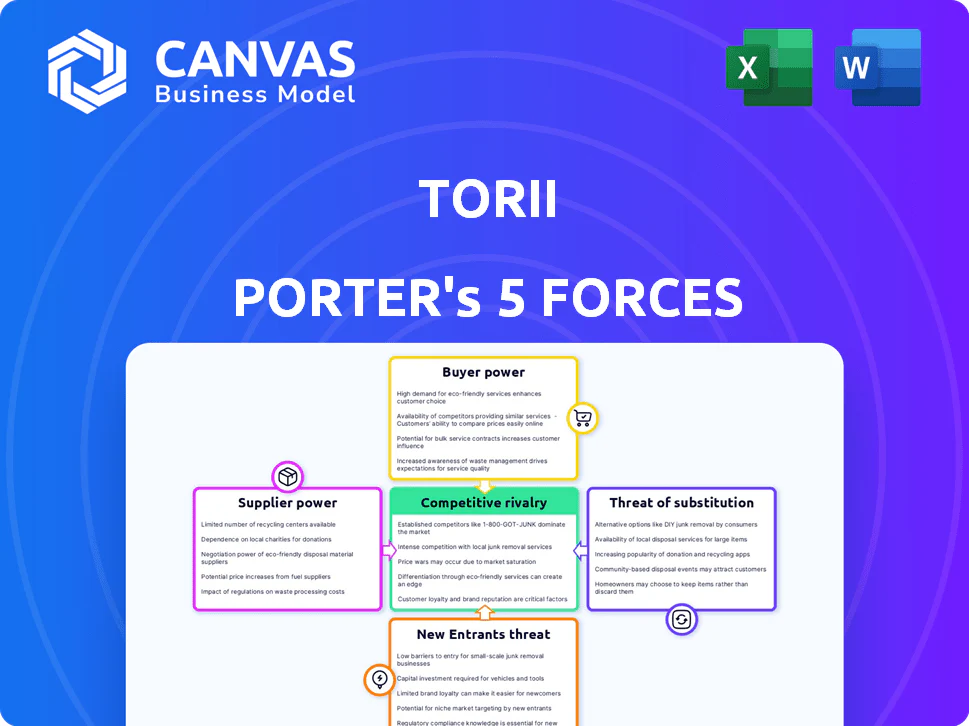
TORII PORTER'S FIVE FORCES TEMPLATE RESEARCH
What is included in the product
 Detailed Word Document
Evaluates control held by suppliers and buyers, and their influence on pricing and profitability.

 Customizable Excel Spreadsheet
Instantly see the top strategic pressures via clear, concise charts—no complex calculations needed.
Full Version Awaits
Torii Porter's Five Forces Analysis
The preview displays Torii Porter's Five Forces Analysis in its entirety. This document is the complete, ready-to-use version you'll receive immediately upon purchase, offering a comprehensive look at the forces shaping the industry. It's fully formatted and ready for your professional needs. What you see here is precisely what you get—no alterations.

Porter's Five Forces Analysis Template

A Must-Have Tool for Decision-Makers
Torii faces competitive pressures from rivals, with established players and emerging competitors vying for market share. Bargaining power of buyers and suppliers significantly impacts profitability and cost structures. The threat of new entrants and substitute products continually challenges Torii's market position and innovation strategies. Understanding these forces is key to assessing long-term viability.
Our full Porter's Five Forces report goes deeper—offering a data-driven framework to understand Torii's real business risks and market opportunities.
Suppliers Bargaining Power

Reliance on Cloud Providers
Torii, as a SaaS company, is highly dependent on cloud providers. The bargaining power of these suppliers is considerable. A 2024 report shows that cloud infrastructure spending reached $270 billion, highlighting their influence. Disruptions or price hikes from providers like AWS, which holds about 32% of the market, could significantly affect Torii's costs and operations.
Dependency on Third-Party Integrations
Torii's reliance on third-party SaaS integrations, like Salesforce and Zoom, introduces supplier power. Changes to these providers' APIs or pricing directly impact Torii's operations. For example, in 2024, Salesforce increased prices by an average of 8%, affecting many SaaS management platforms. This dependency necessitates careful vendor management to mitigate risks.

Availability of Skilled Labor
The availability of skilled labor significantly impacts Torii. A scarcity of software developers and cybersecurity experts could inflate labor costs. In 2024, the average salary for cybersecurity professionals reached $120,000 annually. This shortage might hinder innovation and slow project delivery.

Data Security and Compliance Needs
Suppliers of data security and compliance solutions exert influence over SaaS platforms like Torii, given the critical need for these services. Torii must implement strong security measures, which depend on the capabilities and costs of its security suppliers. The global cybersecurity market is projected to reach $345.7 billion in 2024. This influences Torii's operational costs and security posture. Effective security is not optional; it's a business necessity.
- Market Growth: The cybersecurity market is significantly expanding.
- Compliance Costs: Security solutions affect operational expenses.
- Supplier Influence: Security vendors impact service offerings.
- Data Protection: Robust measures are crucial for data safety.
Potential for Forward Integration
Forward integration, where a supplier moves into a buyer's market, is a less significant threat for Torii. A large SaaS provider Torii integrates with could create its own basic SaaS management tools. However, Torii's specialized focus on SaaS management offers a competitive advantage. In 2024, the SaaS market is expected to reach $232.2 billion, highlighting the need for specialized solutions.
- Market size in 2024: The SaaS market is estimated to be worth $232.2 billion.
- Torii's Focus: Specialization in SaaS management provides a key differentiator.
- Forward Integration Threat: Large SaaS providers could potentially develop basic features.
Supplier Power Challenges for SaaS Platform
Torii faces significant supplier power from cloud providers and SaaS integration partners. Cloud infrastructure spending hit $270 billion in 2024, affecting Torii's costs. Salesforce's 8% price hike in 2024 shows the impact of supplier decisions. Skilled labor scarcity also increases operational expenses.
| Supplier Type | Impact on Torii | 2024 Data |
|---|---|---|
| Cloud Providers | Cost and operational impact | $270B cloud infrastructure spending |
| SaaS Integrations | API changes, pricing | Salesforce 8% price increase |
| Skilled Labor | Increased costs | $120K average cybersecurity salary |
Customers Bargaining Power

Availability of Alternatives
Customers' power increases with available alternatives in the SaaS management market. Torii faces competition from companies like BetterCloud and Zluri. For example, in 2024, the SaaS market grew, offering more choices for customers. This competition gives customers leverage in pricing and service negotiations.
Switching Costs
Switching costs influence customer power in the SaaS world. While SaaS switching is easier than traditional software, changing a platform like Torii and its integrated data requires effort. Consider that 2024 saw average SaaS migration times of 2-4 weeks, indicating some customer inertia. This slightly curbs customer bargaining power.

Customer Size and Concentration
If Torii's revenue relies heavily on a few large enterprise clients, these customers wield substantial bargaining power. This power stems from their ability to negotiate better deals. For example, in 2024, large corporations like Amazon and Walmart, with their massive purchasing volumes, significantly influenced supplier terms. They are able to drive down prices. This dynamic directly impacts Torii's profitability.

Demand for Cost Optimization
Customers are actively seeking ways to reduce SaaS spending and understand their application usage better. This focus on cost optimization gives customers significant leverage to negotiate better deals with vendors like Torii.
In 2024, SaaS spending optimization became a top priority, with many organizations aiming to cut costs by 15-20%. This shift empowers customers to demand more value for their money and negotiate favorable terms.
This increased bargaining power is further fueled by the availability of various SaaS management tools and market intelligence reports, providing customers with the data they need to make informed decisions.
The ability to switch vendors easily in the SaaS market also strengthens customer negotiating positions, as companies must compete fiercely to retain clients.
- SaaS spending optimization is a major focus for businesses in 2024.
- Customers have more data and tools for informed decisions.
- Vendor switching is easy, increasing customer leverage.
Customer Knowledge and Awareness
Customers now have more insights into the SaaS market and management tools. This increased knowledge helps them assess offerings more effectively. Consequently, they can negotiate based on their needs and market standards.
- In 2024, SaaS spending is projected to reach $232 billion, showing a competitive market.
- Customer churn rates in SaaS vary, highlighting the impact of customer satisfaction and negotiation power.
- Average contract lengths have changed as customers seek flexibility.
SaaS Customers in 2024: Power Shift!
Customers hold significant bargaining power in the SaaS market, particularly in 2024. They are focused on cost optimization, with many aiming to cut SaaS spending by 15-20%. The ease of switching vendors also bolsters their negotiating positions.
| Factor | Impact | 2024 Data |
|---|---|---|
| Cost Optimization Focus | Increased Customer Leverage | Businesses aimed for 15-20% cost cuts. |
| Vendor Switching | Strengthens Negotiation | Average SaaS migration times were 2-4 weeks. |
| Market Competition | More Choices | SaaS market projected $232 billion. |
Rivalry Among Competitors

Number and Diversity of Competitors
The SaaS management market is intensely competitive, with many companies vying for market share. This includes established firms and innovative startups, fueling strong rivalry. In 2024, the SaaS market saw over $200 billion in revenue, with competition increasing. The diversity of competitors drives innovation and price wars.
Market Growth Rate
The SaaS market's robust growth, projected to reach $232.5 billion in 2024, typically eases rivalry by offering more opportunities. Despite overall expansion, the SaaS management sector faces intense competition. Recent reports indicate a high churn rate among SaaS management tools, highlighting the challenges. This competitive pressure necessitates constant innovation and strong customer retention strategies.

Product Differentiation
Torii differentiates itself in SaaS management by focusing on automation, AI insights, and extensive integrations. Its competitors also offer core features, intensifying rivalry. For example, the SaaS management market is projected to reach $10.8 billion by 2024, showing growth and competition. This drives Torii to enhance its unique offerings.

Switching Costs for Customers
Switching costs in the platform market can impact competitive rivalry. While not always a huge barrier, the effort to change platforms can make customers less inclined to switch for small advantages. This inertia can stabilize market share, as seen with established players. The stickiness of a platform can be a significant competitive advantage.
- Customer data migration can be complex and costly.
- Training on new platforms requires time and resources.
- Integration with existing systems adds to the switching burden.
- Familiarity and established workflows create inertia.
Aggressive Pricing and Feature Competition
Intense competition can lead rivals to slash prices or add features quickly, challenging Torii. This forces them to innovate to stay competitive and offer good value. For example, in 2024, the software industry saw a 7% average price decrease due to competition. This can erode profit margins if not managed well, especially if Torii can't keep up with feature enhancements.
- Price wars can squeeze profit margins.
- Rapid feature releases demand constant innovation.
- Value becomes crucial to maintain market share.
- The ability to adapt quickly is key.
SaaS Market: Growth vs. Intense Competition
Competitive rivalry in the SaaS management market is fierce, with many players fighting for market share. This drives innovation but also leads to price wars and margin pressure. The industry's growth, projected to $232.5B in 2024, doesn't fully alleviate the intense competition.
| Factor | Impact | Example (2024) |
|---|---|---|
| Market Growth | Reduces rivalry, but not fully | SaaS market projected to $232.5B |
| Pricing | Can squeeze profit margins | 7% average price decrease in software |
| Innovation | Essential for survival | Torii's automation and AI focus |
Original: $10.00
-65%$10.00
$3.50TORII PORTER'S FIVE FORCES TEMPLATE RESEARCH
What is included in the product
Detailed Word Document
Evaluates control held by suppliers and buyers, and their influence on pricing and profitability.
Customizable Excel Spreadsheet
Instantly see the top strategic pressures via clear, concise charts—no complex calculations needed.
Full Version Awaits
Torii Porter's Five Forces Analysis
The preview displays Torii Porter's Five Forces Analysis in its entirety. This document is the complete, ready-to-use version you'll receive immediately upon purchase, offering a comprehensive look at the forces shaping the industry. It's fully formatted and ready for your professional needs. What you see here is precisely what you get—no alterations.
Porter's Five Forces Analysis Template
A Must-Have Tool for Decision-Makers
Torii faces competitive pressures from rivals, with established players and emerging competitors vying for market share. Bargaining power of buyers and suppliers significantly impacts profitability and cost structures. The threat of new entrants and substitute products continually challenges Torii's market position and innovation strategies. Understanding these forces is key to assessing long-term viability.
Our full Porter's Five Forces report goes deeper—offering a data-driven framework to understand Torii's real business risks and market opportunities.
Suppliers Bargaining Power
Reliance on Cloud Providers
Torii, as a SaaS company, is highly dependent on cloud providers. The bargaining power of these suppliers is considerable. A 2024 report shows that cloud infrastructure spending reached $270 billion, highlighting their influence. Disruptions or price hikes from providers like AWS, which holds about 32% of the market, could significantly affect Torii's costs and operations.
Dependency on Third-Party Integrations
Torii's reliance on third-party SaaS integrations, like Salesforce and Zoom, introduces supplier power. Changes to these providers' APIs or pricing directly impact Torii's operations. For example, in 2024, Salesforce increased prices by an average of 8%, affecting many SaaS management platforms. This dependency necessitates careful vendor management to mitigate risks.
Availability of Skilled Labor
The availability of skilled labor significantly impacts Torii. A scarcity of software developers and cybersecurity experts could inflate labor costs. In 2024, the average salary for cybersecurity professionals reached $120,000 annually. This shortage might hinder innovation and slow project delivery.
Data Security and Compliance Needs
Suppliers of data security and compliance solutions exert influence over SaaS platforms like Torii, given the critical need for these services. Torii must implement strong security measures, which depend on the capabilities and costs of its security suppliers. The global cybersecurity market is projected to reach $345.7 billion in 2024. This influences Torii's operational costs and security posture. Effective security is not optional; it's a business necessity.
- Market Growth: The cybersecurity market is significantly expanding.
- Compliance Costs: Security solutions affect operational expenses.
- Supplier Influence: Security vendors impact service offerings.
- Data Protection: Robust measures are crucial for data safety.
Potential for Forward Integration
Forward integration, where a supplier moves into a buyer's market, is a less significant threat for Torii. A large SaaS provider Torii integrates with could create its own basic SaaS management tools. However, Torii's specialized focus on SaaS management offers a competitive advantage. In 2024, the SaaS market is expected to reach $232.2 billion, highlighting the need for specialized solutions.
- Market size in 2024: The SaaS market is estimated to be worth $232.2 billion.
- Torii's Focus: Specialization in SaaS management provides a key differentiator.
- Forward Integration Threat: Large SaaS providers could potentially develop basic features.
Supplier Power Challenges for SaaS Platform
Torii faces significant supplier power from cloud providers and SaaS integration partners. Cloud infrastructure spending hit $270 billion in 2024, affecting Torii's costs. Salesforce's 8% price hike in 2024 shows the impact of supplier decisions. Skilled labor scarcity also increases operational expenses.
| Supplier Type | Impact on Torii | 2024 Data |
|---|---|---|
| Cloud Providers | Cost and operational impact | $270B cloud infrastructure spending |
| SaaS Integrations | API changes, pricing | Salesforce 8% price increase |
| Skilled Labor | Increased costs | $120K average cybersecurity salary |
Customers Bargaining Power
Availability of Alternatives
Customers' power increases with available alternatives in the SaaS management market. Torii faces competition from companies like BetterCloud and Zluri. For example, in 2024, the SaaS market grew, offering more choices for customers. This competition gives customers leverage in pricing and service negotiations.
Switching Costs
Switching costs influence customer power in the SaaS world. While SaaS switching is easier than traditional software, changing a platform like Torii and its integrated data requires effort. Consider that 2024 saw average SaaS migration times of 2-4 weeks, indicating some customer inertia. This slightly curbs customer bargaining power.
Customer Size and Concentration
If Torii's revenue relies heavily on a few large enterprise clients, these customers wield substantial bargaining power. This power stems from their ability to negotiate better deals. For example, in 2024, large corporations like Amazon and Walmart, with their massive purchasing volumes, significantly influenced supplier terms. They are able to drive down prices. This dynamic directly impacts Torii's profitability.
Demand for Cost Optimization
Customers are actively seeking ways to reduce SaaS spending and understand their application usage better. This focus on cost optimization gives customers significant leverage to negotiate better deals with vendors like Torii.
In 2024, SaaS spending optimization became a top priority, with many organizations aiming to cut costs by 15-20%. This shift empowers customers to demand more value for their money and negotiate favorable terms.
This increased bargaining power is further fueled by the availability of various SaaS management tools and market intelligence reports, providing customers with the data they need to make informed decisions.
The ability to switch vendors easily in the SaaS market also strengthens customer negotiating positions, as companies must compete fiercely to retain clients.
- SaaS spending optimization is a major focus for businesses in 2024.
- Customers have more data and tools for informed decisions.
- Vendor switching is easy, increasing customer leverage.
Customer Knowledge and Awareness
Customers now have more insights into the SaaS market and management tools. This increased knowledge helps them assess offerings more effectively. Consequently, they can negotiate based on their needs and market standards.
- In 2024, SaaS spending is projected to reach $232 billion, showing a competitive market.
- Customer churn rates in SaaS vary, highlighting the impact of customer satisfaction and negotiation power.
- Average contract lengths have changed as customers seek flexibility.
SaaS Customers in 2024: Power Shift!
Customers hold significant bargaining power in the SaaS market, particularly in 2024. They are focused on cost optimization, with many aiming to cut SaaS spending by 15-20%. The ease of switching vendors also bolsters their negotiating positions.
| Factor | Impact | 2024 Data |
|---|---|---|
| Cost Optimization Focus | Increased Customer Leverage | Businesses aimed for 15-20% cost cuts. |
| Vendor Switching | Strengthens Negotiation | Average SaaS migration times were 2-4 weeks. |
| Market Competition | More Choices | SaaS market projected $232 billion. |
Rivalry Among Competitors
Number and Diversity of Competitors
The SaaS management market is intensely competitive, with many companies vying for market share. This includes established firms and innovative startups, fueling strong rivalry. In 2024, the SaaS market saw over $200 billion in revenue, with competition increasing. The diversity of competitors drives innovation and price wars.
Market Growth Rate
The SaaS market's robust growth, projected to reach $232.5 billion in 2024, typically eases rivalry by offering more opportunities. Despite overall expansion, the SaaS management sector faces intense competition. Recent reports indicate a high churn rate among SaaS management tools, highlighting the challenges. This competitive pressure necessitates constant innovation and strong customer retention strategies.
Product Differentiation
Torii differentiates itself in SaaS management by focusing on automation, AI insights, and extensive integrations. Its competitors also offer core features, intensifying rivalry. For example, the SaaS management market is projected to reach $10.8 billion by 2024, showing growth and competition. This drives Torii to enhance its unique offerings.
Switching Costs for Customers
Switching costs in the platform market can impact competitive rivalry. While not always a huge barrier, the effort to change platforms can make customers less inclined to switch for small advantages. This inertia can stabilize market share, as seen with established players. The stickiness of a platform can be a significant competitive advantage.
- Customer data migration can be complex and costly.
- Training on new platforms requires time and resources.
- Integration with existing systems adds to the switching burden.
- Familiarity and established workflows create inertia.
Aggressive Pricing and Feature Competition
Intense competition can lead rivals to slash prices or add features quickly, challenging Torii. This forces them to innovate to stay competitive and offer good value. For example, in 2024, the software industry saw a 7% average price decrease due to competition. This can erode profit margins if not managed well, especially if Torii can't keep up with feature enhancements.
- Price wars can squeeze profit margins.
- Rapid feature releases demand constant innovation.
- Value becomes crucial to maintain market share.
- The ability to adapt quickly is key.
SaaS Market: Growth vs. Intense Competition
Competitive rivalry in the SaaS management market is fierce, with many players fighting for market share. This drives innovation but also leads to price wars and margin pressure. The industry's growth, projected to $232.5B in 2024, doesn't fully alleviate the intense competition.
| Factor | Impact | Example (2024) |
|---|---|---|
| Market Growth | Reduces rivalry, but not fully | SaaS market projected to $232.5B |
| Pricing | Can squeeze profit margins | 7% average price decrease in software |
| Innovation | Essential for survival | Torii's automation and AI focus |
Product Information
Product Information
Shipping & Returns
Shipping & Returns
Description
What is included in the product
Detailed Word Document
Evaluates control held by suppliers and buyers, and their influence on pricing and profitability.
Customizable Excel Spreadsheet
Instantly see the top strategic pressures via clear, concise charts—no complex calculations needed.
Full Version Awaits
Torii Porter's Five Forces Analysis
The preview displays Torii Porter's Five Forces Analysis in its entirety. This document is the complete, ready-to-use version you'll receive immediately upon purchase, offering a comprehensive look at the forces shaping the industry. It's fully formatted and ready for your professional needs. What you see here is precisely what you get—no alterations.
Porter's Five Forces Analysis Template
A Must-Have Tool for Decision-Makers
Torii faces competitive pressures from rivals, with established players and emerging competitors vying for market share. Bargaining power of buyers and suppliers significantly impacts profitability and cost structures. The threat of new entrants and substitute products continually challenges Torii's market position and innovation strategies. Understanding these forces is key to assessing long-term viability.
Our full Porter's Five Forces report goes deeper—offering a data-driven framework to understand Torii's real business risks and market opportunities.
Suppliers Bargaining Power
Reliance on Cloud Providers
Torii, as a SaaS company, is highly dependent on cloud providers. The bargaining power of these suppliers is considerable. A 2024 report shows that cloud infrastructure spending reached $270 billion, highlighting their influence. Disruptions or price hikes from providers like AWS, which holds about 32% of the market, could significantly affect Torii's costs and operations.
Dependency on Third-Party Integrations
Torii's reliance on third-party SaaS integrations, like Salesforce and Zoom, introduces supplier power. Changes to these providers' APIs or pricing directly impact Torii's operations. For example, in 2024, Salesforce increased prices by an average of 8%, affecting many SaaS management platforms. This dependency necessitates careful vendor management to mitigate risks.
Availability of Skilled Labor
The availability of skilled labor significantly impacts Torii. A scarcity of software developers and cybersecurity experts could inflate labor costs. In 2024, the average salary for cybersecurity professionals reached $120,000 annually. This shortage might hinder innovation and slow project delivery.
Data Security and Compliance Needs
Suppliers of data security and compliance solutions exert influence over SaaS platforms like Torii, given the critical need for these services. Torii must implement strong security measures, which depend on the capabilities and costs of its security suppliers. The global cybersecurity market is projected to reach $345.7 billion in 2024. This influences Torii's operational costs and security posture. Effective security is not optional; it's a business necessity.
- Market Growth: The cybersecurity market is significantly expanding.
- Compliance Costs: Security solutions affect operational expenses.
- Supplier Influence: Security vendors impact service offerings.
- Data Protection: Robust measures are crucial for data safety.
Potential for Forward Integration
Forward integration, where a supplier moves into a buyer's market, is a less significant threat for Torii. A large SaaS provider Torii integrates with could create its own basic SaaS management tools. However, Torii's specialized focus on SaaS management offers a competitive advantage. In 2024, the SaaS market is expected to reach $232.2 billion, highlighting the need for specialized solutions.
- Market size in 2024: The SaaS market is estimated to be worth $232.2 billion.
- Torii's Focus: Specialization in SaaS management provides a key differentiator.
- Forward Integration Threat: Large SaaS providers could potentially develop basic features.
Supplier Power Challenges for SaaS Platform
Torii faces significant supplier power from cloud providers and SaaS integration partners. Cloud infrastructure spending hit $270 billion in 2024, affecting Torii's costs. Salesforce's 8% price hike in 2024 shows the impact of supplier decisions. Skilled labor scarcity also increases operational expenses.
| Supplier Type | Impact on Torii | 2024 Data |
|---|---|---|
| Cloud Providers | Cost and operational impact | $270B cloud infrastructure spending |
| SaaS Integrations | API changes, pricing | Salesforce 8% price increase |
| Skilled Labor | Increased costs | $120K average cybersecurity salary |
Customers Bargaining Power
Availability of Alternatives
Customers' power increases with available alternatives in the SaaS management market. Torii faces competition from companies like BetterCloud and Zluri. For example, in 2024, the SaaS market grew, offering more choices for customers. This competition gives customers leverage in pricing and service negotiations.
Switching Costs
Switching costs influence customer power in the SaaS world. While SaaS switching is easier than traditional software, changing a platform like Torii and its integrated data requires effort. Consider that 2024 saw average SaaS migration times of 2-4 weeks, indicating some customer inertia. This slightly curbs customer bargaining power.
Customer Size and Concentration
If Torii's revenue relies heavily on a few large enterprise clients, these customers wield substantial bargaining power. This power stems from their ability to negotiate better deals. For example, in 2024, large corporations like Amazon and Walmart, with their massive purchasing volumes, significantly influenced supplier terms. They are able to drive down prices. This dynamic directly impacts Torii's profitability.
Demand for Cost Optimization
Customers are actively seeking ways to reduce SaaS spending and understand their application usage better. This focus on cost optimization gives customers significant leverage to negotiate better deals with vendors like Torii.
In 2024, SaaS spending optimization became a top priority, with many organizations aiming to cut costs by 15-20%. This shift empowers customers to demand more value for their money and negotiate favorable terms.
This increased bargaining power is further fueled by the availability of various SaaS management tools and market intelligence reports, providing customers with the data they need to make informed decisions.
The ability to switch vendors easily in the SaaS market also strengthens customer negotiating positions, as companies must compete fiercely to retain clients.
- SaaS spending optimization is a major focus for businesses in 2024.
- Customers have more data and tools for informed decisions.
- Vendor switching is easy, increasing customer leverage.
Customer Knowledge and Awareness
Customers now have more insights into the SaaS market and management tools. This increased knowledge helps them assess offerings more effectively. Consequently, they can negotiate based on their needs and market standards.
- In 2024, SaaS spending is projected to reach $232 billion, showing a competitive market.
- Customer churn rates in SaaS vary, highlighting the impact of customer satisfaction and negotiation power.
- Average contract lengths have changed as customers seek flexibility.
SaaS Customers in 2024: Power Shift!
Customers hold significant bargaining power in the SaaS market, particularly in 2024. They are focused on cost optimization, with many aiming to cut SaaS spending by 15-20%. The ease of switching vendors also bolsters their negotiating positions.
| Factor | Impact | 2024 Data |
|---|---|---|
| Cost Optimization Focus | Increased Customer Leverage | Businesses aimed for 15-20% cost cuts. |
| Vendor Switching | Strengthens Negotiation | Average SaaS migration times were 2-4 weeks. |
| Market Competition | More Choices | SaaS market projected $232 billion. |
Rivalry Among Competitors
Number and Diversity of Competitors
The SaaS management market is intensely competitive, with many companies vying for market share. This includes established firms and innovative startups, fueling strong rivalry. In 2024, the SaaS market saw over $200 billion in revenue, with competition increasing. The diversity of competitors drives innovation and price wars.
Market Growth Rate
The SaaS market's robust growth, projected to reach $232.5 billion in 2024, typically eases rivalry by offering more opportunities. Despite overall expansion, the SaaS management sector faces intense competition. Recent reports indicate a high churn rate among SaaS management tools, highlighting the challenges. This competitive pressure necessitates constant innovation and strong customer retention strategies.
Product Differentiation
Torii differentiates itself in SaaS management by focusing on automation, AI insights, and extensive integrations. Its competitors also offer core features, intensifying rivalry. For example, the SaaS management market is projected to reach $10.8 billion by 2024, showing growth and competition. This drives Torii to enhance its unique offerings.
Switching Costs for Customers
Switching costs in the platform market can impact competitive rivalry. While not always a huge barrier, the effort to change platforms can make customers less inclined to switch for small advantages. This inertia can stabilize market share, as seen with established players. The stickiness of a platform can be a significant competitive advantage.
- Customer data migration can be complex and costly.
- Training on new platforms requires time and resources.
- Integration with existing systems adds to the switching burden.
- Familiarity and established workflows create inertia.
Aggressive Pricing and Feature Competition
Intense competition can lead rivals to slash prices or add features quickly, challenging Torii. This forces them to innovate to stay competitive and offer good value. For example, in 2024, the software industry saw a 7% average price decrease due to competition. This can erode profit margins if not managed well, especially if Torii can't keep up with feature enhancements.
- Price wars can squeeze profit margins.
- Rapid feature releases demand constant innovation.
- Value becomes crucial to maintain market share.
- The ability to adapt quickly is key.
SaaS Market: Growth vs. Intense Competition
Competitive rivalry in the SaaS management market is fierce, with many players fighting for market share. This drives innovation but also leads to price wars and margin pressure. The industry's growth, projected to $232.5B in 2024, doesn't fully alleviate the intense competition.
| Factor | Impact | Example (2024) |
|---|---|---|
| Market Growth | Reduces rivalry, but not fully | SaaS market projected to $232.5B |
| Pricing | Can squeeze profit margins | 7% average price decrease in software |
| Innovation | Essential for survival | Torii's automation and AI focus |











