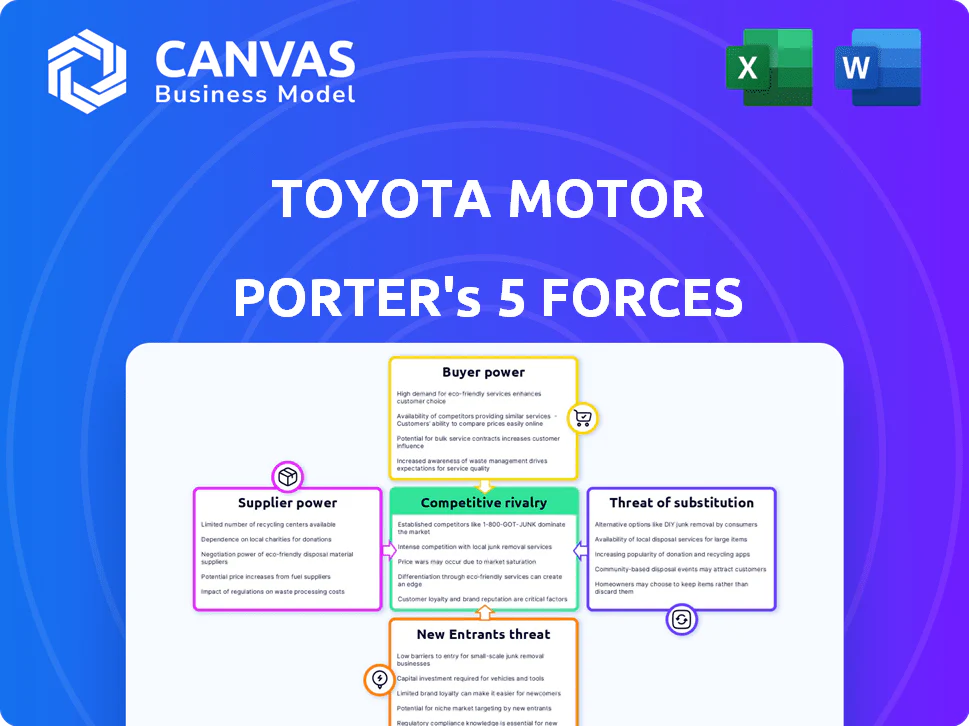
TOYOTA MOTOR PORTER'S FIVE FORCES TEMPLATE RESEARCH

Elevate Your Analysis with the Complete Porter's Five Forces Analysis
Toyota faces intense rivalry, shifting supplier dynamics, rising EV substitutes, moderate buyer power, and significant but manageable entry threats thanks to scale and brand.
This brief snapshot only scratches the surface. Unlock the full Porter's Five Forces Analysis to explore Toyota Motor's competitive dynamics, market pressures, and strategic advantages in detail.
Suppliers Bargaining Power

Critical raw material scarcity
As of early 2026, global lithium demand rose 45% YoY, cobalt supply tightened with spot prices up 70% in 2025, and rare-earth export controls lifted supplier leverage; Toyota's 11.6M vehicle scale helps procurement, but solid-state cells need high-grade lithium/lanthanides from few mines, letting specialists impose premium pricing and create a component bottleneck.
Semiconductor dependency and complexity
While chip shortages eased, software-defined vehicles raised chip value density-Toyota estimates semiconductor content per vehicle rose to ~$1,200 in 2025, up ~30% vs 2020, making each chip more critical.
Advanced AI/autonomy chips are concentrated: NVIDIA and Qualcomm held ~65% of automotive AI chip market share in 2025, giving suppliers strong bargaining power.
Toyota treats these firms as strategic partners, signing multi-year supply and co-development deals (2024-2028) to secure capacity and IP access.

Tier 1 integration and vertical alignment
Toyota's keiretsu ties-including equity stakes in Denso (2.9% as of FY2025) and Aisin-historically cut supplier power, but in FY2025 Denso's automotive electrification sales rose 18% to ¥3.2 trillion, and Aisin's EV module revenue grew 22%, reducing reliance on Toyota. This diversification lets Tier‑1s supply multiple OEMs and resist Toyota's prior aggressive cost cuts; Denso reported 14% higher margin on EV components vs ICE in 2025, strengthening bargaining leverage. Toyota still gains scale benefits, but supplier pricing pressure rose in 2025 as global EV contracts expanded.

Energy costs and manufacturing overhead
Suppliers face volatile energy costs-global industrial electricity prices rose ~18% YoY in 2024-and tighter carbon-neutral mandates, raising supplier manufacturing overheads that are being passed to Toyota, squeezing margins.
Toyota provided emergency funding and price adjustments in 2024-25, with disclosed supplier support programs totaling ¥120 billion (≈$820M) to keep small specialized parts makers solvent.
- Energy price rise ~18% YoY (2024)
- Supplier support ¥120 billion (~$820M) in 2024-25
- Carbon mandates raise CAPEX and OPEX for suppliers
Labor market constraints in logistics
Labor costs for logistics and assembly rose sharply in 2025-2026; industry reports show average wage inflation of 6.8% YoY and spot shortages with vacancy rates near 5.2%, pushing suppliers' unit labor costs up ~9%.
Suppliers face limited scaling ability for Toyota's launches, forcing Toyota Motor to accept 3-7% higher contract prices to secure parts and avoid launch delays.
- Wage inflation 6.8% YoY (2025-26)
- Vacancy rate ~5.2% in logistics
- Suppliers' unit labor costs +9%
- Toyota contract premiums 3-7% to secure supply
Suppliers Gain Pricing Power: Critical Materials & AI Chips Drive 3-7% Toyota Premium
Suppliers' power rose in FY2025 as critical materials (lithium +45% demand YoY; cobalt spot +70% in 2025) and 65% AI‑chip concentration (NVIDIA/Qualcomm) let specialists command premiums; Toyota's scale and keiretsu (Denso stake 2.9%, Denso EV sales ¥3.2T) blunt but don't fully offset 3-7% contract premiums.
| Metric | FY2025 |
|---|---|
| Lithium demand YoY | +45% |
| Cobalt spot price | +70% |
| AI chip share (NVIDIA+QCOM) | ~65% |
| Denso EV sales | ¥3.2T |
| Toyota contract premium | 3-7% |
What is included in the product
 Detailed Word Document
Tailored Porter's Five Forces for Toyota Motor: concise assessment of competitive rivalry, supplier and buyer power, threat of substitutes, and entry barriers-highlighting disruptive EV/AI trends, supplier concentration risks, and Toyota's scale, brand, and hybrid-first strategy that defend margins and market share.

 Customizable Excel Spreadsheet
Concise Porter's Five Forces snapshot for Toyota-instantly reveals supplier, buyer, rivalry, entrant, and substitute pressures to guide strategic moves.
Customers Bargaining Power

Transparency and digital comparison tools
In 2026 buyers use AI platforms to compare total cost of ownership in seconds; 72% of US car shoppers used comparison apps in 2025, cutting Toyota Motor's ability to hide dealer markups and premium pricing.
Transparency drives quick pivots to rivals: Toyota lost 1.1 p.p. U.S. market share in 2025 vs. 2024 as incentive-sensitive buyers chased better deals.
The subscription mindset rose: 18% of new-vehicle transactions in 2025 were subscriptions or short-term leases, pressuring Toyota to offer flexible pricing and value bundles over pure brand loyalty.
Low switching costs in the EV era
As EVs standardize software-driven driving and instant torque, Toyota's decades-old mechanical brand edge weakens, lowering switching costs; JD Power found 56% of EV buyers in 2025 considered non-brand alternatives, and EV models' shared platforms cut onboarding time by ~30%, so a Camry owner can shift to Tesla or Hyundai with minimal re-learning.

Sensitivity to interest rates and financing
With global policy rates averaging ~3.8% in 2025, monthly payments dominate buyer choice; Toyota Motor's captive finance, Toyota Financial Services, reported ¥4.2 trillion in 2025 retail loans, so it must price competitively versus US credit unions (~5.0% avg auto APR) and fintech offers to prevent defections.

Expansion of the used vehicle market
High durability of older Toyota models raises buyer power in the new-car market: 2019-2024 resale data show Toyota Camry and Corolla retain 55-60% of original value after 3 years, pressuring new-vehicle pricing.
Strong used-hybrid demand-used Prius volume rose 18% YoY in 2024-gives consumers an alternative to buying a new 2026 model, reducing willingness to pay premiums.
This internal competition forces Toyota Motor to accelerate tech upgrades; R&D rose to $12.8 billion in FY2025 so Toyota can justify price premiums on new releases.
- Older-model resale: 55-60% value after 3 years
- Used Prius volume: +18% YoY (2024)
- Toyota Motor R&D FY2025: $12.8B
Corporate and fleet buyer influence
Large fleet buyers-ride-hailing firms and government fleets-account for about 12-18% of Toyota Motor's global unit sales in 2025, giving them scale to demand steep volume discounts and bespoke service contracts.
Buying thousands of vehicles at once, these customers extract price reductions often exceeding 8-12% and negotiate extended warranties, maintenance packages, and priority delivery that retail buyers cannot secure.
Their concentrated purchases shift negotiating power away from Toyota Motor on pricing, incentives, and vehicle specs, pressuring margins-Toyota's 2025 global auto gross margin of ~18.5% faces downward pressure in fleet-heavy segments.
- Fleet share: 12-18% of units (2025)
- Typical fleet discounts: 8-12%
- Impact: squeezes segment margins vs. 18.5% gross margin (2025)
Buyers seize power in 2025: comparison apps soar, Toyota slips, subscriptions & EV openness rise
Buyers gained price and switching power in 2025: 72% used comparison apps, Toyota lost 1.1 p.p. U.S. share, subscriptions hit 18%, EV buyers 56% open to non-brand, Toyota Financial Services held ¥4.2T retail loans, R&D rose to $12.8B, resale 55-60% at 3 years, fleet 12-18% units with 8-12% discounts.
| Metric | 2025 Value |
|---|---|
| Comparison app use (US) | 72% |
| U.S. share change | -1.1 p.p. |
| Subscriptions/short leases | 18% |
| EV buyers open to non-brand | 56% |
| Toyota Financial Services loans | ¥4.2 trillion |
| R&D | $12.8 billion |
| Resale (3 yrs) | 55-60% |
| Fleet share | 12-18% |
| Fleet discounts | 8-12% |
Full Version Awaits
Toyota Motor Porter's Five Forces Analysis
This preview shows the exact Toyota Motor Porter's Five Forces analysis you'll receive-no samples or placeholders-covering rivalry, supplier and buyer power, threats of entry and substitution, with concise implications for strategy and valuation; purchase grants instant access to this fully formatted, ready-to-use document.

Original: $10.00
-65%$10.00
$3.50TOYOTA MOTOR PORTER'S FIVE FORCES TEMPLATE RESEARCH
Elevate Your Analysis with the Complete Porter's Five Forces Analysis
Toyota faces intense rivalry, shifting supplier dynamics, rising EV substitutes, moderate buyer power, and significant but manageable entry threats thanks to scale and brand.
This brief snapshot only scratches the surface. Unlock the full Porter's Five Forces Analysis to explore Toyota Motor's competitive dynamics, market pressures, and strategic advantages in detail.
Suppliers Bargaining Power
Critical raw material scarcity
As of early 2026, global lithium demand rose 45% YoY, cobalt supply tightened with spot prices up 70% in 2025, and rare-earth export controls lifted supplier leverage; Toyota's 11.6M vehicle scale helps procurement, but solid-state cells need high-grade lithium/lanthanides from few mines, letting specialists impose premium pricing and create a component bottleneck.
Semiconductor dependency and complexity
While chip shortages eased, software-defined vehicles raised chip value density-Toyota estimates semiconductor content per vehicle rose to ~$1,200 in 2025, up ~30% vs 2020, making each chip more critical.
Advanced AI/autonomy chips are concentrated: NVIDIA and Qualcomm held ~65% of automotive AI chip market share in 2025, giving suppliers strong bargaining power.
Toyota treats these firms as strategic partners, signing multi-year supply and co-development deals (2024-2028) to secure capacity and IP access.
Tier 1 integration and vertical alignment
Toyota's keiretsu ties-including equity stakes in Denso (2.9% as of FY2025) and Aisin-historically cut supplier power, but in FY2025 Denso's automotive electrification sales rose 18% to ¥3.2 trillion, and Aisin's EV module revenue grew 22%, reducing reliance on Toyota. This diversification lets Tier‑1s supply multiple OEMs and resist Toyota's prior aggressive cost cuts; Denso reported 14% higher margin on EV components vs ICE in 2025, strengthening bargaining leverage. Toyota still gains scale benefits, but supplier pricing pressure rose in 2025 as global EV contracts expanded.
Energy costs and manufacturing overhead
Suppliers face volatile energy costs-global industrial electricity prices rose ~18% YoY in 2024-and tighter carbon-neutral mandates, raising supplier manufacturing overheads that are being passed to Toyota, squeezing margins.
Toyota provided emergency funding and price adjustments in 2024-25, with disclosed supplier support programs totaling ¥120 billion (≈$820M) to keep small specialized parts makers solvent.
- Energy price rise ~18% YoY (2024)
- Supplier support ¥120 billion (~$820M) in 2024-25
- Carbon mandates raise CAPEX and OPEX for suppliers
Labor market constraints in logistics
Labor costs for logistics and assembly rose sharply in 2025-2026; industry reports show average wage inflation of 6.8% YoY and spot shortages with vacancy rates near 5.2%, pushing suppliers' unit labor costs up ~9%.
Suppliers face limited scaling ability for Toyota's launches, forcing Toyota Motor to accept 3-7% higher contract prices to secure parts and avoid launch delays.
- Wage inflation 6.8% YoY (2025-26)
- Vacancy rate ~5.2% in logistics
- Suppliers' unit labor costs +9%
- Toyota contract premiums 3-7% to secure supply
Suppliers Gain Pricing Power: Critical Materials & AI Chips Drive 3-7% Toyota Premium
Suppliers' power rose in FY2025 as critical materials (lithium +45% demand YoY; cobalt spot +70% in 2025) and 65% AI‑chip concentration (NVIDIA/Qualcomm) let specialists command premiums; Toyota's scale and keiretsu (Denso stake 2.9%, Denso EV sales ¥3.2T) blunt but don't fully offset 3-7% contract premiums.
| Metric | FY2025 |
|---|---|
| Lithium demand YoY | +45% |
| Cobalt spot price | +70% |
| AI chip share (NVIDIA+QCOM) | ~65% |
| Denso EV sales | ¥3.2T |
| Toyota contract premium | 3-7% |
What is included in the product
Detailed Word Document
Tailored Porter's Five Forces for Toyota Motor: concise assessment of competitive rivalry, supplier and buyer power, threat of substitutes, and entry barriers-highlighting disruptive EV/AI trends, supplier concentration risks, and Toyota's scale, brand, and hybrid-first strategy that defend margins and market share.
Customizable Excel Spreadsheet
Concise Porter's Five Forces snapshot for Toyota-instantly reveals supplier, buyer, rivalry, entrant, and substitute pressures to guide strategic moves.
Customers Bargaining Power
Transparency and digital comparison tools
In 2026 buyers use AI platforms to compare total cost of ownership in seconds; 72% of US car shoppers used comparison apps in 2025, cutting Toyota Motor's ability to hide dealer markups and premium pricing.
Transparency drives quick pivots to rivals: Toyota lost 1.1 p.p. U.S. market share in 2025 vs. 2024 as incentive-sensitive buyers chased better deals.
The subscription mindset rose: 18% of new-vehicle transactions in 2025 were subscriptions or short-term leases, pressuring Toyota to offer flexible pricing and value bundles over pure brand loyalty.
Low switching costs in the EV era
As EVs standardize software-driven driving and instant torque, Toyota's decades-old mechanical brand edge weakens, lowering switching costs; JD Power found 56% of EV buyers in 2025 considered non-brand alternatives, and EV models' shared platforms cut onboarding time by ~30%, so a Camry owner can shift to Tesla or Hyundai with minimal re-learning.
Sensitivity to interest rates and financing
With global policy rates averaging ~3.8% in 2025, monthly payments dominate buyer choice; Toyota Motor's captive finance, Toyota Financial Services, reported ¥4.2 trillion in 2025 retail loans, so it must price competitively versus US credit unions (~5.0% avg auto APR) and fintech offers to prevent defections.
Expansion of the used vehicle market
High durability of older Toyota models raises buyer power in the new-car market: 2019-2024 resale data show Toyota Camry and Corolla retain 55-60% of original value after 3 years, pressuring new-vehicle pricing.
Strong used-hybrid demand-used Prius volume rose 18% YoY in 2024-gives consumers an alternative to buying a new 2026 model, reducing willingness to pay premiums.
This internal competition forces Toyota Motor to accelerate tech upgrades; R&D rose to $12.8 billion in FY2025 so Toyota can justify price premiums on new releases.
- Older-model resale: 55-60% value after 3 years
- Used Prius volume: +18% YoY (2024)
- Toyota Motor R&D FY2025: $12.8B
Corporate and fleet buyer influence
Large fleet buyers-ride-hailing firms and government fleets-account for about 12-18% of Toyota Motor's global unit sales in 2025, giving them scale to demand steep volume discounts and bespoke service contracts.
Buying thousands of vehicles at once, these customers extract price reductions often exceeding 8-12% and negotiate extended warranties, maintenance packages, and priority delivery that retail buyers cannot secure.
Their concentrated purchases shift negotiating power away from Toyota Motor on pricing, incentives, and vehicle specs, pressuring margins-Toyota's 2025 global auto gross margin of ~18.5% faces downward pressure in fleet-heavy segments.
- Fleet share: 12-18% of units (2025)
- Typical fleet discounts: 8-12%
- Impact: squeezes segment margins vs. 18.5% gross margin (2025)
Buyers seize power in 2025: comparison apps soar, Toyota slips, subscriptions & EV openness rise
Buyers gained price and switching power in 2025: 72% used comparison apps, Toyota lost 1.1 p.p. U.S. share, subscriptions hit 18%, EV buyers 56% open to non-brand, Toyota Financial Services held ¥4.2T retail loans, R&D rose to $12.8B, resale 55-60% at 3 years, fleet 12-18% units with 8-12% discounts.
| Metric | 2025 Value |
|---|---|
| Comparison app use (US) | 72% |
| U.S. share change | -1.1 p.p. |
| Subscriptions/short leases | 18% |
| EV buyers open to non-brand | 56% |
| Toyota Financial Services loans | ¥4.2 trillion |
| R&D | $12.8 billion |
| Resale (3 yrs) | 55-60% |
| Fleet share | 12-18% |
| Fleet discounts | 8-12% |
Full Version Awaits
Toyota Motor Porter's Five Forces Analysis
This preview shows the exact Toyota Motor Porter's Five Forces analysis you'll receive-no samples or placeholders-covering rivalry, supplier and buyer power, threats of entry and substitution, with concise implications for strategy and valuation; purchase grants instant access to this fully formatted, ready-to-use document.
Product Information
Product Information
Shipping & Returns
Shipping & Returns
Description
Elevate Your Analysis with the Complete Porter's Five Forces Analysis
Toyota faces intense rivalry, shifting supplier dynamics, rising EV substitutes, moderate buyer power, and significant but manageable entry threats thanks to scale and brand.
This brief snapshot only scratches the surface. Unlock the full Porter's Five Forces Analysis to explore Toyota Motor's competitive dynamics, market pressures, and strategic advantages in detail.
Suppliers Bargaining Power
Critical raw material scarcity
As of early 2026, global lithium demand rose 45% YoY, cobalt supply tightened with spot prices up 70% in 2025, and rare-earth export controls lifted supplier leverage; Toyota's 11.6M vehicle scale helps procurement, but solid-state cells need high-grade lithium/lanthanides from few mines, letting specialists impose premium pricing and create a component bottleneck.
Semiconductor dependency and complexity
While chip shortages eased, software-defined vehicles raised chip value density-Toyota estimates semiconductor content per vehicle rose to ~$1,200 in 2025, up ~30% vs 2020, making each chip more critical.
Advanced AI/autonomy chips are concentrated: NVIDIA and Qualcomm held ~65% of automotive AI chip market share in 2025, giving suppliers strong bargaining power.
Toyota treats these firms as strategic partners, signing multi-year supply and co-development deals (2024-2028) to secure capacity and IP access.
Tier 1 integration and vertical alignment
Toyota's keiretsu ties-including equity stakes in Denso (2.9% as of FY2025) and Aisin-historically cut supplier power, but in FY2025 Denso's automotive electrification sales rose 18% to ¥3.2 trillion, and Aisin's EV module revenue grew 22%, reducing reliance on Toyota. This diversification lets Tier‑1s supply multiple OEMs and resist Toyota's prior aggressive cost cuts; Denso reported 14% higher margin on EV components vs ICE in 2025, strengthening bargaining leverage. Toyota still gains scale benefits, but supplier pricing pressure rose in 2025 as global EV contracts expanded.
Energy costs and manufacturing overhead
Suppliers face volatile energy costs-global industrial electricity prices rose ~18% YoY in 2024-and tighter carbon-neutral mandates, raising supplier manufacturing overheads that are being passed to Toyota, squeezing margins.
Toyota provided emergency funding and price adjustments in 2024-25, with disclosed supplier support programs totaling ¥120 billion (≈$820M) to keep small specialized parts makers solvent.
- Energy price rise ~18% YoY (2024)
- Supplier support ¥120 billion (~$820M) in 2024-25
- Carbon mandates raise CAPEX and OPEX for suppliers
Labor market constraints in logistics
Labor costs for logistics and assembly rose sharply in 2025-2026; industry reports show average wage inflation of 6.8% YoY and spot shortages with vacancy rates near 5.2%, pushing suppliers' unit labor costs up ~9%.
Suppliers face limited scaling ability for Toyota's launches, forcing Toyota Motor to accept 3-7% higher contract prices to secure parts and avoid launch delays.
- Wage inflation 6.8% YoY (2025-26)
- Vacancy rate ~5.2% in logistics
- Suppliers' unit labor costs +9%
- Toyota contract premiums 3-7% to secure supply
Suppliers Gain Pricing Power: Critical Materials & AI Chips Drive 3-7% Toyota Premium
Suppliers' power rose in FY2025 as critical materials (lithium +45% demand YoY; cobalt spot +70% in 2025) and 65% AI‑chip concentration (NVIDIA/Qualcomm) let specialists command premiums; Toyota's scale and keiretsu (Denso stake 2.9%, Denso EV sales ¥3.2T) blunt but don't fully offset 3-7% contract premiums.
| Metric | FY2025 |
|---|---|
| Lithium demand YoY | +45% |
| Cobalt spot price | +70% |
| AI chip share (NVIDIA+QCOM) | ~65% |
| Denso EV sales | ¥3.2T |
| Toyota contract premium | 3-7% |
What is included in the product
Detailed Word Document
Tailored Porter's Five Forces for Toyota Motor: concise assessment of competitive rivalry, supplier and buyer power, threat of substitutes, and entry barriers-highlighting disruptive EV/AI trends, supplier concentration risks, and Toyota's scale, brand, and hybrid-first strategy that defend margins and market share.
Customizable Excel Spreadsheet
Concise Porter's Five Forces snapshot for Toyota-instantly reveals supplier, buyer, rivalry, entrant, and substitute pressures to guide strategic moves.
Customers Bargaining Power
Transparency and digital comparison tools
In 2026 buyers use AI platforms to compare total cost of ownership in seconds; 72% of US car shoppers used comparison apps in 2025, cutting Toyota Motor's ability to hide dealer markups and premium pricing.
Transparency drives quick pivots to rivals: Toyota lost 1.1 p.p. U.S. market share in 2025 vs. 2024 as incentive-sensitive buyers chased better deals.
The subscription mindset rose: 18% of new-vehicle transactions in 2025 were subscriptions or short-term leases, pressuring Toyota to offer flexible pricing and value bundles over pure brand loyalty.
Low switching costs in the EV era
As EVs standardize software-driven driving and instant torque, Toyota's decades-old mechanical brand edge weakens, lowering switching costs; JD Power found 56% of EV buyers in 2025 considered non-brand alternatives, and EV models' shared platforms cut onboarding time by ~30%, so a Camry owner can shift to Tesla or Hyundai with minimal re-learning.
Sensitivity to interest rates and financing
With global policy rates averaging ~3.8% in 2025, monthly payments dominate buyer choice; Toyota Motor's captive finance, Toyota Financial Services, reported ¥4.2 trillion in 2025 retail loans, so it must price competitively versus US credit unions (~5.0% avg auto APR) and fintech offers to prevent defections.
Expansion of the used vehicle market
High durability of older Toyota models raises buyer power in the new-car market: 2019-2024 resale data show Toyota Camry and Corolla retain 55-60% of original value after 3 years, pressuring new-vehicle pricing.
Strong used-hybrid demand-used Prius volume rose 18% YoY in 2024-gives consumers an alternative to buying a new 2026 model, reducing willingness to pay premiums.
This internal competition forces Toyota Motor to accelerate tech upgrades; R&D rose to $12.8 billion in FY2025 so Toyota can justify price premiums on new releases.
- Older-model resale: 55-60% value after 3 years
- Used Prius volume: +18% YoY (2024)
- Toyota Motor R&D FY2025: $12.8B
Corporate and fleet buyer influence
Large fleet buyers-ride-hailing firms and government fleets-account for about 12-18% of Toyota Motor's global unit sales in 2025, giving them scale to demand steep volume discounts and bespoke service contracts.
Buying thousands of vehicles at once, these customers extract price reductions often exceeding 8-12% and negotiate extended warranties, maintenance packages, and priority delivery that retail buyers cannot secure.
Their concentrated purchases shift negotiating power away from Toyota Motor on pricing, incentives, and vehicle specs, pressuring margins-Toyota's 2025 global auto gross margin of ~18.5% faces downward pressure in fleet-heavy segments.
- Fleet share: 12-18% of units (2025)
- Typical fleet discounts: 8-12%
- Impact: squeezes segment margins vs. 18.5% gross margin (2025)
Buyers seize power in 2025: comparison apps soar, Toyota slips, subscriptions & EV openness rise
Buyers gained price and switching power in 2025: 72% used comparison apps, Toyota lost 1.1 p.p. U.S. share, subscriptions hit 18%, EV buyers 56% open to non-brand, Toyota Financial Services held ¥4.2T retail loans, R&D rose to $12.8B, resale 55-60% at 3 years, fleet 12-18% units with 8-12% discounts.
| Metric | 2025 Value |
|---|---|
| Comparison app use (US) | 72% |
| U.S. share change | -1.1 p.p. |
| Subscriptions/short leases | 18% |
| EV buyers open to non-brand | 56% |
| Toyota Financial Services loans | ¥4.2 trillion |
| R&D | $12.8 billion |
| Resale (3 yrs) | 55-60% |
| Fleet share | 12-18% |
| Fleet discounts | 8-12% |
Full Version Awaits
Toyota Motor Porter's Five Forces Analysis
This preview shows the exact Toyota Motor Porter's Five Forces analysis you'll receive-no samples or placeholders-covering rivalry, supplier and buyer power, threats of entry and substitution, with concise implications for strategy and valuation; purchase grants instant access to this fully formatted, ready-to-use document.











