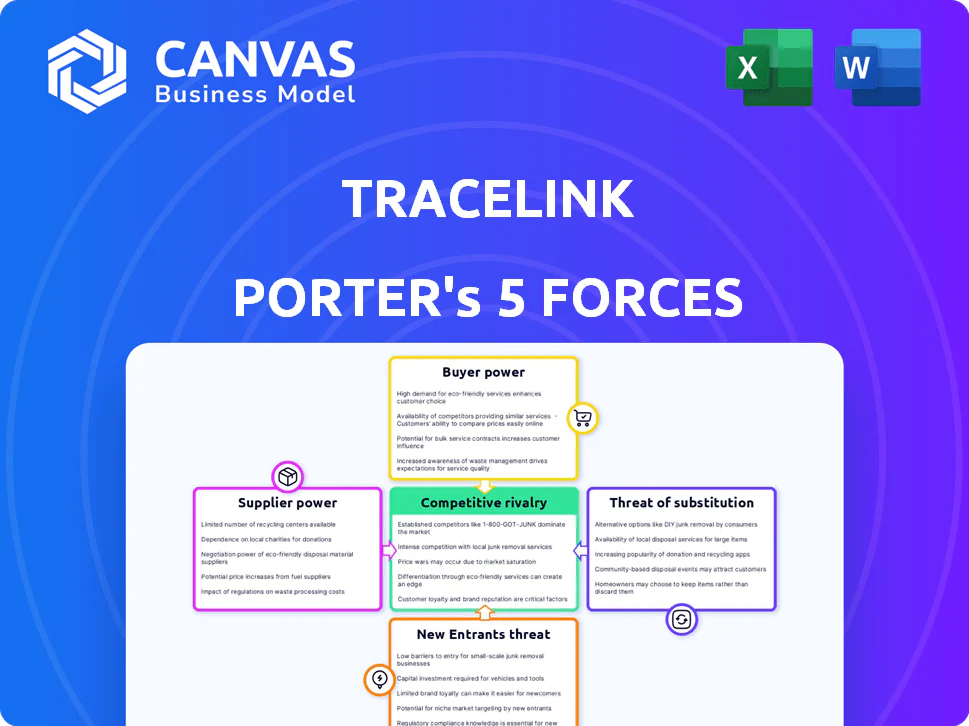
TRACELINK PORTER'S FIVE FORCES TEMPLATE RESEARCH
What is included in the product
 Detailed Word Document
Analyzes TraceLink's competitive forces, assessing supplier/buyer power, threats, and entry barriers.

 Customizable Excel Spreadsheet
Identify and address vulnerabilities in your supply chain by using our easy-to-edit data integration.
Same Document Delivered
TraceLink Porter's Five Forces Analysis
This preview reveals the complete TraceLink Porter's Five Forces Analysis you'll receive. The instant you purchase, this fully formatted document becomes yours.

Porter's Five Forces Analysis Template

A Must-Have Tool for Decision-Makers
TraceLink's competitive landscape is shaped by powerful industry forces. Examining supplier power, the threat of new entrants, and buyer power is crucial. Substitute product threats and competitive rivalry further define TraceLink's market position. Understanding these dynamics reveals strategic opportunities and risks. This brief snapshot only scratches the surface. Unlock the full Porter's Five Forces Analysis to explore TraceLink’s competitive dynamics, market pressures, and strategic advantages in detail.
Suppliers Bargaining Power

Limited number of niche suppliers for specialized technology
TraceLink's reliance on niche tech suppliers, especially for cloud and AI/ML, grants these suppliers some pricing power. However, TraceLink's use of major cloud providers like AWS and Microsoft Azure complicates this. In 2024, AWS and Azure controlled over 60% of the cloud infrastructure market. This widespread availability may limit supplier power.
Differentiated service offerings from suppliers
Suppliers with unique services, like advanced data analytics or AI, boost their bargaining power. If TraceLink uses these specialized tools, those suppliers gain influence. In 2024, the AI market grew significantly, with key players like Microsoft and Google leading, potentially impacting TraceLink's supplier relationships.

Switching costs if alternatives are limited
If TraceLink depends on niche suppliers, switching costs become a factor. SaaS generally has low switching costs, but complex tech integrations raise supplier power. In 2024, tech firms spent billions on vendor lock-in solutions. TraceLink's interoperability model somewhat protects customers, but not necessarily itself against its tech providers.

Dependence on third-party integrations
TraceLink's platform integrates with various trading partners and tech providers, creating dependencies. If key suppliers hold strong market positions, they could exert pressure on TraceLink. This reliance might affect pricing or service terms, impacting TraceLink's profitability.
- Integration with major ERP systems like SAP or Oracle could give these suppliers leverage.
- High switching costs for TraceLink to change integration partners.
- Potential for suppliers to increase prices.
- Supplier's ability to dictate terms.
Supplier consolidation
Supplier consolidation can significantly affect TraceLink's operations. If key technology suppliers merge, TraceLink might face fewer options, potentially increasing costs. This shift could reduce TraceLink's ability to negotiate favorable terms. The trend is already visible in the SaaS market, where mergers have reshaped the competitive landscape. For example, in 2024, several major tech firms announced acquisitions, potentially impacting supply chains.
- Consolidation reduces supplier choices.
- Fewer suppliers increase bargaining power.
- Higher costs and reduced flexibility.
- Market trends show increasing consolidation.
Tech Supplier Dynamics: Pricing Power at Play
TraceLink's reliance on tech suppliers, particularly for cloud services, grants them some pricing power. The dominance of cloud providers like AWS and Azure, which held over 60% of the cloud market in 2024, affects this balance. Specialized services, such as advanced AI, also influence supplier bargaining power.
| Factor | Impact on TraceLink | 2024 Data Point |
|---|---|---|
| Cloud Provider Dominance | Limits supplier pricing power | AWS & Azure: ~60% market share |
| Specialized AI Services | Increases supplier influence | AI market growth: Significant |
| Integration Complexity | Raises supplier power | Tech vendor lock-in spending: Billions |
Customers Bargaining Power

Availability of alternatives in the SaaS market
The SaaS market, including supply chain business networks and EDI software, presents numerous alternatives. This variety elevates customer bargaining power, making it easier to switch vendors. For example, the global SaaS market was valued at $172.3 billion in 2023. The availability of choices allows customers to negotiate better terms.
Large customer size and negotiation power
TraceLink's customer base includes major pharmaceutical companies and healthcare systems. These large entities wield substantial buying power due to their high-volume purchases. This allows them to negotiate favorable pricing and service terms. For instance, in 2024, the top 10 pharmaceutical companies accounted for over 40% of global drug sales, illustrating their significant influence.

Standardization of some requirements
In the life sciences sector, certain track and trace and regulatory compliance requirements are becoming standardized. If essential functions become commoditized, customers could gain leverage to negotiate lower prices. TraceLink's focus on a network and orchestration platform provides value beyond basic compliance. In 2024, the global pharmaceutical track and trace market was valued at $4.8 billion.

Customer's ability to integrate internally or with other providers
Customers, especially large pharmaceutical companies, can wield significant power. They might develop their own internal systems or collaborate with other providers for integration, reducing their dependence on platforms like TraceLink. This ability to integrate elsewhere increases their bargaining power, letting them negotiate better terms or switch providers. Competition among integration solutions is fierce, with the global pharmaceutical market valued at $1.5 trillion in 2023.
- Internal capabilities: Large customers may have the resources to build their own systems.
- External integration: Partnering with other providers offers alternatives.
- Negotiating power: Greater options strengthen customer bargaining position.
- Market dynamics: Competitive landscape influences pricing and terms.
Importance of the service to the customer's operations
TraceLink's platform is crucial for life sciences, ensuring product safety, and complying with regulations. This essential service might limit a customer's ability to switch providers easily. Despite alternative options, the importance of TraceLink's offerings can reduce customer bargaining power. In 2024, the global pharmaceutical supply chain security market was valued at $8.2 billion.
- Critical for product safety and compliance.
- Essential services may limit switching.
- Reduces customer bargaining power.
- Supply chain security market at $8.2B (2024).
SaaS Bargaining Dynamics: Pharma's Influence
Customers' bargaining power in the SaaS market is complex, influenced by available alternatives. Large pharmaceutical companies, representing significant buying power, can negotiate favorable terms. Their influence is substantial, with the top 10 firms accounting for over 40% of global drug sales in 2024.
Standardization of track and trace functions could increase customer leverage. However, TraceLink's crucial role in product safety and compliance reduces customer bargaining power, despite alternatives. The pharmaceutical supply chain security market was valued at $8.2 billion in 2024.
| Factor | Impact | Data |
|---|---|---|
| Market Alternatives | High | SaaS market valued at $172.3B in 2023 |
| Customer Size | High | Top 10 pharma: 40%+ global drug sales (2024) |
| Service Importance | Low | Supply chain security market: $8.2B (2024) |
Rivalry Among Competitors

Number and diversity of competitors
TraceLink faces competition from diverse players in supply chain tech. The market includes large firms like SAP and Oracle. Specialized providers also compete, increasing rivalry. The presence of many competitors can intensify price wars. This dynamic impacts TraceLink's market share and profitability, as seen in the competitive landscape of 2024.
Market growth rate
The life science software market is expanding significantly, with an anticipated CAGR exceeding 10% in the upcoming years. This expansion could attract more competitors. As the market grows, companies may aggressively compete for market share, potentially intensifying the rivalry among them. This dynamic environment necessitates strategic adaptability.

Product differentiation and unique value proposition
TraceLink's network platform, no-code features, and supply chain orchestration are its differentiators. However, the value customers place on these aspects shapes direct competition intensity. For instance, in 2024, the no-code market grew, intensifying rivalry. Its success hinges on how uniquely valued these features are.

Switching costs for customers
Switching costs are a key factor in competitive rivalry. TraceLink's customers face integration complexities. These complexities make it harder to switch to competitors. This reduces the intensity of rivalry. The SaaS market's subscription revenue reached $175.1 billion in 2023.
- Integration Complexity: Complex systems increase switching barriers.
- Market Revenue: The SaaS market is growing rapidly.
- Customer Lock-in: High switching costs reduce rivalry.
- Competitive Advantage: TraceLink benefits from customer lock-in.
Industry-specific focus and regulatory requirements
TraceLink's specialization in life sciences and proficiency in regulations like the DSCSA create a competitive edge. This focus allows TraceLink to understand the industry's nuances better than general supply chain solutions. In 2023, the global pharmaceutical supply chain market was valued at approximately $1.6 trillion. This deep understanding and industry-specific knowledge act as a barrier.
- DSCSA compliance is crucial for pharmaceutical companies, with penalties for non-compliance potentially reaching millions of dollars.
- TraceLink's expertise in serialization and traceability solutions helps pharmaceutical companies meet these regulatory demands.
- The life sciences industry's complex regulatory landscape creates a high barrier to entry for competitors.
TraceLink's Competitive Landscape: Growth and Rivalry
Competitive rivalry for TraceLink is influenced by market growth and the number of competitors. The life science software market's over 10% CAGR attracts new entrants. Switching costs, due to integration complexity, impact rivalry. TraceLink's industry specialization offers a competitive edge.
| Factor | Impact | Data |
|---|---|---|
| Market Growth | Attracts competitors | Life science software CAGR: >10% |
| Switching Costs | Reduce rivalry | SaaS revenue in 2023: $175.1B |
| Specialization | Competitive advantage | Pharma supply chain market (2023): $1.6T |
TRACELINK PORTER'S FIVE FORCES TEMPLATE RESEARCH
What is included in the product
Detailed Word Document
Analyzes TraceLink's competitive forces, assessing supplier/buyer power, threats, and entry barriers.
Customizable Excel Spreadsheet
Identify and address vulnerabilities in your supply chain by using our easy-to-edit data integration.
Same Document Delivered
TraceLink Porter's Five Forces Analysis
This preview reveals the complete TraceLink Porter's Five Forces Analysis you'll receive. The instant you purchase, this fully formatted document becomes yours.
Porter's Five Forces Analysis Template
A Must-Have Tool for Decision-Makers
TraceLink's competitive landscape is shaped by powerful industry forces. Examining supplier power, the threat of new entrants, and buyer power is crucial. Substitute product threats and competitive rivalry further define TraceLink's market position. Understanding these dynamics reveals strategic opportunities and risks. This brief snapshot only scratches the surface. Unlock the full Porter's Five Forces Analysis to explore TraceLink’s competitive dynamics, market pressures, and strategic advantages in detail.
Suppliers Bargaining Power
Limited number of niche suppliers for specialized technology
TraceLink's reliance on niche tech suppliers, especially for cloud and AI/ML, grants these suppliers some pricing power. However, TraceLink's use of major cloud providers like AWS and Microsoft Azure complicates this. In 2024, AWS and Azure controlled over 60% of the cloud infrastructure market. This widespread availability may limit supplier power.
Differentiated service offerings from suppliers
Suppliers with unique services, like advanced data analytics or AI, boost their bargaining power. If TraceLink uses these specialized tools, those suppliers gain influence. In 2024, the AI market grew significantly, with key players like Microsoft and Google leading, potentially impacting TraceLink's supplier relationships.
Switching costs if alternatives are limited
If TraceLink depends on niche suppliers, switching costs become a factor. SaaS generally has low switching costs, but complex tech integrations raise supplier power. In 2024, tech firms spent billions on vendor lock-in solutions. TraceLink's interoperability model somewhat protects customers, but not necessarily itself against its tech providers.
Dependence on third-party integrations
TraceLink's platform integrates with various trading partners and tech providers, creating dependencies. If key suppliers hold strong market positions, they could exert pressure on TraceLink. This reliance might affect pricing or service terms, impacting TraceLink's profitability.
- Integration with major ERP systems like SAP or Oracle could give these suppliers leverage.
- High switching costs for TraceLink to change integration partners.
- Potential for suppliers to increase prices.
- Supplier's ability to dictate terms.
Supplier consolidation
Supplier consolidation can significantly affect TraceLink's operations. If key technology suppliers merge, TraceLink might face fewer options, potentially increasing costs. This shift could reduce TraceLink's ability to negotiate favorable terms. The trend is already visible in the SaaS market, where mergers have reshaped the competitive landscape. For example, in 2024, several major tech firms announced acquisitions, potentially impacting supply chains.
- Consolidation reduces supplier choices.
- Fewer suppliers increase bargaining power.
- Higher costs and reduced flexibility.
- Market trends show increasing consolidation.
Tech Supplier Dynamics: Pricing Power at Play
TraceLink's reliance on tech suppliers, particularly for cloud services, grants them some pricing power. The dominance of cloud providers like AWS and Azure, which held over 60% of the cloud market in 2024, affects this balance. Specialized services, such as advanced AI, also influence supplier bargaining power.
| Factor | Impact on TraceLink | 2024 Data Point |
|---|---|---|
| Cloud Provider Dominance | Limits supplier pricing power | AWS & Azure: ~60% market share |
| Specialized AI Services | Increases supplier influence | AI market growth: Significant |
| Integration Complexity | Raises supplier power | Tech vendor lock-in spending: Billions |
Customers Bargaining Power
Availability of alternatives in the SaaS market
The SaaS market, including supply chain business networks and EDI software, presents numerous alternatives. This variety elevates customer bargaining power, making it easier to switch vendors. For example, the global SaaS market was valued at $172.3 billion in 2023. The availability of choices allows customers to negotiate better terms.
Large customer size and negotiation power
TraceLink's customer base includes major pharmaceutical companies and healthcare systems. These large entities wield substantial buying power due to their high-volume purchases. This allows them to negotiate favorable pricing and service terms. For instance, in 2024, the top 10 pharmaceutical companies accounted for over 40% of global drug sales, illustrating their significant influence.
Standardization of some requirements
In the life sciences sector, certain track and trace and regulatory compliance requirements are becoming standardized. If essential functions become commoditized, customers could gain leverage to negotiate lower prices. TraceLink's focus on a network and orchestration platform provides value beyond basic compliance. In 2024, the global pharmaceutical track and trace market was valued at $4.8 billion.
Customer's ability to integrate internally or with other providers
Customers, especially large pharmaceutical companies, can wield significant power. They might develop their own internal systems or collaborate with other providers for integration, reducing their dependence on platforms like TraceLink. This ability to integrate elsewhere increases their bargaining power, letting them negotiate better terms or switch providers. Competition among integration solutions is fierce, with the global pharmaceutical market valued at $1.5 trillion in 2023.
- Internal capabilities: Large customers may have the resources to build their own systems.
- External integration: Partnering with other providers offers alternatives.
- Negotiating power: Greater options strengthen customer bargaining position.
- Market dynamics: Competitive landscape influences pricing and terms.
Importance of the service to the customer's operations
TraceLink's platform is crucial for life sciences, ensuring product safety, and complying with regulations. This essential service might limit a customer's ability to switch providers easily. Despite alternative options, the importance of TraceLink's offerings can reduce customer bargaining power. In 2024, the global pharmaceutical supply chain security market was valued at $8.2 billion.
- Critical for product safety and compliance.
- Essential services may limit switching.
- Reduces customer bargaining power.
- Supply chain security market at $8.2B (2024).
SaaS Bargaining Dynamics: Pharma's Influence
Customers' bargaining power in the SaaS market is complex, influenced by available alternatives. Large pharmaceutical companies, representing significant buying power, can negotiate favorable terms. Their influence is substantial, with the top 10 firms accounting for over 40% of global drug sales in 2024.
Standardization of track and trace functions could increase customer leverage. However, TraceLink's crucial role in product safety and compliance reduces customer bargaining power, despite alternatives. The pharmaceutical supply chain security market was valued at $8.2 billion in 2024.
| Factor | Impact | Data |
|---|---|---|
| Market Alternatives | High | SaaS market valued at $172.3B in 2023 |
| Customer Size | High | Top 10 pharma: 40%+ global drug sales (2024) |
| Service Importance | Low | Supply chain security market: $8.2B (2024) |
Rivalry Among Competitors
Number and diversity of competitors
TraceLink faces competition from diverse players in supply chain tech. The market includes large firms like SAP and Oracle. Specialized providers also compete, increasing rivalry. The presence of many competitors can intensify price wars. This dynamic impacts TraceLink's market share and profitability, as seen in the competitive landscape of 2024.
Market growth rate
The life science software market is expanding significantly, with an anticipated CAGR exceeding 10% in the upcoming years. This expansion could attract more competitors. As the market grows, companies may aggressively compete for market share, potentially intensifying the rivalry among them. This dynamic environment necessitates strategic adaptability.
Product differentiation and unique value proposition
TraceLink's network platform, no-code features, and supply chain orchestration are its differentiators. However, the value customers place on these aspects shapes direct competition intensity. For instance, in 2024, the no-code market grew, intensifying rivalry. Its success hinges on how uniquely valued these features are.
Switching costs for customers
Switching costs are a key factor in competitive rivalry. TraceLink's customers face integration complexities. These complexities make it harder to switch to competitors. This reduces the intensity of rivalry. The SaaS market's subscription revenue reached $175.1 billion in 2023.
- Integration Complexity: Complex systems increase switching barriers.
- Market Revenue: The SaaS market is growing rapidly.
- Customer Lock-in: High switching costs reduce rivalry.
- Competitive Advantage: TraceLink benefits from customer lock-in.
Industry-specific focus and regulatory requirements
TraceLink's specialization in life sciences and proficiency in regulations like the DSCSA create a competitive edge. This focus allows TraceLink to understand the industry's nuances better than general supply chain solutions. In 2023, the global pharmaceutical supply chain market was valued at approximately $1.6 trillion. This deep understanding and industry-specific knowledge act as a barrier.
- DSCSA compliance is crucial for pharmaceutical companies, with penalties for non-compliance potentially reaching millions of dollars.
- TraceLink's expertise in serialization and traceability solutions helps pharmaceutical companies meet these regulatory demands.
- The life sciences industry's complex regulatory landscape creates a high barrier to entry for competitors.
TraceLink's Competitive Landscape: Growth and Rivalry
Competitive rivalry for TraceLink is influenced by market growth and the number of competitors. The life science software market's over 10% CAGR attracts new entrants. Switching costs, due to integration complexity, impact rivalry. TraceLink's industry specialization offers a competitive edge.
| Factor | Impact | Data |
|---|---|---|
| Market Growth | Attracts competitors | Life science software CAGR: >10% |
| Switching Costs | Reduce rivalry | SaaS revenue in 2023: $175.1B |
| Specialization | Competitive advantage | Pharma supply chain market (2023): $1.6T |
Product Information
Product Information
Shipping & Returns
Shipping & Returns
Description
What is included in the product
Detailed Word Document
Analyzes TraceLink's competitive forces, assessing supplier/buyer power, threats, and entry barriers.
Customizable Excel Spreadsheet
Identify and address vulnerabilities in your supply chain by using our easy-to-edit data integration.
Same Document Delivered
TraceLink Porter's Five Forces Analysis
This preview reveals the complete TraceLink Porter's Five Forces Analysis you'll receive. The instant you purchase, this fully formatted document becomes yours.
Porter's Five Forces Analysis Template
A Must-Have Tool for Decision-Makers
TraceLink's competitive landscape is shaped by powerful industry forces. Examining supplier power, the threat of new entrants, and buyer power is crucial. Substitute product threats and competitive rivalry further define TraceLink's market position. Understanding these dynamics reveals strategic opportunities and risks. This brief snapshot only scratches the surface. Unlock the full Porter's Five Forces Analysis to explore TraceLink’s competitive dynamics, market pressures, and strategic advantages in detail.
Suppliers Bargaining Power
Limited number of niche suppliers for specialized technology
TraceLink's reliance on niche tech suppliers, especially for cloud and AI/ML, grants these suppliers some pricing power. However, TraceLink's use of major cloud providers like AWS and Microsoft Azure complicates this. In 2024, AWS and Azure controlled over 60% of the cloud infrastructure market. This widespread availability may limit supplier power.
Differentiated service offerings from suppliers
Suppliers with unique services, like advanced data analytics or AI, boost their bargaining power. If TraceLink uses these specialized tools, those suppliers gain influence. In 2024, the AI market grew significantly, with key players like Microsoft and Google leading, potentially impacting TraceLink's supplier relationships.
Switching costs if alternatives are limited
If TraceLink depends on niche suppliers, switching costs become a factor. SaaS generally has low switching costs, but complex tech integrations raise supplier power. In 2024, tech firms spent billions on vendor lock-in solutions. TraceLink's interoperability model somewhat protects customers, but not necessarily itself against its tech providers.
Dependence on third-party integrations
TraceLink's platform integrates with various trading partners and tech providers, creating dependencies. If key suppliers hold strong market positions, they could exert pressure on TraceLink. This reliance might affect pricing or service terms, impacting TraceLink's profitability.
- Integration with major ERP systems like SAP or Oracle could give these suppliers leverage.
- High switching costs for TraceLink to change integration partners.
- Potential for suppliers to increase prices.
- Supplier's ability to dictate terms.
Supplier consolidation
Supplier consolidation can significantly affect TraceLink's operations. If key technology suppliers merge, TraceLink might face fewer options, potentially increasing costs. This shift could reduce TraceLink's ability to negotiate favorable terms. The trend is already visible in the SaaS market, where mergers have reshaped the competitive landscape. For example, in 2024, several major tech firms announced acquisitions, potentially impacting supply chains.
- Consolidation reduces supplier choices.
- Fewer suppliers increase bargaining power.
- Higher costs and reduced flexibility.
- Market trends show increasing consolidation.
Tech Supplier Dynamics: Pricing Power at Play
TraceLink's reliance on tech suppliers, particularly for cloud services, grants them some pricing power. The dominance of cloud providers like AWS and Azure, which held over 60% of the cloud market in 2024, affects this balance. Specialized services, such as advanced AI, also influence supplier bargaining power.
| Factor | Impact on TraceLink | 2024 Data Point |
|---|---|---|
| Cloud Provider Dominance | Limits supplier pricing power | AWS & Azure: ~60% market share |
| Specialized AI Services | Increases supplier influence | AI market growth: Significant |
| Integration Complexity | Raises supplier power | Tech vendor lock-in spending: Billions |
Customers Bargaining Power
Availability of alternatives in the SaaS market
The SaaS market, including supply chain business networks and EDI software, presents numerous alternatives. This variety elevates customer bargaining power, making it easier to switch vendors. For example, the global SaaS market was valued at $172.3 billion in 2023. The availability of choices allows customers to negotiate better terms.
Large customer size and negotiation power
TraceLink's customer base includes major pharmaceutical companies and healthcare systems. These large entities wield substantial buying power due to their high-volume purchases. This allows them to negotiate favorable pricing and service terms. For instance, in 2024, the top 10 pharmaceutical companies accounted for over 40% of global drug sales, illustrating their significant influence.
Standardization of some requirements
In the life sciences sector, certain track and trace and regulatory compliance requirements are becoming standardized. If essential functions become commoditized, customers could gain leverage to negotiate lower prices. TraceLink's focus on a network and orchestration platform provides value beyond basic compliance. In 2024, the global pharmaceutical track and trace market was valued at $4.8 billion.
Customer's ability to integrate internally or with other providers
Customers, especially large pharmaceutical companies, can wield significant power. They might develop their own internal systems or collaborate with other providers for integration, reducing their dependence on platforms like TraceLink. This ability to integrate elsewhere increases their bargaining power, letting them negotiate better terms or switch providers. Competition among integration solutions is fierce, with the global pharmaceutical market valued at $1.5 trillion in 2023.
- Internal capabilities: Large customers may have the resources to build their own systems.
- External integration: Partnering with other providers offers alternatives.
- Negotiating power: Greater options strengthen customer bargaining position.
- Market dynamics: Competitive landscape influences pricing and terms.
Importance of the service to the customer's operations
TraceLink's platform is crucial for life sciences, ensuring product safety, and complying with regulations. This essential service might limit a customer's ability to switch providers easily. Despite alternative options, the importance of TraceLink's offerings can reduce customer bargaining power. In 2024, the global pharmaceutical supply chain security market was valued at $8.2 billion.
- Critical for product safety and compliance.
- Essential services may limit switching.
- Reduces customer bargaining power.
- Supply chain security market at $8.2B (2024).
SaaS Bargaining Dynamics: Pharma's Influence
Customers' bargaining power in the SaaS market is complex, influenced by available alternatives. Large pharmaceutical companies, representing significant buying power, can negotiate favorable terms. Their influence is substantial, with the top 10 firms accounting for over 40% of global drug sales in 2024.
Standardization of track and trace functions could increase customer leverage. However, TraceLink's crucial role in product safety and compliance reduces customer bargaining power, despite alternatives. The pharmaceutical supply chain security market was valued at $8.2 billion in 2024.
| Factor | Impact | Data |
|---|---|---|
| Market Alternatives | High | SaaS market valued at $172.3B in 2023 |
| Customer Size | High | Top 10 pharma: 40%+ global drug sales (2024) |
| Service Importance | Low | Supply chain security market: $8.2B (2024) |
Rivalry Among Competitors
Number and diversity of competitors
TraceLink faces competition from diverse players in supply chain tech. The market includes large firms like SAP and Oracle. Specialized providers also compete, increasing rivalry. The presence of many competitors can intensify price wars. This dynamic impacts TraceLink's market share and profitability, as seen in the competitive landscape of 2024.
Market growth rate
The life science software market is expanding significantly, with an anticipated CAGR exceeding 10% in the upcoming years. This expansion could attract more competitors. As the market grows, companies may aggressively compete for market share, potentially intensifying the rivalry among them. This dynamic environment necessitates strategic adaptability.
Product differentiation and unique value proposition
TraceLink's network platform, no-code features, and supply chain orchestration are its differentiators. However, the value customers place on these aspects shapes direct competition intensity. For instance, in 2024, the no-code market grew, intensifying rivalry. Its success hinges on how uniquely valued these features are.
Switching costs for customers
Switching costs are a key factor in competitive rivalry. TraceLink's customers face integration complexities. These complexities make it harder to switch to competitors. This reduces the intensity of rivalry. The SaaS market's subscription revenue reached $175.1 billion in 2023.
- Integration Complexity: Complex systems increase switching barriers.
- Market Revenue: The SaaS market is growing rapidly.
- Customer Lock-in: High switching costs reduce rivalry.
- Competitive Advantage: TraceLink benefits from customer lock-in.
Industry-specific focus and regulatory requirements
TraceLink's specialization in life sciences and proficiency in regulations like the DSCSA create a competitive edge. This focus allows TraceLink to understand the industry's nuances better than general supply chain solutions. In 2023, the global pharmaceutical supply chain market was valued at approximately $1.6 trillion. This deep understanding and industry-specific knowledge act as a barrier.
- DSCSA compliance is crucial for pharmaceutical companies, with penalties for non-compliance potentially reaching millions of dollars.
- TraceLink's expertise in serialization and traceability solutions helps pharmaceutical companies meet these regulatory demands.
- The life sciences industry's complex regulatory landscape creates a high barrier to entry for competitors.
TraceLink's Competitive Landscape: Growth and Rivalry
Competitive rivalry for TraceLink is influenced by market growth and the number of competitors. The life science software market's over 10% CAGR attracts new entrants. Switching costs, due to integration complexity, impact rivalry. TraceLink's industry specialization offers a competitive edge.
| Factor | Impact | Data |
|---|---|---|
| Market Growth | Attracts competitors | Life science software CAGR: >10% |
| Switching Costs | Reduce rivalry | SaaS revenue in 2023: $175.1B |
| Specialization | Competitive advantage | Pharma supply chain market (2023): $1.6T |











