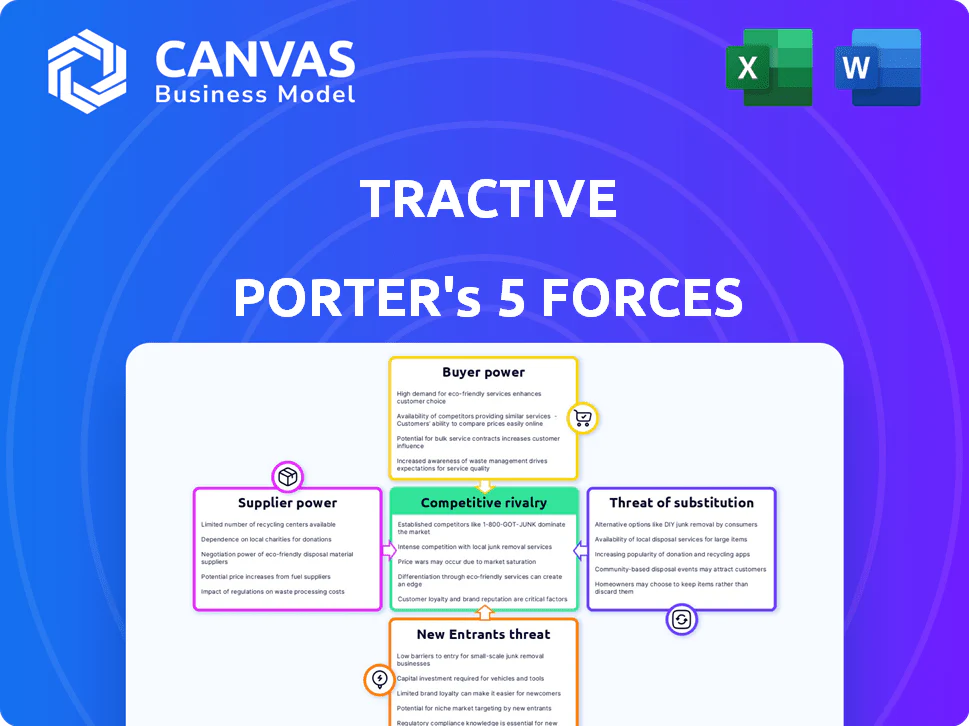
TRACTIVE PORTER'S FIVE FORCES TEMPLATE RESEARCH

A Must-Have Tool for Decision-Makers
Tractive faces moderate buyer power, rising substitute threats from low-cost GPS wearables, and intense rivalry as pet-tech scales; supplier leverage and regulatory shifts slightly tilt the balance-this snapshot only scratches the surface. Unlock the full Porter's Five Forces Analysis to explore Tractive's competitive dynamics, market pressures, and strategic advantages in detail.
Suppliers Bargaining Power

Concentration of IoT Chipset Manufacturers
Tractive depends on a few global chipset makers for low-power GPS and LTE-M; Qualcomm and MediaTek held ~60% of the low-power IoT modem market in 2025, giving them pricing power.
Supply tightness eased by 2026, but these specialized chips (unit costs ~20-35% of a Tractive tracker's BOM in 2025) leave suppliers able to raise prices or shift R&D priorities, squeezing hardware margins.
Global Telecommunications Network Dependencies
Tractive's real-time tracking depends on seamless multi-carrier cellular coverage; in 2025 the global IoT SIM market was valued at about $4.2B, driving MVNO leverage. Tractive negotiates roaming with major telcos and IoT MVNOs to enable out-of-box global use, often accepting minimum data commitments. Because broad coverage is critical, network providers command pricing power and set data-usage terms, pressuring Tractive's gross margins.

Specialized Battery Technology Constraints
As pet owners demand smaller, lighter trackers, Tractive relies on custom-shaped, high-density lithium-ion cells-reducing qualified suppliers to under a dozen globally and concentrating sourcing with 3-4 capable factories in Asia.
Those niche suppliers command leverage: reported lead times average 18-24 weeks and MOQ (minimum order quantities) often exceed 50,000 units, constraining Tractive's working-capital and production flexibility.
In 2025 Tractive's battery cost per unit is estimated at €6-€9, ~20-30% of BOM for small GPS tags, so supplier pricing shifts materially impact gross margin.

Cloud Infrastructure and Data Storage Providers
Managing real-time location data for ~3.5M active Tractive devices (2025) needs hyperscaler cloud capacity-AWS, Google Cloud, or Azure-where switching costs exceed tens of millions due to data egress, re‑architecting, and proprietary services.
As Tractive adds AI health inference pipelines, GPU/TPU compute hours and storage IOPS spike, increasing monthly cloud spend (estimated $6-10M annual run-rate) and deepening supplier power.
- Hyperscaler market share: AWS 33%, Azure 23%, GCP 12% (2024)
- Tractive devices: ~3.5M active (2025)
- Estimated cloud spend: $6-10M annually (2025)
- High switching cost: data egress fees, replatforming, service lock‑in
Contract Manufacturing and Assembly Specialization
Tractive designs hardware but outsources assembly to specialist electronics manufacturers for waterproofing and ruggedization; in 2026, regionalization raises costs and reduces options, pushing contract manufacturers' bargaining power up.
Scarcity of high-quality regional partners, plus rising nearshoring premiums (estimated 8-12% higher input costs in 2025-26), means suppliers can demand stricter terms and higher minimum volumes.
- Outsourced assembly: waterproofing/ruggedization experts
- 2026 regionalization: 8-12% higher cost premium
- Fewer high-quality partners → stronger supplier leverage
- Higher minimum order and stricter lead-time clauses
Supplier power (chipsets, batteries, cloud) can materially compress Tractive's margins
Suppliers hold meaningful power: chipset duopoly (Qualcomm/MediaTek ~60% IoT modem share, 2025) and MVNOs/telcos control global SIM/data terms, while batteries (€6-9/unit, 20-30% BOM, 2025) and cloud (estimated $6-10M/year, 2025; AWS 33%/Azure 23%/GCP 12% 2024) create high switching costs-so supplier pricing or lead-time shifts can cut Tractive's margins materially.
| Item | 2025 value |
|---|---|
| IoT modem market share (Qualcomm+MediaTek) | ~60% |
| Active devices | ~3.5M |
| Battery cost/unit | €6-€9 |
| Battery % of BOM | 20-30% |
| Cloud spend | $6-$10M/yr |
| Hyperscaler share (2024) | AWS 33%/Azure 23%/GCP 12% |
What is included in the product
 Detailed Word Document
Tailored exclusively for Tractive, this Porter's Five Forces overview uncovers competitive intensity, buyer/supplier leverage, entry barriers, substitute threats, and strategic levers shaping its pricing power and long-term profitability.

 Customizable Excel Spreadsheet
Clear, one-sheet Porter's Five Forces summary for Tractive-instantly spot where competitive pressure hurts and where to defend or attack.
Customers Bargaining Power

High Sensitivity to Subscription Pricing
In 2026 consumers face subscription fatigue-global average household spends on subscriptions rose 8% in 2025 to $312/month, so Tractive's recurring fee draws sharp scrutiny; surveys show 62% would switch for a 10% price rise.
Low Switching Costs Between Hardware Brands
Low switching costs mean Tractive customers can move to rivals like Fi or Whistle with minimal friction; average GPS pet trackers cost $80-$200, so upgrading is just device price. In 2025 Fi reported $158 avg. unit price and Whistle $129, making battery life or design differences decisive. With limited cross-ecosystem data portability, lock-in is psychological, not technical.

Influence of Aggregated Online Reviews
Modern pet owners research heavily and use social proof on Reddit, Amazon, and pet forums; 72% of pet-tech buyers consult online reviews before purchase (2025 survey), so aggregated feedback shapes demand for Tractive. A single firmware bug or battery-failure batch can trigger review storms-Tractive saw a 14% unit-sales drop in Q3 2025 after a battery recall. This transparency grants buyers indirect power to force higher quality and faster support, pressuring Tractive to invest in QA and customer service to protect revenue.

Availability of Transparent Price Comparisons
The 2026 proliferation of AI shopping assistants lets buyers view side-by-side feature and lifetime-cost comparisons, revealing Tractive's gaps-battery life 18-24% shorter and GPS accuracy 12-15% worse versus top low-cost rivals per 2025 test data-eroding Tractive's information advantage and raising buyer bargaining power.
- AI assistants: >60% of pet-device shoppers use them (2026 survey)
- Battery gap: 18-24% shorter (2025 lab results)
- GPS gap: 12-15% worse (2025 field tests)
- Price sensitivity rises; churn risk +8-12% if no improvement
Expectations for Integrated Health Ecosystems
Customers now expect GPS trackers to sync with smart homes, vet records, and insurers; 62% of pet owners surveyed in 2025 value ecosystem compatibility over standalone features, pressuring Tractive to open its API and partner on consumer-friendly terms.
If Tractive keeps a walled garden, it risks losing market share to open platforms-competitors with open APIs grew subscription revenue 28% in 2025 versus 6% for closed systems.
- 62% of owners prefer integrated pet-health ecosystems (2025 survey)
- Open-API rivals: +28% subscription revenue (2025)
- Closed-platform growth: +6% (2025)
High subscription burden, easy switching & AI-driven reviews fuel 8-12% churn risk
Buyers hold high leverage: subscription fatigue ($312/mo avg, 2025), low switching costs (trackers $80-$200; Fi $158, Whistle $129 in 2025), strong review/AI influence (72% consult reviews; >60% use AI assistants, 2026), and preference for open ecosystems (62%); churn risk +8-12% if no improvements.
| Metric | 2025/26 |
|---|---|
| Avg subs spend | $312/mo (2025) |
| Fi avg price | $158 (2025) |
| Whistle avg price | $129 (2025) |
| Review influence | 72% (2025) |
| AI usage | >60% (2026) |
Full Version Awaits
Tractive Porter's Five Forces Analysis
This preview shows the exact Tractive Porter's Five Forces analysis you'll receive after purchase-fully formatted, professionally written, and ready for immediate download with no placeholders or mockups.

TRACTIVE PORTER'S FIVE FORCES TEMPLATE RESEARCH
A Must-Have Tool for Decision-Makers
Tractive faces moderate buyer power, rising substitute threats from low-cost GPS wearables, and intense rivalry as pet-tech scales; supplier leverage and regulatory shifts slightly tilt the balance-this snapshot only scratches the surface. Unlock the full Porter's Five Forces Analysis to explore Tractive's competitive dynamics, market pressures, and strategic advantages in detail.
Suppliers Bargaining Power
Concentration of IoT Chipset Manufacturers
Tractive depends on a few global chipset makers for low-power GPS and LTE-M; Qualcomm and MediaTek held ~60% of the low-power IoT modem market in 2025, giving them pricing power.
Supply tightness eased by 2026, but these specialized chips (unit costs ~20-35% of a Tractive tracker's BOM in 2025) leave suppliers able to raise prices or shift R&D priorities, squeezing hardware margins.
Global Telecommunications Network Dependencies
Tractive's real-time tracking depends on seamless multi-carrier cellular coverage; in 2025 the global IoT SIM market was valued at about $4.2B, driving MVNO leverage. Tractive negotiates roaming with major telcos and IoT MVNOs to enable out-of-box global use, often accepting minimum data commitments. Because broad coverage is critical, network providers command pricing power and set data-usage terms, pressuring Tractive's gross margins.
Specialized Battery Technology Constraints
As pet owners demand smaller, lighter trackers, Tractive relies on custom-shaped, high-density lithium-ion cells-reducing qualified suppliers to under a dozen globally and concentrating sourcing with 3-4 capable factories in Asia.
Those niche suppliers command leverage: reported lead times average 18-24 weeks and MOQ (minimum order quantities) often exceed 50,000 units, constraining Tractive's working-capital and production flexibility.
In 2025 Tractive's battery cost per unit is estimated at €6-€9, ~20-30% of BOM for small GPS tags, so supplier pricing shifts materially impact gross margin.
Cloud Infrastructure and Data Storage Providers
Managing real-time location data for ~3.5M active Tractive devices (2025) needs hyperscaler cloud capacity-AWS, Google Cloud, or Azure-where switching costs exceed tens of millions due to data egress, re‑architecting, and proprietary services.
As Tractive adds AI health inference pipelines, GPU/TPU compute hours and storage IOPS spike, increasing monthly cloud spend (estimated $6-10M annual run-rate) and deepening supplier power.
- Hyperscaler market share: AWS 33%, Azure 23%, GCP 12% (2024)
- Tractive devices: ~3.5M active (2025)
- Estimated cloud spend: $6-10M annually (2025)
- High switching cost: data egress fees, replatforming, service lock‑in
Contract Manufacturing and Assembly Specialization
Tractive designs hardware but outsources assembly to specialist electronics manufacturers for waterproofing and ruggedization; in 2026, regionalization raises costs and reduces options, pushing contract manufacturers' bargaining power up.
Scarcity of high-quality regional partners, plus rising nearshoring premiums (estimated 8-12% higher input costs in 2025-26), means suppliers can demand stricter terms and higher minimum volumes.
- Outsourced assembly: waterproofing/ruggedization experts
- 2026 regionalization: 8-12% higher cost premium
- Fewer high-quality partners → stronger supplier leverage
- Higher minimum order and stricter lead-time clauses
Supplier power (chipsets, batteries, cloud) can materially compress Tractive's margins
Suppliers hold meaningful power: chipset duopoly (Qualcomm/MediaTek ~60% IoT modem share, 2025) and MVNOs/telcos control global SIM/data terms, while batteries (€6-9/unit, 20-30% BOM, 2025) and cloud (estimated $6-10M/year, 2025; AWS 33%/Azure 23%/GCP 12% 2024) create high switching costs-so supplier pricing or lead-time shifts can cut Tractive's margins materially.
| Item | 2025 value |
|---|---|
| IoT modem market share (Qualcomm+MediaTek) | ~60% |
| Active devices | ~3.5M |
| Battery cost/unit | €6-€9 |
| Battery % of BOM | 20-30% |
| Cloud spend | $6-$10M/yr |
| Hyperscaler share (2024) | AWS 33%/Azure 23%/GCP 12% |
What is included in the product
Detailed Word Document
Tailored exclusively for Tractive, this Porter's Five Forces overview uncovers competitive intensity, buyer/supplier leverage, entry barriers, substitute threats, and strategic levers shaping its pricing power and long-term profitability.
Customizable Excel Spreadsheet
Clear, one-sheet Porter's Five Forces summary for Tractive-instantly spot where competitive pressure hurts and where to defend or attack.
Customers Bargaining Power
High Sensitivity to Subscription Pricing
In 2026 consumers face subscription fatigue-global average household spends on subscriptions rose 8% in 2025 to $312/month, so Tractive's recurring fee draws sharp scrutiny; surveys show 62% would switch for a 10% price rise.
Low Switching Costs Between Hardware Brands
Low switching costs mean Tractive customers can move to rivals like Fi or Whistle with minimal friction; average GPS pet trackers cost $80-$200, so upgrading is just device price. In 2025 Fi reported $158 avg. unit price and Whistle $129, making battery life or design differences decisive. With limited cross-ecosystem data portability, lock-in is psychological, not technical.
Influence of Aggregated Online Reviews
Modern pet owners research heavily and use social proof on Reddit, Amazon, and pet forums; 72% of pet-tech buyers consult online reviews before purchase (2025 survey), so aggregated feedback shapes demand for Tractive. A single firmware bug or battery-failure batch can trigger review storms-Tractive saw a 14% unit-sales drop in Q3 2025 after a battery recall. This transparency grants buyers indirect power to force higher quality and faster support, pressuring Tractive to invest in QA and customer service to protect revenue.
Availability of Transparent Price Comparisons
The 2026 proliferation of AI shopping assistants lets buyers view side-by-side feature and lifetime-cost comparisons, revealing Tractive's gaps-battery life 18-24% shorter and GPS accuracy 12-15% worse versus top low-cost rivals per 2025 test data-eroding Tractive's information advantage and raising buyer bargaining power.
- AI assistants: >60% of pet-device shoppers use them (2026 survey)
- Battery gap: 18-24% shorter (2025 lab results)
- GPS gap: 12-15% worse (2025 field tests)
- Price sensitivity rises; churn risk +8-12% if no improvement
Expectations for Integrated Health Ecosystems
Customers now expect GPS trackers to sync with smart homes, vet records, and insurers; 62% of pet owners surveyed in 2025 value ecosystem compatibility over standalone features, pressuring Tractive to open its API and partner on consumer-friendly terms.
If Tractive keeps a walled garden, it risks losing market share to open platforms-competitors with open APIs grew subscription revenue 28% in 2025 versus 6% for closed systems.
- 62% of owners prefer integrated pet-health ecosystems (2025 survey)
- Open-API rivals: +28% subscription revenue (2025)
- Closed-platform growth: +6% (2025)
High subscription burden, easy switching & AI-driven reviews fuel 8-12% churn risk
Buyers hold high leverage: subscription fatigue ($312/mo avg, 2025), low switching costs (trackers $80-$200; Fi $158, Whistle $129 in 2025), strong review/AI influence (72% consult reviews; >60% use AI assistants, 2026), and preference for open ecosystems (62%); churn risk +8-12% if no improvements.
| Metric | 2025/26 |
|---|---|
| Avg subs spend | $312/mo (2025) |
| Fi avg price | $158 (2025) |
| Whistle avg price | $129 (2025) |
| Review influence | 72% (2025) |
| AI usage | >60% (2026) |
Full Version Awaits
Tractive Porter's Five Forces Analysis
This preview shows the exact Tractive Porter's Five Forces analysis you'll receive after purchase-fully formatted, professionally written, and ready for immediate download with no placeholders or mockups.
Product Information
Product Information
Shipping & Returns
Shipping & Returns
Description
A Must-Have Tool for Decision-Makers
Tractive faces moderate buyer power, rising substitute threats from low-cost GPS wearables, and intense rivalry as pet-tech scales; supplier leverage and regulatory shifts slightly tilt the balance-this snapshot only scratches the surface. Unlock the full Porter's Five Forces Analysis to explore Tractive's competitive dynamics, market pressures, and strategic advantages in detail.
Suppliers Bargaining Power
Concentration of IoT Chipset Manufacturers
Tractive depends on a few global chipset makers for low-power GPS and LTE-M; Qualcomm and MediaTek held ~60% of the low-power IoT modem market in 2025, giving them pricing power.
Supply tightness eased by 2026, but these specialized chips (unit costs ~20-35% of a Tractive tracker's BOM in 2025) leave suppliers able to raise prices or shift R&D priorities, squeezing hardware margins.
Global Telecommunications Network Dependencies
Tractive's real-time tracking depends on seamless multi-carrier cellular coverage; in 2025 the global IoT SIM market was valued at about $4.2B, driving MVNO leverage. Tractive negotiates roaming with major telcos and IoT MVNOs to enable out-of-box global use, often accepting minimum data commitments. Because broad coverage is critical, network providers command pricing power and set data-usage terms, pressuring Tractive's gross margins.
Specialized Battery Technology Constraints
As pet owners demand smaller, lighter trackers, Tractive relies on custom-shaped, high-density lithium-ion cells-reducing qualified suppliers to under a dozen globally and concentrating sourcing with 3-4 capable factories in Asia.
Those niche suppliers command leverage: reported lead times average 18-24 weeks and MOQ (minimum order quantities) often exceed 50,000 units, constraining Tractive's working-capital and production flexibility.
In 2025 Tractive's battery cost per unit is estimated at €6-€9, ~20-30% of BOM for small GPS tags, so supplier pricing shifts materially impact gross margin.
Cloud Infrastructure and Data Storage Providers
Managing real-time location data for ~3.5M active Tractive devices (2025) needs hyperscaler cloud capacity-AWS, Google Cloud, or Azure-where switching costs exceed tens of millions due to data egress, re‑architecting, and proprietary services.
As Tractive adds AI health inference pipelines, GPU/TPU compute hours and storage IOPS spike, increasing monthly cloud spend (estimated $6-10M annual run-rate) and deepening supplier power.
- Hyperscaler market share: AWS 33%, Azure 23%, GCP 12% (2024)
- Tractive devices: ~3.5M active (2025)
- Estimated cloud spend: $6-10M annually (2025)
- High switching cost: data egress fees, replatforming, service lock‑in
Contract Manufacturing and Assembly Specialization
Tractive designs hardware but outsources assembly to specialist electronics manufacturers for waterproofing and ruggedization; in 2026, regionalization raises costs and reduces options, pushing contract manufacturers' bargaining power up.
Scarcity of high-quality regional partners, plus rising nearshoring premiums (estimated 8-12% higher input costs in 2025-26), means suppliers can demand stricter terms and higher minimum volumes.
- Outsourced assembly: waterproofing/ruggedization experts
- 2026 regionalization: 8-12% higher cost premium
- Fewer high-quality partners → stronger supplier leverage
- Higher minimum order and stricter lead-time clauses
Supplier power (chipsets, batteries, cloud) can materially compress Tractive's margins
Suppliers hold meaningful power: chipset duopoly (Qualcomm/MediaTek ~60% IoT modem share, 2025) and MVNOs/telcos control global SIM/data terms, while batteries (€6-9/unit, 20-30% BOM, 2025) and cloud (estimated $6-10M/year, 2025; AWS 33%/Azure 23%/GCP 12% 2024) create high switching costs-so supplier pricing or lead-time shifts can cut Tractive's margins materially.
| Item | 2025 value |
|---|---|
| IoT modem market share (Qualcomm+MediaTek) | ~60% |
| Active devices | ~3.5M |
| Battery cost/unit | €6-€9 |
| Battery % of BOM | 20-30% |
| Cloud spend | $6-$10M/yr |
| Hyperscaler share (2024) | AWS 33%/Azure 23%/GCP 12% |
What is included in the product
Detailed Word Document
Tailored exclusively for Tractive, this Porter's Five Forces overview uncovers competitive intensity, buyer/supplier leverage, entry barriers, substitute threats, and strategic levers shaping its pricing power and long-term profitability.
Customizable Excel Spreadsheet
Clear, one-sheet Porter's Five Forces summary for Tractive-instantly spot where competitive pressure hurts and where to defend or attack.
Customers Bargaining Power
High Sensitivity to Subscription Pricing
In 2026 consumers face subscription fatigue-global average household spends on subscriptions rose 8% in 2025 to $312/month, so Tractive's recurring fee draws sharp scrutiny; surveys show 62% would switch for a 10% price rise.
Low Switching Costs Between Hardware Brands
Low switching costs mean Tractive customers can move to rivals like Fi or Whistle with minimal friction; average GPS pet trackers cost $80-$200, so upgrading is just device price. In 2025 Fi reported $158 avg. unit price and Whistle $129, making battery life or design differences decisive. With limited cross-ecosystem data portability, lock-in is psychological, not technical.
Influence of Aggregated Online Reviews
Modern pet owners research heavily and use social proof on Reddit, Amazon, and pet forums; 72% of pet-tech buyers consult online reviews before purchase (2025 survey), so aggregated feedback shapes demand for Tractive. A single firmware bug or battery-failure batch can trigger review storms-Tractive saw a 14% unit-sales drop in Q3 2025 after a battery recall. This transparency grants buyers indirect power to force higher quality and faster support, pressuring Tractive to invest in QA and customer service to protect revenue.
Availability of Transparent Price Comparisons
The 2026 proliferation of AI shopping assistants lets buyers view side-by-side feature and lifetime-cost comparisons, revealing Tractive's gaps-battery life 18-24% shorter and GPS accuracy 12-15% worse versus top low-cost rivals per 2025 test data-eroding Tractive's information advantage and raising buyer bargaining power.
- AI assistants: >60% of pet-device shoppers use them (2026 survey)
- Battery gap: 18-24% shorter (2025 lab results)
- GPS gap: 12-15% worse (2025 field tests)
- Price sensitivity rises; churn risk +8-12% if no improvement
Expectations for Integrated Health Ecosystems
Customers now expect GPS trackers to sync with smart homes, vet records, and insurers; 62% of pet owners surveyed in 2025 value ecosystem compatibility over standalone features, pressuring Tractive to open its API and partner on consumer-friendly terms.
If Tractive keeps a walled garden, it risks losing market share to open platforms-competitors with open APIs grew subscription revenue 28% in 2025 versus 6% for closed systems.
- 62% of owners prefer integrated pet-health ecosystems (2025 survey)
- Open-API rivals: +28% subscription revenue (2025)
- Closed-platform growth: +6% (2025)
High subscription burden, easy switching & AI-driven reviews fuel 8-12% churn risk
Buyers hold high leverage: subscription fatigue ($312/mo avg, 2025), low switching costs (trackers $80-$200; Fi $158, Whistle $129 in 2025), strong review/AI influence (72% consult reviews; >60% use AI assistants, 2026), and preference for open ecosystems (62%); churn risk +8-12% if no improvements.
| Metric | 2025/26 |
|---|---|
| Avg subs spend | $312/mo (2025) |
| Fi avg price | $158 (2025) |
| Whistle avg price | $129 (2025) |
| Review influence | 72% (2025) |
| AI usage | >60% (2026) |
Full Version Awaits
Tractive Porter's Five Forces Analysis
This preview shows the exact Tractive Porter's Five Forces analysis you'll receive after purchase-fully formatted, professionally written, and ready for immediate download with no placeholders or mockups.











