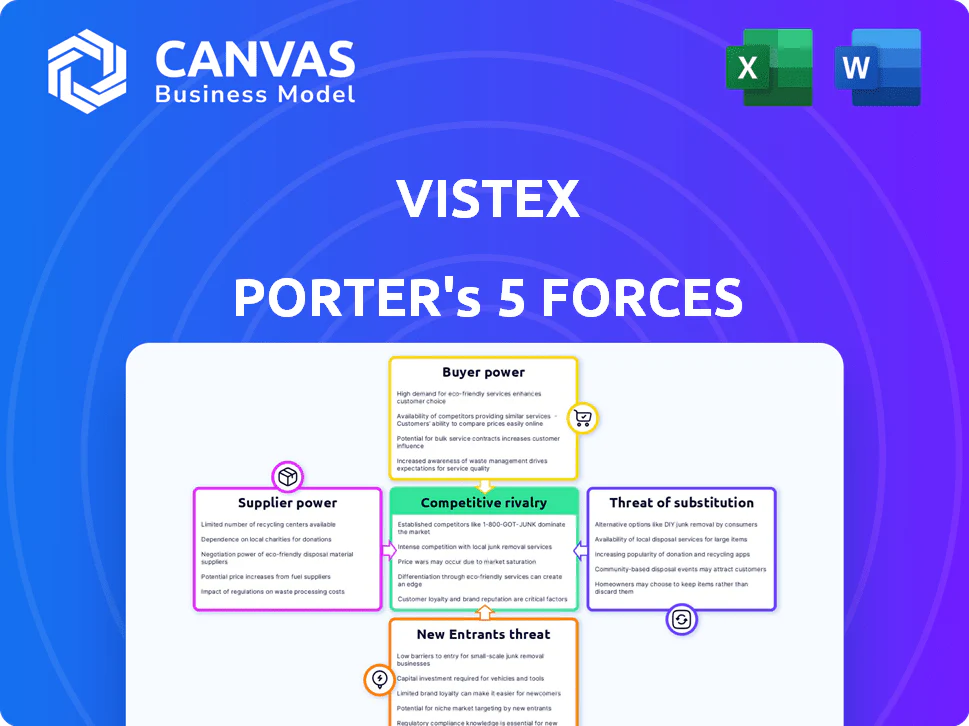
VISTEX PORTER'S FIVE FORCES TEMPLATE RESEARCH
What is included in the product
 Detailed Word Document
Evaluates control held by suppliers and buyers, and their influence on pricing and profitability.

 Customizable Excel Spreadsheet
Instantly visualize competitive forces with a dynamic, color-coded threat matrix.
Preview the Actual Deliverable
Vistex Porter's Five Forces Analysis
This preview presents the complete Porter's Five Forces analysis of Vistex. The document you see is identical to the one you'll receive immediately after your purchase.

Porter's Five Forces Analysis Template

Don't Miss the Bigger Picture
Vistex operates within a complex market shaped by several forces, including supplier and buyer power. The threat of new entrants and substitutes also impacts its competitive landscape. Understanding these dynamics is crucial for assessing Vistex's strategic positioning and growth potential. This brief snapshot only scratches the surface. Unlock the full Porter's Five Forces Analysis to explore Vistex’s competitive dynamics, market pressures, and strategic advantages in detail.
Suppliers Bargaining Power

Reliance on Technology Partners
Vistex's reliance on technology partners, especially major ERP providers like SAP, is significant. This dependence gives these suppliers a moderate to high level of bargaining power. For example, in 2024, SAP's revenue reached approximately $33.8 billion, showcasing its financial strength and influence in the market. Vistex must align with these partners.
Availability of Skilled Labor
The availability of skilled labor significantly impacts supplier power, particularly in the software and consulting sectors. In 2024, the demand for skilled software developers and consultants proficient in revenue management and ERP systems like SAP and Oracle remained high. A scarcity of these experts, as seen with a 15% increase in the average salary for specialized ERP consultants, strengthens suppliers' bargaining position. This talent shortage, especially in niche areas, allows suppliers to command higher prices and more favorable contract terms.

Data Providers
Vistex relies on data for its analytical and market insights. The bargaining power of data suppliers, particularly those offering specialized or unique datasets, can be significant. For instance, the global data analytics market was valued at $274.3 billion in 2023. The suppliers' power depends on data criticality and availability. Companies like Vistex must manage these supplier relationships carefully.

Infrastructure Providers
Vistex, as a cloud-based solution provider, depends on infrastructure providers such as AWS and Azure. These providers possess some bargaining power due to their essential services. However, Vistex can lessen this power through a multi-cloud strategy, diversifying its infrastructure needs. This approach reduces dependency on any single provider. This is critical for cost management and service continuity.
- AWS reported a revenue of $25.04 billion in Q4 2023.
- Azure's revenue grew by 30% in constant currency in Q1 2024.
- Multi-cloud adoption is increasing, with 80% of enterprises using multiple cloud providers in 2024.
Specialized Software Components
Vistex's reliance on specialized software components from third-party vendors can create supplier power. If these components are unique or crucial, suppliers gain leverage. For example, if Vistex uses a proprietary algorithm, its creator holds significant power.
- In 2024, the software industry saw a 12% increase in proprietary software licensing costs.
- Critical components can represent up to 30% of a software company's total costs.
- The market for specialized software components is projected to reach $50 billion by 2027.
Supplier Power Dynamics: A Vistex Perspective
Vistex faces supplier bargaining power from tech partners like SAP, whose 2024 revenue was about $33.8B. Skilled labor scarcity, with a 15% salary increase for ERP consultants, also boosts supplier power. Data suppliers and cloud infrastructure providers (AWS, Azure) exert further influence.
| Supplier Type | Impact on Vistex | 2024 Data |
|---|---|---|
| ERP Providers (e.g., SAP) | High, due to dependency | SAP revenue: ~$33.8B |
| Skilled Labor (Consultants) | Moderate, talent scarcity | ERP consultant salary up 15% |
| Data Suppliers | Variable, based on criticality | Data analytics market: $274.3B (2023) |
| Cloud Infrastructure (AWS, Azure) | Moderate, essential services | AWS Q4 2023 revenue: $25.04B |
Customers Bargaining Power

Diverse Customer Base
Vistex's varied customer base, spanning numerous industries and company sizes, impacts customer bargaining power. Serving both large enterprises and smaller businesses, Vistex experiences diluted individual customer power. However, larger clients, like those in manufacturing or pharmaceuticals, may wield more influence due to their significant contract values. For example, in 2024, Vistex reported a 15% increase in enterprise client contracts, suggesting a potential shift in bargaining dynamics.
Switching Costs
Switching costs play a key role in customer bargaining power, especially in complex software implementations. Implementing solutions like Vistex's demands time, resources, and financial investment, potentially reaching millions for large enterprises. This investment creates a barrier, making customers less likely to switch vendors due to the substantial sunk costs. For example, in 2024, the average cost to implement ERP systems, which often integrate with Vistex, ranged from $100,000 to several million, depending on the company size and project scope, reducing the customer's ability to negotiate aggressively on price or terms.

Availability of Alternatives
Customers evaluating Vistex have multiple software options. Competitors such as SAP, Oracle, and Salesforce offer alternatives. This wide array of choices elevates customer bargaining power. For example, SAP's revenue reached $31.2 billion in 2023. This market competition gives customers leverage.

Customer Concentration
Vistex's customer concentration significantly shapes its bargaining power. If a few major clients account for a large portion of its revenue, their ability to negotiate favorable terms increases. For example, in 2024, companies like SAP and Oracle, who often partner with Vistex, could wield considerable influence if they represent a substantial share of Vistex's business. This scenario allows these customers to demand lower prices or better service conditions.
- Customer concentration can lead to reduced pricing power for Vistex.
- Large clients might seek customized solutions, adding to operational complexity.
- Dependence on a few key accounts exposes Vistex to significant risk.
- Industry-specific concentration amplifies the impact of economic downturns.
Demand for ROI and Analytics
Customers now expect clear ROI and detailed analytics from software, enhancing their bargaining power. This trend allows them to demand value and track performance closely. For example, in 2024, the demand for ROI-focused solutions increased by 20% across various industries. This shift enables customers to negotiate better terms and outcomes.
- 20% increase in demand for ROI-focused solutions.
- Customers push for value-driven outcomes.
- Performance metrics are now a key focus.
- Customers can negotiate better terms.
Customer Power Dynamics: Key Factors
Customer bargaining power in Vistex's market varies. Large clients have more influence. Switching costs and competition also affect this power. The demand for ROI-focused solutions grew by 20% in 2024.
| Factor | Impact on Bargaining Power | 2024 Data |
|---|---|---|
| Customer Concentration | Higher concentration increases customer power. | SAP revenue: $31.2B in 2023. |
| Switching Costs | High costs reduce customer power. | ERP implementation costs: $100k-$millions. |
| ROI Focus | Customers seek value and negotiate. | 20% rise in ROI-focused solutions. |
Rivalry Among Competitors

Presence of Major Competitors
Vistex faces intense competition due to the presence of major players. SAP, a key competitor, reported €30.7 billion in revenue in 2023. Oracle, another significant rival, generated $50.0 billion in revenue in fiscal year 2024. Salesforce, also in the mix, achieved $34.5 billion in revenue in fiscal year 2024. This competition necessitates Vistex to continually innovate to maintain market share.
Market Share
Vistex, with roughly 7% market share, faces intense competition. This indicates a competitive landscape where no single player overwhelmingly dominates, fostering rivalry. Competitors constantly vie for a larger slice of the revenue management market. This dynamic pushes companies to innovate and improve their offerings to attract and retain customers.

Differentiation of Offerings
Vistex faces rivalry through offering differentiation, with companies competing on solution breadth, industry expertise, and integration. They also focus on tangible business outcomes. For example, in 2024, the market saw increased competition in pricing and revenue management solutions, with vendors emphasizing specific industry focus. The total market for these solutions in 2024 was estimated at $2 billion.

Pricing Pressure
Intense competition in the software market, including from firms like SAP and Oracle, can drive pricing pressure. Vistex, to maintain its market position, must justify its pricing through superior value. For example, in 2024, the average discount rate in the software industry was 12.5%, reflecting the need for competitive pricing strategies. This pressure necessitates clear communication of Vistex's unique benefits.
- Discounting: Aggressive discounting is common in competitive markets.
- Value Proposition: Companies must clearly articulate their value.
- Market Dynamics: Competition affects pricing strategies.
- Profit Margins: Pressure can squeeze profit margins.
Innovation and Technology Advancement
Competitive rivalry in the technology sector intensifies the need for constant innovation. Vistex, like its competitors, must adopt technologies like AI and cloud solutions to stay relevant. Companies lagging in tech adoption risk losing market share to those who innovate faster. In 2024, spending on cloud services hit $670 billion, emphasizing the need for tech investment.
- Cloud computing market is projected to reach $1.6 trillion by 2027.
- Global AI market is expected to reach $1.8 trillion by 2030.
- Vistex's competitors include SAP and Oracle, who are also investing heavily in new technologies.
Vistex Faces Intense Competition: SAP, Oracle, and More!
Competitive rivalry is high in Vistex's market, with major players like SAP and Oracle. These rivals reported billions in revenue in 2024, fueling intense competition. This rivalry forces Vistex to innovate and differentiate its offerings to maintain its market share.
| Aspect | Details | Data |
|---|---|---|
| Key Competitors | SAP, Oracle, Salesforce | Combined revenue in 2024 exceeded $134 billion |
| Market Share | Vistex's approximate share | 7% |
| Industry Focus | Emphasis on differentiation | Solution breadth, industry expertise |
VISTEX PORTER'S FIVE FORCES TEMPLATE RESEARCH
What is included in the product
Detailed Word Document
Evaluates control held by suppliers and buyers, and their influence on pricing and profitability.
Customizable Excel Spreadsheet
Instantly visualize competitive forces with a dynamic, color-coded threat matrix.
Preview the Actual Deliverable
Vistex Porter's Five Forces Analysis
This preview presents the complete Porter's Five Forces analysis of Vistex. The document you see is identical to the one you'll receive immediately after your purchase.
Porter's Five Forces Analysis Template
Don't Miss the Bigger Picture
Vistex operates within a complex market shaped by several forces, including supplier and buyer power. The threat of new entrants and substitutes also impacts its competitive landscape. Understanding these dynamics is crucial for assessing Vistex's strategic positioning and growth potential. This brief snapshot only scratches the surface. Unlock the full Porter's Five Forces Analysis to explore Vistex’s competitive dynamics, market pressures, and strategic advantages in detail.
Suppliers Bargaining Power
Reliance on Technology Partners
Vistex's reliance on technology partners, especially major ERP providers like SAP, is significant. This dependence gives these suppliers a moderate to high level of bargaining power. For example, in 2024, SAP's revenue reached approximately $33.8 billion, showcasing its financial strength and influence in the market. Vistex must align with these partners.
Availability of Skilled Labor
The availability of skilled labor significantly impacts supplier power, particularly in the software and consulting sectors. In 2024, the demand for skilled software developers and consultants proficient in revenue management and ERP systems like SAP and Oracle remained high. A scarcity of these experts, as seen with a 15% increase in the average salary for specialized ERP consultants, strengthens suppliers' bargaining position. This talent shortage, especially in niche areas, allows suppliers to command higher prices and more favorable contract terms.
Data Providers
Vistex relies on data for its analytical and market insights. The bargaining power of data suppliers, particularly those offering specialized or unique datasets, can be significant. For instance, the global data analytics market was valued at $274.3 billion in 2023. The suppliers' power depends on data criticality and availability. Companies like Vistex must manage these supplier relationships carefully.
Infrastructure Providers
Vistex, as a cloud-based solution provider, depends on infrastructure providers such as AWS and Azure. These providers possess some bargaining power due to their essential services. However, Vistex can lessen this power through a multi-cloud strategy, diversifying its infrastructure needs. This approach reduces dependency on any single provider. This is critical for cost management and service continuity.
- AWS reported a revenue of $25.04 billion in Q4 2023.
- Azure's revenue grew by 30% in constant currency in Q1 2024.
- Multi-cloud adoption is increasing, with 80% of enterprises using multiple cloud providers in 2024.
Specialized Software Components
Vistex's reliance on specialized software components from third-party vendors can create supplier power. If these components are unique or crucial, suppliers gain leverage. For example, if Vistex uses a proprietary algorithm, its creator holds significant power.
- In 2024, the software industry saw a 12% increase in proprietary software licensing costs.
- Critical components can represent up to 30% of a software company's total costs.
- The market for specialized software components is projected to reach $50 billion by 2027.
Supplier Power Dynamics: A Vistex Perspective
Vistex faces supplier bargaining power from tech partners like SAP, whose 2024 revenue was about $33.8B. Skilled labor scarcity, with a 15% salary increase for ERP consultants, also boosts supplier power. Data suppliers and cloud infrastructure providers (AWS, Azure) exert further influence.
| Supplier Type | Impact on Vistex | 2024 Data |
|---|---|---|
| ERP Providers (e.g., SAP) | High, due to dependency | SAP revenue: ~$33.8B |
| Skilled Labor (Consultants) | Moderate, talent scarcity | ERP consultant salary up 15% |
| Data Suppliers | Variable, based on criticality | Data analytics market: $274.3B (2023) |
| Cloud Infrastructure (AWS, Azure) | Moderate, essential services | AWS Q4 2023 revenue: $25.04B |
Customers Bargaining Power
Diverse Customer Base
Vistex's varied customer base, spanning numerous industries and company sizes, impacts customer bargaining power. Serving both large enterprises and smaller businesses, Vistex experiences diluted individual customer power. However, larger clients, like those in manufacturing or pharmaceuticals, may wield more influence due to their significant contract values. For example, in 2024, Vistex reported a 15% increase in enterprise client contracts, suggesting a potential shift in bargaining dynamics.
Switching Costs
Switching costs play a key role in customer bargaining power, especially in complex software implementations. Implementing solutions like Vistex's demands time, resources, and financial investment, potentially reaching millions for large enterprises. This investment creates a barrier, making customers less likely to switch vendors due to the substantial sunk costs. For example, in 2024, the average cost to implement ERP systems, which often integrate with Vistex, ranged from $100,000 to several million, depending on the company size and project scope, reducing the customer's ability to negotiate aggressively on price or terms.
Availability of Alternatives
Customers evaluating Vistex have multiple software options. Competitors such as SAP, Oracle, and Salesforce offer alternatives. This wide array of choices elevates customer bargaining power. For example, SAP's revenue reached $31.2 billion in 2023. This market competition gives customers leverage.
Customer Concentration
Vistex's customer concentration significantly shapes its bargaining power. If a few major clients account for a large portion of its revenue, their ability to negotiate favorable terms increases. For example, in 2024, companies like SAP and Oracle, who often partner with Vistex, could wield considerable influence if they represent a substantial share of Vistex's business. This scenario allows these customers to demand lower prices or better service conditions.
- Customer concentration can lead to reduced pricing power for Vistex.
- Large clients might seek customized solutions, adding to operational complexity.
- Dependence on a few key accounts exposes Vistex to significant risk.
- Industry-specific concentration amplifies the impact of economic downturns.
Demand for ROI and Analytics
Customers now expect clear ROI and detailed analytics from software, enhancing their bargaining power. This trend allows them to demand value and track performance closely. For example, in 2024, the demand for ROI-focused solutions increased by 20% across various industries. This shift enables customers to negotiate better terms and outcomes.
- 20% increase in demand for ROI-focused solutions.
- Customers push for value-driven outcomes.
- Performance metrics are now a key focus.
- Customers can negotiate better terms.
Customer Power Dynamics: Key Factors
Customer bargaining power in Vistex's market varies. Large clients have more influence. Switching costs and competition also affect this power. The demand for ROI-focused solutions grew by 20% in 2024.
| Factor | Impact on Bargaining Power | 2024 Data |
|---|---|---|
| Customer Concentration | Higher concentration increases customer power. | SAP revenue: $31.2B in 2023. |
| Switching Costs | High costs reduce customer power. | ERP implementation costs: $100k-$millions. |
| ROI Focus | Customers seek value and negotiate. | 20% rise in ROI-focused solutions. |
Rivalry Among Competitors
Presence of Major Competitors
Vistex faces intense competition due to the presence of major players. SAP, a key competitor, reported €30.7 billion in revenue in 2023. Oracle, another significant rival, generated $50.0 billion in revenue in fiscal year 2024. Salesforce, also in the mix, achieved $34.5 billion in revenue in fiscal year 2024. This competition necessitates Vistex to continually innovate to maintain market share.
Market Share
Vistex, with roughly 7% market share, faces intense competition. This indicates a competitive landscape where no single player overwhelmingly dominates, fostering rivalry. Competitors constantly vie for a larger slice of the revenue management market. This dynamic pushes companies to innovate and improve their offerings to attract and retain customers.
Differentiation of Offerings
Vistex faces rivalry through offering differentiation, with companies competing on solution breadth, industry expertise, and integration. They also focus on tangible business outcomes. For example, in 2024, the market saw increased competition in pricing and revenue management solutions, with vendors emphasizing specific industry focus. The total market for these solutions in 2024 was estimated at $2 billion.
Pricing Pressure
Intense competition in the software market, including from firms like SAP and Oracle, can drive pricing pressure. Vistex, to maintain its market position, must justify its pricing through superior value. For example, in 2024, the average discount rate in the software industry was 12.5%, reflecting the need for competitive pricing strategies. This pressure necessitates clear communication of Vistex's unique benefits.
- Discounting: Aggressive discounting is common in competitive markets.
- Value Proposition: Companies must clearly articulate their value.
- Market Dynamics: Competition affects pricing strategies.
- Profit Margins: Pressure can squeeze profit margins.
Innovation and Technology Advancement
Competitive rivalry in the technology sector intensifies the need for constant innovation. Vistex, like its competitors, must adopt technologies like AI and cloud solutions to stay relevant. Companies lagging in tech adoption risk losing market share to those who innovate faster. In 2024, spending on cloud services hit $670 billion, emphasizing the need for tech investment.
- Cloud computing market is projected to reach $1.6 trillion by 2027.
- Global AI market is expected to reach $1.8 trillion by 2030.
- Vistex's competitors include SAP and Oracle, who are also investing heavily in new technologies.
Vistex Faces Intense Competition: SAP, Oracle, and More!
Competitive rivalry is high in Vistex's market, with major players like SAP and Oracle. These rivals reported billions in revenue in 2024, fueling intense competition. This rivalry forces Vistex to innovate and differentiate its offerings to maintain its market share.
| Aspect | Details | Data |
|---|---|---|
| Key Competitors | SAP, Oracle, Salesforce | Combined revenue in 2024 exceeded $134 billion |
| Market Share | Vistex's approximate share | 7% |
| Industry Focus | Emphasis on differentiation | Solution breadth, industry expertise |
Product Information
Product Information
Shipping & Returns
Shipping & Returns
Description
What is included in the product
Detailed Word Document
Evaluates control held by suppliers and buyers, and their influence on pricing and profitability.
Customizable Excel Spreadsheet
Instantly visualize competitive forces with a dynamic, color-coded threat matrix.
Preview the Actual Deliverable
Vistex Porter's Five Forces Analysis
This preview presents the complete Porter's Five Forces analysis of Vistex. The document you see is identical to the one you'll receive immediately after your purchase.
Porter's Five Forces Analysis Template
Don't Miss the Bigger Picture
Vistex operates within a complex market shaped by several forces, including supplier and buyer power. The threat of new entrants and substitutes also impacts its competitive landscape. Understanding these dynamics is crucial for assessing Vistex's strategic positioning and growth potential. This brief snapshot only scratches the surface. Unlock the full Porter's Five Forces Analysis to explore Vistex’s competitive dynamics, market pressures, and strategic advantages in detail.
Suppliers Bargaining Power
Reliance on Technology Partners
Vistex's reliance on technology partners, especially major ERP providers like SAP, is significant. This dependence gives these suppliers a moderate to high level of bargaining power. For example, in 2024, SAP's revenue reached approximately $33.8 billion, showcasing its financial strength and influence in the market. Vistex must align with these partners.
Availability of Skilled Labor
The availability of skilled labor significantly impacts supplier power, particularly in the software and consulting sectors. In 2024, the demand for skilled software developers and consultants proficient in revenue management and ERP systems like SAP and Oracle remained high. A scarcity of these experts, as seen with a 15% increase in the average salary for specialized ERP consultants, strengthens suppliers' bargaining position. This talent shortage, especially in niche areas, allows suppliers to command higher prices and more favorable contract terms.
Data Providers
Vistex relies on data for its analytical and market insights. The bargaining power of data suppliers, particularly those offering specialized or unique datasets, can be significant. For instance, the global data analytics market was valued at $274.3 billion in 2023. The suppliers' power depends on data criticality and availability. Companies like Vistex must manage these supplier relationships carefully.
Infrastructure Providers
Vistex, as a cloud-based solution provider, depends on infrastructure providers such as AWS and Azure. These providers possess some bargaining power due to their essential services. However, Vistex can lessen this power through a multi-cloud strategy, diversifying its infrastructure needs. This approach reduces dependency on any single provider. This is critical for cost management and service continuity.
- AWS reported a revenue of $25.04 billion in Q4 2023.
- Azure's revenue grew by 30% in constant currency in Q1 2024.
- Multi-cloud adoption is increasing, with 80% of enterprises using multiple cloud providers in 2024.
Specialized Software Components
Vistex's reliance on specialized software components from third-party vendors can create supplier power. If these components are unique or crucial, suppliers gain leverage. For example, if Vistex uses a proprietary algorithm, its creator holds significant power.
- In 2024, the software industry saw a 12% increase in proprietary software licensing costs.
- Critical components can represent up to 30% of a software company's total costs.
- The market for specialized software components is projected to reach $50 billion by 2027.
Supplier Power Dynamics: A Vistex Perspective
Vistex faces supplier bargaining power from tech partners like SAP, whose 2024 revenue was about $33.8B. Skilled labor scarcity, with a 15% salary increase for ERP consultants, also boosts supplier power. Data suppliers and cloud infrastructure providers (AWS, Azure) exert further influence.
| Supplier Type | Impact on Vistex | 2024 Data |
|---|---|---|
| ERP Providers (e.g., SAP) | High, due to dependency | SAP revenue: ~$33.8B |
| Skilled Labor (Consultants) | Moderate, talent scarcity | ERP consultant salary up 15% |
| Data Suppliers | Variable, based on criticality | Data analytics market: $274.3B (2023) |
| Cloud Infrastructure (AWS, Azure) | Moderate, essential services | AWS Q4 2023 revenue: $25.04B |
Customers Bargaining Power
Diverse Customer Base
Vistex's varied customer base, spanning numerous industries and company sizes, impacts customer bargaining power. Serving both large enterprises and smaller businesses, Vistex experiences diluted individual customer power. However, larger clients, like those in manufacturing or pharmaceuticals, may wield more influence due to their significant contract values. For example, in 2024, Vistex reported a 15% increase in enterprise client contracts, suggesting a potential shift in bargaining dynamics.
Switching Costs
Switching costs play a key role in customer bargaining power, especially in complex software implementations. Implementing solutions like Vistex's demands time, resources, and financial investment, potentially reaching millions for large enterprises. This investment creates a barrier, making customers less likely to switch vendors due to the substantial sunk costs. For example, in 2024, the average cost to implement ERP systems, which often integrate with Vistex, ranged from $100,000 to several million, depending on the company size and project scope, reducing the customer's ability to negotiate aggressively on price or terms.
Availability of Alternatives
Customers evaluating Vistex have multiple software options. Competitors such as SAP, Oracle, and Salesforce offer alternatives. This wide array of choices elevates customer bargaining power. For example, SAP's revenue reached $31.2 billion in 2023. This market competition gives customers leverage.
Customer Concentration
Vistex's customer concentration significantly shapes its bargaining power. If a few major clients account for a large portion of its revenue, their ability to negotiate favorable terms increases. For example, in 2024, companies like SAP and Oracle, who often partner with Vistex, could wield considerable influence if they represent a substantial share of Vistex's business. This scenario allows these customers to demand lower prices or better service conditions.
- Customer concentration can lead to reduced pricing power for Vistex.
- Large clients might seek customized solutions, adding to operational complexity.
- Dependence on a few key accounts exposes Vistex to significant risk.
- Industry-specific concentration amplifies the impact of economic downturns.
Demand for ROI and Analytics
Customers now expect clear ROI and detailed analytics from software, enhancing their bargaining power. This trend allows them to demand value and track performance closely. For example, in 2024, the demand for ROI-focused solutions increased by 20% across various industries. This shift enables customers to negotiate better terms and outcomes.
- 20% increase in demand for ROI-focused solutions.
- Customers push for value-driven outcomes.
- Performance metrics are now a key focus.
- Customers can negotiate better terms.
Customer Power Dynamics: Key Factors
Customer bargaining power in Vistex's market varies. Large clients have more influence. Switching costs and competition also affect this power. The demand for ROI-focused solutions grew by 20% in 2024.
| Factor | Impact on Bargaining Power | 2024 Data |
|---|---|---|
| Customer Concentration | Higher concentration increases customer power. | SAP revenue: $31.2B in 2023. |
| Switching Costs | High costs reduce customer power. | ERP implementation costs: $100k-$millions. |
| ROI Focus | Customers seek value and negotiate. | 20% rise in ROI-focused solutions. |
Rivalry Among Competitors
Presence of Major Competitors
Vistex faces intense competition due to the presence of major players. SAP, a key competitor, reported €30.7 billion in revenue in 2023. Oracle, another significant rival, generated $50.0 billion in revenue in fiscal year 2024. Salesforce, also in the mix, achieved $34.5 billion in revenue in fiscal year 2024. This competition necessitates Vistex to continually innovate to maintain market share.
Market Share
Vistex, with roughly 7% market share, faces intense competition. This indicates a competitive landscape where no single player overwhelmingly dominates, fostering rivalry. Competitors constantly vie for a larger slice of the revenue management market. This dynamic pushes companies to innovate and improve their offerings to attract and retain customers.
Differentiation of Offerings
Vistex faces rivalry through offering differentiation, with companies competing on solution breadth, industry expertise, and integration. They also focus on tangible business outcomes. For example, in 2024, the market saw increased competition in pricing and revenue management solutions, with vendors emphasizing specific industry focus. The total market for these solutions in 2024 was estimated at $2 billion.
Pricing Pressure
Intense competition in the software market, including from firms like SAP and Oracle, can drive pricing pressure. Vistex, to maintain its market position, must justify its pricing through superior value. For example, in 2024, the average discount rate in the software industry was 12.5%, reflecting the need for competitive pricing strategies. This pressure necessitates clear communication of Vistex's unique benefits.
- Discounting: Aggressive discounting is common in competitive markets.
- Value Proposition: Companies must clearly articulate their value.
- Market Dynamics: Competition affects pricing strategies.
- Profit Margins: Pressure can squeeze profit margins.
Innovation and Technology Advancement
Competitive rivalry in the technology sector intensifies the need for constant innovation. Vistex, like its competitors, must adopt technologies like AI and cloud solutions to stay relevant. Companies lagging in tech adoption risk losing market share to those who innovate faster. In 2024, spending on cloud services hit $670 billion, emphasizing the need for tech investment.
- Cloud computing market is projected to reach $1.6 trillion by 2027.
- Global AI market is expected to reach $1.8 trillion by 2030.
- Vistex's competitors include SAP and Oracle, who are also investing heavily in new technologies.
Vistex Faces Intense Competition: SAP, Oracle, and More!
Competitive rivalry is high in Vistex's market, with major players like SAP and Oracle. These rivals reported billions in revenue in 2024, fueling intense competition. This rivalry forces Vistex to innovate and differentiate its offerings to maintain its market share.
| Aspect | Details | Data |
|---|---|---|
| Key Competitors | SAP, Oracle, Salesforce | Combined revenue in 2024 exceeded $134 billion |
| Market Share | Vistex's approximate share | 7% |
| Industry Focus | Emphasis on differentiation | Solution breadth, industry expertise |











