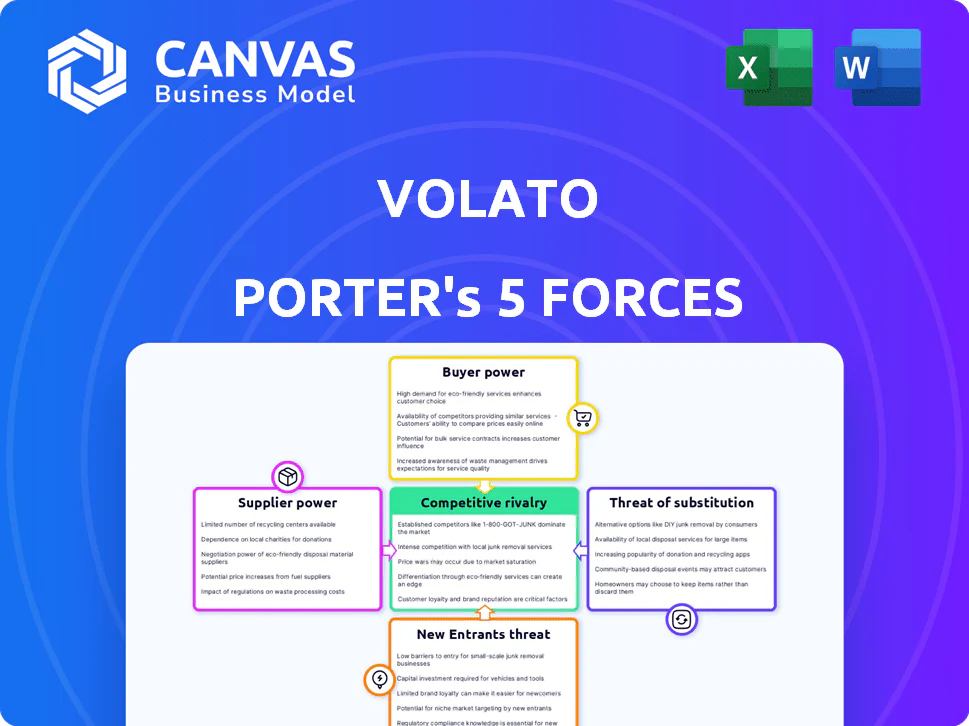
VOLATO PORTER'S FIVE FORCES TEMPLATE RESEARCH
What is included in the product
 Detailed Word Document
Evaluates control held by suppliers and buyers, and their influence on pricing and profitability.

 Customizable Excel Spreadsheet
Quickly assess industry competition with dynamic scoring, replacing lengthy analysis.
Full Version Awaits
Volato Porter's Five Forces Analysis
The preview showcases the Volato Porter's Five Forces analysis in its entirety. This comprehensive document is identical to the one you'll receive immediately upon purchase. It provides a detailed examination of industry competition, threat of new entrants, supplier power, buyer power, and the threat of substitutes. You can immediately download and utilize this fully formatted analysis for your purposes.

Porter's Five Forces Analysis Template

A Must-Have Tool for Decision-Makers
Analyzing Volato through Porter's Five Forces reveals intense competition within the private aviation sector. Supplier power, particularly aircraft manufacturers, poses a significant challenge. Buyer power is moderate, influenced by the availability of alternatives. Threat of new entrants is considerable due to high capital requirements and established players. Substitute threats, such as commercial airlines, exist but offer a different experience. Rivalry among existing competitors is fierce, driven by a fragmented market and service differentiation.
Ready to move beyond the basics? Get a full strategic breakdown of Volato’s market position, competitive intensity, and external threats—all in one powerful analysis.
Suppliers Bargaining Power

Aircraft Manufacturers
Volato's primary supplier, Honda Aircraft Company, holds considerable bargaining power. There are limited manufacturers for specific jets like the HondaJet. In 2024, HondaJet sales totaled approximately $160 million, reflecting their market position. This allows Honda to influence pricing and delivery terms for Volato.
Engine Manufacturers
Engine manufacturers like GE Honda have significant bargaining power due to the critical nature of aircraft engines. The GE Honda HF120 engines, essential for HondaJets, exemplify this. In 2024, engine maintenance costs represented a substantial portion of overall operational expenses for aircraft operators. This control over pricing and servicing directly affects Volato's profitability.

Maintenance, Repair, and Overhaul (MRO) Providers
Maintaining Volato's aircraft fleet demands specialized Maintenance, Repair, and Overhaul (MRO) services. In 2024, the MRO market was valued at approximately $86.8 billion globally. The concentration of qualified MRO providers gives them bargaining power. Their pricing and service quality directly affect Volato's operational costs and aircraft availability. Any disruption to MRO services can cause significant downtime and financial impact.

Fuel Suppliers
Fuel suppliers hold significant bargaining power over Volato due to fuel's substantial impact on operating costs. Volatility in jet fuel prices directly affects Volato's profitability and financial planning. The global fuel market's structure and the number of available suppliers shape Volato's negotiation leverage. This power dynamic can influence Volato's cost structure and overall financial performance.
- In 2024, jet fuel prices have fluctuated, affecting airline operational costs.
- The number of fuel suppliers and market concentration impact negotiation power.
- Hedging strategies and fuel contracts are crucial for mitigating price risks.
Highly Skilled Labor (Pilots, Technicians)
Volato Porter faces significant bargaining power from highly skilled labor, such as pilots and technicians. The aviation industry's reliance on experienced professionals, coupled with the high costs of training and competitive salaries, strengthens their negotiating position. This can lead to increased operational costs for Volato Porter. The average pilot salary in private aviation in 2024 was around $200,000.
- High Demand: Experienced pilots and technicians are always in demand.
- Training Costs: Training is expensive, increasing supplier power.
- Salary Impact: High salaries directly affect operational costs.
- Negotiation Leverage: Skilled workers can influence terms.
Volato's Cost Dynamics: Supplier Power Plays
Suppliers significantly influence Volato's costs. Honda Aircraft, essential for Volato's operations, dictates terms. Engine and MRO providers, due to their specialized services, also hold considerable power. Fuel suppliers' influence stems from the impact of fuel prices on operational costs.
| Supplier Type | Impact | 2024 Data |
|---|---|---|
| Aircraft Manufacturer | Pricing, Delivery Terms | HondaJet sales: $160M |
| Engine/MRO | Service Costs, Downtime | MRO Market: $86.8B |
| Fuel | Operational Costs | Jet fuel price volatility |
Customers Bargaining Power

Individual Fractional Owners and Jet Card Holders
Volato's customers, especially fractional owners and jet cardholders, wield bargaining power. They can choose from several private aviation providers. Price, flexibility, and service quality heavily influence their choices. In 2024, fractional jet ownership saw a rise, with a 12% increase in new program sales. This gives customers leverage.
On-Demand Charter Customers
On-demand charter customers wield significant bargaining power due to easy access to multiple operators. They can quickly compare prices and availability, driving competition among providers. In 2024, the fractional jet ownership market grew, but the on-demand charter segment saw a slight price decrease. This flexibility allows customers to choose the most favorable terms, pressuring operators to offer competitive rates and services.

Corporate Clients
Corporate clients often wield considerable bargaining power in private aviation. Companies with extensive travel demands can negotiate favorable terms. In 2024, companies like NetJets offered volume discounts. These clients may seek custom pricing models. They might also demand specific service levels.

Sensitivity to Price and Value
Customers in the private aviation sector, although wealthy, are discerning about value. They meticulously assess service costs against the benefits of convenience and luxury. This evaluation is key to their purchasing decisions in 2024. The private jet market saw about $35 billion in transactions in 2023, indicating significant customer influence.
- Price comparison: Customers compare prices across various operators.
- Service evaluation: They assess the quality of service and its alignment with cost.
- Market dynamics: Competition among providers influences pricing and service offerings.
Availability of Alternatives
The availability of alternatives significantly impacts customer bargaining power. Customers can easily switch between fractional ownership programs, jet cards, and charter companies. This competition forces companies like Volato to offer competitive pricing and better services to retain clients. For example, the fractional jet ownership market was valued at $10.9 billion in 2024.
- Competitive Pricing: Alternative options drive down prices.
- Service Quality: Companies must offer superior service.
- Market Dynamics: Competition shapes the market landscape.
- Customer Choice: Easy access to various options empowers customers.
Bargaining Power: A Look at Volato's Clients
Volato's customers, including fractional owners, jet cardholders, and charter clients, have strong bargaining power. They can easily compare prices and services across providers. Competition, especially in 2024, pressures Volato to offer competitive terms.
| Customer Segment | Bargaining Power | Factors |
|---|---|---|
| Fractional Owners | High | Multiple providers, price sensitivity, service demands |
| Jet Cardholders | High | Price comparison, service quality evaluation, market competition |
| Charter Clients | High | On-demand access to multiple operators, flexible options |
Rivalry Among Competitors

Other Fractional Ownership Providers
Volato faces competition from other fractional jet ownership providers. Competitors like NetJets and Flexjet offer similar services, vying for the same customer base. In 2024, NetJets held a significant market share, and Flexjet demonstrated strong growth, intensifying the rivalry for potential owners. This competition impacts pricing and program features.
Jet Card and Membership Programs
The jet card and membership market is intensely competitive. Companies like NetJets and Flexjet offer diverse access levels and pricing. Volato's jet card program competes directly with these established players. In 2024, the private aviation market saw significant growth, increasing competition further.

On-Demand Charter Operators
The on-demand charter market is fiercely competitive. Volato faces rivals of all sizes. Competition includes established giants and regional players. The market's value was about $3 billion in 2024. This drives price pressure.

Different Aircraft Types and Sizes
Competitive rivalry in the private aviation sector extends beyond direct service comparisons. It encompasses a range of aircraft types and sizes, influencing customer choices. Customers evaluate options based on mission needs, like range and passenger capacity. This competition pushes companies to offer diverse fleets. For example, NetJets operates over 750 aircraft.
- Aircraft size and type are key differentiators.
- Customers prioritize mission-specific needs.
- Operators offer varied fleets to meet demands.
- NetJets' large fleet indicates market scale.
Market Consolidation and New Entrants
The private aviation sector experiences intense competition due to market consolidation and the arrival of new players. This environment drives firms to compete aggressively for market share and stand out. Companies battle to attract customers through various strategies. This includes service enhancements and strategic pricing.
- Market consolidation has been ongoing, with several mergers and acquisitions in 2024.
- New entrants, such as new fractional ownership programs, continue to emerge, intensifying competition.
- Competitive rivalry is further fueled by the need to differentiate services and pricing strategies.
- Industry reports show a rise in marketing and promotional spending in 2024.
Private Aviation: 2024's Competitive Skies
Competitive rivalry in the private aviation market is fierce, with numerous companies vying for market share. In 2024, the market saw intense competition, driven by consolidation and new entrants. Operators use pricing and service enhancements to attract customers.
| Aspect | Details | 2024 Data |
|---|---|---|
| Market Growth | Overall market expansion | ~12% growth |
| Key Competitors | Main players | NetJets, Flexjet, Volato |
| Competition Drivers | Factors intensifying rivalry | Consolidation, new entrants |
Original: $10.00
-65%$10.00
$3.50VOLATO PORTER'S FIVE FORCES TEMPLATE RESEARCH
What is included in the product
Detailed Word Document
Evaluates control held by suppliers and buyers, and their influence on pricing and profitability.
Customizable Excel Spreadsheet
Quickly assess industry competition with dynamic scoring, replacing lengthy analysis.
Full Version Awaits
Volato Porter's Five Forces Analysis
The preview showcases the Volato Porter's Five Forces analysis in its entirety. This comprehensive document is identical to the one you'll receive immediately upon purchase. It provides a detailed examination of industry competition, threat of new entrants, supplier power, buyer power, and the threat of substitutes. You can immediately download and utilize this fully formatted analysis for your purposes.
Porter's Five Forces Analysis Template
A Must-Have Tool for Decision-Makers
Analyzing Volato through Porter's Five Forces reveals intense competition within the private aviation sector. Supplier power, particularly aircraft manufacturers, poses a significant challenge. Buyer power is moderate, influenced by the availability of alternatives. Threat of new entrants is considerable due to high capital requirements and established players. Substitute threats, such as commercial airlines, exist but offer a different experience. Rivalry among existing competitors is fierce, driven by a fragmented market and service differentiation.
Ready to move beyond the basics? Get a full strategic breakdown of Volato’s market position, competitive intensity, and external threats—all in one powerful analysis.
Suppliers Bargaining Power
Aircraft Manufacturers
Volato's primary supplier, Honda Aircraft Company, holds considerable bargaining power. There are limited manufacturers for specific jets like the HondaJet. In 2024, HondaJet sales totaled approximately $160 million, reflecting their market position. This allows Honda to influence pricing and delivery terms for Volato.
Engine Manufacturers
Engine manufacturers like GE Honda have significant bargaining power due to the critical nature of aircraft engines. The GE Honda HF120 engines, essential for HondaJets, exemplify this. In 2024, engine maintenance costs represented a substantial portion of overall operational expenses for aircraft operators. This control over pricing and servicing directly affects Volato's profitability.
Maintenance, Repair, and Overhaul (MRO) Providers
Maintaining Volato's aircraft fleet demands specialized Maintenance, Repair, and Overhaul (MRO) services. In 2024, the MRO market was valued at approximately $86.8 billion globally. The concentration of qualified MRO providers gives them bargaining power. Their pricing and service quality directly affect Volato's operational costs and aircraft availability. Any disruption to MRO services can cause significant downtime and financial impact.
Fuel Suppliers
Fuel suppliers hold significant bargaining power over Volato due to fuel's substantial impact on operating costs. Volatility in jet fuel prices directly affects Volato's profitability and financial planning. The global fuel market's structure and the number of available suppliers shape Volato's negotiation leverage. This power dynamic can influence Volato's cost structure and overall financial performance.
- In 2024, jet fuel prices have fluctuated, affecting airline operational costs.
- The number of fuel suppliers and market concentration impact negotiation power.
- Hedging strategies and fuel contracts are crucial for mitigating price risks.
Highly Skilled Labor (Pilots, Technicians)
Volato Porter faces significant bargaining power from highly skilled labor, such as pilots and technicians. The aviation industry's reliance on experienced professionals, coupled with the high costs of training and competitive salaries, strengthens their negotiating position. This can lead to increased operational costs for Volato Porter. The average pilot salary in private aviation in 2024 was around $200,000.
- High Demand: Experienced pilots and technicians are always in demand.
- Training Costs: Training is expensive, increasing supplier power.
- Salary Impact: High salaries directly affect operational costs.
- Negotiation Leverage: Skilled workers can influence terms.
Volato's Cost Dynamics: Supplier Power Plays
Suppliers significantly influence Volato's costs. Honda Aircraft, essential for Volato's operations, dictates terms. Engine and MRO providers, due to their specialized services, also hold considerable power. Fuel suppliers' influence stems from the impact of fuel prices on operational costs.
| Supplier Type | Impact | 2024 Data |
|---|---|---|
| Aircraft Manufacturer | Pricing, Delivery Terms | HondaJet sales: $160M |
| Engine/MRO | Service Costs, Downtime | MRO Market: $86.8B |
| Fuel | Operational Costs | Jet fuel price volatility |
Customers Bargaining Power
Individual Fractional Owners and Jet Card Holders
Volato's customers, especially fractional owners and jet cardholders, wield bargaining power. They can choose from several private aviation providers. Price, flexibility, and service quality heavily influence their choices. In 2024, fractional jet ownership saw a rise, with a 12% increase in new program sales. This gives customers leverage.
On-Demand Charter Customers
On-demand charter customers wield significant bargaining power due to easy access to multiple operators. They can quickly compare prices and availability, driving competition among providers. In 2024, the fractional jet ownership market grew, but the on-demand charter segment saw a slight price decrease. This flexibility allows customers to choose the most favorable terms, pressuring operators to offer competitive rates and services.
Corporate Clients
Corporate clients often wield considerable bargaining power in private aviation. Companies with extensive travel demands can negotiate favorable terms. In 2024, companies like NetJets offered volume discounts. These clients may seek custom pricing models. They might also demand specific service levels.
Sensitivity to Price and Value
Customers in the private aviation sector, although wealthy, are discerning about value. They meticulously assess service costs against the benefits of convenience and luxury. This evaluation is key to their purchasing decisions in 2024. The private jet market saw about $35 billion in transactions in 2023, indicating significant customer influence.
- Price comparison: Customers compare prices across various operators.
- Service evaluation: They assess the quality of service and its alignment with cost.
- Market dynamics: Competition among providers influences pricing and service offerings.
Availability of Alternatives
The availability of alternatives significantly impacts customer bargaining power. Customers can easily switch between fractional ownership programs, jet cards, and charter companies. This competition forces companies like Volato to offer competitive pricing and better services to retain clients. For example, the fractional jet ownership market was valued at $10.9 billion in 2024.
- Competitive Pricing: Alternative options drive down prices.
- Service Quality: Companies must offer superior service.
- Market Dynamics: Competition shapes the market landscape.
- Customer Choice: Easy access to various options empowers customers.
Bargaining Power: A Look at Volato's Clients
Volato's customers, including fractional owners, jet cardholders, and charter clients, have strong bargaining power. They can easily compare prices and services across providers. Competition, especially in 2024, pressures Volato to offer competitive terms.
| Customer Segment | Bargaining Power | Factors |
|---|---|---|
| Fractional Owners | High | Multiple providers, price sensitivity, service demands |
| Jet Cardholders | High | Price comparison, service quality evaluation, market competition |
| Charter Clients | High | On-demand access to multiple operators, flexible options |
Rivalry Among Competitors
Other Fractional Ownership Providers
Volato faces competition from other fractional jet ownership providers. Competitors like NetJets and Flexjet offer similar services, vying for the same customer base. In 2024, NetJets held a significant market share, and Flexjet demonstrated strong growth, intensifying the rivalry for potential owners. This competition impacts pricing and program features.
Jet Card and Membership Programs
The jet card and membership market is intensely competitive. Companies like NetJets and Flexjet offer diverse access levels and pricing. Volato's jet card program competes directly with these established players. In 2024, the private aviation market saw significant growth, increasing competition further.
On-Demand Charter Operators
The on-demand charter market is fiercely competitive. Volato faces rivals of all sizes. Competition includes established giants and regional players. The market's value was about $3 billion in 2024. This drives price pressure.
Different Aircraft Types and Sizes
Competitive rivalry in the private aviation sector extends beyond direct service comparisons. It encompasses a range of aircraft types and sizes, influencing customer choices. Customers evaluate options based on mission needs, like range and passenger capacity. This competition pushes companies to offer diverse fleets. For example, NetJets operates over 750 aircraft.
- Aircraft size and type are key differentiators.
- Customers prioritize mission-specific needs.
- Operators offer varied fleets to meet demands.
- NetJets' large fleet indicates market scale.
Market Consolidation and New Entrants
The private aviation sector experiences intense competition due to market consolidation and the arrival of new players. This environment drives firms to compete aggressively for market share and stand out. Companies battle to attract customers through various strategies. This includes service enhancements and strategic pricing.
- Market consolidation has been ongoing, with several mergers and acquisitions in 2024.
- New entrants, such as new fractional ownership programs, continue to emerge, intensifying competition.
- Competitive rivalry is further fueled by the need to differentiate services and pricing strategies.
- Industry reports show a rise in marketing and promotional spending in 2024.
Private Aviation: 2024's Competitive Skies
Competitive rivalry in the private aviation market is fierce, with numerous companies vying for market share. In 2024, the market saw intense competition, driven by consolidation and new entrants. Operators use pricing and service enhancements to attract customers.
| Aspect | Details | 2024 Data |
|---|---|---|
| Market Growth | Overall market expansion | ~12% growth |
| Key Competitors | Main players | NetJets, Flexjet, Volato |
| Competition Drivers | Factors intensifying rivalry | Consolidation, new entrants |
Product Information
Product Information
Shipping & Returns
Shipping & Returns
Description
What is included in the product
Detailed Word Document
Evaluates control held by suppliers and buyers, and their influence on pricing and profitability.
Customizable Excel Spreadsheet
Quickly assess industry competition with dynamic scoring, replacing lengthy analysis.
Full Version Awaits
Volato Porter's Five Forces Analysis
The preview showcases the Volato Porter's Five Forces analysis in its entirety. This comprehensive document is identical to the one you'll receive immediately upon purchase. It provides a detailed examination of industry competition, threat of new entrants, supplier power, buyer power, and the threat of substitutes. You can immediately download and utilize this fully formatted analysis for your purposes.
Porter's Five Forces Analysis Template
A Must-Have Tool for Decision-Makers
Analyzing Volato through Porter's Five Forces reveals intense competition within the private aviation sector. Supplier power, particularly aircraft manufacturers, poses a significant challenge. Buyer power is moderate, influenced by the availability of alternatives. Threat of new entrants is considerable due to high capital requirements and established players. Substitute threats, such as commercial airlines, exist but offer a different experience. Rivalry among existing competitors is fierce, driven by a fragmented market and service differentiation.
Ready to move beyond the basics? Get a full strategic breakdown of Volato’s market position, competitive intensity, and external threats—all in one powerful analysis.
Suppliers Bargaining Power
Aircraft Manufacturers
Volato's primary supplier, Honda Aircraft Company, holds considerable bargaining power. There are limited manufacturers for specific jets like the HondaJet. In 2024, HondaJet sales totaled approximately $160 million, reflecting their market position. This allows Honda to influence pricing and delivery terms for Volato.
Engine Manufacturers
Engine manufacturers like GE Honda have significant bargaining power due to the critical nature of aircraft engines. The GE Honda HF120 engines, essential for HondaJets, exemplify this. In 2024, engine maintenance costs represented a substantial portion of overall operational expenses for aircraft operators. This control over pricing and servicing directly affects Volato's profitability.
Maintenance, Repair, and Overhaul (MRO) Providers
Maintaining Volato's aircraft fleet demands specialized Maintenance, Repair, and Overhaul (MRO) services. In 2024, the MRO market was valued at approximately $86.8 billion globally. The concentration of qualified MRO providers gives them bargaining power. Their pricing and service quality directly affect Volato's operational costs and aircraft availability. Any disruption to MRO services can cause significant downtime and financial impact.
Fuel Suppliers
Fuel suppliers hold significant bargaining power over Volato due to fuel's substantial impact on operating costs. Volatility in jet fuel prices directly affects Volato's profitability and financial planning. The global fuel market's structure and the number of available suppliers shape Volato's negotiation leverage. This power dynamic can influence Volato's cost structure and overall financial performance.
- In 2024, jet fuel prices have fluctuated, affecting airline operational costs.
- The number of fuel suppliers and market concentration impact negotiation power.
- Hedging strategies and fuel contracts are crucial for mitigating price risks.
Highly Skilled Labor (Pilots, Technicians)
Volato Porter faces significant bargaining power from highly skilled labor, such as pilots and technicians. The aviation industry's reliance on experienced professionals, coupled with the high costs of training and competitive salaries, strengthens their negotiating position. This can lead to increased operational costs for Volato Porter. The average pilot salary in private aviation in 2024 was around $200,000.
- High Demand: Experienced pilots and technicians are always in demand.
- Training Costs: Training is expensive, increasing supplier power.
- Salary Impact: High salaries directly affect operational costs.
- Negotiation Leverage: Skilled workers can influence terms.
Volato's Cost Dynamics: Supplier Power Plays
Suppliers significantly influence Volato's costs. Honda Aircraft, essential for Volato's operations, dictates terms. Engine and MRO providers, due to their specialized services, also hold considerable power. Fuel suppliers' influence stems from the impact of fuel prices on operational costs.
| Supplier Type | Impact | 2024 Data |
|---|---|---|
| Aircraft Manufacturer | Pricing, Delivery Terms | HondaJet sales: $160M |
| Engine/MRO | Service Costs, Downtime | MRO Market: $86.8B |
| Fuel | Operational Costs | Jet fuel price volatility |
Customers Bargaining Power
Individual Fractional Owners and Jet Card Holders
Volato's customers, especially fractional owners and jet cardholders, wield bargaining power. They can choose from several private aviation providers. Price, flexibility, and service quality heavily influence their choices. In 2024, fractional jet ownership saw a rise, with a 12% increase in new program sales. This gives customers leverage.
On-Demand Charter Customers
On-demand charter customers wield significant bargaining power due to easy access to multiple operators. They can quickly compare prices and availability, driving competition among providers. In 2024, the fractional jet ownership market grew, but the on-demand charter segment saw a slight price decrease. This flexibility allows customers to choose the most favorable terms, pressuring operators to offer competitive rates and services.
Corporate Clients
Corporate clients often wield considerable bargaining power in private aviation. Companies with extensive travel demands can negotiate favorable terms. In 2024, companies like NetJets offered volume discounts. These clients may seek custom pricing models. They might also demand specific service levels.
Sensitivity to Price and Value
Customers in the private aviation sector, although wealthy, are discerning about value. They meticulously assess service costs against the benefits of convenience and luxury. This evaluation is key to their purchasing decisions in 2024. The private jet market saw about $35 billion in transactions in 2023, indicating significant customer influence.
- Price comparison: Customers compare prices across various operators.
- Service evaluation: They assess the quality of service and its alignment with cost.
- Market dynamics: Competition among providers influences pricing and service offerings.
Availability of Alternatives
The availability of alternatives significantly impacts customer bargaining power. Customers can easily switch between fractional ownership programs, jet cards, and charter companies. This competition forces companies like Volato to offer competitive pricing and better services to retain clients. For example, the fractional jet ownership market was valued at $10.9 billion in 2024.
- Competitive Pricing: Alternative options drive down prices.
- Service Quality: Companies must offer superior service.
- Market Dynamics: Competition shapes the market landscape.
- Customer Choice: Easy access to various options empowers customers.
Bargaining Power: A Look at Volato's Clients
Volato's customers, including fractional owners, jet cardholders, and charter clients, have strong bargaining power. They can easily compare prices and services across providers. Competition, especially in 2024, pressures Volato to offer competitive terms.
| Customer Segment | Bargaining Power | Factors |
|---|---|---|
| Fractional Owners | High | Multiple providers, price sensitivity, service demands |
| Jet Cardholders | High | Price comparison, service quality evaluation, market competition |
| Charter Clients | High | On-demand access to multiple operators, flexible options |
Rivalry Among Competitors
Other Fractional Ownership Providers
Volato faces competition from other fractional jet ownership providers. Competitors like NetJets and Flexjet offer similar services, vying for the same customer base. In 2024, NetJets held a significant market share, and Flexjet demonstrated strong growth, intensifying the rivalry for potential owners. This competition impacts pricing and program features.
Jet Card and Membership Programs
The jet card and membership market is intensely competitive. Companies like NetJets and Flexjet offer diverse access levels and pricing. Volato's jet card program competes directly with these established players. In 2024, the private aviation market saw significant growth, increasing competition further.
On-Demand Charter Operators
The on-demand charter market is fiercely competitive. Volato faces rivals of all sizes. Competition includes established giants and regional players. The market's value was about $3 billion in 2024. This drives price pressure.
Different Aircraft Types and Sizes
Competitive rivalry in the private aviation sector extends beyond direct service comparisons. It encompasses a range of aircraft types and sizes, influencing customer choices. Customers evaluate options based on mission needs, like range and passenger capacity. This competition pushes companies to offer diverse fleets. For example, NetJets operates over 750 aircraft.
- Aircraft size and type are key differentiators.
- Customers prioritize mission-specific needs.
- Operators offer varied fleets to meet demands.
- NetJets' large fleet indicates market scale.
Market Consolidation and New Entrants
The private aviation sector experiences intense competition due to market consolidation and the arrival of new players. This environment drives firms to compete aggressively for market share and stand out. Companies battle to attract customers through various strategies. This includes service enhancements and strategic pricing.
- Market consolidation has been ongoing, with several mergers and acquisitions in 2024.
- New entrants, such as new fractional ownership programs, continue to emerge, intensifying competition.
- Competitive rivalry is further fueled by the need to differentiate services and pricing strategies.
- Industry reports show a rise in marketing and promotional spending in 2024.
Private Aviation: 2024's Competitive Skies
Competitive rivalry in the private aviation market is fierce, with numerous companies vying for market share. In 2024, the market saw intense competition, driven by consolidation and new entrants. Operators use pricing and service enhancements to attract customers.
| Aspect | Details | 2024 Data |
|---|---|---|
| Market Growth | Overall market expansion | ~12% growth |
| Key Competitors | Main players | NetJets, Flexjet, Volato |
| Competition Drivers | Factors intensifying rivalry | Consolidation, new entrants |











