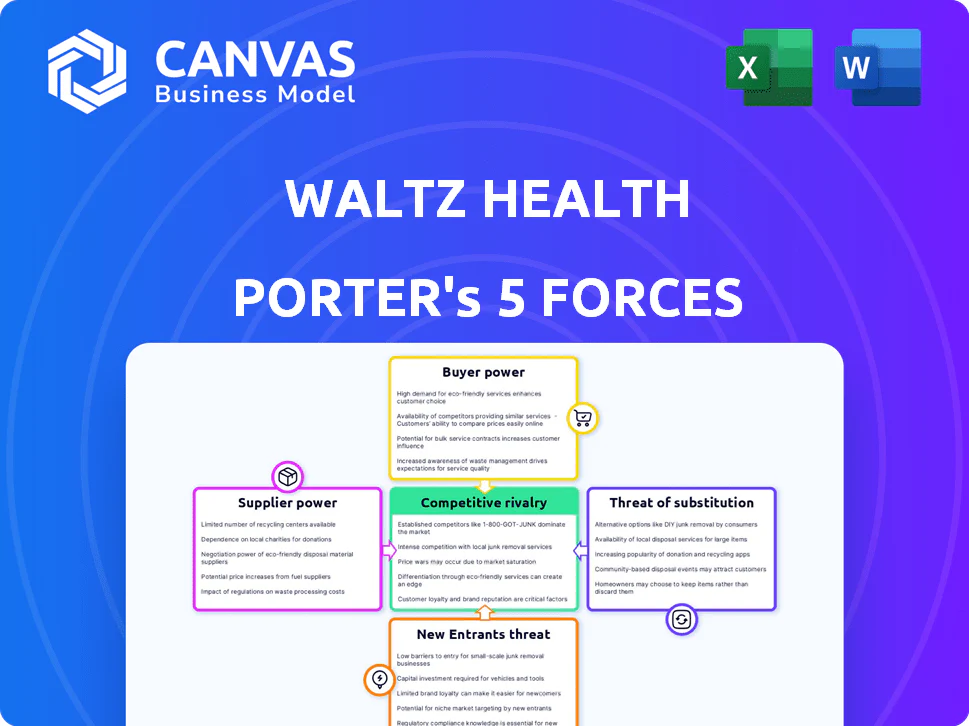
WALTZ HEALTH PORTER'S FIVE FORCES TEMPLATE RESEARCH
What is included in the product
 Detailed Word Document
Tailored exclusively for Waltz Health, analyzing its position within its competitive landscape.

 Customizable Excel Spreadsheet
Quickly see opportunities for profit with color-coded threat and opportunity levels.
Preview the Actual Deliverable
Waltz Health Porter's Five Forces Analysis
This preview reveals the Waltz Health Porter's Five Forces Analysis in its entirety, so you know exactly what you’re getting.
The displayed document is the identical, complete analysis you'll download instantly upon purchase.
No hidden sections or edits; the comprehensive, formatted analysis shown is the final product.
Rest assured, the content you are reviewing is the complete, ready-to-use document you will receive.
This is your deliverable: a fully realized Porter's Five Forces analysis of Waltz Health.

Porter's Five Forces Analysis Template

Don't Miss the Bigger Picture
Waltz Health's industry faces complex forces. Buyer power influences pricing and service demands. Supplier leverage impacts operational costs. Competitive rivalry is high. The threat of new entrants and substitutes adds pressure.
This brief snapshot only scratches the surface. Unlock the full Porter's Five Forces Analysis to explore Waltz Health’s competitive dynamics, market pressures, and strategic advantages in detail.
Suppliers Bargaining Power

Pharmaceutical Manufacturers
Pharmaceutical manufacturers wield substantial bargaining power, dictating medication production and pricing. Waltz Health depends on access to these medications for consumer cost savings. The concentration of manufacturers for specific drugs, especially specialty drugs, strengthens their position. In 2024, the pharmaceutical industry's global revenue is projected to reach $1.6 trillion, indicating significant influence.
Pharmacies
Pharmacies are crucial for Waltz Health, dispensing medications directly to patients. Major pharmacy chains' concentration and PBM relationships grant bargaining power. However, Waltz Health's ability to drive prescription volume and attract new customers can counter this. Walgreens and CVS, holding significant market share, influence pricing. In 2024, pharmacy sales in the US reached approximately $600 billion.

Pharmacy Benefit Managers (PBMs)
Pharmacy Benefit Managers (PBMs) are key players, wielding significant power in the pharmaceutical supply chain. The top three PBMs, controlling about 75% of the market as of late 2024, negotiate drug prices. Waltz Health partners with PBMs, but their market dominance influences drug formularies. This gives PBMs considerable supplier power.

Technology Providers
Waltz Health's reliance on technology, especially AI, introduces supplier bargaining power. Specialized AI and data analytics providers could have leverage, especially if their offerings are unique. The digital health tech market, however, is rapidly changing, potentially lessening supplier power. In 2024, the global healthcare AI market was valued at approximately $14.3 billion.
- The global healthcare AI market is projected to reach $194.4 billion by 2032.
- Investment in digital health reached $15.3 billion in 2023.
- Waltz Health uses AI for its core operations.
Data Providers
Data providers significantly influence Waltz Health's operations, controlling access to essential information on drug pricing, pharmacy networks, and patient eligibility. Their bargaining power stems from their control over comprehensive and up-to-date data, critical for Waltz Health's value proposition. The cost and availability of data can significantly impact Waltz Health's operational costs and service delivery. Access to, and integration of, diverse data sources is paramount.
- Data and analytics spending in the healthcare sector reached $38.7 billion in 2023.
- The global healthcare data analytics market is projected to reach $108.7 billion by 2028.
- Data breaches in healthcare cost an average of $10.93 million per incident in 2023.
- The top 5 healthcare data breaches of 2024 compromised between 100,000 and 8 million records.
Data Dominance: Who Controls the Healthcare Data?
Data providers hold significant bargaining power, controlling critical data essential for Waltz Health's operations. This includes drug pricing, pharmacy networks, and patient eligibility information. The healthcare data analytics market is projected to hit $108.7 billion by 2028, highlighting the value of this data.
| Supplier | Bargaining Power | Impact on Waltz Health |
|---|---|---|
| Data Providers | High | Operational costs, service delivery |
| Pharmaceutical Manufacturers | High | Medication production, pricing |
| PBMs | High | Drug formularies, pricing |
Customers Bargaining Power

Health Plans and Employers
Waltz Health's primary clients are health plans and employers aiming to cut prescription drug expenses. These customers wield considerable bargaining power, managing large prescription volumes and prioritizing cost control. In 2024, the average cost of a prescription in the US was around $540, highlighting the financial stakes. Waltz Health must prove substantial savings and an easy user experience to keep these clients.
Patients and Consumers
Although Waltz Health collaborates with health plans and employers, patients and consumers seeking affordable medications are the ultimate users of their platform. As patients gain more information and tools for price comparison, their bargaining power grows. Waltz Health's platform, which provides real savings, directly affects patient choices and satisfaction. In 2024, the prescription drug spending in the U.S. reached $420 billion, highlighting the financial impact on consumers.

Government and Regulatory Bodies
Government and regulatory bodies are major customers, especially with programs like Medicare and Medicaid. They shape the market for Waltz Health through drug pricing regulations and digital health policies. For instance, in 2024, Medicare spending reached approximately $970 billion, influencing healthcare providers. Regulatory changes can significantly affect Waltz Health's operations and profitability.

Pharmacies (as partners serving customers)
Pharmacies, acting as both suppliers and customers, significantly impact Waltz Health. Their adoption and satisfaction with the platform are key for network effects. The ease of integration and value proposition for pharmacies influence their use and promotion of Waltz Health's services. In 2024, the pharmacy tech market is booming, with a projected value of $12.5 billion.
- Pharmacy adoption rates are crucial, with 80% of pharmacies now using digital tools for patient care.
- Integration ease is key; platforms with seamless integration see a 30% higher adoption rate among pharmacies.
- Value proposition is vital; pharmacies using platforms that reduce costs see a 20% increase in profitability.
Third-Party Administrators (TPAs) and Consultants
Third-Party Administrators (TPAs) and consultants significantly affect Waltz Health's customer relationships. They advise employers and health plans on benefits, influencing platform adoption. Their recommendations and perceptions critically affect customer acquisition and retention for Waltz Health. For example, in 2024, about 68% of US employers use TPAs for health benefits administration.
- TPAs and consultants shape Waltz Health's market entry.
- Recommendations directly impact customer decisions.
- Perceptions of value drive adoption rates.
- They influence customer acquisition and retention.
Waltz Health: Customers Drive the Rx Market
Customers significantly influence Waltz Health's success. Health plans and employers, managing large prescription volumes, seek cost savings, exemplified by 2024's $540 average prescription cost. Patients and consumers gain power through price comparison tools, impacting choices and satisfaction. This is fueled by the $420 billion spent on prescriptions in 2024.
| Customer Type | Influence | 2024 Data |
|---|---|---|
| Health Plans/Employers | Cost control | Avg. Rx cost: $540 |
| Patients/Consumers | Price sensitivity | Rx spending: $420B |
| Government | Regulation | Medicare spending: $970B |
Rivalry Among Competitors

Direct Competitors (Digital Health & Prescription Savings)
Waltz Health faces intense competition in digital health, particularly in prescription cost management. Key competitors include GoodRx, with a 2023 revenue of $780 million, and Blink Health. These platforms offer similar prescription discount and price comparison services. The competitive landscape is crowded, with many players vying for market share.
Pharmacy Benefit Managers (PBMs)
Waltz Health collaborates with Pharmacy Benefit Managers (PBMs), yet these entities also pose competitive challenges, especially the large, integrated ones. These PBMs, such as CVS Health and Express Scripts, provide their own tools for managing prescription costs. In 2024, CVS Health's pharmacy services revenue was approximately $172.7 billion. PBMs may perceive companies like Waltz Health as threats to their established business models. This rivalry is intensified by the push for lower healthcare costs.

Traditional Pharmacies and Chains
Traditional pharmacies and chains present a competitive landscape. Large chains like CVS and Walgreens, with extensive networks, offer their own discount programs. These chains can compete with Waltz Health by managing medication costs directly. In 2024, CVS reported a revenue of $357.7 billion, indicating its market presence.

Health Plans and Insurers (with internal tools)
Health plans and insurers developing internal tools intensifies competition. These tools may offer prescription management and cost savings, potentially reducing the need for external services. This internal competition can directly impact Waltz Health's market share and growth prospects. Several major insurers have invested billions in digital health platforms.
- UnitedHealth Group's Optum, for example, generated $22.8 billion in revenue in Q3 2023, reflecting its significant digital health presence.
- Cigna's Evernorth also offers integrated pharmacy and care management solutions.
- Internal solutions can create data silos, limiting the ability to aggregate information across different providers, which could be a competitive advantage for Waltz Health.
New Entrants (Tech Companies & Startups)
The digital health market's growth attracts tech firms and startups. These new entrants offer innovative solutions for healthcare and prescription management. This could intensify competition, especially with lower entry barriers for digital platforms. The global digital health market was valued at $175.6 billion in 2023. It is projected to reach $660.7 billion by 2029.
- Market growth attracts new competitors.
- Tech and startups offer innovative solutions.
- Digital platforms have lower entry barriers.
- The digital health market is growing rapidly.
Market Rivals: A Deep Dive
Competitive rivalry in Waltz Health's market is fierce, featuring digital health platforms like GoodRx, which generated $780 million in 2023. PBMs such as CVS Health ($172.7B pharmacy services revenue in 2024) also compete, offering similar services. Traditional pharmacies and insurers further intensify competition. The digital health market, valued at $175.6 billion in 2023, attracts new entrants.
| Competitor Type | Example | 2024/2023 Revenue |
|---|---|---|
| Digital Health Platforms | GoodRx | $780 million (2023) |
| PBMs | CVS Health (Pharmacy Services) | $172.7 billion (2024) |
| Insurers (Optum) | UnitedHealth Group | $22.8 billion (Q3 2023) |
Original: $10.00
-65%$10.00
$3.50WALTZ HEALTH PORTER'S FIVE FORCES TEMPLATE RESEARCH
What is included in the product
Detailed Word Document
Tailored exclusively for Waltz Health, analyzing its position within its competitive landscape.
Customizable Excel Spreadsheet
Quickly see opportunities for profit with color-coded threat and opportunity levels.
Preview the Actual Deliverable
Waltz Health Porter's Five Forces Analysis
This preview reveals the Waltz Health Porter's Five Forces Analysis in its entirety, so you know exactly what you’re getting.
The displayed document is the identical, complete analysis you'll download instantly upon purchase.
No hidden sections or edits; the comprehensive, formatted analysis shown is the final product.
Rest assured, the content you are reviewing is the complete, ready-to-use document you will receive.
This is your deliverable: a fully realized Porter's Five Forces analysis of Waltz Health.
Porter's Five Forces Analysis Template
Don't Miss the Bigger Picture
Waltz Health's industry faces complex forces. Buyer power influences pricing and service demands. Supplier leverage impacts operational costs. Competitive rivalry is high. The threat of new entrants and substitutes adds pressure.
This brief snapshot only scratches the surface. Unlock the full Porter's Five Forces Analysis to explore Waltz Health’s competitive dynamics, market pressures, and strategic advantages in detail.
Suppliers Bargaining Power
Pharmaceutical Manufacturers
Pharmaceutical manufacturers wield substantial bargaining power, dictating medication production and pricing. Waltz Health depends on access to these medications for consumer cost savings. The concentration of manufacturers for specific drugs, especially specialty drugs, strengthens their position. In 2024, the pharmaceutical industry's global revenue is projected to reach $1.6 trillion, indicating significant influence.
Pharmacies
Pharmacies are crucial for Waltz Health, dispensing medications directly to patients. Major pharmacy chains' concentration and PBM relationships grant bargaining power. However, Waltz Health's ability to drive prescription volume and attract new customers can counter this. Walgreens and CVS, holding significant market share, influence pricing. In 2024, pharmacy sales in the US reached approximately $600 billion.
Pharmacy Benefit Managers (PBMs)
Pharmacy Benefit Managers (PBMs) are key players, wielding significant power in the pharmaceutical supply chain. The top three PBMs, controlling about 75% of the market as of late 2024, negotiate drug prices. Waltz Health partners with PBMs, but their market dominance influences drug formularies. This gives PBMs considerable supplier power.
Technology Providers
Waltz Health's reliance on technology, especially AI, introduces supplier bargaining power. Specialized AI and data analytics providers could have leverage, especially if their offerings are unique. The digital health tech market, however, is rapidly changing, potentially lessening supplier power. In 2024, the global healthcare AI market was valued at approximately $14.3 billion.
- The global healthcare AI market is projected to reach $194.4 billion by 2032.
- Investment in digital health reached $15.3 billion in 2023.
- Waltz Health uses AI for its core operations.
Data Providers
Data providers significantly influence Waltz Health's operations, controlling access to essential information on drug pricing, pharmacy networks, and patient eligibility. Their bargaining power stems from their control over comprehensive and up-to-date data, critical for Waltz Health's value proposition. The cost and availability of data can significantly impact Waltz Health's operational costs and service delivery. Access to, and integration of, diverse data sources is paramount.
- Data and analytics spending in the healthcare sector reached $38.7 billion in 2023.
- The global healthcare data analytics market is projected to reach $108.7 billion by 2028.
- Data breaches in healthcare cost an average of $10.93 million per incident in 2023.
- The top 5 healthcare data breaches of 2024 compromised between 100,000 and 8 million records.
Data Dominance: Who Controls the Healthcare Data?
Data providers hold significant bargaining power, controlling critical data essential for Waltz Health's operations. This includes drug pricing, pharmacy networks, and patient eligibility information. The healthcare data analytics market is projected to hit $108.7 billion by 2028, highlighting the value of this data.
| Supplier | Bargaining Power | Impact on Waltz Health |
|---|---|---|
| Data Providers | High | Operational costs, service delivery |
| Pharmaceutical Manufacturers | High | Medication production, pricing |
| PBMs | High | Drug formularies, pricing |
Customers Bargaining Power
Health Plans and Employers
Waltz Health's primary clients are health plans and employers aiming to cut prescription drug expenses. These customers wield considerable bargaining power, managing large prescription volumes and prioritizing cost control. In 2024, the average cost of a prescription in the US was around $540, highlighting the financial stakes. Waltz Health must prove substantial savings and an easy user experience to keep these clients.
Patients and Consumers
Although Waltz Health collaborates with health plans and employers, patients and consumers seeking affordable medications are the ultimate users of their platform. As patients gain more information and tools for price comparison, their bargaining power grows. Waltz Health's platform, which provides real savings, directly affects patient choices and satisfaction. In 2024, the prescription drug spending in the U.S. reached $420 billion, highlighting the financial impact on consumers.
Government and Regulatory Bodies
Government and regulatory bodies are major customers, especially with programs like Medicare and Medicaid. They shape the market for Waltz Health through drug pricing regulations and digital health policies. For instance, in 2024, Medicare spending reached approximately $970 billion, influencing healthcare providers. Regulatory changes can significantly affect Waltz Health's operations and profitability.
Pharmacies (as partners serving customers)
Pharmacies, acting as both suppliers and customers, significantly impact Waltz Health. Their adoption and satisfaction with the platform are key for network effects. The ease of integration and value proposition for pharmacies influence their use and promotion of Waltz Health's services. In 2024, the pharmacy tech market is booming, with a projected value of $12.5 billion.
- Pharmacy adoption rates are crucial, with 80% of pharmacies now using digital tools for patient care.
- Integration ease is key; platforms with seamless integration see a 30% higher adoption rate among pharmacies.
- Value proposition is vital; pharmacies using platforms that reduce costs see a 20% increase in profitability.
Third-Party Administrators (TPAs) and Consultants
Third-Party Administrators (TPAs) and consultants significantly affect Waltz Health's customer relationships. They advise employers and health plans on benefits, influencing platform adoption. Their recommendations and perceptions critically affect customer acquisition and retention for Waltz Health. For example, in 2024, about 68% of US employers use TPAs for health benefits administration.
- TPAs and consultants shape Waltz Health's market entry.
- Recommendations directly impact customer decisions.
- Perceptions of value drive adoption rates.
- They influence customer acquisition and retention.
Waltz Health: Customers Drive the Rx Market
Customers significantly influence Waltz Health's success. Health plans and employers, managing large prescription volumes, seek cost savings, exemplified by 2024's $540 average prescription cost. Patients and consumers gain power through price comparison tools, impacting choices and satisfaction. This is fueled by the $420 billion spent on prescriptions in 2024.
| Customer Type | Influence | 2024 Data |
|---|---|---|
| Health Plans/Employers | Cost control | Avg. Rx cost: $540 |
| Patients/Consumers | Price sensitivity | Rx spending: $420B |
| Government | Regulation | Medicare spending: $970B |
Rivalry Among Competitors
Direct Competitors (Digital Health & Prescription Savings)
Waltz Health faces intense competition in digital health, particularly in prescription cost management. Key competitors include GoodRx, with a 2023 revenue of $780 million, and Blink Health. These platforms offer similar prescription discount and price comparison services. The competitive landscape is crowded, with many players vying for market share.
Pharmacy Benefit Managers (PBMs)
Waltz Health collaborates with Pharmacy Benefit Managers (PBMs), yet these entities also pose competitive challenges, especially the large, integrated ones. These PBMs, such as CVS Health and Express Scripts, provide their own tools for managing prescription costs. In 2024, CVS Health's pharmacy services revenue was approximately $172.7 billion. PBMs may perceive companies like Waltz Health as threats to their established business models. This rivalry is intensified by the push for lower healthcare costs.
Traditional Pharmacies and Chains
Traditional pharmacies and chains present a competitive landscape. Large chains like CVS and Walgreens, with extensive networks, offer their own discount programs. These chains can compete with Waltz Health by managing medication costs directly. In 2024, CVS reported a revenue of $357.7 billion, indicating its market presence.
Health Plans and Insurers (with internal tools)
Health plans and insurers developing internal tools intensifies competition. These tools may offer prescription management and cost savings, potentially reducing the need for external services. This internal competition can directly impact Waltz Health's market share and growth prospects. Several major insurers have invested billions in digital health platforms.
- UnitedHealth Group's Optum, for example, generated $22.8 billion in revenue in Q3 2023, reflecting its significant digital health presence.
- Cigna's Evernorth also offers integrated pharmacy and care management solutions.
- Internal solutions can create data silos, limiting the ability to aggregate information across different providers, which could be a competitive advantage for Waltz Health.
New Entrants (Tech Companies & Startups)
The digital health market's growth attracts tech firms and startups. These new entrants offer innovative solutions for healthcare and prescription management. This could intensify competition, especially with lower entry barriers for digital platforms. The global digital health market was valued at $175.6 billion in 2023. It is projected to reach $660.7 billion by 2029.
- Market growth attracts new competitors.
- Tech and startups offer innovative solutions.
- Digital platforms have lower entry barriers.
- The digital health market is growing rapidly.
Market Rivals: A Deep Dive
Competitive rivalry in Waltz Health's market is fierce, featuring digital health platforms like GoodRx, which generated $780 million in 2023. PBMs such as CVS Health ($172.7B pharmacy services revenue in 2024) also compete, offering similar services. Traditional pharmacies and insurers further intensify competition. The digital health market, valued at $175.6 billion in 2023, attracts new entrants.
| Competitor Type | Example | 2024/2023 Revenue |
|---|---|---|
| Digital Health Platforms | GoodRx | $780 million (2023) |
| PBMs | CVS Health (Pharmacy Services) | $172.7 billion (2024) |
| Insurers (Optum) | UnitedHealth Group | $22.8 billion (Q3 2023) |
Product Information
Product Information
Shipping & Returns
Shipping & Returns
Description
What is included in the product
Detailed Word Document
Tailored exclusively for Waltz Health, analyzing its position within its competitive landscape.
Customizable Excel Spreadsheet
Quickly see opportunities for profit with color-coded threat and opportunity levels.
Preview the Actual Deliverable
Waltz Health Porter's Five Forces Analysis
This preview reveals the Waltz Health Porter's Five Forces Analysis in its entirety, so you know exactly what you’re getting.
The displayed document is the identical, complete analysis you'll download instantly upon purchase.
No hidden sections or edits; the comprehensive, formatted analysis shown is the final product.
Rest assured, the content you are reviewing is the complete, ready-to-use document you will receive.
This is your deliverable: a fully realized Porter's Five Forces analysis of Waltz Health.
Porter's Five Forces Analysis Template
Don't Miss the Bigger Picture
Waltz Health's industry faces complex forces. Buyer power influences pricing and service demands. Supplier leverage impacts operational costs. Competitive rivalry is high. The threat of new entrants and substitutes adds pressure.
This brief snapshot only scratches the surface. Unlock the full Porter's Five Forces Analysis to explore Waltz Health’s competitive dynamics, market pressures, and strategic advantages in detail.
Suppliers Bargaining Power
Pharmaceutical Manufacturers
Pharmaceutical manufacturers wield substantial bargaining power, dictating medication production and pricing. Waltz Health depends on access to these medications for consumer cost savings. The concentration of manufacturers for specific drugs, especially specialty drugs, strengthens their position. In 2024, the pharmaceutical industry's global revenue is projected to reach $1.6 trillion, indicating significant influence.
Pharmacies
Pharmacies are crucial for Waltz Health, dispensing medications directly to patients. Major pharmacy chains' concentration and PBM relationships grant bargaining power. However, Waltz Health's ability to drive prescription volume and attract new customers can counter this. Walgreens and CVS, holding significant market share, influence pricing. In 2024, pharmacy sales in the US reached approximately $600 billion.
Pharmacy Benefit Managers (PBMs)
Pharmacy Benefit Managers (PBMs) are key players, wielding significant power in the pharmaceutical supply chain. The top three PBMs, controlling about 75% of the market as of late 2024, negotiate drug prices. Waltz Health partners with PBMs, but their market dominance influences drug formularies. This gives PBMs considerable supplier power.
Technology Providers
Waltz Health's reliance on technology, especially AI, introduces supplier bargaining power. Specialized AI and data analytics providers could have leverage, especially if their offerings are unique. The digital health tech market, however, is rapidly changing, potentially lessening supplier power. In 2024, the global healthcare AI market was valued at approximately $14.3 billion.
- The global healthcare AI market is projected to reach $194.4 billion by 2032.
- Investment in digital health reached $15.3 billion in 2023.
- Waltz Health uses AI for its core operations.
Data Providers
Data providers significantly influence Waltz Health's operations, controlling access to essential information on drug pricing, pharmacy networks, and patient eligibility. Their bargaining power stems from their control over comprehensive and up-to-date data, critical for Waltz Health's value proposition. The cost and availability of data can significantly impact Waltz Health's operational costs and service delivery. Access to, and integration of, diverse data sources is paramount.
- Data and analytics spending in the healthcare sector reached $38.7 billion in 2023.
- The global healthcare data analytics market is projected to reach $108.7 billion by 2028.
- Data breaches in healthcare cost an average of $10.93 million per incident in 2023.
- The top 5 healthcare data breaches of 2024 compromised between 100,000 and 8 million records.
Data Dominance: Who Controls the Healthcare Data?
Data providers hold significant bargaining power, controlling critical data essential for Waltz Health's operations. This includes drug pricing, pharmacy networks, and patient eligibility information. The healthcare data analytics market is projected to hit $108.7 billion by 2028, highlighting the value of this data.
| Supplier | Bargaining Power | Impact on Waltz Health |
|---|---|---|
| Data Providers | High | Operational costs, service delivery |
| Pharmaceutical Manufacturers | High | Medication production, pricing |
| PBMs | High | Drug formularies, pricing |
Customers Bargaining Power
Health Plans and Employers
Waltz Health's primary clients are health plans and employers aiming to cut prescription drug expenses. These customers wield considerable bargaining power, managing large prescription volumes and prioritizing cost control. In 2024, the average cost of a prescription in the US was around $540, highlighting the financial stakes. Waltz Health must prove substantial savings and an easy user experience to keep these clients.
Patients and Consumers
Although Waltz Health collaborates with health plans and employers, patients and consumers seeking affordable medications are the ultimate users of their platform. As patients gain more information and tools for price comparison, their bargaining power grows. Waltz Health's platform, which provides real savings, directly affects patient choices and satisfaction. In 2024, the prescription drug spending in the U.S. reached $420 billion, highlighting the financial impact on consumers.
Government and Regulatory Bodies
Government and regulatory bodies are major customers, especially with programs like Medicare and Medicaid. They shape the market for Waltz Health through drug pricing regulations and digital health policies. For instance, in 2024, Medicare spending reached approximately $970 billion, influencing healthcare providers. Regulatory changes can significantly affect Waltz Health's operations and profitability.
Pharmacies (as partners serving customers)
Pharmacies, acting as both suppliers and customers, significantly impact Waltz Health. Their adoption and satisfaction with the platform are key for network effects. The ease of integration and value proposition for pharmacies influence their use and promotion of Waltz Health's services. In 2024, the pharmacy tech market is booming, with a projected value of $12.5 billion.
- Pharmacy adoption rates are crucial, with 80% of pharmacies now using digital tools for patient care.
- Integration ease is key; platforms with seamless integration see a 30% higher adoption rate among pharmacies.
- Value proposition is vital; pharmacies using platforms that reduce costs see a 20% increase in profitability.
Third-Party Administrators (TPAs) and Consultants
Third-Party Administrators (TPAs) and consultants significantly affect Waltz Health's customer relationships. They advise employers and health plans on benefits, influencing platform adoption. Their recommendations and perceptions critically affect customer acquisition and retention for Waltz Health. For example, in 2024, about 68% of US employers use TPAs for health benefits administration.
- TPAs and consultants shape Waltz Health's market entry.
- Recommendations directly impact customer decisions.
- Perceptions of value drive adoption rates.
- They influence customer acquisition and retention.
Waltz Health: Customers Drive the Rx Market
Customers significantly influence Waltz Health's success. Health plans and employers, managing large prescription volumes, seek cost savings, exemplified by 2024's $540 average prescription cost. Patients and consumers gain power through price comparison tools, impacting choices and satisfaction. This is fueled by the $420 billion spent on prescriptions in 2024.
| Customer Type | Influence | 2024 Data |
|---|---|---|
| Health Plans/Employers | Cost control | Avg. Rx cost: $540 |
| Patients/Consumers | Price sensitivity | Rx spending: $420B |
| Government | Regulation | Medicare spending: $970B |
Rivalry Among Competitors
Direct Competitors (Digital Health & Prescription Savings)
Waltz Health faces intense competition in digital health, particularly in prescription cost management. Key competitors include GoodRx, with a 2023 revenue of $780 million, and Blink Health. These platforms offer similar prescription discount and price comparison services. The competitive landscape is crowded, with many players vying for market share.
Pharmacy Benefit Managers (PBMs)
Waltz Health collaborates with Pharmacy Benefit Managers (PBMs), yet these entities also pose competitive challenges, especially the large, integrated ones. These PBMs, such as CVS Health and Express Scripts, provide their own tools for managing prescription costs. In 2024, CVS Health's pharmacy services revenue was approximately $172.7 billion. PBMs may perceive companies like Waltz Health as threats to their established business models. This rivalry is intensified by the push for lower healthcare costs.
Traditional Pharmacies and Chains
Traditional pharmacies and chains present a competitive landscape. Large chains like CVS and Walgreens, with extensive networks, offer their own discount programs. These chains can compete with Waltz Health by managing medication costs directly. In 2024, CVS reported a revenue of $357.7 billion, indicating its market presence.
Health Plans and Insurers (with internal tools)
Health plans and insurers developing internal tools intensifies competition. These tools may offer prescription management and cost savings, potentially reducing the need for external services. This internal competition can directly impact Waltz Health's market share and growth prospects. Several major insurers have invested billions in digital health platforms.
- UnitedHealth Group's Optum, for example, generated $22.8 billion in revenue in Q3 2023, reflecting its significant digital health presence.
- Cigna's Evernorth also offers integrated pharmacy and care management solutions.
- Internal solutions can create data silos, limiting the ability to aggregate information across different providers, which could be a competitive advantage for Waltz Health.
New Entrants (Tech Companies & Startups)
The digital health market's growth attracts tech firms and startups. These new entrants offer innovative solutions for healthcare and prescription management. This could intensify competition, especially with lower entry barriers for digital platforms. The global digital health market was valued at $175.6 billion in 2023. It is projected to reach $660.7 billion by 2029.
- Market growth attracts new competitors.
- Tech and startups offer innovative solutions.
- Digital platforms have lower entry barriers.
- The digital health market is growing rapidly.
Market Rivals: A Deep Dive
Competitive rivalry in Waltz Health's market is fierce, featuring digital health platforms like GoodRx, which generated $780 million in 2023. PBMs such as CVS Health ($172.7B pharmacy services revenue in 2024) also compete, offering similar services. Traditional pharmacies and insurers further intensify competition. The digital health market, valued at $175.6 billion in 2023, attracts new entrants.
| Competitor Type | Example | 2024/2023 Revenue |
|---|---|---|
| Digital Health Platforms | GoodRx | $780 million (2023) |
| PBMs | CVS Health (Pharmacy Services) | $172.7 billion (2024) |
| Insurers (Optum) | UnitedHealth Group | $22.8 billion (Q3 2023) |











