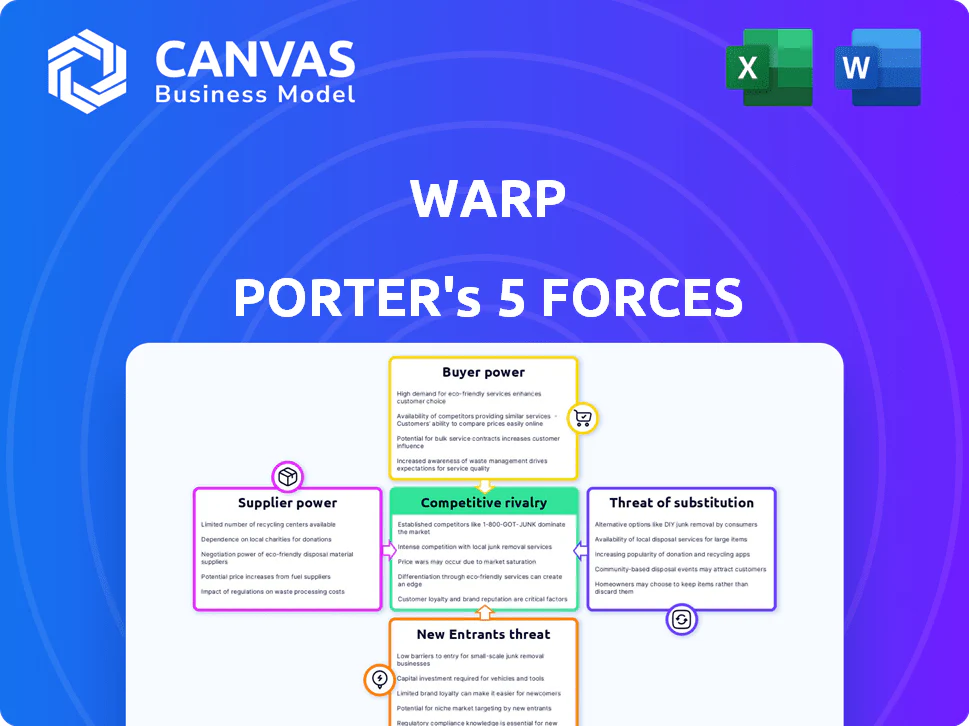
WARP PORTER'S FIVE FORCES TEMPLATE RESEARCH
What is included in the product
 Detailed Word Document
Uncovers key drivers of competition, customer influence, and market entry risks tailored to the specific company.

 Customizable Excel Spreadsheet
Customizable weighting options empower you to react to change and adapt quickly.
Full Version Awaits
Warp Porter's Five Forces Analysis
This preview showcases the comprehensive Porter's Five Forces analysis you'll receive. The full, ready-to-use document is immediately available upon purchase. It's professionally written, fully formatted, and provides in-depth insights. There are no differences between the preview and the purchased document.

Porter's Five Forces Analysis Template

From Overview to Strategy Blueprint
Warp faces competitive pressures shaped by suppliers, buyers, and the threat of new entrants and substitutes. Intense rivalry and pricing wars also impact profitability. This analysis identifies key forces shaping Warp’s market dynamics. Understanding these forces is vital for strategic planning and investment. Deep dive into Warp's competitive landscape with our complete Porter's Five Forces Analysis.
Suppliers Bargaining Power

Availability of Rust Developers
The bargaining power of suppliers, specifically Rust developers, is a key factor for Warp Porter. A scarcity of proficient Rust developers could drive up their salaries and project rates, increasing Warp's costs. In 2024, the average salary for a Rust developer in the US was around $140,000, reflecting the demand. This impacts operational costs.
Reliance on Cloud Infrastructure Providers
Warp, as a software company, depends on cloud infrastructure providers. These providers, like AWS, Google Cloud, and Microsoft Azure, have substantial supplier power. In 2024, AWS controlled about 32% of the cloud infrastructure market, followed by Microsoft Azure at 23%. This dominance impacts Warp's costs and operational flexibility. The pricing and service terms set by these providers directly affect Warp's profitability.

Dependency on Open-Source Libraries and Tools
Warp, built on Rust, relies on open-source libraries. Licensing changes or discontinued support for key libraries could impact operations. In 2024, the open-source software market was valued at over $50 billion, showing significant supplier influence. The risk is mitigated by the availability of alternatives and the community support within the Rust ecosystem.

Hardware and Equipment Providers
Warp Porter's hardware and equipment suppliers have moderate bargaining power. For a software company, this power is less pronounced than that of software or cloud providers. This dynamic is influenced by the availability of hardware components and competitive pricing. The market saw a drop in PC shipments in 2023, with a 14.6% decrease year-over-year, showing some supplier vulnerability.
- Hardware suppliers' bargaining power is typically moderate for software firms.
- The availability and pricing of components affect this power.
- PC shipments decreased in 2023, impacting supplier leverage.
- Software companies often have more significant cloud service negotiations.
Third-Party Service Providers (e.g., AI Models)
Warp's integration of AI features, leveraging third-party AI models, introduces supplier bargaining power dynamics. The providers of these AI services, like OpenAI or Google, can exert influence. Their bargaining power hinges on the uniqueness and efficacy of their AI models and their pricing strategies. For example, in 2024, OpenAI's revenue reached approximately $3.4 billion. This shows the significant market power of AI providers.
- AI model uniqueness directly impacts supplier power.
- Pricing structures of AI services vary widely.
- Dependence on specific AI models can increase supplier power.
- Competitive landscape among AI providers affects bargaining power.
Warp Porter's Costs: A Deep Dive into Supplier Power
Supplier bargaining power significantly affects Warp Porter's costs and operations. Rust developers' salaries, averaging $140,000 in 2024, influence expenses. Cloud providers, like AWS with 32% market share, also wield substantial power. This affects Warp's profitability.
| Supplier Type | Market Share/Impact | Financial Impact |
|---|---|---|
| Rust Developers | Salary Demand | $140,000 avg. salary (2024) |
| Cloud Providers (AWS) | 32% market share (2024) | Pricing, service terms |
| AI Model Providers (OpenAI) | Revenue approx. $3.4B (2024) | Pricing, model efficacy |
Customers Bargaining Power

Availability of Alternative Terminal Applications
Customers wield significant power due to the abundance of terminal application alternatives. In 2024, the market saw robust growth in open-source terminal applications. This gives users leverage to switch if Warp's offerings don't meet their needs. The availability of alternatives increases price sensitivity.
Customer Sensitivity to Pricing
Customer sensitivity to Warp's pricing differs. Individual developers might be price-sensitive, while enterprise teams view it as a productivity investment. Warp's free tier attracts budget-conscious users, whereas paid tiers offer advanced features. In 2024, subscription revenue models showed strong growth, indicating customer willingness to pay for value. This is evident in the software industry's 15% annual growth.

Switching Costs
Switching costs for terminal applications are relatively low. The fundamental function of a terminal is standardized, making it easier for users to switch between different applications. This standardization reduces the barriers to change, unlike more complex development environments. For instance, in 2024, the average cost to switch between similar software solutions was about 10-15% of the initial investment, indicating a manageable shift for most users.

Customer Base Size and Concentration
The size and concentration of Warp's customer base significantly impact customer bargaining power. A diverse, fragmented customer base reduces individual customer influence. For instance, if Warp serves many small businesses, no single customer can heavily dictate terms. However, if a few major corporations dominate, they wield considerable power. This power dynamic affects pricing and service negotiations.
- Large customers can demand lower prices.
- Concentrated markets increase customer leverage.
- Fragmented markets reduce customer power.
- Customer concentration affects profitability.
Demand for Specific Features (e.g., Collaboration, AI)
Warp's focus on collaboration and AI gives it an edge. Customers wanting these features may have less power if Warp is the best option. Consider that in 2024, the AI market grew, with collaborative tools being a key driver. This reduces customer power for features only Warp offers.
- AI market growth in 2024 was significant.
- Collaboration features increased in value.
- Warp's unique offerings limit customer power.
Warp's Customer Power: Market Dynamics in Focus
Customers' bargaining power for Warp varies based on market dynamics. Alternative terminal applications are readily available, increasing price sensitivity among users. The customer base's size and concentration significantly impact their influence on pricing and service terms.
| Factor | Impact | Data (2024) |
|---|---|---|
| Availability of Alternatives | High customer power | Open-source terminal market grew by 18%. |
| Customer Base | Fragmented base reduces power | Software industry saw 15% annual growth. |
| Unique Features | Warp's advantage, lower power | AI market grew, collaborative tools key. |
Rivalry Among Competitors

Number and Diversity of Competitors
The terminal market sees robust competition. Established players include default system terminals, with alternatives like iTerm2 and Hyper gaining traction. Newer entrants continuously emerge, increasing the diversity of options for users in 2024. This dynamic landscape intensifies the competitive rivalry within the industry. The market is expected to reach $2.6 billion by the end of 2024.
Feature Differentiation
Warp Porter's competitive rivalry is influenced by feature differentiation. Warp distinguishes itself with features like a modern UI, AI tools, and collaboration features. The uniqueness and perceived value of these features directly affect rivalry intensity. For instance, companies investing heavily in AI saw their stock prices rise, with some, like Palantir, up over 100% in 2024.

Market Growth Rate
The developer tools and terminal management market is currently seeing growth. This expansion can shape competitive dynamics. In markets with high growth, rivalry can lessen as more companies find success. However, the developer terminal niche may present unique challenges. For instance, the global developer tools market was valued at $40.5 billion in 2024.

Brand Loyalty and Network Effects
Brand loyalty among developers to their preferred tools can be significant. Collaboration features in Warp could foster network effects, especially within teams. However, the impact might not be as strong as in social networks. Network effects could lead to increased user retention. In 2024, the software development tools market reached $60 billion.
- Strong brand loyalty can exist among developers.
- Collaboration features can introduce network effects.
- Network effects can boost user retention.
- The software development tools market was $60 billion in 2024.
Pricing Strategies of Competitors
Warp Porter confronts a diverse pricing landscape. Competitors use varied models, from free, open-source tools to costly proprietary terminals. Warp's freemium approach aims to balance accessibility and revenue generation within this environment. This strategy directly challenges both free and premium competitors.
- Bloomberg Terminal costs approximately $2,400 per month.
- Open-source alternatives may lack the comprehensive features of paid options.
- Freemium models aim for user base growth and potential upgrades.
Terminal Market: Fierce Competition & Growth
Competitive rivalry in the terminal market is intense, fueled by feature differentiation and growth. Warp Porter competes with established and emerging players, impacting market dynamics. Brand loyalty and network effects, particularly in developer tools, influence competition and user retention.
| Factor | Impact | Data (2024) |
|---|---|---|
| Market Growth | Influences rivalry intensity | Developer tools market: $40.5B |
| Feature Differentiation | Affects competitive advantage | Palantir stock up >100% due to AI |
| Pricing Models | Shapes competitive landscape | Bloomberg Terminal: ~$2,400/month |
Original: $10.00
-65%$10.00
$3.50WARP PORTER'S FIVE FORCES TEMPLATE RESEARCH
What is included in the product
Detailed Word Document
Uncovers key drivers of competition, customer influence, and market entry risks tailored to the specific company.
Customizable Excel Spreadsheet
Customizable weighting options empower you to react to change and adapt quickly.
Full Version Awaits
Warp Porter's Five Forces Analysis
This preview showcases the comprehensive Porter's Five Forces analysis you'll receive. The full, ready-to-use document is immediately available upon purchase. It's professionally written, fully formatted, and provides in-depth insights. There are no differences between the preview and the purchased document.
Porter's Five Forces Analysis Template
From Overview to Strategy Blueprint
Warp faces competitive pressures shaped by suppliers, buyers, and the threat of new entrants and substitutes. Intense rivalry and pricing wars also impact profitability. This analysis identifies key forces shaping Warp’s market dynamics. Understanding these forces is vital for strategic planning and investment. Deep dive into Warp's competitive landscape with our complete Porter's Five Forces Analysis.
Suppliers Bargaining Power
Availability of Rust Developers
The bargaining power of suppliers, specifically Rust developers, is a key factor for Warp Porter. A scarcity of proficient Rust developers could drive up their salaries and project rates, increasing Warp's costs. In 2024, the average salary for a Rust developer in the US was around $140,000, reflecting the demand. This impacts operational costs.
Reliance on Cloud Infrastructure Providers
Warp, as a software company, depends on cloud infrastructure providers. These providers, like AWS, Google Cloud, and Microsoft Azure, have substantial supplier power. In 2024, AWS controlled about 32% of the cloud infrastructure market, followed by Microsoft Azure at 23%. This dominance impacts Warp's costs and operational flexibility. The pricing and service terms set by these providers directly affect Warp's profitability.
Dependency on Open-Source Libraries and Tools
Warp, built on Rust, relies on open-source libraries. Licensing changes or discontinued support for key libraries could impact operations. In 2024, the open-source software market was valued at over $50 billion, showing significant supplier influence. The risk is mitigated by the availability of alternatives and the community support within the Rust ecosystem.
Hardware and Equipment Providers
Warp Porter's hardware and equipment suppliers have moderate bargaining power. For a software company, this power is less pronounced than that of software or cloud providers. This dynamic is influenced by the availability of hardware components and competitive pricing. The market saw a drop in PC shipments in 2023, with a 14.6% decrease year-over-year, showing some supplier vulnerability.
- Hardware suppliers' bargaining power is typically moderate for software firms.
- The availability and pricing of components affect this power.
- PC shipments decreased in 2023, impacting supplier leverage.
- Software companies often have more significant cloud service negotiations.
Third-Party Service Providers (e.g., AI Models)
Warp's integration of AI features, leveraging third-party AI models, introduces supplier bargaining power dynamics. The providers of these AI services, like OpenAI or Google, can exert influence. Their bargaining power hinges on the uniqueness and efficacy of their AI models and their pricing strategies. For example, in 2024, OpenAI's revenue reached approximately $3.4 billion. This shows the significant market power of AI providers.
- AI model uniqueness directly impacts supplier power.
- Pricing structures of AI services vary widely.
- Dependence on specific AI models can increase supplier power.
- Competitive landscape among AI providers affects bargaining power.
Warp Porter's Costs: A Deep Dive into Supplier Power
Supplier bargaining power significantly affects Warp Porter's costs and operations. Rust developers' salaries, averaging $140,000 in 2024, influence expenses. Cloud providers, like AWS with 32% market share, also wield substantial power. This affects Warp's profitability.
| Supplier Type | Market Share/Impact | Financial Impact |
|---|---|---|
| Rust Developers | Salary Demand | $140,000 avg. salary (2024) |
| Cloud Providers (AWS) | 32% market share (2024) | Pricing, service terms |
| AI Model Providers (OpenAI) | Revenue approx. $3.4B (2024) | Pricing, model efficacy |
Customers Bargaining Power
Availability of Alternative Terminal Applications
Customers wield significant power due to the abundance of terminal application alternatives. In 2024, the market saw robust growth in open-source terminal applications. This gives users leverage to switch if Warp's offerings don't meet their needs. The availability of alternatives increases price sensitivity.
Customer Sensitivity to Pricing
Customer sensitivity to Warp's pricing differs. Individual developers might be price-sensitive, while enterprise teams view it as a productivity investment. Warp's free tier attracts budget-conscious users, whereas paid tiers offer advanced features. In 2024, subscription revenue models showed strong growth, indicating customer willingness to pay for value. This is evident in the software industry's 15% annual growth.
Switching Costs
Switching costs for terminal applications are relatively low. The fundamental function of a terminal is standardized, making it easier for users to switch between different applications. This standardization reduces the barriers to change, unlike more complex development environments. For instance, in 2024, the average cost to switch between similar software solutions was about 10-15% of the initial investment, indicating a manageable shift for most users.
Customer Base Size and Concentration
The size and concentration of Warp's customer base significantly impact customer bargaining power. A diverse, fragmented customer base reduces individual customer influence. For instance, if Warp serves many small businesses, no single customer can heavily dictate terms. However, if a few major corporations dominate, they wield considerable power. This power dynamic affects pricing and service negotiations.
- Large customers can demand lower prices.
- Concentrated markets increase customer leverage.
- Fragmented markets reduce customer power.
- Customer concentration affects profitability.
Demand for Specific Features (e.g., Collaboration, AI)
Warp's focus on collaboration and AI gives it an edge. Customers wanting these features may have less power if Warp is the best option. Consider that in 2024, the AI market grew, with collaborative tools being a key driver. This reduces customer power for features only Warp offers.
- AI market growth in 2024 was significant.
- Collaboration features increased in value.
- Warp's unique offerings limit customer power.
Warp's Customer Power: Market Dynamics in Focus
Customers' bargaining power for Warp varies based on market dynamics. Alternative terminal applications are readily available, increasing price sensitivity among users. The customer base's size and concentration significantly impact their influence on pricing and service terms.
| Factor | Impact | Data (2024) |
|---|---|---|
| Availability of Alternatives | High customer power | Open-source terminal market grew by 18%. |
| Customer Base | Fragmented base reduces power | Software industry saw 15% annual growth. |
| Unique Features | Warp's advantage, lower power | AI market grew, collaborative tools key. |
Rivalry Among Competitors
Number and Diversity of Competitors
The terminal market sees robust competition. Established players include default system terminals, with alternatives like iTerm2 and Hyper gaining traction. Newer entrants continuously emerge, increasing the diversity of options for users in 2024. This dynamic landscape intensifies the competitive rivalry within the industry. The market is expected to reach $2.6 billion by the end of 2024.
Feature Differentiation
Warp Porter's competitive rivalry is influenced by feature differentiation. Warp distinguishes itself with features like a modern UI, AI tools, and collaboration features. The uniqueness and perceived value of these features directly affect rivalry intensity. For instance, companies investing heavily in AI saw their stock prices rise, with some, like Palantir, up over 100% in 2024.
Market Growth Rate
The developer tools and terminal management market is currently seeing growth. This expansion can shape competitive dynamics. In markets with high growth, rivalry can lessen as more companies find success. However, the developer terminal niche may present unique challenges. For instance, the global developer tools market was valued at $40.5 billion in 2024.
Brand Loyalty and Network Effects
Brand loyalty among developers to their preferred tools can be significant. Collaboration features in Warp could foster network effects, especially within teams. However, the impact might not be as strong as in social networks. Network effects could lead to increased user retention. In 2024, the software development tools market reached $60 billion.
- Strong brand loyalty can exist among developers.
- Collaboration features can introduce network effects.
- Network effects can boost user retention.
- The software development tools market was $60 billion in 2024.
Pricing Strategies of Competitors
Warp Porter confronts a diverse pricing landscape. Competitors use varied models, from free, open-source tools to costly proprietary terminals. Warp's freemium approach aims to balance accessibility and revenue generation within this environment. This strategy directly challenges both free and premium competitors.
- Bloomberg Terminal costs approximately $2,400 per month.
- Open-source alternatives may lack the comprehensive features of paid options.
- Freemium models aim for user base growth and potential upgrades.
Terminal Market: Fierce Competition & Growth
Competitive rivalry in the terminal market is intense, fueled by feature differentiation and growth. Warp Porter competes with established and emerging players, impacting market dynamics. Brand loyalty and network effects, particularly in developer tools, influence competition and user retention.
| Factor | Impact | Data (2024) |
|---|---|---|
| Market Growth | Influences rivalry intensity | Developer tools market: $40.5B |
| Feature Differentiation | Affects competitive advantage | Palantir stock up >100% due to AI |
| Pricing Models | Shapes competitive landscape | Bloomberg Terminal: ~$2,400/month |
Product Information
Product Information
Shipping & Returns
Shipping & Returns
Description
What is included in the product
Detailed Word Document
Uncovers key drivers of competition, customer influence, and market entry risks tailored to the specific company.
Customizable Excel Spreadsheet
Customizable weighting options empower you to react to change and adapt quickly.
Full Version Awaits
Warp Porter's Five Forces Analysis
This preview showcases the comprehensive Porter's Five Forces analysis you'll receive. The full, ready-to-use document is immediately available upon purchase. It's professionally written, fully formatted, and provides in-depth insights. There are no differences between the preview and the purchased document.
Porter's Five Forces Analysis Template
From Overview to Strategy Blueprint
Warp faces competitive pressures shaped by suppliers, buyers, and the threat of new entrants and substitutes. Intense rivalry and pricing wars also impact profitability. This analysis identifies key forces shaping Warp’s market dynamics. Understanding these forces is vital for strategic planning and investment. Deep dive into Warp's competitive landscape with our complete Porter's Five Forces Analysis.
Suppliers Bargaining Power
Availability of Rust Developers
The bargaining power of suppliers, specifically Rust developers, is a key factor for Warp Porter. A scarcity of proficient Rust developers could drive up their salaries and project rates, increasing Warp's costs. In 2024, the average salary for a Rust developer in the US was around $140,000, reflecting the demand. This impacts operational costs.
Reliance on Cloud Infrastructure Providers
Warp, as a software company, depends on cloud infrastructure providers. These providers, like AWS, Google Cloud, and Microsoft Azure, have substantial supplier power. In 2024, AWS controlled about 32% of the cloud infrastructure market, followed by Microsoft Azure at 23%. This dominance impacts Warp's costs and operational flexibility. The pricing and service terms set by these providers directly affect Warp's profitability.
Dependency on Open-Source Libraries and Tools
Warp, built on Rust, relies on open-source libraries. Licensing changes or discontinued support for key libraries could impact operations. In 2024, the open-source software market was valued at over $50 billion, showing significant supplier influence. The risk is mitigated by the availability of alternatives and the community support within the Rust ecosystem.
Hardware and Equipment Providers
Warp Porter's hardware and equipment suppliers have moderate bargaining power. For a software company, this power is less pronounced than that of software or cloud providers. This dynamic is influenced by the availability of hardware components and competitive pricing. The market saw a drop in PC shipments in 2023, with a 14.6% decrease year-over-year, showing some supplier vulnerability.
- Hardware suppliers' bargaining power is typically moderate for software firms.
- The availability and pricing of components affect this power.
- PC shipments decreased in 2023, impacting supplier leverage.
- Software companies often have more significant cloud service negotiations.
Third-Party Service Providers (e.g., AI Models)
Warp's integration of AI features, leveraging third-party AI models, introduces supplier bargaining power dynamics. The providers of these AI services, like OpenAI or Google, can exert influence. Their bargaining power hinges on the uniqueness and efficacy of their AI models and their pricing strategies. For example, in 2024, OpenAI's revenue reached approximately $3.4 billion. This shows the significant market power of AI providers.
- AI model uniqueness directly impacts supplier power.
- Pricing structures of AI services vary widely.
- Dependence on specific AI models can increase supplier power.
- Competitive landscape among AI providers affects bargaining power.
Warp Porter's Costs: A Deep Dive into Supplier Power
Supplier bargaining power significantly affects Warp Porter's costs and operations. Rust developers' salaries, averaging $140,000 in 2024, influence expenses. Cloud providers, like AWS with 32% market share, also wield substantial power. This affects Warp's profitability.
| Supplier Type | Market Share/Impact | Financial Impact |
|---|---|---|
| Rust Developers | Salary Demand | $140,000 avg. salary (2024) |
| Cloud Providers (AWS) | 32% market share (2024) | Pricing, service terms |
| AI Model Providers (OpenAI) | Revenue approx. $3.4B (2024) | Pricing, model efficacy |
Customers Bargaining Power
Availability of Alternative Terminal Applications
Customers wield significant power due to the abundance of terminal application alternatives. In 2024, the market saw robust growth in open-source terminal applications. This gives users leverage to switch if Warp's offerings don't meet their needs. The availability of alternatives increases price sensitivity.
Customer Sensitivity to Pricing
Customer sensitivity to Warp's pricing differs. Individual developers might be price-sensitive, while enterprise teams view it as a productivity investment. Warp's free tier attracts budget-conscious users, whereas paid tiers offer advanced features. In 2024, subscription revenue models showed strong growth, indicating customer willingness to pay for value. This is evident in the software industry's 15% annual growth.
Switching Costs
Switching costs for terminal applications are relatively low. The fundamental function of a terminal is standardized, making it easier for users to switch between different applications. This standardization reduces the barriers to change, unlike more complex development environments. For instance, in 2024, the average cost to switch between similar software solutions was about 10-15% of the initial investment, indicating a manageable shift for most users.
Customer Base Size and Concentration
The size and concentration of Warp's customer base significantly impact customer bargaining power. A diverse, fragmented customer base reduces individual customer influence. For instance, if Warp serves many small businesses, no single customer can heavily dictate terms. However, if a few major corporations dominate, they wield considerable power. This power dynamic affects pricing and service negotiations.
- Large customers can demand lower prices.
- Concentrated markets increase customer leverage.
- Fragmented markets reduce customer power.
- Customer concentration affects profitability.
Demand for Specific Features (e.g., Collaboration, AI)
Warp's focus on collaboration and AI gives it an edge. Customers wanting these features may have less power if Warp is the best option. Consider that in 2024, the AI market grew, with collaborative tools being a key driver. This reduces customer power for features only Warp offers.
- AI market growth in 2024 was significant.
- Collaboration features increased in value.
- Warp's unique offerings limit customer power.
Warp's Customer Power: Market Dynamics in Focus
Customers' bargaining power for Warp varies based on market dynamics. Alternative terminal applications are readily available, increasing price sensitivity among users. The customer base's size and concentration significantly impact their influence on pricing and service terms.
| Factor | Impact | Data (2024) |
|---|---|---|
| Availability of Alternatives | High customer power | Open-source terminal market grew by 18%. |
| Customer Base | Fragmented base reduces power | Software industry saw 15% annual growth. |
| Unique Features | Warp's advantage, lower power | AI market grew, collaborative tools key. |
Rivalry Among Competitors
Number and Diversity of Competitors
The terminal market sees robust competition. Established players include default system terminals, with alternatives like iTerm2 and Hyper gaining traction. Newer entrants continuously emerge, increasing the diversity of options for users in 2024. This dynamic landscape intensifies the competitive rivalry within the industry. The market is expected to reach $2.6 billion by the end of 2024.
Feature Differentiation
Warp Porter's competitive rivalry is influenced by feature differentiation. Warp distinguishes itself with features like a modern UI, AI tools, and collaboration features. The uniqueness and perceived value of these features directly affect rivalry intensity. For instance, companies investing heavily in AI saw their stock prices rise, with some, like Palantir, up over 100% in 2024.
Market Growth Rate
The developer tools and terminal management market is currently seeing growth. This expansion can shape competitive dynamics. In markets with high growth, rivalry can lessen as more companies find success. However, the developer terminal niche may present unique challenges. For instance, the global developer tools market was valued at $40.5 billion in 2024.
Brand Loyalty and Network Effects
Brand loyalty among developers to their preferred tools can be significant. Collaboration features in Warp could foster network effects, especially within teams. However, the impact might not be as strong as in social networks. Network effects could lead to increased user retention. In 2024, the software development tools market reached $60 billion.
- Strong brand loyalty can exist among developers.
- Collaboration features can introduce network effects.
- Network effects can boost user retention.
- The software development tools market was $60 billion in 2024.
Pricing Strategies of Competitors
Warp Porter confronts a diverse pricing landscape. Competitors use varied models, from free, open-source tools to costly proprietary terminals. Warp's freemium approach aims to balance accessibility and revenue generation within this environment. This strategy directly challenges both free and premium competitors.
- Bloomberg Terminal costs approximately $2,400 per month.
- Open-source alternatives may lack the comprehensive features of paid options.
- Freemium models aim for user base growth and potential upgrades.
Terminal Market: Fierce Competition & Growth
Competitive rivalry in the terminal market is intense, fueled by feature differentiation and growth. Warp Porter competes with established and emerging players, impacting market dynamics. Brand loyalty and network effects, particularly in developer tools, influence competition and user retention.
| Factor | Impact | Data (2024) |
|---|---|---|
| Market Growth | Influences rivalry intensity | Developer tools market: $40.5B |
| Feature Differentiation | Affects competitive advantage | Palantir stock up >100% due to AI |
| Pricing Models | Shapes competitive landscape | Bloomberg Terminal: ~$2,400/month |











