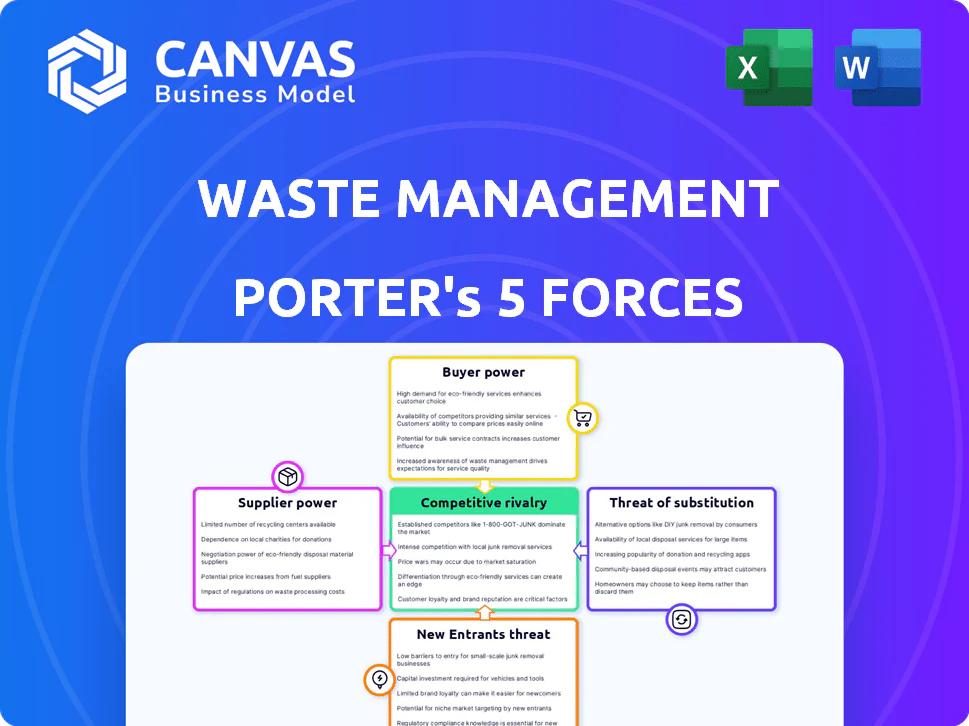
WASTE MANAGEMENT PORTER'S FIVE FORCES TEMPLATE RESEARCH

Go Beyond the Preview-Access the Full Strategic Report
Waste Management faces high barriers to entry, regional pricing power, moderate supplier leverage, rising substitute threats from recycling/composting, and intense rivalry-this snapshot highlights key competitive pressures and strategic levers.
This brief only scratches the surface. Unlock the full Porter's Five Forces Analysis to access force-by-force ratings, visuals, and actionable insights to inform investment or strategy.
Suppliers Bargaining Power

Specialized Equipment and EV Transition
Waste Management relies on a narrow set of OEMs for heavy-duty trucks and landfill gear; in FY2025 WM spent about $1.8bn on capital equipment, concentrating bargaining with few suppliers.
WM aims to electrify ~15% of its 20,000-vehicle fleet and convert 10% to CNG by 2026, raising dependence on high-tech battery and CNG system makers.
Scale gives WM negotiating power-bulk orders lower unit cost-but specialized zero-emission tech lets suppliers push premium pricing and extend lead times by 6-12 months.
Energy and Fuel Volatility
Fuel and energy accounted for about 9% of Waste Management's (WM) 2025 operating expenses, making fuel cost volatility a material input cost tied to global oil prices that rose 18% in 2024-25; WM offsets some exposure via 140 MW of landfill-gas-to-energy capacity but still buys diesel and grid power for its 40,000-vehicle fleet and facilities, leaving suppliers of fuels and clean-energy credits with pricing leverage.

Skilled Labor and Union Influence
A substantial portion of Waste Management's workforce is unionized, giving unions real bargaining power over wages and benefits; as of FY2025 about 28% of frontline employees were union members, driving negotiated wage increases.
In the 2026 labor market, scarcity of CDL-certified drivers and technicians raised average starting wages by ~9% year-over-year, forcing WM to offer premium pay and signing bonuses to fill roles.
This internal supplier of labor exerts steady upward pressure on operating costs-WM's 2025 labor and benefits expense rose to $6.2 billion-forcing tight cost management to protect margins.

Regulatory and Landfill Permitting
Local governments and agencies supply WM's core asset-land-via permits; without approvals WM cannot add landfill cells or new transfer stations, capping growth and raising costs.
In 2025 WM faced ~$2.5B in capital projects tied to permitting delays; new landfill permits are rare-single-digit approvals yearly nationwide-so regulators wield de facto veto power.
- Permits = bottleneck; expansion halted without approval
- 2025: WM ~$2.5B capex at risk from delays
- NIMBY makes new permits extremely scarce (single-digit US approvals/year)
Advanced Technology and AI Vendors
As Waste Management integrates AI for route optimization and automated MRF sorting, it relies on niche vendors like Siemens, Honeywell, and AMP Robotics, creating high switching costs tied to proprietary software and trained models; WM reported $2.6B capital expenditure in 2025, with ~12% for technology upgrades, raising supplier leverage.
Digital dependence shifts supplier power from hardware to IP, where software licensing, data integration, and maintenance margins (often 20-40%) give vendors recurring revenue and bargaining leverage over WM's operational costs and upgrade timelines.
- Niche vendors: AMP Robotics, Siemens, Honeywell
- WM 2025 capex: $2.6B; ~12% tech
- Vendor margins: 20-40% on software/maintenance
- High switching cost: proprietary models, data integration
WM's buying power vs concentrated suppliers, union and permit risks threaten $2.6B capex
WM's supplier power is mixed: scale and $2.6B FY2025 capex give buying leverage, but dependence on a few OEMs, niche EV/CNG/battery vendors, fuel suppliers (fuel = 9% of Opex), unions (28% unionized) and permit authorities (≈$2.5B capex at risk) create pockets of strong bargaining power.
| Metric | 2025 |
|---|---|
| Capex | $2.6B |
| Capex tech share | ~12% |
| Capital equipment spend | $1.8B |
| Fuel (% Opex) | 9% |
| Labor & benefits | $6.2B |
| Unionized frontline | 28% |
| Capex at permit risk | $2.5B |
What is included in the product
 Detailed Word Document
Tailored Porter's Five Forces for Waste Management: analyzes competitive intensity, supplier and buyer power, threat of substitutes and entrants, and industry rivalry to reveal pricing pressure, margin risks, regulatory barriers, and strategic defenses supporting incumbent advantage.

 Customizable Excel Spreadsheet
Clear, one-sheet Porter's Five Forces for Waste Management-quickly gauge supplier, buyer, entrant, substitute, and rivalry pressures to inform operational and M&A decisions.
Customers Bargaining Power

Municipal Contract Bidding Pressure
Large municipal contracts account for roughly 30-40% of Waste Management Inc.'s 2025 revenue (~$20-27B of $68B), yet RFP cycles force aggressive price competition every 5-7 years, compressing EBITDA margins from ~17% companywide toward low-double digits in bid-heavy regions.
Commercial and Industrial Negotiation
Commercial clients can switch vendors quickly, and in 2025 WM's commercial revenue was about $14.2B, so losing even 5% equals $710M; competitors like Republic Services threaten that margin with bundled pricing.
In 2026 buyers demand integrated ESG reporting; 62% of Fortune 500 now require scope-data, giving customers leverage to extract lower rates or extra services.
WM must prove value-service reliability, ESG transparency, and bespoke contracts-to defend high-margin accounts that drove ~40% of operating income in 2025.

Residential Price Sensitivity
While most homeowners lack direct provider choice, they exert indirect power via local politics; 2025 surveys show 62% of suburban residents oppose rate hikes, and 18 US cities imposed municipal caps or contract pauses in 2024-25, forcing Waste Management to limit average residential revenue-per-can to about $27-$32 monthly in key suburbs.

Recycling Commodity Buyers
Global manufacturers buying processed recyclables act as price-makers in a volatile market; Waste Management (WM) cannot control 2025 spot prices for cardboard, aluminum, and plastics, which fell 18% YoY for mixed paper and rose 12% YoY for scrap aluminum in 2025.
This limited pricing power forces WM toward service-based recycling-charging for collection, sorting, and certified recycling-to stabilize margins; WM reported 2025 recycling service revenue of $1.9 billion, up 9% from 2024.
- Buyers set spot prices; WM price-taker
- 2025: mixed paper -18% YoY; scrap aluminum +12% YoY
- WM 2025 recycling service revenue $1.9B (+9%)
- Shift to service fees reduces commodity-price exposure
National Account Consolidation
Fortune 500 national accounts force Waste Management to offer centralized pricing and management; in 2025 WM reported $19.0B in commercial revenue, with large accounts driving a meaningful share and pushing negotiated discounts that compress margins.
These power buyers use hundreds of sites to extract scale pricing few locals match, so WM often trades margin for stable, multi-year contracts and volume growth-affecting segment EBITDA margins.
- Large-account leverage: dozens-hundreds sites per client
- WM 2025 commercial revenue: $19.0B
- Discounts reduce per-yard margins but secure long-term volume
Waste Management faces pricing pressure: municipal leverage shields margins as commodity mix shifts
Customers hold strong leverage: municipal contracts were ~30-40% of Waste Management Inc.'s 2025 revenue (~$20-27B of $68B), commercial revenue ~$19.0B so 5% loss ≈$950M, recycling service revenue $1.9B (+9%), commodity prices: mixed paper -18% YoY, scrap aluminum +12% YoY; buyers force discounts, favoring service fees to protect margins.
| Metric | 2025 |
|---|---|
| Revenue | $68B |
| Municipal share | $20-27B (30-40%) |
| Commercial rev | $19.0B |
| Recycling service rev | $1.9B (+9%) |
| Mixed paper price | -18% YoY |
| Scrap aluminum price | +12% YoY |
Full Version Awaits
Waste Management Porter's Five Forces Analysis
This preview shows the exact Waste Management Porter's Five Forces analysis you'll receive immediately after purchase-no surprises, no placeholders. The document covers industry rivalry, supplier and buyer power, threat of substitutes, and barriers to entry with actionable takeaways. It's fully formatted, ready to download, and usable the moment you buy.

Original: $10.00
-65%$10.00
$3.50WASTE MANAGEMENT PORTER'S FIVE FORCES TEMPLATE RESEARCH
Go Beyond the Preview-Access the Full Strategic Report
Waste Management faces high barriers to entry, regional pricing power, moderate supplier leverage, rising substitute threats from recycling/composting, and intense rivalry-this snapshot highlights key competitive pressures and strategic levers.
This brief only scratches the surface. Unlock the full Porter's Five Forces Analysis to access force-by-force ratings, visuals, and actionable insights to inform investment or strategy.
Suppliers Bargaining Power
Specialized Equipment and EV Transition
Waste Management relies on a narrow set of OEMs for heavy-duty trucks and landfill gear; in FY2025 WM spent about $1.8bn on capital equipment, concentrating bargaining with few suppliers.
WM aims to electrify ~15% of its 20,000-vehicle fleet and convert 10% to CNG by 2026, raising dependence on high-tech battery and CNG system makers.
Scale gives WM negotiating power-bulk orders lower unit cost-but specialized zero-emission tech lets suppliers push premium pricing and extend lead times by 6-12 months.
Energy and Fuel Volatility
Fuel and energy accounted for about 9% of Waste Management's (WM) 2025 operating expenses, making fuel cost volatility a material input cost tied to global oil prices that rose 18% in 2024-25; WM offsets some exposure via 140 MW of landfill-gas-to-energy capacity but still buys diesel and grid power for its 40,000-vehicle fleet and facilities, leaving suppliers of fuels and clean-energy credits with pricing leverage.
Skilled Labor and Union Influence
A substantial portion of Waste Management's workforce is unionized, giving unions real bargaining power over wages and benefits; as of FY2025 about 28% of frontline employees were union members, driving negotiated wage increases.
In the 2026 labor market, scarcity of CDL-certified drivers and technicians raised average starting wages by ~9% year-over-year, forcing WM to offer premium pay and signing bonuses to fill roles.
This internal supplier of labor exerts steady upward pressure on operating costs-WM's 2025 labor and benefits expense rose to $6.2 billion-forcing tight cost management to protect margins.
Regulatory and Landfill Permitting
Local governments and agencies supply WM's core asset-land-via permits; without approvals WM cannot add landfill cells or new transfer stations, capping growth and raising costs.
In 2025 WM faced ~$2.5B in capital projects tied to permitting delays; new landfill permits are rare-single-digit approvals yearly nationwide-so regulators wield de facto veto power.
- Permits = bottleneck; expansion halted without approval
- 2025: WM ~$2.5B capex at risk from delays
- NIMBY makes new permits extremely scarce (single-digit US approvals/year)
Advanced Technology and AI Vendors
As Waste Management integrates AI for route optimization and automated MRF sorting, it relies on niche vendors like Siemens, Honeywell, and AMP Robotics, creating high switching costs tied to proprietary software and trained models; WM reported $2.6B capital expenditure in 2025, with ~12% for technology upgrades, raising supplier leverage.
Digital dependence shifts supplier power from hardware to IP, where software licensing, data integration, and maintenance margins (often 20-40%) give vendors recurring revenue and bargaining leverage over WM's operational costs and upgrade timelines.
- Niche vendors: AMP Robotics, Siemens, Honeywell
- WM 2025 capex: $2.6B; ~12% tech
- Vendor margins: 20-40% on software/maintenance
- High switching cost: proprietary models, data integration
WM's buying power vs concentrated suppliers, union and permit risks threaten $2.6B capex
WM's supplier power is mixed: scale and $2.6B FY2025 capex give buying leverage, but dependence on a few OEMs, niche EV/CNG/battery vendors, fuel suppliers (fuel = 9% of Opex), unions (28% unionized) and permit authorities (≈$2.5B capex at risk) create pockets of strong bargaining power.
| Metric | 2025 |
|---|---|
| Capex | $2.6B |
| Capex tech share | ~12% |
| Capital equipment spend | $1.8B |
| Fuel (% Opex) | 9% |
| Labor & benefits | $6.2B |
| Unionized frontline | 28% |
| Capex at permit risk | $2.5B |
What is included in the product
Detailed Word Document
Tailored Porter's Five Forces for Waste Management: analyzes competitive intensity, supplier and buyer power, threat of substitutes and entrants, and industry rivalry to reveal pricing pressure, margin risks, regulatory barriers, and strategic defenses supporting incumbent advantage.
Customizable Excel Spreadsheet
Clear, one-sheet Porter's Five Forces for Waste Management-quickly gauge supplier, buyer, entrant, substitute, and rivalry pressures to inform operational and M&A decisions.
Customers Bargaining Power
Municipal Contract Bidding Pressure
Large municipal contracts account for roughly 30-40% of Waste Management Inc.'s 2025 revenue (~$20-27B of $68B), yet RFP cycles force aggressive price competition every 5-7 years, compressing EBITDA margins from ~17% companywide toward low-double digits in bid-heavy regions.
Commercial and Industrial Negotiation
Commercial clients can switch vendors quickly, and in 2025 WM's commercial revenue was about $14.2B, so losing even 5% equals $710M; competitors like Republic Services threaten that margin with bundled pricing.
In 2026 buyers demand integrated ESG reporting; 62% of Fortune 500 now require scope-data, giving customers leverage to extract lower rates or extra services.
WM must prove value-service reliability, ESG transparency, and bespoke contracts-to defend high-margin accounts that drove ~40% of operating income in 2025.
Residential Price Sensitivity
While most homeowners lack direct provider choice, they exert indirect power via local politics; 2025 surveys show 62% of suburban residents oppose rate hikes, and 18 US cities imposed municipal caps or contract pauses in 2024-25, forcing Waste Management to limit average residential revenue-per-can to about $27-$32 monthly in key suburbs.
Recycling Commodity Buyers
Global manufacturers buying processed recyclables act as price-makers in a volatile market; Waste Management (WM) cannot control 2025 spot prices for cardboard, aluminum, and plastics, which fell 18% YoY for mixed paper and rose 12% YoY for scrap aluminum in 2025.
This limited pricing power forces WM toward service-based recycling-charging for collection, sorting, and certified recycling-to stabilize margins; WM reported 2025 recycling service revenue of $1.9 billion, up 9% from 2024.
- Buyers set spot prices; WM price-taker
- 2025: mixed paper -18% YoY; scrap aluminum +12% YoY
- WM 2025 recycling service revenue $1.9B (+9%)
- Shift to service fees reduces commodity-price exposure
National Account Consolidation
Fortune 500 national accounts force Waste Management to offer centralized pricing and management; in 2025 WM reported $19.0B in commercial revenue, with large accounts driving a meaningful share and pushing negotiated discounts that compress margins.
These power buyers use hundreds of sites to extract scale pricing few locals match, so WM often trades margin for stable, multi-year contracts and volume growth-affecting segment EBITDA margins.
- Large-account leverage: dozens-hundreds sites per client
- WM 2025 commercial revenue: $19.0B
- Discounts reduce per-yard margins but secure long-term volume
Waste Management faces pricing pressure: municipal leverage shields margins as commodity mix shifts
Customers hold strong leverage: municipal contracts were ~30-40% of Waste Management Inc.'s 2025 revenue (~$20-27B of $68B), commercial revenue ~$19.0B so 5% loss ≈$950M, recycling service revenue $1.9B (+9%), commodity prices: mixed paper -18% YoY, scrap aluminum +12% YoY; buyers force discounts, favoring service fees to protect margins.
| Metric | 2025 |
|---|---|
| Revenue | $68B |
| Municipal share | $20-27B (30-40%) |
| Commercial rev | $19.0B |
| Recycling service rev | $1.9B (+9%) |
| Mixed paper price | -18% YoY |
| Scrap aluminum price | +12% YoY |
Full Version Awaits
Waste Management Porter's Five Forces Analysis
This preview shows the exact Waste Management Porter's Five Forces analysis you'll receive immediately after purchase-no surprises, no placeholders. The document covers industry rivalry, supplier and buyer power, threat of substitutes, and barriers to entry with actionable takeaways. It's fully formatted, ready to download, and usable the moment you buy.
Product Information
Product Information
Shipping & Returns
Shipping & Returns
Description
Go Beyond the Preview-Access the Full Strategic Report
Waste Management faces high barriers to entry, regional pricing power, moderate supplier leverage, rising substitute threats from recycling/composting, and intense rivalry-this snapshot highlights key competitive pressures and strategic levers.
This brief only scratches the surface. Unlock the full Porter's Five Forces Analysis to access force-by-force ratings, visuals, and actionable insights to inform investment or strategy.
Suppliers Bargaining Power
Specialized Equipment and EV Transition
Waste Management relies on a narrow set of OEMs for heavy-duty trucks and landfill gear; in FY2025 WM spent about $1.8bn on capital equipment, concentrating bargaining with few suppliers.
WM aims to electrify ~15% of its 20,000-vehicle fleet and convert 10% to CNG by 2026, raising dependence on high-tech battery and CNG system makers.
Scale gives WM negotiating power-bulk orders lower unit cost-but specialized zero-emission tech lets suppliers push premium pricing and extend lead times by 6-12 months.
Energy and Fuel Volatility
Fuel and energy accounted for about 9% of Waste Management's (WM) 2025 operating expenses, making fuel cost volatility a material input cost tied to global oil prices that rose 18% in 2024-25; WM offsets some exposure via 140 MW of landfill-gas-to-energy capacity but still buys diesel and grid power for its 40,000-vehicle fleet and facilities, leaving suppliers of fuels and clean-energy credits with pricing leverage.
Skilled Labor and Union Influence
A substantial portion of Waste Management's workforce is unionized, giving unions real bargaining power over wages and benefits; as of FY2025 about 28% of frontline employees were union members, driving negotiated wage increases.
In the 2026 labor market, scarcity of CDL-certified drivers and technicians raised average starting wages by ~9% year-over-year, forcing WM to offer premium pay and signing bonuses to fill roles.
This internal supplier of labor exerts steady upward pressure on operating costs-WM's 2025 labor and benefits expense rose to $6.2 billion-forcing tight cost management to protect margins.
Regulatory and Landfill Permitting
Local governments and agencies supply WM's core asset-land-via permits; without approvals WM cannot add landfill cells or new transfer stations, capping growth and raising costs.
In 2025 WM faced ~$2.5B in capital projects tied to permitting delays; new landfill permits are rare-single-digit approvals yearly nationwide-so regulators wield de facto veto power.
- Permits = bottleneck; expansion halted without approval
- 2025: WM ~$2.5B capex at risk from delays
- NIMBY makes new permits extremely scarce (single-digit US approvals/year)
Advanced Technology and AI Vendors
As Waste Management integrates AI for route optimization and automated MRF sorting, it relies on niche vendors like Siemens, Honeywell, and AMP Robotics, creating high switching costs tied to proprietary software and trained models; WM reported $2.6B capital expenditure in 2025, with ~12% for technology upgrades, raising supplier leverage.
Digital dependence shifts supplier power from hardware to IP, where software licensing, data integration, and maintenance margins (often 20-40%) give vendors recurring revenue and bargaining leverage over WM's operational costs and upgrade timelines.
- Niche vendors: AMP Robotics, Siemens, Honeywell
- WM 2025 capex: $2.6B; ~12% tech
- Vendor margins: 20-40% on software/maintenance
- High switching cost: proprietary models, data integration
WM's buying power vs concentrated suppliers, union and permit risks threaten $2.6B capex
WM's supplier power is mixed: scale and $2.6B FY2025 capex give buying leverage, but dependence on a few OEMs, niche EV/CNG/battery vendors, fuel suppliers (fuel = 9% of Opex), unions (28% unionized) and permit authorities (≈$2.5B capex at risk) create pockets of strong bargaining power.
| Metric | 2025 |
|---|---|
| Capex | $2.6B |
| Capex tech share | ~12% |
| Capital equipment spend | $1.8B |
| Fuel (% Opex) | 9% |
| Labor & benefits | $6.2B |
| Unionized frontline | 28% |
| Capex at permit risk | $2.5B |
What is included in the product
Detailed Word Document
Tailored Porter's Five Forces for Waste Management: analyzes competitive intensity, supplier and buyer power, threat of substitutes and entrants, and industry rivalry to reveal pricing pressure, margin risks, regulatory barriers, and strategic defenses supporting incumbent advantage.
Customizable Excel Spreadsheet
Clear, one-sheet Porter's Five Forces for Waste Management-quickly gauge supplier, buyer, entrant, substitute, and rivalry pressures to inform operational and M&A decisions.
Customers Bargaining Power
Municipal Contract Bidding Pressure
Large municipal contracts account for roughly 30-40% of Waste Management Inc.'s 2025 revenue (~$20-27B of $68B), yet RFP cycles force aggressive price competition every 5-7 years, compressing EBITDA margins from ~17% companywide toward low-double digits in bid-heavy regions.
Commercial and Industrial Negotiation
Commercial clients can switch vendors quickly, and in 2025 WM's commercial revenue was about $14.2B, so losing even 5% equals $710M; competitors like Republic Services threaten that margin with bundled pricing.
In 2026 buyers demand integrated ESG reporting; 62% of Fortune 500 now require scope-data, giving customers leverage to extract lower rates or extra services.
WM must prove value-service reliability, ESG transparency, and bespoke contracts-to defend high-margin accounts that drove ~40% of operating income in 2025.
Residential Price Sensitivity
While most homeowners lack direct provider choice, they exert indirect power via local politics; 2025 surveys show 62% of suburban residents oppose rate hikes, and 18 US cities imposed municipal caps or contract pauses in 2024-25, forcing Waste Management to limit average residential revenue-per-can to about $27-$32 monthly in key suburbs.
Recycling Commodity Buyers
Global manufacturers buying processed recyclables act as price-makers in a volatile market; Waste Management (WM) cannot control 2025 spot prices for cardboard, aluminum, and plastics, which fell 18% YoY for mixed paper and rose 12% YoY for scrap aluminum in 2025.
This limited pricing power forces WM toward service-based recycling-charging for collection, sorting, and certified recycling-to stabilize margins; WM reported 2025 recycling service revenue of $1.9 billion, up 9% from 2024.
- Buyers set spot prices; WM price-taker
- 2025: mixed paper -18% YoY; scrap aluminum +12% YoY
- WM 2025 recycling service revenue $1.9B (+9%)
- Shift to service fees reduces commodity-price exposure
National Account Consolidation
Fortune 500 national accounts force Waste Management to offer centralized pricing and management; in 2025 WM reported $19.0B in commercial revenue, with large accounts driving a meaningful share and pushing negotiated discounts that compress margins.
These power buyers use hundreds of sites to extract scale pricing few locals match, so WM often trades margin for stable, multi-year contracts and volume growth-affecting segment EBITDA margins.
- Large-account leverage: dozens-hundreds sites per client
- WM 2025 commercial revenue: $19.0B
- Discounts reduce per-yard margins but secure long-term volume
Waste Management faces pricing pressure: municipal leverage shields margins as commodity mix shifts
Customers hold strong leverage: municipal contracts were ~30-40% of Waste Management Inc.'s 2025 revenue (~$20-27B of $68B), commercial revenue ~$19.0B so 5% loss ≈$950M, recycling service revenue $1.9B (+9%), commodity prices: mixed paper -18% YoY, scrap aluminum +12% YoY; buyers force discounts, favoring service fees to protect margins.
| Metric | 2025 |
|---|---|
| Revenue | $68B |
| Municipal share | $20-27B (30-40%) |
| Commercial rev | $19.0B |
| Recycling service rev | $1.9B (+9%) |
| Mixed paper price | -18% YoY |
| Scrap aluminum price | +12% YoY |
Full Version Awaits
Waste Management Porter's Five Forces Analysis
This preview shows the exact Waste Management Porter's Five Forces analysis you'll receive immediately after purchase-no surprises, no placeholders. The document covers industry rivalry, supplier and buyer power, threat of substitutes, and barriers to entry with actionable takeaways. It's fully formatted, ready to download, and usable the moment you buy.











