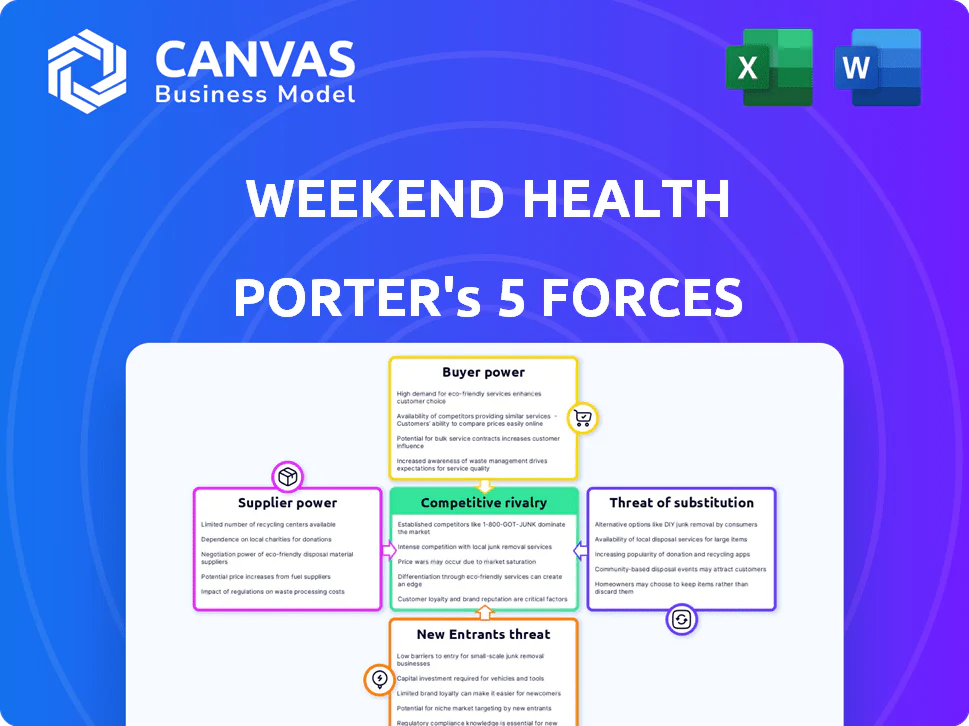
WEEKEND HEALTH PORTER'S FIVE FORCES TEMPLATE RESEARCH
What is included in the product
 Detailed Word Document
Weekend Health's competitive landscape is explored, focusing on market entry risks, buyer power, and substitution threats.

 Customizable Excel Spreadsheet
Easy data input and flexible scoring, quickly analyze and adapt to market shifts.
Full Version Awaits
Weekend Health Porter's Five Forces Analysis
You're seeing the full Weekend Health Porter's Five Forces analysis. After purchase, you'll receive this exact, comprehensive document immediately.

Porter's Five Forces Analysis Template

Go Beyond the Preview—Access the Full Strategic Report
Weekend Health faces a competitive landscape shaped by several forces. The bargaining power of buyers and suppliers significantly impacts profitability. The threat of new entrants, driven by capital requirements and regulatory hurdles, adds pressure. Substitutes, like traditional healthcare, offer alternative solutions. Intense rivalry exists with established competitors.
This brief snapshot only scratches the surface. Unlock the full Porter's Five Forces Analysis to explore Weekend Health’s competitive dynamics, market pressures, and strategic advantages in detail.
Suppliers Bargaining Power

Limited number of specialized telehealth technology providers
The telehealth sector hinges on tech platforms for service delivery. A limited number of specialized providers offer robust software and infrastructure. This scarcity boosts suppliers' bargaining power, as switching costs are high. In 2024, the global telehealth market was valued at $62.4 billion, with continued growth projected. High switching costs give suppliers leverage.
Dependence on trained clinicians
Weekend Health, similar to its competitors, relies on trained clinicians, including doctors and nurse practitioners, for consultations and treatment plans. The power of suppliers, in this case, healthcare professionals, is affected by their availability and cost. In 2024, the U.S. faced a significant shortage of physicians, with an estimated deficit of 17,000 to 48,000 primary care physicians, potentially increasing supplier power.

Influence of pharmaceutical companies
Pharmaceutical companies, like those manufacturing GLP-1 medications, wield substantial power over Weekend Health. Their control over pricing and supply directly impacts Weekend Health's operational costs. For instance, in 2024, the average monthly cost for GLP-1 drugs ranged from $900 to $1,300, significantly affecting service affordability. The regulatory environment, with bodies like the FDA, also plays a crucial role, potentially limiting access or increasing costs.

Regulatory bodies and their requirements
Regulatory bodies, acting as suppliers, significantly influence telehealth operations. They dictate technology standards, clinician qualifications, and operational protocols. Changes in regulations directly impact costs and service offerings, giving these bodies considerable bargaining power. For instance, in 2024, updates to HIPAA compliance and data privacy regulations increased operational expenses for telehealth providers by an average of 15%.
- HIPAA compliance costs increased by 15% in 2024.
- Regulatory changes impact technology and clinician requirements.
- Operational procedures are directly influenced by compliance rules.
- Regulatory bodies hold substantial bargaining power in the telehealth sector.
Data and cybersecurity providers
Telehealth platforms like Weekend Health heavily rely on data and cybersecurity providers, especially given their handling of sensitive patient information. The need for secure data storage and robust cybersecurity solutions is paramount. These providers wield significant bargaining power because Weekend Health depends on them to maintain patient trust and comply with stringent regulations. Data breaches in healthcare cost an average of $11 million in 2024, emphasizing the critical importance of these services.
- Data breaches cost healthcare providers an average of $11 million in 2024.
- Cybersecurity spending in healthcare is projected to reach $14.5 billion by the end of 2024.
- Regulations like HIPAA mandate data protection, increasing the bargaining power of compliant providers.
Weekend Health's Supplier Dynamics: A Deep Dive
Suppliers significantly impact Weekend Health's operations. Key suppliers include tech platforms, healthcare professionals, and pharmaceutical companies. Their bargaining power is amplified by factors like scarcity and regulatory demands. The telehealth market was valued at $62.4 billion in 2024.
| Supplier Type | Bargaining Power Driver | 2024 Impact |
|---|---|---|
| Tech Platforms | Specialization and Switching Costs | Market valued at $62.4B |
| Healthcare Professionals | Availability and Cost | Physician shortage of 17,000-48,000 |
| Pharmaceutical Companies | Pricing and Supply Control | GLP-1 drugs cost $900-$1,300 monthly |
Customers Bargaining Power

Availability of alternative weight loss options
Consumers have a plethora of weight loss choices. These include in-person clinics, diet programs, and digital platforms. This variety boosts customer bargaining power. In 2024, the global weight loss market was valued at over $254 billion.
Price sensitivity
Price sensitivity is crucial for Weekend Health. The cost of weight loss programs and medications greatly impacts customer decisions. If prices aren't competitive, customers might opt for cheaper alternatives like compounded medications. Data from 2024 shows a 15% shift to lower-cost options due to price concerns.

Access to information and ease of switching
Customers in the telehealth market have significant bargaining power. They can easily access information and compare services due to online resources. This includes comparing prices, features, and user reviews across platforms. The low switching costs, like signing up for different services, further empower customers. In 2024, the telehealth market saw a 15% increase in platform switching.

Influence of patient outcomes and reviews
Patient reviews and reported outcomes significantly shape Weekend Health's appeal. In 2024, platforms like Healthgrades saw a 20% increase in users seeking reviews before choosing healthcare providers. Positive testimonials boost attractiveness, while negative ones can deter clients, giving customers bargaining power.
- Customer reviews influence choices.
- Negative feedback can hurt.
- Existing customers have power.
- Platforms show review trends.
Demand for personalized and effective solutions
Customers' demand for personalized weight loss solutions is rising. This includes tailored programs and access to specific medications. This impacts Weekend Health's offerings to stay competitive. Consider that the global weight loss market was valued at $254.9 billion in 2023.
- Personalization drives customer choices.
- Tailored programs are increasingly sought after.
- Access to medications is a key factor.
- Competition requires adapting services.
Customer Power Drives Market Shifts in 2024
Customer power is high due to many choices. Price sensitivity influences decisions; 15% shifted to cheaper options in 2024. Online resources and reviews boost customer influence; telehealth switching rose by 15% in 2024. Personalization is key, reflecting market demands.
| Factor | Impact | 2024 Data |
|---|---|---|
| Choice Availability | High customer power | Weight loss market: $254B+ |
| Price Sensitivity | Influences decisions | 15% shift to cheaper options |
| Online Resources/Reviews | Boosts customer influence | Telehealth switching up 15% |
Rivalry Among Competitors

Large number of telehealth weight loss providers
Competitive rivalry is high in the telehealth weight loss market. The market is saturated with many competitors, including established telehealth providers and startups. In 2024, the telehealth market was valued at approximately $62 billion, with weight loss programs contributing a significant portion. The increasing number of companies intensifies competition, potentially lowering profit margins.
Competition from traditional weight loss methods
Weekend Health faces competition from established players like Weight Watchers and in-person clinics. These traditional methods maintain a strong presence, especially for those preferring face-to-face interactions. In 2024, the global weight loss market was valued at approximately $254.9 billion. They have brand recognition and established customer bases. This rivalry pressures Weekend Health to offer competitive pricing and superior service to attract and retain customers.

Focus on GLP-1 medications
The GLP-1 market is highly competitive, with numerous companies vying for market share. Novo Nordisk and Eli Lilly, key players in 2024, face competition from smaller firms and generic manufacturers. Price wars and innovative support programs are strategies used to attract patients. The market's 2024 value is estimated at $30 billion, and competition is fierce.

Pricing pressure and the need for differentiation
Intense competition in the healthcare sector leads to significant pricing pressures. Companies must set themselves apart to survive. Differentiation can be achieved through superior value, quality of care, innovative technology, or holistic support. This is vital to capturing and keeping patients.
- Hospital operating margins in 2024 were around 3-4%, showing pricing challenges.
- The telehealth market, valued at $62.5 billion in 2023, highlights the importance of tech differentiation.
- Patient loyalty is crucial, with repeat business accounting for a significant portion of revenue.
- Focusing on patient experience can increase market share.
Rapid technological advancements
Rapid technological advancements significantly shape competition. Telehealth and digital health see continuous innovation, including AI, wearables, and advanced data analytics. Competitors quickly adopt these technologies, enhancing their services and intensifying rivalry. This requires Weekend Health to continuously innovate to stay competitive.
- The global telehealth market was valued at USD 62.4 billion in 2023.
- It is projected to reach USD 365.8 billion by 2030.
- The digital health market is expected to grow at a CAGR of 14.8% from 2023 to 2030.
Telehealth Weight Loss: A $62 Billion Battleground
Competitive rivalry in the telehealth weight loss market is fierce. The market's value in 2024 was around $62 billion, with numerous competitors vying for market share. Companies must differentiate themselves through pricing, service, and technology to succeed. The pressure to innovate and maintain patient loyalty is high.
| Aspect | Details | 2024 Data |
|---|---|---|
| Market Value | Telehealth Market | $62 Billion |
| Weight Loss Market | Global Size | $254.9 Billion |
| GLP-1 Market | Estimated Value | $30 Billion |
Original: $10.00
-65%$10.00
$3.50WEEKEND HEALTH PORTER'S FIVE FORCES TEMPLATE RESEARCH
What is included in the product
Detailed Word Document
Weekend Health's competitive landscape is explored, focusing on market entry risks, buyer power, and substitution threats.
Customizable Excel Spreadsheet
Easy data input and flexible scoring, quickly analyze and adapt to market shifts.
Full Version Awaits
Weekend Health Porter's Five Forces Analysis
You're seeing the full Weekend Health Porter's Five Forces analysis. After purchase, you'll receive this exact, comprehensive document immediately.
Porter's Five Forces Analysis Template
Go Beyond the Preview—Access the Full Strategic Report
Weekend Health faces a competitive landscape shaped by several forces. The bargaining power of buyers and suppliers significantly impacts profitability. The threat of new entrants, driven by capital requirements and regulatory hurdles, adds pressure. Substitutes, like traditional healthcare, offer alternative solutions. Intense rivalry exists with established competitors.
This brief snapshot only scratches the surface. Unlock the full Porter's Five Forces Analysis to explore Weekend Health’s competitive dynamics, market pressures, and strategic advantages in detail.
Suppliers Bargaining Power
Limited number of specialized telehealth technology providers
The telehealth sector hinges on tech platforms for service delivery. A limited number of specialized providers offer robust software and infrastructure. This scarcity boosts suppliers' bargaining power, as switching costs are high. In 2024, the global telehealth market was valued at $62.4 billion, with continued growth projected. High switching costs give suppliers leverage.
Dependence on trained clinicians
Weekend Health, similar to its competitors, relies on trained clinicians, including doctors and nurse practitioners, for consultations and treatment plans. The power of suppliers, in this case, healthcare professionals, is affected by their availability and cost. In 2024, the U.S. faced a significant shortage of physicians, with an estimated deficit of 17,000 to 48,000 primary care physicians, potentially increasing supplier power.
Influence of pharmaceutical companies
Pharmaceutical companies, like those manufacturing GLP-1 medications, wield substantial power over Weekend Health. Their control over pricing and supply directly impacts Weekend Health's operational costs. For instance, in 2024, the average monthly cost for GLP-1 drugs ranged from $900 to $1,300, significantly affecting service affordability. The regulatory environment, with bodies like the FDA, also plays a crucial role, potentially limiting access or increasing costs.
Regulatory bodies and their requirements
Regulatory bodies, acting as suppliers, significantly influence telehealth operations. They dictate technology standards, clinician qualifications, and operational protocols. Changes in regulations directly impact costs and service offerings, giving these bodies considerable bargaining power. For instance, in 2024, updates to HIPAA compliance and data privacy regulations increased operational expenses for telehealth providers by an average of 15%.
- HIPAA compliance costs increased by 15% in 2024.
- Regulatory changes impact technology and clinician requirements.
- Operational procedures are directly influenced by compliance rules.
- Regulatory bodies hold substantial bargaining power in the telehealth sector.
Data and cybersecurity providers
Telehealth platforms like Weekend Health heavily rely on data and cybersecurity providers, especially given their handling of sensitive patient information. The need for secure data storage and robust cybersecurity solutions is paramount. These providers wield significant bargaining power because Weekend Health depends on them to maintain patient trust and comply with stringent regulations. Data breaches in healthcare cost an average of $11 million in 2024, emphasizing the critical importance of these services.
- Data breaches cost healthcare providers an average of $11 million in 2024.
- Cybersecurity spending in healthcare is projected to reach $14.5 billion by the end of 2024.
- Regulations like HIPAA mandate data protection, increasing the bargaining power of compliant providers.
Weekend Health's Supplier Dynamics: A Deep Dive
Suppliers significantly impact Weekend Health's operations. Key suppliers include tech platforms, healthcare professionals, and pharmaceutical companies. Their bargaining power is amplified by factors like scarcity and regulatory demands. The telehealth market was valued at $62.4 billion in 2024.
| Supplier Type | Bargaining Power Driver | 2024 Impact |
|---|---|---|
| Tech Platforms | Specialization and Switching Costs | Market valued at $62.4B |
| Healthcare Professionals | Availability and Cost | Physician shortage of 17,000-48,000 |
| Pharmaceutical Companies | Pricing and Supply Control | GLP-1 drugs cost $900-$1,300 monthly |
Customers Bargaining Power
Availability of alternative weight loss options
Consumers have a plethora of weight loss choices. These include in-person clinics, diet programs, and digital platforms. This variety boosts customer bargaining power. In 2024, the global weight loss market was valued at over $254 billion.
Price sensitivity
Price sensitivity is crucial for Weekend Health. The cost of weight loss programs and medications greatly impacts customer decisions. If prices aren't competitive, customers might opt for cheaper alternatives like compounded medications. Data from 2024 shows a 15% shift to lower-cost options due to price concerns.
Access to information and ease of switching
Customers in the telehealth market have significant bargaining power. They can easily access information and compare services due to online resources. This includes comparing prices, features, and user reviews across platforms. The low switching costs, like signing up for different services, further empower customers. In 2024, the telehealth market saw a 15% increase in platform switching.
Influence of patient outcomes and reviews
Patient reviews and reported outcomes significantly shape Weekend Health's appeal. In 2024, platforms like Healthgrades saw a 20% increase in users seeking reviews before choosing healthcare providers. Positive testimonials boost attractiveness, while negative ones can deter clients, giving customers bargaining power.
- Customer reviews influence choices.
- Negative feedback can hurt.
- Existing customers have power.
- Platforms show review trends.
Demand for personalized and effective solutions
Customers' demand for personalized weight loss solutions is rising. This includes tailored programs and access to specific medications. This impacts Weekend Health's offerings to stay competitive. Consider that the global weight loss market was valued at $254.9 billion in 2023.
- Personalization drives customer choices.
- Tailored programs are increasingly sought after.
- Access to medications is a key factor.
- Competition requires adapting services.
Customer Power Drives Market Shifts in 2024
Customer power is high due to many choices. Price sensitivity influences decisions; 15% shifted to cheaper options in 2024. Online resources and reviews boost customer influence; telehealth switching rose by 15% in 2024. Personalization is key, reflecting market demands.
| Factor | Impact | 2024 Data |
|---|---|---|
| Choice Availability | High customer power | Weight loss market: $254B+ |
| Price Sensitivity | Influences decisions | 15% shift to cheaper options |
| Online Resources/Reviews | Boosts customer influence | Telehealth switching up 15% |
Rivalry Among Competitors
Large number of telehealth weight loss providers
Competitive rivalry is high in the telehealth weight loss market. The market is saturated with many competitors, including established telehealth providers and startups. In 2024, the telehealth market was valued at approximately $62 billion, with weight loss programs contributing a significant portion. The increasing number of companies intensifies competition, potentially lowering profit margins.
Competition from traditional weight loss methods
Weekend Health faces competition from established players like Weight Watchers and in-person clinics. These traditional methods maintain a strong presence, especially for those preferring face-to-face interactions. In 2024, the global weight loss market was valued at approximately $254.9 billion. They have brand recognition and established customer bases. This rivalry pressures Weekend Health to offer competitive pricing and superior service to attract and retain customers.
Focus on GLP-1 medications
The GLP-1 market is highly competitive, with numerous companies vying for market share. Novo Nordisk and Eli Lilly, key players in 2024, face competition from smaller firms and generic manufacturers. Price wars and innovative support programs are strategies used to attract patients. The market's 2024 value is estimated at $30 billion, and competition is fierce.
Pricing pressure and the need for differentiation
Intense competition in the healthcare sector leads to significant pricing pressures. Companies must set themselves apart to survive. Differentiation can be achieved through superior value, quality of care, innovative technology, or holistic support. This is vital to capturing and keeping patients.
- Hospital operating margins in 2024 were around 3-4%, showing pricing challenges.
- The telehealth market, valued at $62.5 billion in 2023, highlights the importance of tech differentiation.
- Patient loyalty is crucial, with repeat business accounting for a significant portion of revenue.
- Focusing on patient experience can increase market share.
Rapid technological advancements
Rapid technological advancements significantly shape competition. Telehealth and digital health see continuous innovation, including AI, wearables, and advanced data analytics. Competitors quickly adopt these technologies, enhancing their services and intensifying rivalry. This requires Weekend Health to continuously innovate to stay competitive.
- The global telehealth market was valued at USD 62.4 billion in 2023.
- It is projected to reach USD 365.8 billion by 2030.
- The digital health market is expected to grow at a CAGR of 14.8% from 2023 to 2030.
Telehealth Weight Loss: A $62 Billion Battleground
Competitive rivalry in the telehealth weight loss market is fierce. The market's value in 2024 was around $62 billion, with numerous competitors vying for market share. Companies must differentiate themselves through pricing, service, and technology to succeed. The pressure to innovate and maintain patient loyalty is high.
| Aspect | Details | 2024 Data |
|---|---|---|
| Market Value | Telehealth Market | $62 Billion |
| Weight Loss Market | Global Size | $254.9 Billion |
| GLP-1 Market | Estimated Value | $30 Billion |
Product Information
Product Information
Shipping & Returns
Shipping & Returns
Description
What is included in the product
Detailed Word Document
Weekend Health's competitive landscape is explored, focusing on market entry risks, buyer power, and substitution threats.
Customizable Excel Spreadsheet
Easy data input and flexible scoring, quickly analyze and adapt to market shifts.
Full Version Awaits
Weekend Health Porter's Five Forces Analysis
You're seeing the full Weekend Health Porter's Five Forces analysis. After purchase, you'll receive this exact, comprehensive document immediately.
Porter's Five Forces Analysis Template
Go Beyond the Preview—Access the Full Strategic Report
Weekend Health faces a competitive landscape shaped by several forces. The bargaining power of buyers and suppliers significantly impacts profitability. The threat of new entrants, driven by capital requirements and regulatory hurdles, adds pressure. Substitutes, like traditional healthcare, offer alternative solutions. Intense rivalry exists with established competitors.
This brief snapshot only scratches the surface. Unlock the full Porter's Five Forces Analysis to explore Weekend Health’s competitive dynamics, market pressures, and strategic advantages in detail.
Suppliers Bargaining Power
Limited number of specialized telehealth technology providers
The telehealth sector hinges on tech platforms for service delivery. A limited number of specialized providers offer robust software and infrastructure. This scarcity boosts suppliers' bargaining power, as switching costs are high. In 2024, the global telehealth market was valued at $62.4 billion, with continued growth projected. High switching costs give suppliers leverage.
Dependence on trained clinicians
Weekend Health, similar to its competitors, relies on trained clinicians, including doctors and nurse practitioners, for consultations and treatment plans. The power of suppliers, in this case, healthcare professionals, is affected by their availability and cost. In 2024, the U.S. faced a significant shortage of physicians, with an estimated deficit of 17,000 to 48,000 primary care physicians, potentially increasing supplier power.
Influence of pharmaceutical companies
Pharmaceutical companies, like those manufacturing GLP-1 medications, wield substantial power over Weekend Health. Their control over pricing and supply directly impacts Weekend Health's operational costs. For instance, in 2024, the average monthly cost for GLP-1 drugs ranged from $900 to $1,300, significantly affecting service affordability. The regulatory environment, with bodies like the FDA, also plays a crucial role, potentially limiting access or increasing costs.
Regulatory bodies and their requirements
Regulatory bodies, acting as suppliers, significantly influence telehealth operations. They dictate technology standards, clinician qualifications, and operational protocols. Changes in regulations directly impact costs and service offerings, giving these bodies considerable bargaining power. For instance, in 2024, updates to HIPAA compliance and data privacy regulations increased operational expenses for telehealth providers by an average of 15%.
- HIPAA compliance costs increased by 15% in 2024.
- Regulatory changes impact technology and clinician requirements.
- Operational procedures are directly influenced by compliance rules.
- Regulatory bodies hold substantial bargaining power in the telehealth sector.
Data and cybersecurity providers
Telehealth platforms like Weekend Health heavily rely on data and cybersecurity providers, especially given their handling of sensitive patient information. The need for secure data storage and robust cybersecurity solutions is paramount. These providers wield significant bargaining power because Weekend Health depends on them to maintain patient trust and comply with stringent regulations. Data breaches in healthcare cost an average of $11 million in 2024, emphasizing the critical importance of these services.
- Data breaches cost healthcare providers an average of $11 million in 2024.
- Cybersecurity spending in healthcare is projected to reach $14.5 billion by the end of 2024.
- Regulations like HIPAA mandate data protection, increasing the bargaining power of compliant providers.
Weekend Health's Supplier Dynamics: A Deep Dive
Suppliers significantly impact Weekend Health's operations. Key suppliers include tech platforms, healthcare professionals, and pharmaceutical companies. Their bargaining power is amplified by factors like scarcity and regulatory demands. The telehealth market was valued at $62.4 billion in 2024.
| Supplier Type | Bargaining Power Driver | 2024 Impact |
|---|---|---|
| Tech Platforms | Specialization and Switching Costs | Market valued at $62.4B |
| Healthcare Professionals | Availability and Cost | Physician shortage of 17,000-48,000 |
| Pharmaceutical Companies | Pricing and Supply Control | GLP-1 drugs cost $900-$1,300 monthly |
Customers Bargaining Power
Availability of alternative weight loss options
Consumers have a plethora of weight loss choices. These include in-person clinics, diet programs, and digital platforms. This variety boosts customer bargaining power. In 2024, the global weight loss market was valued at over $254 billion.
Price sensitivity
Price sensitivity is crucial for Weekend Health. The cost of weight loss programs and medications greatly impacts customer decisions. If prices aren't competitive, customers might opt for cheaper alternatives like compounded medications. Data from 2024 shows a 15% shift to lower-cost options due to price concerns.
Access to information and ease of switching
Customers in the telehealth market have significant bargaining power. They can easily access information and compare services due to online resources. This includes comparing prices, features, and user reviews across platforms. The low switching costs, like signing up for different services, further empower customers. In 2024, the telehealth market saw a 15% increase in platform switching.
Influence of patient outcomes and reviews
Patient reviews and reported outcomes significantly shape Weekend Health's appeal. In 2024, platforms like Healthgrades saw a 20% increase in users seeking reviews before choosing healthcare providers. Positive testimonials boost attractiveness, while negative ones can deter clients, giving customers bargaining power.
- Customer reviews influence choices.
- Negative feedback can hurt.
- Existing customers have power.
- Platforms show review trends.
Demand for personalized and effective solutions
Customers' demand for personalized weight loss solutions is rising. This includes tailored programs and access to specific medications. This impacts Weekend Health's offerings to stay competitive. Consider that the global weight loss market was valued at $254.9 billion in 2023.
- Personalization drives customer choices.
- Tailored programs are increasingly sought after.
- Access to medications is a key factor.
- Competition requires adapting services.
Customer Power Drives Market Shifts in 2024
Customer power is high due to many choices. Price sensitivity influences decisions; 15% shifted to cheaper options in 2024. Online resources and reviews boost customer influence; telehealth switching rose by 15% in 2024. Personalization is key, reflecting market demands.
| Factor | Impact | 2024 Data |
|---|---|---|
| Choice Availability | High customer power | Weight loss market: $254B+ |
| Price Sensitivity | Influences decisions | 15% shift to cheaper options |
| Online Resources/Reviews | Boosts customer influence | Telehealth switching up 15% |
Rivalry Among Competitors
Large number of telehealth weight loss providers
Competitive rivalry is high in the telehealth weight loss market. The market is saturated with many competitors, including established telehealth providers and startups. In 2024, the telehealth market was valued at approximately $62 billion, with weight loss programs contributing a significant portion. The increasing number of companies intensifies competition, potentially lowering profit margins.
Competition from traditional weight loss methods
Weekend Health faces competition from established players like Weight Watchers and in-person clinics. These traditional methods maintain a strong presence, especially for those preferring face-to-face interactions. In 2024, the global weight loss market was valued at approximately $254.9 billion. They have brand recognition and established customer bases. This rivalry pressures Weekend Health to offer competitive pricing and superior service to attract and retain customers.
Focus on GLP-1 medications
The GLP-1 market is highly competitive, with numerous companies vying for market share. Novo Nordisk and Eli Lilly, key players in 2024, face competition from smaller firms and generic manufacturers. Price wars and innovative support programs are strategies used to attract patients. The market's 2024 value is estimated at $30 billion, and competition is fierce.
Pricing pressure and the need for differentiation
Intense competition in the healthcare sector leads to significant pricing pressures. Companies must set themselves apart to survive. Differentiation can be achieved through superior value, quality of care, innovative technology, or holistic support. This is vital to capturing and keeping patients.
- Hospital operating margins in 2024 were around 3-4%, showing pricing challenges.
- The telehealth market, valued at $62.5 billion in 2023, highlights the importance of tech differentiation.
- Patient loyalty is crucial, with repeat business accounting for a significant portion of revenue.
- Focusing on patient experience can increase market share.
Rapid technological advancements
Rapid technological advancements significantly shape competition. Telehealth and digital health see continuous innovation, including AI, wearables, and advanced data analytics. Competitors quickly adopt these technologies, enhancing their services and intensifying rivalry. This requires Weekend Health to continuously innovate to stay competitive.
- The global telehealth market was valued at USD 62.4 billion in 2023.
- It is projected to reach USD 365.8 billion by 2030.
- The digital health market is expected to grow at a CAGR of 14.8% from 2023 to 2030.
Telehealth Weight Loss: A $62 Billion Battleground
Competitive rivalry in the telehealth weight loss market is fierce. The market's value in 2024 was around $62 billion, with numerous competitors vying for market share. Companies must differentiate themselves through pricing, service, and technology to succeed. The pressure to innovate and maintain patient loyalty is high.
| Aspect | Details | 2024 Data |
|---|---|---|
| Market Value | Telehealth Market | $62 Billion |
| Weight Loss Market | Global Size | $254.9 Billion |
| GLP-1 Market | Estimated Value | $30 Billion |











