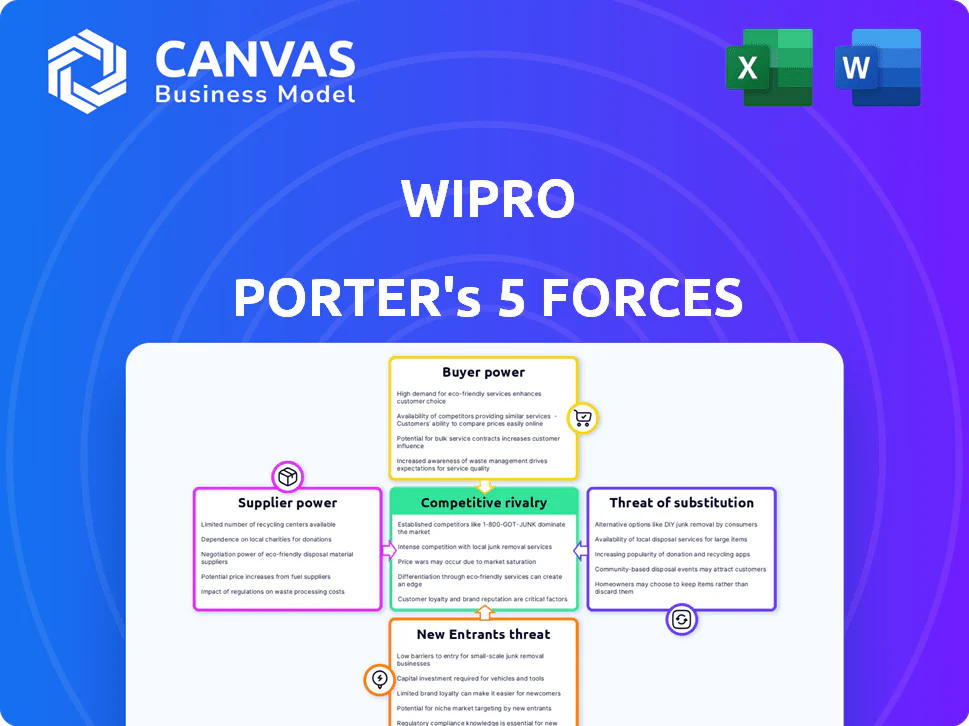
WIPRO PORTER'S FIVE FORCES TEMPLATE RESEARCH

A Must-Have Tool for Decision-Makers
Wipro faces moderate buyer power, evolving tech substitutes, and intense rivalry from global IT players, while supplier and entrant threats remain manageable-this snapshot highlights pressures on margins and strategic levers for growth.
Suppliers Bargaining Power

Global Talent Scarcity in AI
Wipro's primary suppliers are skilled professionals; by FY2025 attrition for tech roles hit ~22% and global GenAI/cybersecurity salaries rose ~18% YoY, forcing Wipro to pay premiums that compressed operating margin by an estimated 120-150 bps.
Hyperscale Cloud Provider Dominance
Wipro relies heavily on Microsoft Azure, AWS, and Google Cloud for infrastructure; as of FY2025 Wipro reported 28% revenue from cloud-led deals, tying its delivery to hyperscalers' platforms and pricing.
These providers hold pricing power-AWS and Azure together control ~60% global IaaS/PaaS market (2025); platform fee changes or API shifts can raise Wipro's costs or force rework.
Wipro is a strategic partner but remains beholden to hyperscalers' updates and cost structures, exposing margins-cloud spend passed to clients rose ~12% YoY in enterprise contracts during 2024-25.

Specialized Software Licensing Costs
Third-party ERP, CRM, and security vendors form a critical input for Wipro's services; in FY2025 enterprise software spending rose 9% globally to $815 billion, tightening supplier leverage.
Most vendors use non-negotiable subscription pricing-SaaS median annual price increases hit 7.5% in 2025-limiting Wipro's bargaining room.
Higher license costs feed directly into Wipro's deal TCO; an average 7.5% license uplift would raise a $50m program's software line by $3.75m annually, pressuring margins.

Geopolitical Labor Market Shifts
Wipro's heavy reliance on India faces wage pressure: average IT salaries in Bengaluru rose ~11% in 2024, and attrition hit 21.4% in FY2025, forcing higher pay and hiring costs.
US firms' Global Capability Centers (GCCs) grew to ~1,200 in India by 2025, tightening the talent pool and raising retention spend for Wipro.
Higher recruitment and training lifted Wipro's SG&A per employee in FY2025, squeezing margins unless offset by pricing or automation.
- India IT avg salary +11% (2024)
- Wipro attrition 21.4% (FY2025)
- ~1,200 GCCs in India (2025)
- Rising SG&A per employee in FY2025
Hardware and Semiconductor Constraints
Wipro faces supply risk from hardware vendors like Dell Technologies and HPE; global server shipments fell 2.3% in 2025 H1 while NAND flash prices rose ~12% yoy, making component-driven capex swings likely and delaying data‑center rollouts.
Such semiconductor volatility and 2025 memory price increases compress margins and constrain Wipro's ability to offer fixed‑price infrastructure contracts.
- Server shipments down 2.3% (2025 H1)
- NAND flash price +12% yoy (2025)
- Higher capex risk; fixed‑price exposure limited
Supplier squeeze: labor, hyperscalers, SaaS and NAND tighten margins in 2025
Suppliers-talent, hyperscalers, and enterprise software/hardware vendors-wield significant pricing power: Wipro FY2025 attrition 21.4% and Bengaluru salaries +11% (2024) raised labor cost, hyperscalers (AWS+Azure ~60% IaaS/PaaS) tie delivery/pricing, SaaS price +7.5% (2025) and NAND +12% (2025) squeeze margins.
| Metric | Value (2025) |
|---|---|
| Wipro attrition | 21.4% |
| Bengaluru avg salary change | +11% (2024) |
| AWS+Azure IaaS/PaaS share | ~60% |
| SaaS price change | +7.5% |
| NAND price change | +12% yoy |
What is included in the product
 Detailed Word Document
Comprehensive Porter's Five Forces analysis tailored for Wipro, assessing competitive rivalry, buyer and supplier power, threat of new entrants and substitutes, and identifying disruptors and strategic levers that influence pricing, margins, and market positioning.

 Customizable Excel Spreadsheet
A concise, one-sheet Porter's Five Forces for Wipro-translate competitive pressures into clear actions for bid strategies, pricing, and partnership decisions.
Customers Bargaining Power

Consolidation of IT Spending
Large enterprise clients are consolidating vendors to cut costs and complexity; top 50 clients made up about 36% of Wipro Limited's FY2025 revenue of $11.3 billion, boosting client bargaining leverage.
This concentration forces Wipro to compete on price and differentiated services-Wipro reported a 4.8% margin compression in FY2025, reflecting pricing pressure.
When a few clients account for outsized spend, their contract terms and volumes can be renegotiated, increasing Wipro's exposure to demand shifts and term concessions.
Demand for Outcome-Based Pricing
By 2026, buyers prefer outcome-based pricing over time-and-materials; 62% of Wipro's largest clients (>$100M spend) demanded outcome contracts in FY2025, shifting revenue recognition and placing performance risk on Wipro.
Wipro only earns fees when KPIs-like a 15% cost reduction or 20% revenue lift-are met, exposing the firm to payout clawbacks; FY2025 incentive-adjusted revenue was $8.9B vs. $9.4B reported.
This trend shows high buyer sophistication and leverage: enterprise clients now negotiate average contract penalty clauses of 10-18% and push for variable pricing tied to EBITDA or process automation metrics.

Low Switching Costs for Digital Services
While Wipro's core ERP contracts remain sticky, many cloud-native digital projects are modular, letting clients switch providers with low friction; cloud services accounted for 38% of Wipro's FY2025 revenue (₹86,400 crore total revenue in FY2025), so Wipro must continually prove value to keep clients from rivals like Accenture (FY2025 revenue $67.8B) and Infosys (FY2025 revenue $18.7B).

Transparency of Market Pricing
The rise of third-party procurement consultants and benchmarking tools has driven pricing transparency in IT services; by 2025, clients reference benchmarks showing median cloud migration rates of 18-22% lower than 2022 bids, forcing Wipro to match market rates during renewals.
This real-time peer-pricing-often based on datasets covering 200+ deals-leaves Wipro minimal room to pad margins on AI and cloud contracts, squeezing renewal uplifts to single-digit percentage points.
- Clients use 200+ deal benchmarks
- Median cloud bid cuts 18-22%
- Renewal uplifts compressed to low single digits
Internalization of Tech Capabilities
Wipro faces weaker customer bargaining as top clients build internal IT teams; in 2025, 28% of its $11.5B revenue came from accounts pushing insourcing, shifting Wipro to maintenance and niche projects with lower margins.
When clients can self-deliver strategic work, Wipro loses pricing power and sees longer sales cycles for high-value deals; retention relies on specialized offerings and outcomes-based contracts.
- 28% of 2025 revenue tied to insourcing clients
- $11.5B FY2025 revenue
- Margin pressure from maintenance work
- Strategy: focus on niche IP and outcomes-based pricing
Wipro FY25: Top‑50 clients squeeze margins as cloud, insourcing cut renewal uplifts
Large clients drove bargaining power: top 50 made 36% of Wipro Limited's FY2025 $11.3B revenue, pushing price competition and outcomes-based deals; FY2025 margin fell 4.8% and incentive-adjusted revenue was $8.9B. Cloud (38% of FY2025 revenue) and benchmarking (200+ deals) compressed renewal uplifts to low single digits; 28% of FY2025 revenue faced insourcing risk.
| Metric | FY2025 |
|---|---|
| Revenue | $11.3B |
| Top‑50 client share | 36% |
| Incentive‑adjusted revenue | $8.9B |
| Cloud revenue | 38% |
| Margin compression | -4.8% |
| Insourcing exposure | 28% |
Full Version Awaits
Wipro Porter's Five Forces Analysis
This preview shows the exact Wipro Porter's Five Forces analysis you'll receive immediately after purchase-no placeholders, fully formatted and ready for download. The document is the final deliverable, professionally written and suitable for presentations or decision-making. No mockups or samples-what you see is what you get upon payment.

WIPRO PORTER'S FIVE FORCES TEMPLATE RESEARCH
A Must-Have Tool for Decision-Makers
Wipro faces moderate buyer power, evolving tech substitutes, and intense rivalry from global IT players, while supplier and entrant threats remain manageable-this snapshot highlights pressures on margins and strategic levers for growth.
Suppliers Bargaining Power
Global Talent Scarcity in AI
Wipro's primary suppliers are skilled professionals; by FY2025 attrition for tech roles hit ~22% and global GenAI/cybersecurity salaries rose ~18% YoY, forcing Wipro to pay premiums that compressed operating margin by an estimated 120-150 bps.
Hyperscale Cloud Provider Dominance
Wipro relies heavily on Microsoft Azure, AWS, and Google Cloud for infrastructure; as of FY2025 Wipro reported 28% revenue from cloud-led deals, tying its delivery to hyperscalers' platforms and pricing.
These providers hold pricing power-AWS and Azure together control ~60% global IaaS/PaaS market (2025); platform fee changes or API shifts can raise Wipro's costs or force rework.
Wipro is a strategic partner but remains beholden to hyperscalers' updates and cost structures, exposing margins-cloud spend passed to clients rose ~12% YoY in enterprise contracts during 2024-25.
Specialized Software Licensing Costs
Third-party ERP, CRM, and security vendors form a critical input for Wipro's services; in FY2025 enterprise software spending rose 9% globally to $815 billion, tightening supplier leverage.
Most vendors use non-negotiable subscription pricing-SaaS median annual price increases hit 7.5% in 2025-limiting Wipro's bargaining room.
Higher license costs feed directly into Wipro's deal TCO; an average 7.5% license uplift would raise a $50m program's software line by $3.75m annually, pressuring margins.
Geopolitical Labor Market Shifts
Wipro's heavy reliance on India faces wage pressure: average IT salaries in Bengaluru rose ~11% in 2024, and attrition hit 21.4% in FY2025, forcing higher pay and hiring costs.
US firms' Global Capability Centers (GCCs) grew to ~1,200 in India by 2025, tightening the talent pool and raising retention spend for Wipro.
Higher recruitment and training lifted Wipro's SG&A per employee in FY2025, squeezing margins unless offset by pricing or automation.
- India IT avg salary +11% (2024)
- Wipro attrition 21.4% (FY2025)
- ~1,200 GCCs in India (2025)
- Rising SG&A per employee in FY2025
Hardware and Semiconductor Constraints
Wipro faces supply risk from hardware vendors like Dell Technologies and HPE; global server shipments fell 2.3% in 2025 H1 while NAND flash prices rose ~12% yoy, making component-driven capex swings likely and delaying data‑center rollouts.
Such semiconductor volatility and 2025 memory price increases compress margins and constrain Wipro's ability to offer fixed‑price infrastructure contracts.
- Server shipments down 2.3% (2025 H1)
- NAND flash price +12% yoy (2025)
- Higher capex risk; fixed‑price exposure limited
Supplier squeeze: labor, hyperscalers, SaaS and NAND tighten margins in 2025
Suppliers-talent, hyperscalers, and enterprise software/hardware vendors-wield significant pricing power: Wipro FY2025 attrition 21.4% and Bengaluru salaries +11% (2024) raised labor cost, hyperscalers (AWS+Azure ~60% IaaS/PaaS) tie delivery/pricing, SaaS price +7.5% (2025) and NAND +12% (2025) squeeze margins.
| Metric | Value (2025) |
|---|---|
| Wipro attrition | 21.4% |
| Bengaluru avg salary change | +11% (2024) |
| AWS+Azure IaaS/PaaS share | ~60% |
| SaaS price change | +7.5% |
| NAND price change | +12% yoy |
What is included in the product
Detailed Word Document
Comprehensive Porter's Five Forces analysis tailored for Wipro, assessing competitive rivalry, buyer and supplier power, threat of new entrants and substitutes, and identifying disruptors and strategic levers that influence pricing, margins, and market positioning.
Customizable Excel Spreadsheet
A concise, one-sheet Porter's Five Forces for Wipro-translate competitive pressures into clear actions for bid strategies, pricing, and partnership decisions.
Customers Bargaining Power
Consolidation of IT Spending
Large enterprise clients are consolidating vendors to cut costs and complexity; top 50 clients made up about 36% of Wipro Limited's FY2025 revenue of $11.3 billion, boosting client bargaining leverage.
This concentration forces Wipro to compete on price and differentiated services-Wipro reported a 4.8% margin compression in FY2025, reflecting pricing pressure.
When a few clients account for outsized spend, their contract terms and volumes can be renegotiated, increasing Wipro's exposure to demand shifts and term concessions.
Demand for Outcome-Based Pricing
By 2026, buyers prefer outcome-based pricing over time-and-materials; 62% of Wipro's largest clients (>$100M spend) demanded outcome contracts in FY2025, shifting revenue recognition and placing performance risk on Wipro.
Wipro only earns fees when KPIs-like a 15% cost reduction or 20% revenue lift-are met, exposing the firm to payout clawbacks; FY2025 incentive-adjusted revenue was $8.9B vs. $9.4B reported.
This trend shows high buyer sophistication and leverage: enterprise clients now negotiate average contract penalty clauses of 10-18% and push for variable pricing tied to EBITDA or process automation metrics.
Low Switching Costs for Digital Services
While Wipro's core ERP contracts remain sticky, many cloud-native digital projects are modular, letting clients switch providers with low friction; cloud services accounted for 38% of Wipro's FY2025 revenue (₹86,400 crore total revenue in FY2025), so Wipro must continually prove value to keep clients from rivals like Accenture (FY2025 revenue $67.8B) and Infosys (FY2025 revenue $18.7B).
Transparency of Market Pricing
The rise of third-party procurement consultants and benchmarking tools has driven pricing transparency in IT services; by 2025, clients reference benchmarks showing median cloud migration rates of 18-22% lower than 2022 bids, forcing Wipro to match market rates during renewals.
This real-time peer-pricing-often based on datasets covering 200+ deals-leaves Wipro minimal room to pad margins on AI and cloud contracts, squeezing renewal uplifts to single-digit percentage points.
- Clients use 200+ deal benchmarks
- Median cloud bid cuts 18-22%
- Renewal uplifts compressed to low single digits
Internalization of Tech Capabilities
Wipro faces weaker customer bargaining as top clients build internal IT teams; in 2025, 28% of its $11.5B revenue came from accounts pushing insourcing, shifting Wipro to maintenance and niche projects with lower margins.
When clients can self-deliver strategic work, Wipro loses pricing power and sees longer sales cycles for high-value deals; retention relies on specialized offerings and outcomes-based contracts.
- 28% of 2025 revenue tied to insourcing clients
- $11.5B FY2025 revenue
- Margin pressure from maintenance work
- Strategy: focus on niche IP and outcomes-based pricing
Wipro FY25: Top‑50 clients squeeze margins as cloud, insourcing cut renewal uplifts
Large clients drove bargaining power: top 50 made 36% of Wipro Limited's FY2025 $11.3B revenue, pushing price competition and outcomes-based deals; FY2025 margin fell 4.8% and incentive-adjusted revenue was $8.9B. Cloud (38% of FY2025 revenue) and benchmarking (200+ deals) compressed renewal uplifts to low single digits; 28% of FY2025 revenue faced insourcing risk.
| Metric | FY2025 |
|---|---|
| Revenue | $11.3B |
| Top‑50 client share | 36% |
| Incentive‑adjusted revenue | $8.9B |
| Cloud revenue | 38% |
| Margin compression | -4.8% |
| Insourcing exposure | 28% |
Full Version Awaits
Wipro Porter's Five Forces Analysis
This preview shows the exact Wipro Porter's Five Forces analysis you'll receive immediately after purchase-no placeholders, fully formatted and ready for download. The document is the final deliverable, professionally written and suitable for presentations or decision-making. No mockups or samples-what you see is what you get upon payment.
Product Information
Product Information
Shipping & Returns
Shipping & Returns
Description
A Must-Have Tool for Decision-Makers
Wipro faces moderate buyer power, evolving tech substitutes, and intense rivalry from global IT players, while supplier and entrant threats remain manageable-this snapshot highlights pressures on margins and strategic levers for growth.
Suppliers Bargaining Power
Global Talent Scarcity in AI
Wipro's primary suppliers are skilled professionals; by FY2025 attrition for tech roles hit ~22% and global GenAI/cybersecurity salaries rose ~18% YoY, forcing Wipro to pay premiums that compressed operating margin by an estimated 120-150 bps.
Hyperscale Cloud Provider Dominance
Wipro relies heavily on Microsoft Azure, AWS, and Google Cloud for infrastructure; as of FY2025 Wipro reported 28% revenue from cloud-led deals, tying its delivery to hyperscalers' platforms and pricing.
These providers hold pricing power-AWS and Azure together control ~60% global IaaS/PaaS market (2025); platform fee changes or API shifts can raise Wipro's costs or force rework.
Wipro is a strategic partner but remains beholden to hyperscalers' updates and cost structures, exposing margins-cloud spend passed to clients rose ~12% YoY in enterprise contracts during 2024-25.
Specialized Software Licensing Costs
Third-party ERP, CRM, and security vendors form a critical input for Wipro's services; in FY2025 enterprise software spending rose 9% globally to $815 billion, tightening supplier leverage.
Most vendors use non-negotiable subscription pricing-SaaS median annual price increases hit 7.5% in 2025-limiting Wipro's bargaining room.
Higher license costs feed directly into Wipro's deal TCO; an average 7.5% license uplift would raise a $50m program's software line by $3.75m annually, pressuring margins.
Geopolitical Labor Market Shifts
Wipro's heavy reliance on India faces wage pressure: average IT salaries in Bengaluru rose ~11% in 2024, and attrition hit 21.4% in FY2025, forcing higher pay and hiring costs.
US firms' Global Capability Centers (GCCs) grew to ~1,200 in India by 2025, tightening the talent pool and raising retention spend for Wipro.
Higher recruitment and training lifted Wipro's SG&A per employee in FY2025, squeezing margins unless offset by pricing or automation.
- India IT avg salary +11% (2024)
- Wipro attrition 21.4% (FY2025)
- ~1,200 GCCs in India (2025)
- Rising SG&A per employee in FY2025
Hardware and Semiconductor Constraints
Wipro faces supply risk from hardware vendors like Dell Technologies and HPE; global server shipments fell 2.3% in 2025 H1 while NAND flash prices rose ~12% yoy, making component-driven capex swings likely and delaying data‑center rollouts.
Such semiconductor volatility and 2025 memory price increases compress margins and constrain Wipro's ability to offer fixed‑price infrastructure contracts.
- Server shipments down 2.3% (2025 H1)
- NAND flash price +12% yoy (2025)
- Higher capex risk; fixed‑price exposure limited
Supplier squeeze: labor, hyperscalers, SaaS and NAND tighten margins in 2025
Suppliers-talent, hyperscalers, and enterprise software/hardware vendors-wield significant pricing power: Wipro FY2025 attrition 21.4% and Bengaluru salaries +11% (2024) raised labor cost, hyperscalers (AWS+Azure ~60% IaaS/PaaS) tie delivery/pricing, SaaS price +7.5% (2025) and NAND +12% (2025) squeeze margins.
| Metric | Value (2025) |
|---|---|
| Wipro attrition | 21.4% |
| Bengaluru avg salary change | +11% (2024) |
| AWS+Azure IaaS/PaaS share | ~60% |
| SaaS price change | +7.5% |
| NAND price change | +12% yoy |
What is included in the product
Detailed Word Document
Comprehensive Porter's Five Forces analysis tailored for Wipro, assessing competitive rivalry, buyer and supplier power, threat of new entrants and substitutes, and identifying disruptors and strategic levers that influence pricing, margins, and market positioning.
Customizable Excel Spreadsheet
A concise, one-sheet Porter's Five Forces for Wipro-translate competitive pressures into clear actions for bid strategies, pricing, and partnership decisions.
Customers Bargaining Power
Consolidation of IT Spending
Large enterprise clients are consolidating vendors to cut costs and complexity; top 50 clients made up about 36% of Wipro Limited's FY2025 revenue of $11.3 billion, boosting client bargaining leverage.
This concentration forces Wipro to compete on price and differentiated services-Wipro reported a 4.8% margin compression in FY2025, reflecting pricing pressure.
When a few clients account for outsized spend, their contract terms and volumes can be renegotiated, increasing Wipro's exposure to demand shifts and term concessions.
Demand for Outcome-Based Pricing
By 2026, buyers prefer outcome-based pricing over time-and-materials; 62% of Wipro's largest clients (>$100M spend) demanded outcome contracts in FY2025, shifting revenue recognition and placing performance risk on Wipro.
Wipro only earns fees when KPIs-like a 15% cost reduction or 20% revenue lift-are met, exposing the firm to payout clawbacks; FY2025 incentive-adjusted revenue was $8.9B vs. $9.4B reported.
This trend shows high buyer sophistication and leverage: enterprise clients now negotiate average contract penalty clauses of 10-18% and push for variable pricing tied to EBITDA or process automation metrics.
Low Switching Costs for Digital Services
While Wipro's core ERP contracts remain sticky, many cloud-native digital projects are modular, letting clients switch providers with low friction; cloud services accounted for 38% of Wipro's FY2025 revenue (₹86,400 crore total revenue in FY2025), so Wipro must continually prove value to keep clients from rivals like Accenture (FY2025 revenue $67.8B) and Infosys (FY2025 revenue $18.7B).
Transparency of Market Pricing
The rise of third-party procurement consultants and benchmarking tools has driven pricing transparency in IT services; by 2025, clients reference benchmarks showing median cloud migration rates of 18-22% lower than 2022 bids, forcing Wipro to match market rates during renewals.
This real-time peer-pricing-often based on datasets covering 200+ deals-leaves Wipro minimal room to pad margins on AI and cloud contracts, squeezing renewal uplifts to single-digit percentage points.
- Clients use 200+ deal benchmarks
- Median cloud bid cuts 18-22%
- Renewal uplifts compressed to low single digits
Internalization of Tech Capabilities
Wipro faces weaker customer bargaining as top clients build internal IT teams; in 2025, 28% of its $11.5B revenue came from accounts pushing insourcing, shifting Wipro to maintenance and niche projects with lower margins.
When clients can self-deliver strategic work, Wipro loses pricing power and sees longer sales cycles for high-value deals; retention relies on specialized offerings and outcomes-based contracts.
- 28% of 2025 revenue tied to insourcing clients
- $11.5B FY2025 revenue
- Margin pressure from maintenance work
- Strategy: focus on niche IP and outcomes-based pricing
Wipro FY25: Top‑50 clients squeeze margins as cloud, insourcing cut renewal uplifts
Large clients drove bargaining power: top 50 made 36% of Wipro Limited's FY2025 $11.3B revenue, pushing price competition and outcomes-based deals; FY2025 margin fell 4.8% and incentive-adjusted revenue was $8.9B. Cloud (38% of FY2025 revenue) and benchmarking (200+ deals) compressed renewal uplifts to low single digits; 28% of FY2025 revenue faced insourcing risk.
| Metric | FY2025 |
|---|---|
| Revenue | $11.3B |
| Top‑50 client share | 36% |
| Incentive‑adjusted revenue | $8.9B |
| Cloud revenue | 38% |
| Margin compression | -4.8% |
| Insourcing exposure | 28% |
Full Version Awaits
Wipro Porter's Five Forces Analysis
This preview shows the exact Wipro Porter's Five Forces analysis you'll receive immediately after purchase-no placeholders, fully formatted and ready for download. The document is the final deliverable, professionally written and suitable for presentations or decision-making. No mockups or samples-what you see is what you get upon payment.











