WIZ FREIGHT PORTER'S FIVE FORCES TEMPLATE RESEARCH
What is included in the product
 Detailed Word Document
Tailored exclusively for Wiz Freight, analyzing its position within its competitive landscape.

 Customizable Excel Spreadsheet
Customize pressure levels based on new data or evolving market trends.
Preview the Actual Deliverable
Wiz Freight Porter's Five Forces Analysis
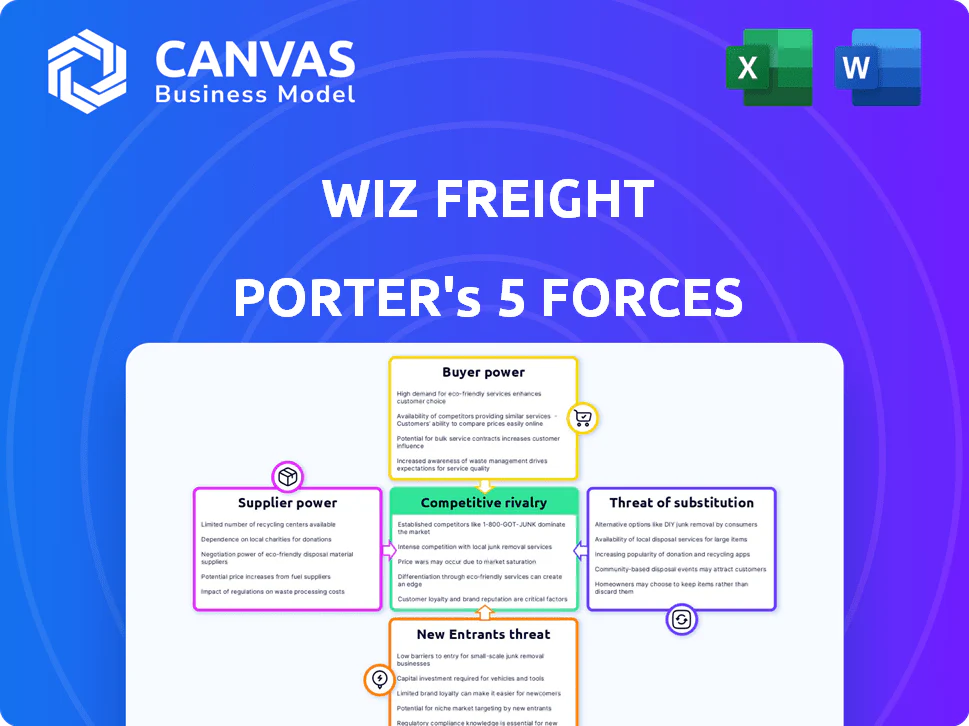
This preview reveals the exact Wiz Freight Porter's Five Forces analysis you will receive. This detailed assessment covers all five forces, examining industry competition, and buyer/supplier power. It presents a thorough market analysis for informed decision-making. The document is ready to download and use immediately after your purchase.

Porter's Five Forces Analysis Template

Elevate Your Analysis with the Complete Porter's Five Forces Analysis
Wiz Freight operates within a competitive logistics landscape. The bargaining power of buyers, including large enterprises, significantly impacts profitability. Supplier power, particularly from shipping lines, also presents a challenge. The threat of new entrants, especially tech-driven logistics startups, is moderate. Substitutes like alternative transportation modes exist. Competitive rivalry among established freight forwarders is intense.
Ready to move beyond the basics? Get a full strategic breakdown of Wiz Freight’s market position, competitive intensity, and external threats—all in one powerful analysis.
Suppliers Bargaining Power

Concentration of Suppliers
In the freight forwarding sector, including digital platforms like Wiz Freight, the bargaining power of suppliers is substantial. This power stems from the concentration of major carriers in air, ocean, and road transport. For instance, in 2024, the top 10 ocean carriers controlled over 85% of global container capacity, providing them with significant leverage over pricing and service terms.
Switching Costs for Freight Forwarders
Switching freight carriers is tough for forwarders. They often have long-term relationships, and integrated systems are in place. Contractual agreements and the lack of easily transferable data add to the complexity. A 2024 report showed that switching costs can be up to 15% of a company's annual logistics budget.

Control over Pricing and Service Terms
Large freight carriers, like Maersk and MSC, control pricing. In 2024, these giants managed over 30% of global container capacity, influencing costs. They set service terms, affecting forwarders. This impacts Wiz Freight's cost structure.

Specialized Services
Specialized freight services can give suppliers more power. This is because forwarders and clients often need unique solutions for tricky logistics. The global specialized freight market was valued at $1.25 trillion in 2024. It is expected to reach $1.75 trillion by 2029.
- Custom solutions command higher prices.
- Few suppliers mean less choice for buyers.
- Switching costs can be significant.
- Suppliers can control key technologies.
Forward Integration Potential
Forward integration allows suppliers, like large carriers, to offer direct logistics services, increasing their power. This could let them bypass freight forwarders. Recent data shows the global freight forwarding market was valued at $180 billion in 2024. This shift could reshape market dynamics.
- Direct services could increase carrier revenue.
- Freight forwarders might face increased competition.
- Market consolidation could accelerate.
- Customer relationships could change.
Freight Forwarding: Power Dynamics & Costs
Suppliers, like major carriers, hold significant bargaining power in the freight forwarding industry. This stems from market concentration; for instance, the top 10 ocean carriers controlled over 85% of global container capacity in 2024. Switching carriers is costly, with expenses potentially reaching up to 15% of a company's annual logistics budget.
| Aspect | Details |
|---|---|
| Market Concentration | Top 10 ocean carriers control over 85% of global container capacity (2024) |
| Switching Costs | Can be up to 15% of annual logistics budget (2024) |
| Specialized Freight Market | Valued at $1.25 trillion in 2024, expected to reach $1.75 trillion by 2029 |
Customers Bargaining Power

Availability of Multiple Forwarders
Customers now easily compare freight forwarders due to online platforms, boosting price transparency and competition. This shift gives clients more negotiating power. For example, in 2024, the digital freight forwarding market saw over $20 billion in transactions globally. This allows customers to choose based on price and service, increasing their leverage. This increased choice directly impacts forwarders' pricing strategies and profit margins.
Large Volume Customers
Large customers, like major retailers or manufacturers, wield substantial bargaining power due to their high-volume freight needs. They can secure favorable rates and terms, squeezing margins for companies like Wiz Freight. For instance, in 2024, large retailers saw an average of 7% decrease in freight costs due to strong negotiation. This pressure impacts profitability, especially for forwarders heavily reliant on these key accounts.

Price Sensitivity
Customers' bargaining power is amplified by pricing transparency, especially online. This heightened awareness compels freight forwarders to provide competitive rates. For example, in 2024, the average shipping cost decreased by 7% due to increased competition and price comparison tools. This dynamic directly impacts profitability, as forwarders must balance competitive pricing with operational costs.

Customization of Services
Customers' ability to demand customized logistics solutions significantly impacts their bargaining power. The freight forwarders' capacity to tailor services is crucial for attracting and retaining clients. Companies like Flexport and Maersk are investing heavily in technology to personalize services. In 2024, the demand for customized freight solutions rose by 15%.
- Customized solutions increase customer control.
- Technology plays a key role in offering tailored services.
- Freight forwarders' adaptability is vital.
- Personalization can drive customer loyalty.
Low Switching Costs for Customers
Customers in the freight forwarding industry often have low switching costs, making it easier to move between providers. Digital platforms have simplified the process, increasing the ease with which customers can compare and switch services. This dynamic affects the bargaining power, as customers can quickly shift to competitors if they are not satisfied. The market is competitive, with no single player dominating, which further enhances customer flexibility. For example, in 2024, the average contract duration in the freight forwarding sector was about 12 months, reflecting this flexibility.
- Digitalization has lowered switching costs.
- Competitive market offers alternatives.
- Short contract durations enhance flexibility.
- Customer satisfaction is key for retention.
Freight Forwarding: Customer Power Dynamics
Customers' bargaining power is significant due to price transparency and online tools, leading to increased competition. Large customers leverage high-volume needs for favorable rates, impacting forwarders' margins. The ease of switching providers, amplified by digital platforms, further strengthens customer influence. In 2024, the digital freight forwarding market reached $20B globally.
| Factor | Impact | 2024 Data |
|---|---|---|
| Price Transparency | Increased competition | 7% average shipping cost decrease |
| Customer Volume | Favorable rates | 7% freight cost reduction for large retailers |
| Switching Costs | Enhanced flexibility | 12-month average contract duration |
Rivalry Among Competitors

Numerous Competitors
The freight forwarding industry is very competitive with many companies. This includes small and big players, like traditional forwarders and digital ones. Wiz Freight competes in this environment. In 2024, the global freight forwarding market size was valued at $200 billion.
Price and Service Competition
Competitive rivalry at Wiz Freight is fierce, primarily revolving around price and service quality. Digital platforms boost transparency, intensifying price wars. Wiz Freight competes with established players and startups, focusing on competitive pricing and diverse service offerings. The industry's revenue in 2024 was approximately $300 billion, showing intense competition.

Differentiation
Differentiation in freight services is present but limited. Specialized services or tech offer some edge, yet core goods movement is often commoditized. This leads to fierce price wars, especially impacting margins. For instance, the global freight market, valued at $14.6 trillion in 2024, sees constant price pressure.

Technological Advancements
Technological advancements are intensifying competition in freight forwarding. Wiz Freight competes by integrating AI, blockchain, and IoT. These technologies boost visibility and efficiency. The global freight and logistics market was valued at $10.8 trillion in 2023. Companies are investing heavily in tech.
- Wiz Freight uses tech in its core offerings.
- AI improves predictive capabilities.
- Blockchain enhances security in shipping.
- IoT provides real-time tracking.
Market Growth and Expansion
The digital freight forwarding market is rapidly growing, drawing in new competitors and prompting existing ones to broaden their services and global presence, thus escalating rivalry. Wiz Freight, for example, is actively pursuing global expansion, intensifying competition in various regions. The increasing market size, projected to reach $26.9 billion by 2028, fuels this expansion and rivalry. This growth is driven by the rising demand for efficient and transparent logistics solutions. The market's competitive landscape is becoming increasingly dynamic, with companies vying for market share and customer loyalty.
- Market size is projected to reach $26.9 billion by 2028.
- Wiz Freight is expanding globally.
- Increased competition due to market growth.
- Demand for efficient logistics solutions is rising.
Freight Forwarding: A $14.6T Battleground
Competitive rivalry in freight forwarding is high, driven by numerous players and price pressures. Digital platforms increase transparency, intensifying price wars. Wiz Freight battles established firms and startups, focusing on competitive pricing and diverse services. The global freight market was $14.6 trillion in 2024.
| Aspect | Details | Data (2024) |
|---|---|---|
| Market Size | Global Freight Market | $14.6 trillion |
| Market Growth | Digital Freight Market | Projected to $26.9B by 2028 |
| Competition | Intense, Price-driven | Numerous Players |
WIZ FREIGHT PORTER'S FIVE FORCES TEMPLATE RESEARCH
What is included in the product
Detailed Word Document
Tailored exclusively for Wiz Freight, analyzing its position within its competitive landscape.
Customizable Excel Spreadsheet
Customize pressure levels based on new data or evolving market trends.
Preview the Actual Deliverable
Wiz Freight Porter's Five Forces Analysis
This preview reveals the exact Wiz Freight Porter's Five Forces analysis you will receive. This detailed assessment covers all five forces, examining industry competition, and buyer/supplier power. It presents a thorough market analysis for informed decision-making. The document is ready to download and use immediately after your purchase.
Porter's Five Forces Analysis Template
Elevate Your Analysis with the Complete Porter's Five Forces Analysis
Wiz Freight operates within a competitive logistics landscape. The bargaining power of buyers, including large enterprises, significantly impacts profitability. Supplier power, particularly from shipping lines, also presents a challenge. The threat of new entrants, especially tech-driven logistics startups, is moderate. Substitutes like alternative transportation modes exist. Competitive rivalry among established freight forwarders is intense.
Ready to move beyond the basics? Get a full strategic breakdown of Wiz Freight’s market position, competitive intensity, and external threats—all in one powerful analysis.
Suppliers Bargaining Power
Concentration of Suppliers
In the freight forwarding sector, including digital platforms like Wiz Freight, the bargaining power of suppliers is substantial. This power stems from the concentration of major carriers in air, ocean, and road transport. For instance, in 2024, the top 10 ocean carriers controlled over 85% of global container capacity, providing them with significant leverage over pricing and service terms.
Switching Costs for Freight Forwarders
Switching freight carriers is tough for forwarders. They often have long-term relationships, and integrated systems are in place. Contractual agreements and the lack of easily transferable data add to the complexity. A 2024 report showed that switching costs can be up to 15% of a company's annual logistics budget.
Control over Pricing and Service Terms
Large freight carriers, like Maersk and MSC, control pricing. In 2024, these giants managed over 30% of global container capacity, influencing costs. They set service terms, affecting forwarders. This impacts Wiz Freight's cost structure.
Specialized Services
Specialized freight services can give suppliers more power. This is because forwarders and clients often need unique solutions for tricky logistics. The global specialized freight market was valued at $1.25 trillion in 2024. It is expected to reach $1.75 trillion by 2029.
- Custom solutions command higher prices.
- Few suppliers mean less choice for buyers.
- Switching costs can be significant.
- Suppliers can control key technologies.
Forward Integration Potential
Forward integration allows suppliers, like large carriers, to offer direct logistics services, increasing their power. This could let them bypass freight forwarders. Recent data shows the global freight forwarding market was valued at $180 billion in 2024. This shift could reshape market dynamics.
- Direct services could increase carrier revenue.
- Freight forwarders might face increased competition.
- Market consolidation could accelerate.
- Customer relationships could change.
Freight Forwarding: Power Dynamics & Costs
Suppliers, like major carriers, hold significant bargaining power in the freight forwarding industry. This stems from market concentration; for instance, the top 10 ocean carriers controlled over 85% of global container capacity in 2024. Switching carriers is costly, with expenses potentially reaching up to 15% of a company's annual logistics budget.
| Aspect | Details |
|---|---|
| Market Concentration | Top 10 ocean carriers control over 85% of global container capacity (2024) |
| Switching Costs | Can be up to 15% of annual logistics budget (2024) |
| Specialized Freight Market | Valued at $1.25 trillion in 2024, expected to reach $1.75 trillion by 2029 |
Customers Bargaining Power
Availability of Multiple Forwarders
Customers now easily compare freight forwarders due to online platforms, boosting price transparency and competition. This shift gives clients more negotiating power. For example, in 2024, the digital freight forwarding market saw over $20 billion in transactions globally. This allows customers to choose based on price and service, increasing their leverage. This increased choice directly impacts forwarders' pricing strategies and profit margins.
Large Volume Customers
Large customers, like major retailers or manufacturers, wield substantial bargaining power due to their high-volume freight needs. They can secure favorable rates and terms, squeezing margins for companies like Wiz Freight. For instance, in 2024, large retailers saw an average of 7% decrease in freight costs due to strong negotiation. This pressure impacts profitability, especially for forwarders heavily reliant on these key accounts.
Price Sensitivity
Customers' bargaining power is amplified by pricing transparency, especially online. This heightened awareness compels freight forwarders to provide competitive rates. For example, in 2024, the average shipping cost decreased by 7% due to increased competition and price comparison tools. This dynamic directly impacts profitability, as forwarders must balance competitive pricing with operational costs.
Customization of Services
Customers' ability to demand customized logistics solutions significantly impacts their bargaining power. The freight forwarders' capacity to tailor services is crucial for attracting and retaining clients. Companies like Flexport and Maersk are investing heavily in technology to personalize services. In 2024, the demand for customized freight solutions rose by 15%.
- Customized solutions increase customer control.
- Technology plays a key role in offering tailored services.
- Freight forwarders' adaptability is vital.
- Personalization can drive customer loyalty.
Low Switching Costs for Customers
Customers in the freight forwarding industry often have low switching costs, making it easier to move between providers. Digital platforms have simplified the process, increasing the ease with which customers can compare and switch services. This dynamic affects the bargaining power, as customers can quickly shift to competitors if they are not satisfied. The market is competitive, with no single player dominating, which further enhances customer flexibility. For example, in 2024, the average contract duration in the freight forwarding sector was about 12 months, reflecting this flexibility.
- Digitalization has lowered switching costs.
- Competitive market offers alternatives.
- Short contract durations enhance flexibility.
- Customer satisfaction is key for retention.
Freight Forwarding: Customer Power Dynamics
Customers' bargaining power is significant due to price transparency and online tools, leading to increased competition. Large customers leverage high-volume needs for favorable rates, impacting forwarders' margins. The ease of switching providers, amplified by digital platforms, further strengthens customer influence. In 2024, the digital freight forwarding market reached $20B globally.
| Factor | Impact | 2024 Data |
|---|---|---|
| Price Transparency | Increased competition | 7% average shipping cost decrease |
| Customer Volume | Favorable rates | 7% freight cost reduction for large retailers |
| Switching Costs | Enhanced flexibility | 12-month average contract duration |
Rivalry Among Competitors
Numerous Competitors
The freight forwarding industry is very competitive with many companies. This includes small and big players, like traditional forwarders and digital ones. Wiz Freight competes in this environment. In 2024, the global freight forwarding market size was valued at $200 billion.
Price and Service Competition
Competitive rivalry at Wiz Freight is fierce, primarily revolving around price and service quality. Digital platforms boost transparency, intensifying price wars. Wiz Freight competes with established players and startups, focusing on competitive pricing and diverse service offerings. The industry's revenue in 2024 was approximately $300 billion, showing intense competition.
Differentiation
Differentiation in freight services is present but limited. Specialized services or tech offer some edge, yet core goods movement is often commoditized. This leads to fierce price wars, especially impacting margins. For instance, the global freight market, valued at $14.6 trillion in 2024, sees constant price pressure.
Technological Advancements
Technological advancements are intensifying competition in freight forwarding. Wiz Freight competes by integrating AI, blockchain, and IoT. These technologies boost visibility and efficiency. The global freight and logistics market was valued at $10.8 trillion in 2023. Companies are investing heavily in tech.
- Wiz Freight uses tech in its core offerings.
- AI improves predictive capabilities.
- Blockchain enhances security in shipping.
- IoT provides real-time tracking.
Market Growth and Expansion
The digital freight forwarding market is rapidly growing, drawing in new competitors and prompting existing ones to broaden their services and global presence, thus escalating rivalry. Wiz Freight, for example, is actively pursuing global expansion, intensifying competition in various regions. The increasing market size, projected to reach $26.9 billion by 2028, fuels this expansion and rivalry. This growth is driven by the rising demand for efficient and transparent logistics solutions. The market's competitive landscape is becoming increasingly dynamic, with companies vying for market share and customer loyalty.
- Market size is projected to reach $26.9 billion by 2028.
- Wiz Freight is expanding globally.
- Increased competition due to market growth.
- Demand for efficient logistics solutions is rising.
Freight Forwarding: A $14.6T Battleground
Competitive rivalry in freight forwarding is high, driven by numerous players and price pressures. Digital platforms increase transparency, intensifying price wars. Wiz Freight battles established firms and startups, focusing on competitive pricing and diverse services. The global freight market was $14.6 trillion in 2024.
| Aspect | Details | Data (2024) |
|---|---|---|
| Market Size | Global Freight Market | $14.6 trillion |
| Market Growth | Digital Freight Market | Projected to $26.9B by 2028 |
| Competition | Intense, Price-driven | Numerous Players |
Product Information
Product Information
Shipping & Returns
Shipping & Returns
Description
What is included in the product
Detailed Word Document
Tailored exclusively for Wiz Freight, analyzing its position within its competitive landscape.
Customizable Excel Spreadsheet
Customize pressure levels based on new data or evolving market trends.
Preview the Actual Deliverable
Wiz Freight Porter's Five Forces Analysis
This preview reveals the exact Wiz Freight Porter's Five Forces analysis you will receive. This detailed assessment covers all five forces, examining industry competition, and buyer/supplier power. It presents a thorough market analysis for informed decision-making. The document is ready to download and use immediately after your purchase.
Porter's Five Forces Analysis Template
Elevate Your Analysis with the Complete Porter's Five Forces Analysis
Wiz Freight operates within a competitive logistics landscape. The bargaining power of buyers, including large enterprises, significantly impacts profitability. Supplier power, particularly from shipping lines, also presents a challenge. The threat of new entrants, especially tech-driven logistics startups, is moderate. Substitutes like alternative transportation modes exist. Competitive rivalry among established freight forwarders is intense.
Ready to move beyond the basics? Get a full strategic breakdown of Wiz Freight’s market position, competitive intensity, and external threats—all in one powerful analysis.
Suppliers Bargaining Power
Concentration of Suppliers
In the freight forwarding sector, including digital platforms like Wiz Freight, the bargaining power of suppliers is substantial. This power stems from the concentration of major carriers in air, ocean, and road transport. For instance, in 2024, the top 10 ocean carriers controlled over 85% of global container capacity, providing them with significant leverage over pricing and service terms.
Switching Costs for Freight Forwarders
Switching freight carriers is tough for forwarders. They often have long-term relationships, and integrated systems are in place. Contractual agreements and the lack of easily transferable data add to the complexity. A 2024 report showed that switching costs can be up to 15% of a company's annual logistics budget.
Control over Pricing and Service Terms
Large freight carriers, like Maersk and MSC, control pricing. In 2024, these giants managed over 30% of global container capacity, influencing costs. They set service terms, affecting forwarders. This impacts Wiz Freight's cost structure.
Specialized Services
Specialized freight services can give suppliers more power. This is because forwarders and clients often need unique solutions for tricky logistics. The global specialized freight market was valued at $1.25 trillion in 2024. It is expected to reach $1.75 trillion by 2029.
- Custom solutions command higher prices.
- Few suppliers mean less choice for buyers.
- Switching costs can be significant.
- Suppliers can control key technologies.
Forward Integration Potential
Forward integration allows suppliers, like large carriers, to offer direct logistics services, increasing their power. This could let them bypass freight forwarders. Recent data shows the global freight forwarding market was valued at $180 billion in 2024. This shift could reshape market dynamics.
- Direct services could increase carrier revenue.
- Freight forwarders might face increased competition.
- Market consolidation could accelerate.
- Customer relationships could change.
Freight Forwarding: Power Dynamics & Costs
Suppliers, like major carriers, hold significant bargaining power in the freight forwarding industry. This stems from market concentration; for instance, the top 10 ocean carriers controlled over 85% of global container capacity in 2024. Switching carriers is costly, with expenses potentially reaching up to 15% of a company's annual logistics budget.
| Aspect | Details |
|---|---|
| Market Concentration | Top 10 ocean carriers control over 85% of global container capacity (2024) |
| Switching Costs | Can be up to 15% of annual logistics budget (2024) |
| Specialized Freight Market | Valued at $1.25 trillion in 2024, expected to reach $1.75 trillion by 2029 |
Customers Bargaining Power
Availability of Multiple Forwarders
Customers now easily compare freight forwarders due to online platforms, boosting price transparency and competition. This shift gives clients more negotiating power. For example, in 2024, the digital freight forwarding market saw over $20 billion in transactions globally. This allows customers to choose based on price and service, increasing their leverage. This increased choice directly impacts forwarders' pricing strategies and profit margins.
Large Volume Customers
Large customers, like major retailers or manufacturers, wield substantial bargaining power due to their high-volume freight needs. They can secure favorable rates and terms, squeezing margins for companies like Wiz Freight. For instance, in 2024, large retailers saw an average of 7% decrease in freight costs due to strong negotiation. This pressure impacts profitability, especially for forwarders heavily reliant on these key accounts.
Price Sensitivity
Customers' bargaining power is amplified by pricing transparency, especially online. This heightened awareness compels freight forwarders to provide competitive rates. For example, in 2024, the average shipping cost decreased by 7% due to increased competition and price comparison tools. This dynamic directly impacts profitability, as forwarders must balance competitive pricing with operational costs.
Customization of Services
Customers' ability to demand customized logistics solutions significantly impacts their bargaining power. The freight forwarders' capacity to tailor services is crucial for attracting and retaining clients. Companies like Flexport and Maersk are investing heavily in technology to personalize services. In 2024, the demand for customized freight solutions rose by 15%.
- Customized solutions increase customer control.
- Technology plays a key role in offering tailored services.
- Freight forwarders' adaptability is vital.
- Personalization can drive customer loyalty.
Low Switching Costs for Customers
Customers in the freight forwarding industry often have low switching costs, making it easier to move between providers. Digital platforms have simplified the process, increasing the ease with which customers can compare and switch services. This dynamic affects the bargaining power, as customers can quickly shift to competitors if they are not satisfied. The market is competitive, with no single player dominating, which further enhances customer flexibility. For example, in 2024, the average contract duration in the freight forwarding sector was about 12 months, reflecting this flexibility.
- Digitalization has lowered switching costs.
- Competitive market offers alternatives.
- Short contract durations enhance flexibility.
- Customer satisfaction is key for retention.
Freight Forwarding: Customer Power Dynamics
Customers' bargaining power is significant due to price transparency and online tools, leading to increased competition. Large customers leverage high-volume needs for favorable rates, impacting forwarders' margins. The ease of switching providers, amplified by digital platforms, further strengthens customer influence. In 2024, the digital freight forwarding market reached $20B globally.
| Factor | Impact | 2024 Data |
|---|---|---|
| Price Transparency | Increased competition | 7% average shipping cost decrease |
| Customer Volume | Favorable rates | 7% freight cost reduction for large retailers |
| Switching Costs | Enhanced flexibility | 12-month average contract duration |
Rivalry Among Competitors
Numerous Competitors
The freight forwarding industry is very competitive with many companies. This includes small and big players, like traditional forwarders and digital ones. Wiz Freight competes in this environment. In 2024, the global freight forwarding market size was valued at $200 billion.
Price and Service Competition
Competitive rivalry at Wiz Freight is fierce, primarily revolving around price and service quality. Digital platforms boost transparency, intensifying price wars. Wiz Freight competes with established players and startups, focusing on competitive pricing and diverse service offerings. The industry's revenue in 2024 was approximately $300 billion, showing intense competition.
Differentiation
Differentiation in freight services is present but limited. Specialized services or tech offer some edge, yet core goods movement is often commoditized. This leads to fierce price wars, especially impacting margins. For instance, the global freight market, valued at $14.6 trillion in 2024, sees constant price pressure.
Technological Advancements
Technological advancements are intensifying competition in freight forwarding. Wiz Freight competes by integrating AI, blockchain, and IoT. These technologies boost visibility and efficiency. The global freight and logistics market was valued at $10.8 trillion in 2023. Companies are investing heavily in tech.
- Wiz Freight uses tech in its core offerings.
- AI improves predictive capabilities.
- Blockchain enhances security in shipping.
- IoT provides real-time tracking.
Market Growth and Expansion
The digital freight forwarding market is rapidly growing, drawing in new competitors and prompting existing ones to broaden their services and global presence, thus escalating rivalry. Wiz Freight, for example, is actively pursuing global expansion, intensifying competition in various regions. The increasing market size, projected to reach $26.9 billion by 2028, fuels this expansion and rivalry. This growth is driven by the rising demand for efficient and transparent logistics solutions. The market's competitive landscape is becoming increasingly dynamic, with companies vying for market share and customer loyalty.
- Market size is projected to reach $26.9 billion by 2028.
- Wiz Freight is expanding globally.
- Increased competition due to market growth.
- Demand for efficient logistics solutions is rising.
Freight Forwarding: A $14.6T Battleground
Competitive rivalry in freight forwarding is high, driven by numerous players and price pressures. Digital platforms increase transparency, intensifying price wars. Wiz Freight battles established firms and startups, focusing on competitive pricing and diverse services. The global freight market was $14.6 trillion in 2024.
| Aspect | Details | Data (2024) |
|---|---|---|
| Market Size | Global Freight Market | $14.6 trillion |
| Market Growth | Digital Freight Market | Projected to $26.9B by 2028 |
| Competition | Intense, Price-driven | Numerous Players |











