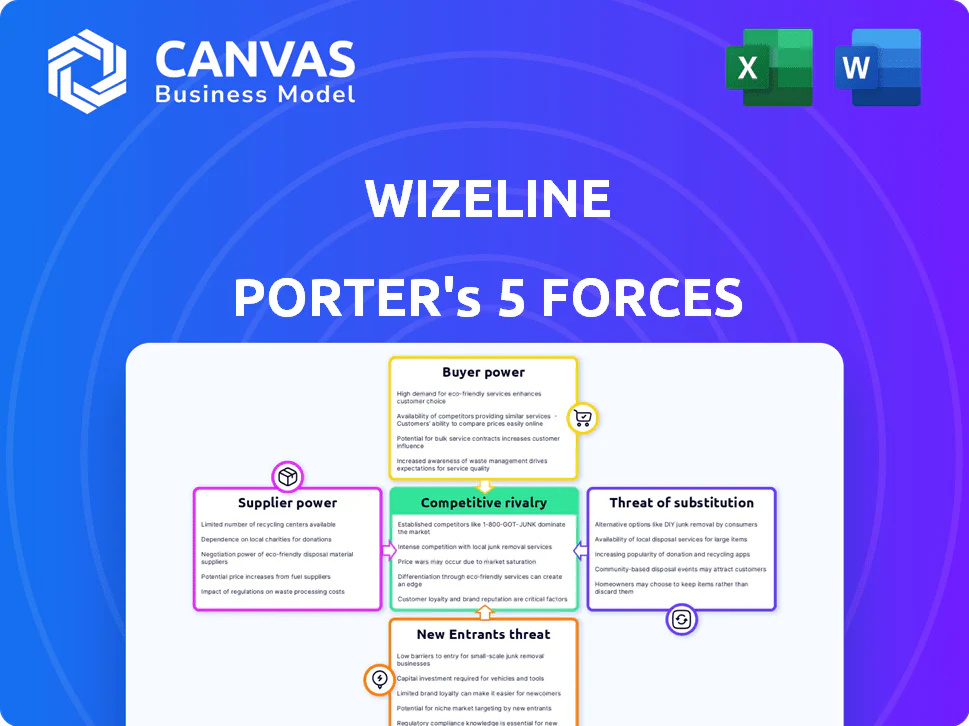
WIZELINE PORTER'S FIVE FORCES TEMPLATE RESEARCH
What is included in the product
 Detailed Word Document
Analyzes Wizeline's market position, considering competitive forces, buyer power, and new entry threats.

 Customizable Excel Spreadsheet
Instantly understand strategic pressure with a powerful spider/radar chart.
Preview the Actual Deliverable
Wizeline Porter's Five Forces Analysis
This preview showcases Wizeline's Porter's Five Forces analysis document in its entirety. The file you see is the precise, professionally-written analysis you'll download after purchase. This means no modifications or additional formatting are needed from your side. The document includes a comprehensive study of the competitive landscape, offering strategic insights. You will have instant access to this finished product immediately upon completing your order.

Porter's Five Forces Analysis Template

A Must-Have Tool for Decision-Makers
Wizeline's competitive landscape is shaped by powerful market forces. Buyer power, supplier influence, and the threat of new entrants significantly impact its strategy. Competitive rivalry and substitute products also create industry dynamics. This analysis provides a snapshot of these forces.
Ready to move beyond the basics? Get a full strategic breakdown of Wizeline’s market position, competitive intensity, and external threats—all in one powerful analysis.
Suppliers Bargaining Power

Availability of Skilled Talent
Wizeline's reliance on skilled tech professionals affects supplier power. Demand for product strategists, designers, engineers, and data scientists is high. In 2024, the average salary for data scientists in the US reached $120,000. This scarcity strengthens the bargaining position of potential employees and talent acquisition channels. The competition for talent impacts Wizeline's operational costs. It influences the company's ability to negotiate favorable terms with suppliers.
Technology and Software Providers
Wizeline, as a digital product developer, relies heavily on software and technology. Vendors offering crucial platforms and tools possess bargaining power, especially with unique or popular offerings. For example, in 2024, the software-as-a-service (SaaS) market reached $208 billion, indicating significant vendor influence. This power is amplified if switching costs are high.

Cloud Infrastructure Providers
Wizeline's reliance on cloud providers like AWS, GCP, and Azure puts them in a position where these suppliers wield considerable influence. The cloud market is concentrated; in Q4 2023, AWS held 31%, Azure 24%, and GCP 11% of the market. This concentration allows cloud providers to dictate pricing and service terms. For example, in 2024, AWS increased prices for some services.

Data and Analytics Tool Vendors
For Wizeline, which prioritizes data-driven solutions, the bargaining power of data analytics tool vendors is significant. These vendors, offering sophisticated and often exclusive tools, can exert considerable influence. The market for data analytics is booming, with a projected global market size of $231.4 billion in 2024, according to Statista. This growth strengthens suppliers' positions.
- Market Growth: The data analytics market is rapidly expanding.
- Tool Sophistication: Advanced tools increase supplier power.
- Vendor Influence: Key vendors can dictate terms.
- Exclusivity: Unique tools enhance supplier control.
Acquired Company's Influence
Wizeline's acquisition by CDPQ in 2021 significantly altered its supplier dynamics. CDPQ, as the parent company, wields considerable influence over resource allocation, strategic direction, and access to extensive networks. This influence can impact Wizeline's operations and its relationships with other suppliers. The shift in control introduces a new layer of bargaining power, potentially affecting Wizeline's cost structure and service delivery. Specifically, CDPQ's backing could influence the selection and negotiation with suppliers.
- CDPQ manages over $300 billion in net assets as of 2024.
- Wizeline's revenue growth has been influenced by CDPQ's investment strategies.
- Access to CDPQ's network has expanded Wizeline's market reach.
- CDPQ’s strategic direction has shaped Wizeline's supplier relationships.
Wizeline's Supplier Power Dynamics: A Deep Dive
Wizeline faces supplier power from skilled tech professionals, software vendors, and cloud providers. The SaaS market's $208B in 2024 highlights vendor influence. The data analytics market, projected at $231.4B, strengthens suppliers.
| Supplier Type | Impact on Wizeline | 2024 Data Points |
|---|---|---|
| Tech Talent | Higher labor costs | US data scientist avg. salary: $120K |
| Software Vendors | Pricing & terms | SaaS market: $208B |
| Cloud Providers | Pricing & service terms | AWS: 31%, Azure: 24%, GCP: 11% market share |
Customers Bargaining Power

Client Concentration
Client concentration significantly influences Wizeline's bargaining power. If a few key clients generate most revenue, they gain leverage. This can lead to pressure on pricing and terms. While specific client figures aren't public, working with large brands implies some concentration. For instance, in 2024, a study revealed that in the IT services sector, the top 10 clients often account for over 60% of revenue for some firms.
Availability of Alternatives
Clients of Wizeline have numerous choices for product development. These include internal teams, freelancers, and various consulting firms. The ability to easily switch to these alternatives strengthens client bargaining power. For instance, the global IT services market was valued at $1.03 trillion in 2023. This shows the breadth of options available.

Project Scope and Budget
Project scope and budget significantly affect customer bargaining power. Clients with substantial budgets often wield more influence. For example, in 2024, projects exceeding $1 million saw clients negotiating 10-15% discounts. This leverage impacts deliverables and timelines.

Industry Expertise and Knowledge
Customers possessing deep industry and technology knowledge can significantly influence pricing and service terms. They understand the value offered and can effectively negotiate, which boosts their bargaining strength. In 2024, tech-savvy clients, especially in sectors like cloud computing, have leveraged their expertise to secure better deals. For example, a study showed that companies with in-house IT expertise saved up to 15% on software licensing compared to those without.
- Understanding of industry standards and best practices.
- Ability to assess the vendor's capabilities and pricing models.
- Leveraging knowledge to negotiate favorable contract terms.
- Seeking alternative vendors or solutions.
Client's Financial Health and Performance
Wizeline's clients' financial health significantly impacts their bargaining power. Financially robust clients can negotiate better terms and demand more favorable service agreements. For example, a client experiencing strong revenue growth, like a tech firm with a 20% annual increase in 2024, might invest more in product development, giving them leverage.
Conversely, clients facing financial difficulties might seek cost reductions, pressuring Wizeline to offer discounts or compromise on project scope. According to recent reports, companies in sectors experiencing economic downturns, such as real estate, have reduced their spending on external services by approximately 10% in 2024, affecting their bargaining power.
The financial performance of clients, therefore, determines their ability to influence pricing, service levels, and contract terms. Strong financial health allows clients to explore more options, while financial constraints limit their negotiating flexibility. This dynamic is crucial in shaping Wizeline's client relationships and profitability.
- Revenue Growth Impact: A tech firm experiencing 20% annual revenue growth in 2024 has increased negotiating power.
- Spending Reductions: Sectors in economic decline reduced external service spending by 10% in 2024.
- Negotiating Flexibility: Client financial health determines their ability to influence pricing and service levels.
Client Power Dynamics: Key Factors
Client concentration, like having a few key clients, boosts their bargaining power, potentially pressuring pricing and terms. Client choice also impacts power; numerous alternatives like freelancers weaken Wizeline's position. Project budgets play a role, with larger budgets often giving clients more leverage.
| Factor | Impact | Example (2024 Data) |
|---|---|---|
| Client Concentration | Increases bargaining power | Top 10 clients account for 60%+ revenue for some IT firms. |
| Client Choices | Weakens Wizeline's position | Global IT services market valued at $1.03 trillion (2023). |
| Project Budget | Influences negotiation | Projects over $1M saw 10-15% discounts negotiated. |
Rivalry Among Competitors

Number and Diversity of Competitors
The product development and technology services market is highly competitive. It features a diverse array of rivals, from giants like Accenture, with a 2024 revenue of ~$64 billion, to specialized firms. This wide range fuels intense competition.
Differentiation of Services
Wizeline's competitive edge hinges on its data-driven, cloud-native, and AI solutions. This differentiation influences the competitive landscape by making its services more or less susceptible to direct comparison. If clients highly value these unique features, Wizeline can command higher prices and face less rivalry. For example, in 2024, companies investing in AI-powered solutions grew by 25% demonstrating the demand for such services.

Market Growth Rate
The digital product development market is expanding, driven by AI and cloud technologies. Strong growth typically lessens rivalry by offering opportunities for various companies. However, fast tech advancements intensify competition as firms chase market share. In 2024, the global digital transformation market was valued at $767.8 billion.

Switching Costs for Clients
Switching costs significantly shape competitive rivalry. If clients can easily switch, rivalry intensifies, forcing companies to compete aggressively on price and service. Conversely, high switching costs create barriers, reducing rivalry as clients are less likely to change providers. This dynamic is evident in the SaaS industry, where the average customer churn rate in 2024 was around 5%, indicating moderate switching costs.
- Low Switching Costs: Intensify rivalry.
- High Switching Costs: Reduce rivalry.
- SaaS Churn Rate (2024): Approximately 5%.
Brand Reputation and Track Record
Wizeline's brand reputation and track record are key in competitive rivalry. Their successful projects and partnerships bolster their market position. A strong reputation attracts clients and top talent. Wizeline's ability to deliver projects on time is a competitive advantage. This is crucial in the tech industry.
- Wizeline's revenue in 2023 was approximately $200 million.
- They have completed over 1,000 projects.
- Wizeline has partnerships with major tech companies.
- Their client retention rate is above 80%.
Product Development: Competitive Dynamics
Competitive rivalry in the product development market is fierce, with many players. Wizeline's unique AI and cloud solutions help it stand out. Switching costs and brand reputation greatly impact the intensity of competition.
| Factor | Impact | Example |
|---|---|---|
| Market Growth | High growth lessens rivalry | Digital transformation market ($767.8B in 2024) |
| Switching Costs | Low costs intensify rivalry | SaaS churn rate ~5% (2024) |
| Brand Reputation | Strong reputation reduces rivalry | Wizeline's client retention rate >80% |
WIZELINE PORTER'S FIVE FORCES TEMPLATE RESEARCH
What is included in the product
Detailed Word Document
Analyzes Wizeline's market position, considering competitive forces, buyer power, and new entry threats.
Customizable Excel Spreadsheet
Instantly understand strategic pressure with a powerful spider/radar chart.
Preview the Actual Deliverable
Wizeline Porter's Five Forces Analysis
This preview showcases Wizeline's Porter's Five Forces analysis document in its entirety. The file you see is the precise, professionally-written analysis you'll download after purchase. This means no modifications or additional formatting are needed from your side. The document includes a comprehensive study of the competitive landscape, offering strategic insights. You will have instant access to this finished product immediately upon completing your order.
Porter's Five Forces Analysis Template
A Must-Have Tool for Decision-Makers
Wizeline's competitive landscape is shaped by powerful market forces. Buyer power, supplier influence, and the threat of new entrants significantly impact its strategy. Competitive rivalry and substitute products also create industry dynamics. This analysis provides a snapshot of these forces.
Ready to move beyond the basics? Get a full strategic breakdown of Wizeline’s market position, competitive intensity, and external threats—all in one powerful analysis.
Suppliers Bargaining Power
Availability of Skilled Talent
Wizeline's reliance on skilled tech professionals affects supplier power. Demand for product strategists, designers, engineers, and data scientists is high. In 2024, the average salary for data scientists in the US reached $120,000. This scarcity strengthens the bargaining position of potential employees and talent acquisition channels. The competition for talent impacts Wizeline's operational costs. It influences the company's ability to negotiate favorable terms with suppliers.
Technology and Software Providers
Wizeline, as a digital product developer, relies heavily on software and technology. Vendors offering crucial platforms and tools possess bargaining power, especially with unique or popular offerings. For example, in 2024, the software-as-a-service (SaaS) market reached $208 billion, indicating significant vendor influence. This power is amplified if switching costs are high.
Cloud Infrastructure Providers
Wizeline's reliance on cloud providers like AWS, GCP, and Azure puts them in a position where these suppliers wield considerable influence. The cloud market is concentrated; in Q4 2023, AWS held 31%, Azure 24%, and GCP 11% of the market. This concentration allows cloud providers to dictate pricing and service terms. For example, in 2024, AWS increased prices for some services.
Data and Analytics Tool Vendors
For Wizeline, which prioritizes data-driven solutions, the bargaining power of data analytics tool vendors is significant. These vendors, offering sophisticated and often exclusive tools, can exert considerable influence. The market for data analytics is booming, with a projected global market size of $231.4 billion in 2024, according to Statista. This growth strengthens suppliers' positions.
- Market Growth: The data analytics market is rapidly expanding.
- Tool Sophistication: Advanced tools increase supplier power.
- Vendor Influence: Key vendors can dictate terms.
- Exclusivity: Unique tools enhance supplier control.
Acquired Company's Influence
Wizeline's acquisition by CDPQ in 2021 significantly altered its supplier dynamics. CDPQ, as the parent company, wields considerable influence over resource allocation, strategic direction, and access to extensive networks. This influence can impact Wizeline's operations and its relationships with other suppliers. The shift in control introduces a new layer of bargaining power, potentially affecting Wizeline's cost structure and service delivery. Specifically, CDPQ's backing could influence the selection and negotiation with suppliers.
- CDPQ manages over $300 billion in net assets as of 2024.
- Wizeline's revenue growth has been influenced by CDPQ's investment strategies.
- Access to CDPQ's network has expanded Wizeline's market reach.
- CDPQ’s strategic direction has shaped Wizeline's supplier relationships.
Wizeline's Supplier Power Dynamics: A Deep Dive
Wizeline faces supplier power from skilled tech professionals, software vendors, and cloud providers. The SaaS market's $208B in 2024 highlights vendor influence. The data analytics market, projected at $231.4B, strengthens suppliers.
| Supplier Type | Impact on Wizeline | 2024 Data Points |
|---|---|---|
| Tech Talent | Higher labor costs | US data scientist avg. salary: $120K |
| Software Vendors | Pricing & terms | SaaS market: $208B |
| Cloud Providers | Pricing & service terms | AWS: 31%, Azure: 24%, GCP: 11% market share |
Customers Bargaining Power
Client Concentration
Client concentration significantly influences Wizeline's bargaining power. If a few key clients generate most revenue, they gain leverage. This can lead to pressure on pricing and terms. While specific client figures aren't public, working with large brands implies some concentration. For instance, in 2024, a study revealed that in the IT services sector, the top 10 clients often account for over 60% of revenue for some firms.
Availability of Alternatives
Clients of Wizeline have numerous choices for product development. These include internal teams, freelancers, and various consulting firms. The ability to easily switch to these alternatives strengthens client bargaining power. For instance, the global IT services market was valued at $1.03 trillion in 2023. This shows the breadth of options available.
Project Scope and Budget
Project scope and budget significantly affect customer bargaining power. Clients with substantial budgets often wield more influence. For example, in 2024, projects exceeding $1 million saw clients negotiating 10-15% discounts. This leverage impacts deliverables and timelines.
Industry Expertise and Knowledge
Customers possessing deep industry and technology knowledge can significantly influence pricing and service terms. They understand the value offered and can effectively negotiate, which boosts their bargaining strength. In 2024, tech-savvy clients, especially in sectors like cloud computing, have leveraged their expertise to secure better deals. For example, a study showed that companies with in-house IT expertise saved up to 15% on software licensing compared to those without.
- Understanding of industry standards and best practices.
- Ability to assess the vendor's capabilities and pricing models.
- Leveraging knowledge to negotiate favorable contract terms.
- Seeking alternative vendors or solutions.
Client's Financial Health and Performance
Wizeline's clients' financial health significantly impacts their bargaining power. Financially robust clients can negotiate better terms and demand more favorable service agreements. For example, a client experiencing strong revenue growth, like a tech firm with a 20% annual increase in 2024, might invest more in product development, giving them leverage.
Conversely, clients facing financial difficulties might seek cost reductions, pressuring Wizeline to offer discounts or compromise on project scope. According to recent reports, companies in sectors experiencing economic downturns, such as real estate, have reduced their spending on external services by approximately 10% in 2024, affecting their bargaining power.
The financial performance of clients, therefore, determines their ability to influence pricing, service levels, and contract terms. Strong financial health allows clients to explore more options, while financial constraints limit their negotiating flexibility. This dynamic is crucial in shaping Wizeline's client relationships and profitability.
- Revenue Growth Impact: A tech firm experiencing 20% annual revenue growth in 2024 has increased negotiating power.
- Spending Reductions: Sectors in economic decline reduced external service spending by 10% in 2024.
- Negotiating Flexibility: Client financial health determines their ability to influence pricing and service levels.
Client Power Dynamics: Key Factors
Client concentration, like having a few key clients, boosts their bargaining power, potentially pressuring pricing and terms. Client choice also impacts power; numerous alternatives like freelancers weaken Wizeline's position. Project budgets play a role, with larger budgets often giving clients more leverage.
| Factor | Impact | Example (2024 Data) |
|---|---|---|
| Client Concentration | Increases bargaining power | Top 10 clients account for 60%+ revenue for some IT firms. |
| Client Choices | Weakens Wizeline's position | Global IT services market valued at $1.03 trillion (2023). |
| Project Budget | Influences negotiation | Projects over $1M saw 10-15% discounts negotiated. |
Rivalry Among Competitors
Number and Diversity of Competitors
The product development and technology services market is highly competitive. It features a diverse array of rivals, from giants like Accenture, with a 2024 revenue of ~$64 billion, to specialized firms. This wide range fuels intense competition.
Differentiation of Services
Wizeline's competitive edge hinges on its data-driven, cloud-native, and AI solutions. This differentiation influences the competitive landscape by making its services more or less susceptible to direct comparison. If clients highly value these unique features, Wizeline can command higher prices and face less rivalry. For example, in 2024, companies investing in AI-powered solutions grew by 25% demonstrating the demand for such services.
Market Growth Rate
The digital product development market is expanding, driven by AI and cloud technologies. Strong growth typically lessens rivalry by offering opportunities for various companies. However, fast tech advancements intensify competition as firms chase market share. In 2024, the global digital transformation market was valued at $767.8 billion.
Switching Costs for Clients
Switching costs significantly shape competitive rivalry. If clients can easily switch, rivalry intensifies, forcing companies to compete aggressively on price and service. Conversely, high switching costs create barriers, reducing rivalry as clients are less likely to change providers. This dynamic is evident in the SaaS industry, where the average customer churn rate in 2024 was around 5%, indicating moderate switching costs.
- Low Switching Costs: Intensify rivalry.
- High Switching Costs: Reduce rivalry.
- SaaS Churn Rate (2024): Approximately 5%.
Brand Reputation and Track Record
Wizeline's brand reputation and track record are key in competitive rivalry. Their successful projects and partnerships bolster their market position. A strong reputation attracts clients and top talent. Wizeline's ability to deliver projects on time is a competitive advantage. This is crucial in the tech industry.
- Wizeline's revenue in 2023 was approximately $200 million.
- They have completed over 1,000 projects.
- Wizeline has partnerships with major tech companies.
- Their client retention rate is above 80%.
Product Development: Competitive Dynamics
Competitive rivalry in the product development market is fierce, with many players. Wizeline's unique AI and cloud solutions help it stand out. Switching costs and brand reputation greatly impact the intensity of competition.
| Factor | Impact | Example |
|---|---|---|
| Market Growth | High growth lessens rivalry | Digital transformation market ($767.8B in 2024) |
| Switching Costs | Low costs intensify rivalry | SaaS churn rate ~5% (2024) |
| Brand Reputation | Strong reputation reduces rivalry | Wizeline's client retention rate >80% |
Product Information
Product Information
Shipping & Returns
Shipping & Returns
Description
What is included in the product
Detailed Word Document
Analyzes Wizeline's market position, considering competitive forces, buyer power, and new entry threats.
Customizable Excel Spreadsheet
Instantly understand strategic pressure with a powerful spider/radar chart.
Preview the Actual Deliverable
Wizeline Porter's Five Forces Analysis
This preview showcases Wizeline's Porter's Five Forces analysis document in its entirety. The file you see is the precise, professionally-written analysis you'll download after purchase. This means no modifications or additional formatting are needed from your side. The document includes a comprehensive study of the competitive landscape, offering strategic insights. You will have instant access to this finished product immediately upon completing your order.
Porter's Five Forces Analysis Template
A Must-Have Tool for Decision-Makers
Wizeline's competitive landscape is shaped by powerful market forces. Buyer power, supplier influence, and the threat of new entrants significantly impact its strategy. Competitive rivalry and substitute products also create industry dynamics. This analysis provides a snapshot of these forces.
Ready to move beyond the basics? Get a full strategic breakdown of Wizeline’s market position, competitive intensity, and external threats—all in one powerful analysis.
Suppliers Bargaining Power
Availability of Skilled Talent
Wizeline's reliance on skilled tech professionals affects supplier power. Demand for product strategists, designers, engineers, and data scientists is high. In 2024, the average salary for data scientists in the US reached $120,000. This scarcity strengthens the bargaining position of potential employees and talent acquisition channels. The competition for talent impacts Wizeline's operational costs. It influences the company's ability to negotiate favorable terms with suppliers.
Technology and Software Providers
Wizeline, as a digital product developer, relies heavily on software and technology. Vendors offering crucial platforms and tools possess bargaining power, especially with unique or popular offerings. For example, in 2024, the software-as-a-service (SaaS) market reached $208 billion, indicating significant vendor influence. This power is amplified if switching costs are high.
Cloud Infrastructure Providers
Wizeline's reliance on cloud providers like AWS, GCP, and Azure puts them in a position where these suppliers wield considerable influence. The cloud market is concentrated; in Q4 2023, AWS held 31%, Azure 24%, and GCP 11% of the market. This concentration allows cloud providers to dictate pricing and service terms. For example, in 2024, AWS increased prices for some services.
Data and Analytics Tool Vendors
For Wizeline, which prioritizes data-driven solutions, the bargaining power of data analytics tool vendors is significant. These vendors, offering sophisticated and often exclusive tools, can exert considerable influence. The market for data analytics is booming, with a projected global market size of $231.4 billion in 2024, according to Statista. This growth strengthens suppliers' positions.
- Market Growth: The data analytics market is rapidly expanding.
- Tool Sophistication: Advanced tools increase supplier power.
- Vendor Influence: Key vendors can dictate terms.
- Exclusivity: Unique tools enhance supplier control.
Acquired Company's Influence
Wizeline's acquisition by CDPQ in 2021 significantly altered its supplier dynamics. CDPQ, as the parent company, wields considerable influence over resource allocation, strategic direction, and access to extensive networks. This influence can impact Wizeline's operations and its relationships with other suppliers. The shift in control introduces a new layer of bargaining power, potentially affecting Wizeline's cost structure and service delivery. Specifically, CDPQ's backing could influence the selection and negotiation with suppliers.
- CDPQ manages over $300 billion in net assets as of 2024.
- Wizeline's revenue growth has been influenced by CDPQ's investment strategies.
- Access to CDPQ's network has expanded Wizeline's market reach.
- CDPQ’s strategic direction has shaped Wizeline's supplier relationships.
Wizeline's Supplier Power Dynamics: A Deep Dive
Wizeline faces supplier power from skilled tech professionals, software vendors, and cloud providers. The SaaS market's $208B in 2024 highlights vendor influence. The data analytics market, projected at $231.4B, strengthens suppliers.
| Supplier Type | Impact on Wizeline | 2024 Data Points |
|---|---|---|
| Tech Talent | Higher labor costs | US data scientist avg. salary: $120K |
| Software Vendors | Pricing & terms | SaaS market: $208B |
| Cloud Providers | Pricing & service terms | AWS: 31%, Azure: 24%, GCP: 11% market share |
Customers Bargaining Power
Client Concentration
Client concentration significantly influences Wizeline's bargaining power. If a few key clients generate most revenue, they gain leverage. This can lead to pressure on pricing and terms. While specific client figures aren't public, working with large brands implies some concentration. For instance, in 2024, a study revealed that in the IT services sector, the top 10 clients often account for over 60% of revenue for some firms.
Availability of Alternatives
Clients of Wizeline have numerous choices for product development. These include internal teams, freelancers, and various consulting firms. The ability to easily switch to these alternatives strengthens client bargaining power. For instance, the global IT services market was valued at $1.03 trillion in 2023. This shows the breadth of options available.
Project Scope and Budget
Project scope and budget significantly affect customer bargaining power. Clients with substantial budgets often wield more influence. For example, in 2024, projects exceeding $1 million saw clients negotiating 10-15% discounts. This leverage impacts deliverables and timelines.
Industry Expertise and Knowledge
Customers possessing deep industry and technology knowledge can significantly influence pricing and service terms. They understand the value offered and can effectively negotiate, which boosts their bargaining strength. In 2024, tech-savvy clients, especially in sectors like cloud computing, have leveraged their expertise to secure better deals. For example, a study showed that companies with in-house IT expertise saved up to 15% on software licensing compared to those without.
- Understanding of industry standards and best practices.
- Ability to assess the vendor's capabilities and pricing models.
- Leveraging knowledge to negotiate favorable contract terms.
- Seeking alternative vendors or solutions.
Client's Financial Health and Performance
Wizeline's clients' financial health significantly impacts their bargaining power. Financially robust clients can negotiate better terms and demand more favorable service agreements. For example, a client experiencing strong revenue growth, like a tech firm with a 20% annual increase in 2024, might invest more in product development, giving them leverage.
Conversely, clients facing financial difficulties might seek cost reductions, pressuring Wizeline to offer discounts or compromise on project scope. According to recent reports, companies in sectors experiencing economic downturns, such as real estate, have reduced their spending on external services by approximately 10% in 2024, affecting their bargaining power.
The financial performance of clients, therefore, determines their ability to influence pricing, service levels, and contract terms. Strong financial health allows clients to explore more options, while financial constraints limit their negotiating flexibility. This dynamic is crucial in shaping Wizeline's client relationships and profitability.
- Revenue Growth Impact: A tech firm experiencing 20% annual revenue growth in 2024 has increased negotiating power.
- Spending Reductions: Sectors in economic decline reduced external service spending by 10% in 2024.
- Negotiating Flexibility: Client financial health determines their ability to influence pricing and service levels.
Client Power Dynamics: Key Factors
Client concentration, like having a few key clients, boosts their bargaining power, potentially pressuring pricing and terms. Client choice also impacts power; numerous alternatives like freelancers weaken Wizeline's position. Project budgets play a role, with larger budgets often giving clients more leverage.
| Factor | Impact | Example (2024 Data) |
|---|---|---|
| Client Concentration | Increases bargaining power | Top 10 clients account for 60%+ revenue for some IT firms. |
| Client Choices | Weakens Wizeline's position | Global IT services market valued at $1.03 trillion (2023). |
| Project Budget | Influences negotiation | Projects over $1M saw 10-15% discounts negotiated. |
Rivalry Among Competitors
Number and Diversity of Competitors
The product development and technology services market is highly competitive. It features a diverse array of rivals, from giants like Accenture, with a 2024 revenue of ~$64 billion, to specialized firms. This wide range fuels intense competition.
Differentiation of Services
Wizeline's competitive edge hinges on its data-driven, cloud-native, and AI solutions. This differentiation influences the competitive landscape by making its services more or less susceptible to direct comparison. If clients highly value these unique features, Wizeline can command higher prices and face less rivalry. For example, in 2024, companies investing in AI-powered solutions grew by 25% demonstrating the demand for such services.
Market Growth Rate
The digital product development market is expanding, driven by AI and cloud technologies. Strong growth typically lessens rivalry by offering opportunities for various companies. However, fast tech advancements intensify competition as firms chase market share. In 2024, the global digital transformation market was valued at $767.8 billion.
Switching Costs for Clients
Switching costs significantly shape competitive rivalry. If clients can easily switch, rivalry intensifies, forcing companies to compete aggressively on price and service. Conversely, high switching costs create barriers, reducing rivalry as clients are less likely to change providers. This dynamic is evident in the SaaS industry, where the average customer churn rate in 2024 was around 5%, indicating moderate switching costs.
- Low Switching Costs: Intensify rivalry.
- High Switching Costs: Reduce rivalry.
- SaaS Churn Rate (2024): Approximately 5%.
Brand Reputation and Track Record
Wizeline's brand reputation and track record are key in competitive rivalry. Their successful projects and partnerships bolster their market position. A strong reputation attracts clients and top talent. Wizeline's ability to deliver projects on time is a competitive advantage. This is crucial in the tech industry.
- Wizeline's revenue in 2023 was approximately $200 million.
- They have completed over 1,000 projects.
- Wizeline has partnerships with major tech companies.
- Their client retention rate is above 80%.
Product Development: Competitive Dynamics
Competitive rivalry in the product development market is fierce, with many players. Wizeline's unique AI and cloud solutions help it stand out. Switching costs and brand reputation greatly impact the intensity of competition.
| Factor | Impact | Example |
|---|---|---|
| Market Growth | High growth lessens rivalry | Digital transformation market ($767.8B in 2024) |
| Switching Costs | Low costs intensify rivalry | SaaS churn rate ~5% (2024) |
| Brand Reputation | Strong reputation reduces rivalry | Wizeline's client retention rate >80% |











