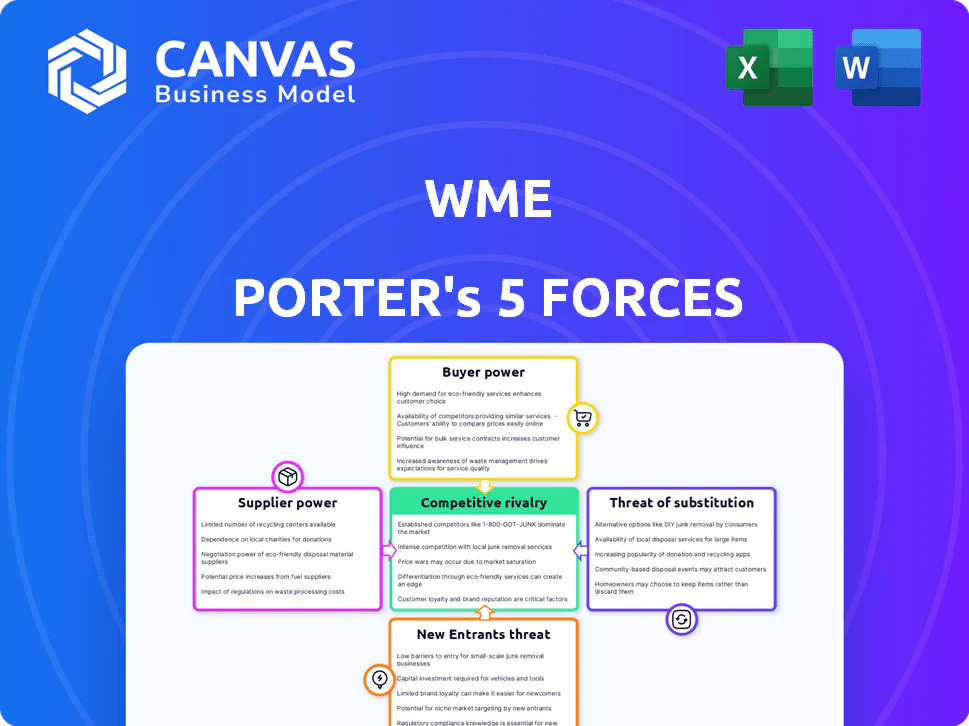
WME PORTER'S FIVE FORCES TEMPLATE RESEARCH

A Must-Have Tool for Decision-Makers
WME faces intense rivalry from diversified media firms, moderate buyer power from major distributors, and evolving threats from digital substitutes reshaping content monetization; this snapshot highlights key pressures but omits force-by-force ratings, data visuals, and tactical implications.
Suppliers Bargaining Power

The High Leverage of A-List Talent
In talent agencies the suppliers are artists; as of March 2026 A-list talent hold high leverage-top stars drove an estimated $1.2bn of agency-originated revenue for WME in fiscal 2025, letting them press for lower commissions (below the industry 10-15% norm) or equity stakes, forcing bespoke, high-touch service models to retain them.
Talent Scarcity and the AI Skill Gap
By early 2026, a 2025 industry survey showed 68% of studios report difficulty hiring AI-creative talent, and LinkedIn data found AI-skills postings rose 210% in 2025; this scarcity gives AI-fluent creators outsized bargaining power as WME and peers pay premiums-reported agent advances for top AI-augmented creators rose ~35% in 2025 versus 2024.

Collective Bargaining and Guild Influence
Collective supplier power from the Writers Guild of America (WGA) and SAG-AFTRA limits WME's agency packaging and ownership of production affiliates, reducing fee capture; after 2023-24 strikes these guilds enforced codes constraining agency-produced content, cutting WME's potential production margin by an estimated 10-15% of upstream revenue.

The Rise of Independent 'Super-Creators'
Digital-native super-creators now run mini-studios, with top 0.1% influencers earning $5-20M annually via subscriptions, product lines, and creator-first platforms by Mar 2026, so they often see WME's 10% fee as optional.
Their direct-brand deals and private-platform monetization cut agency dependence, forcing WME to add VC access, IP globalization, or scale deals to justify fees.
- Top creators: $5-20M revenue/year (Mar 2026)
- Direct deals reduce agency role by ~30-50%
- WME must offer VC, global IP, or distribution to retain clients
Specialized Equipment and Tech Providers
WME's production and packaging arms depend on a small set of niche tech suppliers-virtual production vendors, AI analytics firms, and 70mm IMAX equipment makers-giving these suppliers high bargaining power as their products are proprietary and scarce.
In 2025 WME faces supplier-driven cost pressure: virtual-production rentals rose ~18% YoY, AI licensing fees average $0.5-$2.0M per title, and 70mm IMAX shoots add $250K-$1.2M to budgets, increasing content unit costs.
- Concentrated suppliers = pricing leverage
- Proprietary tech limits switching
- AI/licensing adds $0.5-2.0M/title
- 70mm IMAX adds $250K-1.2M/shoot
- Virtual-production rentals +18% YoY (2025)
Creators, Agents & AI Command the Market: $1.2B A‑List Power, Soaring AI Demand
Suppliers (artists, AI creators, guilds, tech vendors) hold high leverage: A-list talent drove $1.2bn of WME-originated revenue in FY2025, top creators earn $5-20M/yr (Mar 2026), AI-skilled postings rose 210% in 2025, agent advances +35% YoY, AI licenses $0.5-2.0M/title, virtual-production rentals +18% YoY.
| Metric | 2025/Mar‑2026 |
|---|---|
| A‑list revenue to WME | $1.2bn (FY2025) |
| Top creator income | $5-20M/yr (Mar 2026) |
| AI job postings rise | +210% (2025) |
| Agent advances | +35% YoY (2025) |
| AI license per title | $0.5-2.0M |
| Virtual‑prod rentals | +18% YoY (2025) |
What is included in the product
 Detailed Word Document
Concise Porter's Five Forces for WME: examines rivalry, buyer/supplier power, entry barriers, and substitutes, highlighting disruptive threats, pricing leverage, and strategic defenses to protect WME's market position.

 Customizable Excel Spreadsheet
A one-page WME Porter's Five Forces snapshot that highlights competitive pressures and relief levers-ready to drop into decks for faster, clearer strategic decisions.
Customers Bargaining Power

The Dominance of Global Streaming Giants
By 2026, Netflix, Disney+, and Amazon control >65% of global streaming spend; their combined 2025 content budgets totaled roughly $75B, letting them demand work-for-hire deals that strip backend residuals from WME and its talent.
Those terms compressed WME's content margins-WME's 2025 agency segment operating margin fell ~180 basis points vs. 2023-forcing tougher negotiations to keep historical profit levels on originals.
Consolidation of Major Film Studios
Consolidation has cut major Hollywood studios to roughly six global powerhouses (Disney, Warner Bros. Discovery, Paramount, Universal/Comcast, Sony, Apple/Netflix as top buyers), so each studio can represent 10-25% of WME's film revenue-giving buyers leverage to demand bundled packaging and steeper fee discounts.

Data-Driven Content Acquisition
Buyers now run AI analytics-studios used predictive ROI models and sentiment analysis in 2025 that cut package premiums by ~18%, per industry surveys-so WME's ability to upsell mid-tier talent with stars is weaker.

Brand Advertisers Seeking Direct Access
Brands are building creator-relations teams and cutting out intermediaries, pressuring WME's middleman role as direct deals rose ~22% y/y in 2025 influencer spend trends.
WME has expanded 160over90 into full-service brand strategy-strategy, activation, measurement-so it can offer services beyond match-making and retain high-value advertising clients.
This shift risks fee compression; WME needs to prove superior ROI-160over90 reported contributing to $120m+ in client billings in 2025-to keep advertiser customers engaged.
- Direct brand‑creator deals up ~22% y/y (2025)
- 160over90 client billings ~$120m (2025)
- WME must sell strategy + measurement, not just talent
The Shift Toward Performance-Based Deals
Market dynamics in early 2026 favor at-risk deals: buyers pay ~30-60% less upfront and shift 20-40% of fees to performance bonuses tied to viewership or $ box-office milestones, pressuring WME's cash flow and raising its risk profile.
Buyers-especially streamers-use leverage on unproven IP and digital-first creators to demand these terms, forcing WME to act as strategic partner, sharing marketing and distribution risk to secure deals.
- At-risk shift: 30-60% lower upfront fees
- Performance portion: 20-40% of total pay
- Impact: tighter cash flow, higher working-capital needs
- Response: WME must co-invest in marketing/distribution
Streamers' buying power slashes WME margins as direct brand deals surge and upfronts fall
Buyers wield strong leverage: top streamers held >65% of global streaming spend in 2026 and spent ~$75B on content in 2025, forcing work‑for‑hire deals that cut WME margins; agency segment operating margin fell ~180 bps vs 2023. Direct brand‑creator deals rose ~22% y/y (2025), while 30-60% lower upfronts and 20-40% performance pay shifted cash‑flow risk to WME, which reported 160over90 billings of ~$120M (2025).
| Metric | 2025/2026 |
|---|---|
| Top streamers share | >65% (2026) |
| Top streamers content spend | ~$75B (2025) |
| Agency margin change | -180 bps vs 2023 |
| Direct brand‑creator deals | +22% y/y (2025) |
| 160over90 billings | ~$120M (2025) |
| Upfront fee cut | 30-60% (2025-26) |
| Performance pay share | 20-40% (2025-26) |
Same Document Delivered
WME Porter's Five Forces Analysis
This preview shows the exact WME Porter's Five Forces analysis you'll receive immediately after purchase-no placeholders or samples; the file is fully formatted, ready to download and use the moment you buy.

WME PORTER'S FIVE FORCES TEMPLATE RESEARCH
A Must-Have Tool for Decision-Makers
WME faces intense rivalry from diversified media firms, moderate buyer power from major distributors, and evolving threats from digital substitutes reshaping content monetization; this snapshot highlights key pressures but omits force-by-force ratings, data visuals, and tactical implications.
Suppliers Bargaining Power
The High Leverage of A-List Talent
In talent agencies the suppliers are artists; as of March 2026 A-list talent hold high leverage-top stars drove an estimated $1.2bn of agency-originated revenue for WME in fiscal 2025, letting them press for lower commissions (below the industry 10-15% norm) or equity stakes, forcing bespoke, high-touch service models to retain them.
Talent Scarcity and the AI Skill Gap
By early 2026, a 2025 industry survey showed 68% of studios report difficulty hiring AI-creative talent, and LinkedIn data found AI-skills postings rose 210% in 2025; this scarcity gives AI-fluent creators outsized bargaining power as WME and peers pay premiums-reported agent advances for top AI-augmented creators rose ~35% in 2025 versus 2024.
Collective Bargaining and Guild Influence
Collective supplier power from the Writers Guild of America (WGA) and SAG-AFTRA limits WME's agency packaging and ownership of production affiliates, reducing fee capture; after 2023-24 strikes these guilds enforced codes constraining agency-produced content, cutting WME's potential production margin by an estimated 10-15% of upstream revenue.
The Rise of Independent 'Super-Creators'
Digital-native super-creators now run mini-studios, with top 0.1% influencers earning $5-20M annually via subscriptions, product lines, and creator-first platforms by Mar 2026, so they often see WME's 10% fee as optional.
Their direct-brand deals and private-platform monetization cut agency dependence, forcing WME to add VC access, IP globalization, or scale deals to justify fees.
- Top creators: $5-20M revenue/year (Mar 2026)
- Direct deals reduce agency role by ~30-50%
- WME must offer VC, global IP, or distribution to retain clients
Specialized Equipment and Tech Providers
WME's production and packaging arms depend on a small set of niche tech suppliers-virtual production vendors, AI analytics firms, and 70mm IMAX equipment makers-giving these suppliers high bargaining power as their products are proprietary and scarce.
In 2025 WME faces supplier-driven cost pressure: virtual-production rentals rose ~18% YoY, AI licensing fees average $0.5-$2.0M per title, and 70mm IMAX shoots add $250K-$1.2M to budgets, increasing content unit costs.
- Concentrated suppliers = pricing leverage
- Proprietary tech limits switching
- AI/licensing adds $0.5-2.0M/title
- 70mm IMAX adds $250K-1.2M/shoot
- Virtual-production rentals +18% YoY (2025)
Creators, Agents & AI Command the Market: $1.2B A‑List Power, Soaring AI Demand
Suppliers (artists, AI creators, guilds, tech vendors) hold high leverage: A-list talent drove $1.2bn of WME-originated revenue in FY2025, top creators earn $5-20M/yr (Mar 2026), AI-skilled postings rose 210% in 2025, agent advances +35% YoY, AI licenses $0.5-2.0M/title, virtual-production rentals +18% YoY.
| Metric | 2025/Mar‑2026 |
|---|---|
| A‑list revenue to WME | $1.2bn (FY2025) |
| Top creator income | $5-20M/yr (Mar 2026) |
| AI job postings rise | +210% (2025) |
| Agent advances | +35% YoY (2025) |
| AI license per title | $0.5-2.0M |
| Virtual‑prod rentals | +18% YoY (2025) |
What is included in the product
Detailed Word Document
Concise Porter's Five Forces for WME: examines rivalry, buyer/supplier power, entry barriers, and substitutes, highlighting disruptive threats, pricing leverage, and strategic defenses to protect WME's market position.
Customizable Excel Spreadsheet
A one-page WME Porter's Five Forces snapshot that highlights competitive pressures and relief levers-ready to drop into decks for faster, clearer strategic decisions.
Customers Bargaining Power
The Dominance of Global Streaming Giants
By 2026, Netflix, Disney+, and Amazon control >65% of global streaming spend; their combined 2025 content budgets totaled roughly $75B, letting them demand work-for-hire deals that strip backend residuals from WME and its talent.
Those terms compressed WME's content margins-WME's 2025 agency segment operating margin fell ~180 basis points vs. 2023-forcing tougher negotiations to keep historical profit levels on originals.
Consolidation of Major Film Studios
Consolidation has cut major Hollywood studios to roughly six global powerhouses (Disney, Warner Bros. Discovery, Paramount, Universal/Comcast, Sony, Apple/Netflix as top buyers), so each studio can represent 10-25% of WME's film revenue-giving buyers leverage to demand bundled packaging and steeper fee discounts.
Data-Driven Content Acquisition
Buyers now run AI analytics-studios used predictive ROI models and sentiment analysis in 2025 that cut package premiums by ~18%, per industry surveys-so WME's ability to upsell mid-tier talent with stars is weaker.
Brand Advertisers Seeking Direct Access
Brands are building creator-relations teams and cutting out intermediaries, pressuring WME's middleman role as direct deals rose ~22% y/y in 2025 influencer spend trends.
WME has expanded 160over90 into full-service brand strategy-strategy, activation, measurement-so it can offer services beyond match-making and retain high-value advertising clients.
This shift risks fee compression; WME needs to prove superior ROI-160over90 reported contributing to $120m+ in client billings in 2025-to keep advertiser customers engaged.
- Direct brand‑creator deals up ~22% y/y (2025)
- 160over90 client billings ~$120m (2025)
- WME must sell strategy + measurement, not just talent
The Shift Toward Performance-Based Deals
Market dynamics in early 2026 favor at-risk deals: buyers pay ~30-60% less upfront and shift 20-40% of fees to performance bonuses tied to viewership or $ box-office milestones, pressuring WME's cash flow and raising its risk profile.
Buyers-especially streamers-use leverage on unproven IP and digital-first creators to demand these terms, forcing WME to act as strategic partner, sharing marketing and distribution risk to secure deals.
- At-risk shift: 30-60% lower upfront fees
- Performance portion: 20-40% of total pay
- Impact: tighter cash flow, higher working-capital needs
- Response: WME must co-invest in marketing/distribution
Streamers' buying power slashes WME margins as direct brand deals surge and upfronts fall
Buyers wield strong leverage: top streamers held >65% of global streaming spend in 2026 and spent ~$75B on content in 2025, forcing work‑for‑hire deals that cut WME margins; agency segment operating margin fell ~180 bps vs 2023. Direct brand‑creator deals rose ~22% y/y (2025), while 30-60% lower upfronts and 20-40% performance pay shifted cash‑flow risk to WME, which reported 160over90 billings of ~$120M (2025).
| Metric | 2025/2026 |
|---|---|
| Top streamers share | >65% (2026) |
| Top streamers content spend | ~$75B (2025) |
| Agency margin change | -180 bps vs 2023 |
| Direct brand‑creator deals | +22% y/y (2025) |
| 160over90 billings | ~$120M (2025) |
| Upfront fee cut | 30-60% (2025-26) |
| Performance pay share | 20-40% (2025-26) |
Same Document Delivered
WME Porter's Five Forces Analysis
This preview shows the exact WME Porter's Five Forces analysis you'll receive immediately after purchase-no placeholders or samples; the file is fully formatted, ready to download and use the moment you buy.
Product Information
Product Information
Shipping & Returns
Shipping & Returns
Description
A Must-Have Tool for Decision-Makers
WME faces intense rivalry from diversified media firms, moderate buyer power from major distributors, and evolving threats from digital substitutes reshaping content monetization; this snapshot highlights key pressures but omits force-by-force ratings, data visuals, and tactical implications.
Suppliers Bargaining Power
The High Leverage of A-List Talent
In talent agencies the suppliers are artists; as of March 2026 A-list talent hold high leverage-top stars drove an estimated $1.2bn of agency-originated revenue for WME in fiscal 2025, letting them press for lower commissions (below the industry 10-15% norm) or equity stakes, forcing bespoke, high-touch service models to retain them.
Talent Scarcity and the AI Skill Gap
By early 2026, a 2025 industry survey showed 68% of studios report difficulty hiring AI-creative talent, and LinkedIn data found AI-skills postings rose 210% in 2025; this scarcity gives AI-fluent creators outsized bargaining power as WME and peers pay premiums-reported agent advances for top AI-augmented creators rose ~35% in 2025 versus 2024.
Collective Bargaining and Guild Influence
Collective supplier power from the Writers Guild of America (WGA) and SAG-AFTRA limits WME's agency packaging and ownership of production affiliates, reducing fee capture; after 2023-24 strikes these guilds enforced codes constraining agency-produced content, cutting WME's potential production margin by an estimated 10-15% of upstream revenue.
The Rise of Independent 'Super-Creators'
Digital-native super-creators now run mini-studios, with top 0.1% influencers earning $5-20M annually via subscriptions, product lines, and creator-first platforms by Mar 2026, so they often see WME's 10% fee as optional.
Their direct-brand deals and private-platform monetization cut agency dependence, forcing WME to add VC access, IP globalization, or scale deals to justify fees.
- Top creators: $5-20M revenue/year (Mar 2026)
- Direct deals reduce agency role by ~30-50%
- WME must offer VC, global IP, or distribution to retain clients
Specialized Equipment and Tech Providers
WME's production and packaging arms depend on a small set of niche tech suppliers-virtual production vendors, AI analytics firms, and 70mm IMAX equipment makers-giving these suppliers high bargaining power as their products are proprietary and scarce.
In 2025 WME faces supplier-driven cost pressure: virtual-production rentals rose ~18% YoY, AI licensing fees average $0.5-$2.0M per title, and 70mm IMAX shoots add $250K-$1.2M to budgets, increasing content unit costs.
- Concentrated suppliers = pricing leverage
- Proprietary tech limits switching
- AI/licensing adds $0.5-2.0M/title
- 70mm IMAX adds $250K-1.2M/shoot
- Virtual-production rentals +18% YoY (2025)
Creators, Agents & AI Command the Market: $1.2B A‑List Power, Soaring AI Demand
Suppliers (artists, AI creators, guilds, tech vendors) hold high leverage: A-list talent drove $1.2bn of WME-originated revenue in FY2025, top creators earn $5-20M/yr (Mar 2026), AI-skilled postings rose 210% in 2025, agent advances +35% YoY, AI licenses $0.5-2.0M/title, virtual-production rentals +18% YoY.
| Metric | 2025/Mar‑2026 |
|---|---|
| A‑list revenue to WME | $1.2bn (FY2025) |
| Top creator income | $5-20M/yr (Mar 2026) |
| AI job postings rise | +210% (2025) |
| Agent advances | +35% YoY (2025) |
| AI license per title | $0.5-2.0M |
| Virtual‑prod rentals | +18% YoY (2025) |
What is included in the product
Detailed Word Document
Concise Porter's Five Forces for WME: examines rivalry, buyer/supplier power, entry barriers, and substitutes, highlighting disruptive threats, pricing leverage, and strategic defenses to protect WME's market position.
Customizable Excel Spreadsheet
A one-page WME Porter's Five Forces snapshot that highlights competitive pressures and relief levers-ready to drop into decks for faster, clearer strategic decisions.
Customers Bargaining Power
The Dominance of Global Streaming Giants
By 2026, Netflix, Disney+, and Amazon control >65% of global streaming spend; their combined 2025 content budgets totaled roughly $75B, letting them demand work-for-hire deals that strip backend residuals from WME and its talent.
Those terms compressed WME's content margins-WME's 2025 agency segment operating margin fell ~180 basis points vs. 2023-forcing tougher negotiations to keep historical profit levels on originals.
Consolidation of Major Film Studios
Consolidation has cut major Hollywood studios to roughly six global powerhouses (Disney, Warner Bros. Discovery, Paramount, Universal/Comcast, Sony, Apple/Netflix as top buyers), so each studio can represent 10-25% of WME's film revenue-giving buyers leverage to demand bundled packaging and steeper fee discounts.
Data-Driven Content Acquisition
Buyers now run AI analytics-studios used predictive ROI models and sentiment analysis in 2025 that cut package premiums by ~18%, per industry surveys-so WME's ability to upsell mid-tier talent with stars is weaker.
Brand Advertisers Seeking Direct Access
Brands are building creator-relations teams and cutting out intermediaries, pressuring WME's middleman role as direct deals rose ~22% y/y in 2025 influencer spend trends.
WME has expanded 160over90 into full-service brand strategy-strategy, activation, measurement-so it can offer services beyond match-making and retain high-value advertising clients.
This shift risks fee compression; WME needs to prove superior ROI-160over90 reported contributing to $120m+ in client billings in 2025-to keep advertiser customers engaged.
- Direct brand‑creator deals up ~22% y/y (2025)
- 160over90 client billings ~$120m (2025)
- WME must sell strategy + measurement, not just talent
The Shift Toward Performance-Based Deals
Market dynamics in early 2026 favor at-risk deals: buyers pay ~30-60% less upfront and shift 20-40% of fees to performance bonuses tied to viewership or $ box-office milestones, pressuring WME's cash flow and raising its risk profile.
Buyers-especially streamers-use leverage on unproven IP and digital-first creators to demand these terms, forcing WME to act as strategic partner, sharing marketing and distribution risk to secure deals.
- At-risk shift: 30-60% lower upfront fees
- Performance portion: 20-40% of total pay
- Impact: tighter cash flow, higher working-capital needs
- Response: WME must co-invest in marketing/distribution
Streamers' buying power slashes WME margins as direct brand deals surge and upfronts fall
Buyers wield strong leverage: top streamers held >65% of global streaming spend in 2026 and spent ~$75B on content in 2025, forcing work‑for‑hire deals that cut WME margins; agency segment operating margin fell ~180 bps vs 2023. Direct brand‑creator deals rose ~22% y/y (2025), while 30-60% lower upfronts and 20-40% performance pay shifted cash‑flow risk to WME, which reported 160over90 billings of ~$120M (2025).
| Metric | 2025/2026 |
|---|---|
| Top streamers share | >65% (2026) |
| Top streamers content spend | ~$75B (2025) |
| Agency margin change | -180 bps vs 2023 |
| Direct brand‑creator deals | +22% y/y (2025) |
| 160over90 billings | ~$120M (2025) |
| Upfront fee cut | 30-60% (2025-26) |
| Performance pay share | 20-40% (2025-26) |
Same Document Delivered
WME Porter's Five Forces Analysis
This preview shows the exact WME Porter's Five Forces analysis you'll receive immediately after purchase-no placeholders or samples; the file is fully formatted, ready to download and use the moment you buy.











