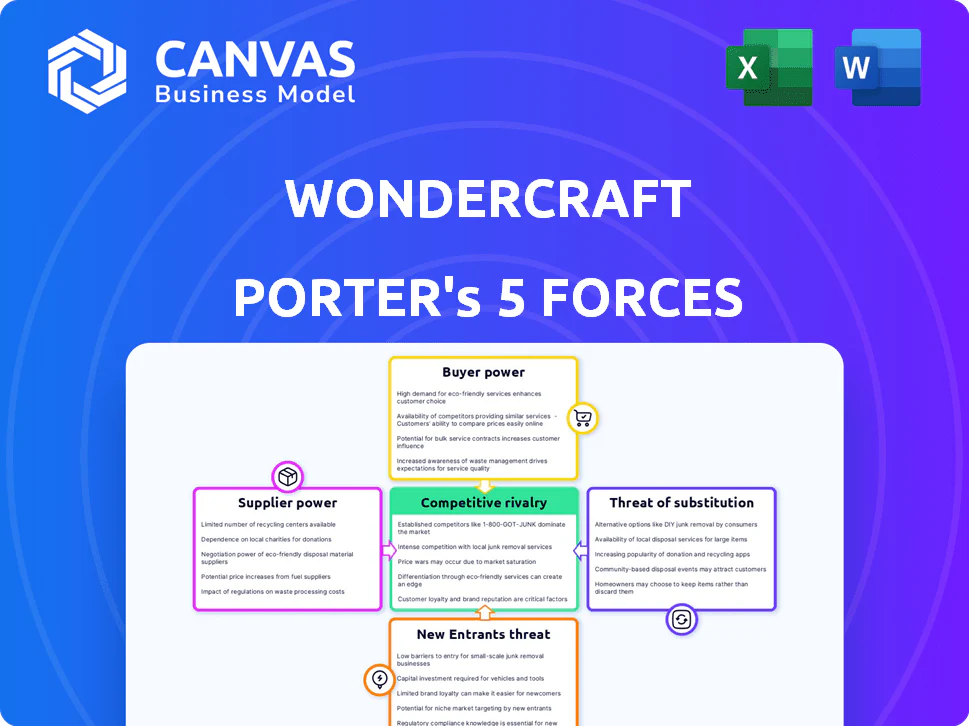
WONDERCRAFT PORTER'S FIVE FORCES TEMPLATE RESEARCH
What is included in the product
 Detailed Word Document
Analyzes competitive forces shaping Wondercraft's market position, covering suppliers, buyers, and rivals.

 Customizable Excel Spreadsheet
Understand strategic pressure quickly with a spider/radar chart.
Preview Before You Purchase
Wondercraft Porter's Five Forces Analysis
This is the complete Wondercraft Porter's Five Forces Analysis document. The preview you see provides the full scope of what you'll receive. It's a ready-to-use, professionally crafted analysis. Get instant access to this exact file upon purchase. No changes needed, just download and use.

Porter's Five Forces Analysis Template

Elevate Your Analysis with the Complete Porter's Five Forces Analysis
Wondercraft's competitive landscape is shaped by five key forces: supplier power, buyer power, threat of new entrants, threat of substitutes, and rivalry among existing competitors. Analyzing these forces reveals the intensity of competition and potential profitability within Wondercraft's industry. Understanding these dynamics is crucial for strategic planning and investment decisions. This glimpse only offers a taste of the full strategic analysis.
Unlock key insights into Wondercraft’s industry forces—from buyer power to substitute threats—and use this knowledge to inform strategy or investment decisions.
Suppliers Bargaining Power

Dependency on AI Models
Wondercraft's dependence on AI model providers like OpenAI, Google, and Anthropic gives these suppliers substantial bargaining power. These firms control access to cutting-edge text-to-speech and language models, which are essential for Wondercraft's platform. For instance, OpenAI's revenue reached $3.4 billion in 2023, reflecting their market dominance. Any price hikes or restrictions from these suppliers directly affect Wondercraft's operational costs and innovation capabilities.
Availability of High-Quality Voices
The quality and variety of AI voices are vital to Wondercraft's appeal. Suppliers offering realistic, expressive, and multilingual voices hold significant sway. Wondercraft uses various AI voice models to provide a broad selection of voices. In 2024, the AI voice market was valued at approximately $2.8 billion, showing the importance of high-quality voice providers. This figure is projected to reach $5.5 billion by 2028, underscoring their leverage.

Access to Training Data
Suppliers with superior data access, like those providing audio datasets, hold significant bargaining power. Training text-to-speech models demands extensive, high-quality audio data. In 2024, the market for AI training data was valued at billions, with projections of continued growth. This reliance gives data providers leverage.

Switching Costs for Wondercraft
Switching costs for Wondercraft could arise from integrating different AI voice models. This includes adjusting to new features and potential audio quality variations. Renegotiating terms with a new supplier also contributes to these costs. In 2024, the average contract negotiation time for AI services was about 4-6 weeks.
- Integration challenges: adapting to new voice models.
- Quality concerns: potential audio inconsistencies.
- Contract terms: renegotiating agreements.
- Time factor: lengthy negotiation periods.
Concentration of Key Technology Providers
In the realm of AI voice technology, the bargaining power of suppliers is significantly shaped by market concentration. A limited number of key providers for advanced AI voice technology and language models, like Google, Amazon, and Microsoft, hold considerable sway. This concentration empowers these dominant players to exert more control over pricing and terms. For example, in 2024, these three companies accounted for over 70% of the global cloud infrastructure market, which supports AI voice services.
- Market dominance by a few key players, like Google, Amazon, and Microsoft.
- Over 70% of the global cloud infrastructure market share in 2024 held by the top three companies.
- This concentration allows them to dictate pricing and service terms.
- Smaller players face higher costs and fewer options.
Wondercraft's Supplier Power: AI & Data Dynamics
Wondercraft faces supplier bargaining power from AI model and data providers. Market dominance by key players like OpenAI and Google grants them significant leverage. Switching costs, including integration and negotiation, further influence this dynamic. The AI voice market was valued at $2.8 billion in 2024, projected to reach $5.5 billion by 2028, highlighting this power.
| Factor | Impact | Data (2024) |
|---|---|---|
| AI Model Providers | High bargaining power | OpenAI revenue: $3.4B |
| Voice Quality | Affects appeal | AI voice market: $2.8B |
| Data Access | Significant leverage | AI training data market: billions |
Customers Bargaining Power

Availability of Alternatives
Customers now have many choices for audio content creation, including AI platforms, traditional methods, and voice actors. This abundance strengthens their bargaining power. In 2024, the global text-to-speech market was valued at $3.2 billion, showing robust competition. The availability of alternatives allows customers to easily switch if Wondercraft's offerings are not appealing.
Price Sensitivity
Wondercraft's tiered pricing, including a free option, caters to diverse users. Price sensitivity is significant, especially for cost-conscious individual creators or small businesses. Approximately 60% of consumers consider price a top factor when choosing products or services. This sensitivity can impact demand for higher-volume usage or premium features. In 2024, the average churn rate for SaaS companies was about 10-15%.

Customer Concentration
If a few major clients account for most of Wondercraft's revenue, they can demand better terms. For example, if 30% of revenue comes from 2-3 customers, their power increases. However, Wondercraft's diverse user base (creators, businesses) weakens this.

Low Switching Costs for Customers
Wondercraft faces considerable customer bargaining power, particularly due to low switching costs. Competitors offer similar services, and many provide free trials, making it easy for users to explore alternatives. For instance, in 2024, the text-to-speech market saw over 20 major players, intensifying competition. This environment pressures Wondercraft to offer competitive pricing and maintain high service quality to retain customers, as switching to a different platform requires minimal effort.
- Market competition is fierce, with numerous providers available.
- Free trials and freemium models facilitate easy switching.
- Customers can quickly compare different platforms.
- Wondercraft must focus on value to retain users.
Customer's Ability to Create Content Themselves
Customers can create audio content independently using affordable tools, posing a challenge to platforms like Wondercraft. This self-sufficiency reduces reliance on Wondercraft, affecting its market position. The cost-effectiveness of creating content independently versus using Wondercraft is a key consideration for customers. For example, in 2024, the average cost of a quality USB microphone was $79, making independent content creation accessible.
- Independent content creation is made easier and cheaper.
- This diminishes the need for platforms like Wondercraft.
- Cost comparison influences customer choices.
- In 2024, podcasting grew by 15%.
Wondercraft's Pricing Strategy Under Pressure
Wondercraft faces strong customer bargaining power. The market features many competitors, and switching costs are low, encouraging customers to explore alternatives easily. In 2024, the SaaS churn rate was 10-15%, highlighting the need for Wondercraft to offer competitive pricing and maintain high service quality.
| Factor | Impact | 2024 Data |
|---|---|---|
| Market Competition | High | Text-to-speech market size: $3.2B |
| Switching Costs | Low | Average cost of a USB mic: $79 |
| Customer Price Sensitivity | High | 60% consider price a top factor |
Rivalry Among Competitors

Number and Diversity of Competitors
The AI audio content creation market is heating up. It's seeing a surge in both startups and tech giants vying for market share. In 2024, the market size was valued at $2.7 billion. This competition includes dedicated AI audio platforms and software with AI capabilities.
Market Growth Rate
The text-to-speech market is booming; experts project it to reach $5.06 billion by 2024. High growth can initially lessen rivalry, as seen with Wondercraft. However, it also pulls in more competitors, intensifying the fight for market share. This dynamic requires constant adaptation and innovation to stay ahead.

Product Differentiation and Features
Wondercraft distinguishes itself through its unique features. These include an AI script assistant, realistic voices, and a timeline editor. The integration of music, sound effects, and translation capabilities also sets it apart. This differentiation helps reduce direct price-based competition.

Brand Identity and Customer Loyalty
Wondercraft's success hinges on solidifying its brand identity and cultivating customer loyalty to navigate the competitive landscape. The company's focus on innovative features like voice cloning and a user-friendly platform is crucial. These elements can differentiate Wondercraft from competitors and foster customer retention. Strong branding can lead to increased market share and pricing power, as demonstrated by companies like Adobe, which maintains high customer loyalty. In 2024, the AI voice cloning market is projected to reach $1.5 billion.
- Voice cloning technology adoption is predicted to grow by 25% in 2024.
- User-friendly platforms have a 30% higher customer retention rate.
- Brand loyalty programs increase customer lifetime value by up to 20%.
- Companies with strong brands see a 10-15% price premium.
Switching Costs for Customers
Low switching costs can heighten competitive rivalry. If customers find it easy to move between platforms, businesses must compete fiercely to retain them. In 2024, the average churn rate in the SaaS industry was about 10%, indicating how readily customers switch.
- Competition intensifies when switching is easy.
- High churn rates exemplify the impact.
- Businesses must focus on customer retention.
- Low switching costs make rivalry aggressive.
AI Audio Market: $2.7 Billion Battleground!
Competitive rivalry in the AI audio market is fierce, with numerous players vying for market share. The market, valued at $2.7 billion in 2024, sees intense competition among startups and tech giants. Differentiation through unique features and strong branding is crucial to reduce direct competition and retain customers.
| Factor | Impact | Data (2024) |
|---|---|---|
| Market Size | High competition | $2.7 billion |
| Churn Rate (SaaS) | Customer switching | ~10% |
| Voice Cloning Growth | Innovation | 25% adoption |
WONDERCRAFT PORTER'S FIVE FORCES TEMPLATE RESEARCH
What is included in the product
Detailed Word Document
Analyzes competitive forces shaping Wondercraft's market position, covering suppliers, buyers, and rivals.
Customizable Excel Spreadsheet
Understand strategic pressure quickly with a spider/radar chart.
Preview Before You Purchase
Wondercraft Porter's Five Forces Analysis
This is the complete Wondercraft Porter's Five Forces Analysis document. The preview you see provides the full scope of what you'll receive. It's a ready-to-use, professionally crafted analysis. Get instant access to this exact file upon purchase. No changes needed, just download and use.
Porter's Five Forces Analysis Template
Elevate Your Analysis with the Complete Porter's Five Forces Analysis
Wondercraft's competitive landscape is shaped by five key forces: supplier power, buyer power, threat of new entrants, threat of substitutes, and rivalry among existing competitors. Analyzing these forces reveals the intensity of competition and potential profitability within Wondercraft's industry. Understanding these dynamics is crucial for strategic planning and investment decisions. This glimpse only offers a taste of the full strategic analysis.
Unlock key insights into Wondercraft’s industry forces—from buyer power to substitute threats—and use this knowledge to inform strategy or investment decisions.
Suppliers Bargaining Power
Dependency on AI Models
Wondercraft's dependence on AI model providers like OpenAI, Google, and Anthropic gives these suppliers substantial bargaining power. These firms control access to cutting-edge text-to-speech and language models, which are essential for Wondercraft's platform. For instance, OpenAI's revenue reached $3.4 billion in 2023, reflecting their market dominance. Any price hikes or restrictions from these suppliers directly affect Wondercraft's operational costs and innovation capabilities.
Availability of High-Quality Voices
The quality and variety of AI voices are vital to Wondercraft's appeal. Suppliers offering realistic, expressive, and multilingual voices hold significant sway. Wondercraft uses various AI voice models to provide a broad selection of voices. In 2024, the AI voice market was valued at approximately $2.8 billion, showing the importance of high-quality voice providers. This figure is projected to reach $5.5 billion by 2028, underscoring their leverage.
Access to Training Data
Suppliers with superior data access, like those providing audio datasets, hold significant bargaining power. Training text-to-speech models demands extensive, high-quality audio data. In 2024, the market for AI training data was valued at billions, with projections of continued growth. This reliance gives data providers leverage.
Switching Costs for Wondercraft
Switching costs for Wondercraft could arise from integrating different AI voice models. This includes adjusting to new features and potential audio quality variations. Renegotiating terms with a new supplier also contributes to these costs. In 2024, the average contract negotiation time for AI services was about 4-6 weeks.
- Integration challenges: adapting to new voice models.
- Quality concerns: potential audio inconsistencies.
- Contract terms: renegotiating agreements.
- Time factor: lengthy negotiation periods.
Concentration of Key Technology Providers
In the realm of AI voice technology, the bargaining power of suppliers is significantly shaped by market concentration. A limited number of key providers for advanced AI voice technology and language models, like Google, Amazon, and Microsoft, hold considerable sway. This concentration empowers these dominant players to exert more control over pricing and terms. For example, in 2024, these three companies accounted for over 70% of the global cloud infrastructure market, which supports AI voice services.
- Market dominance by a few key players, like Google, Amazon, and Microsoft.
- Over 70% of the global cloud infrastructure market share in 2024 held by the top three companies.
- This concentration allows them to dictate pricing and service terms.
- Smaller players face higher costs and fewer options.
Wondercraft's Supplier Power: AI & Data Dynamics
Wondercraft faces supplier bargaining power from AI model and data providers. Market dominance by key players like OpenAI and Google grants them significant leverage. Switching costs, including integration and negotiation, further influence this dynamic. The AI voice market was valued at $2.8 billion in 2024, projected to reach $5.5 billion by 2028, highlighting this power.
| Factor | Impact | Data (2024) |
|---|---|---|
| AI Model Providers | High bargaining power | OpenAI revenue: $3.4B |
| Voice Quality | Affects appeal | AI voice market: $2.8B |
| Data Access | Significant leverage | AI training data market: billions |
Customers Bargaining Power
Availability of Alternatives
Customers now have many choices for audio content creation, including AI platforms, traditional methods, and voice actors. This abundance strengthens their bargaining power. In 2024, the global text-to-speech market was valued at $3.2 billion, showing robust competition. The availability of alternatives allows customers to easily switch if Wondercraft's offerings are not appealing.
Price Sensitivity
Wondercraft's tiered pricing, including a free option, caters to diverse users. Price sensitivity is significant, especially for cost-conscious individual creators or small businesses. Approximately 60% of consumers consider price a top factor when choosing products or services. This sensitivity can impact demand for higher-volume usage or premium features. In 2024, the average churn rate for SaaS companies was about 10-15%.
Customer Concentration
If a few major clients account for most of Wondercraft's revenue, they can demand better terms. For example, if 30% of revenue comes from 2-3 customers, their power increases. However, Wondercraft's diverse user base (creators, businesses) weakens this.
Low Switching Costs for Customers
Wondercraft faces considerable customer bargaining power, particularly due to low switching costs. Competitors offer similar services, and many provide free trials, making it easy for users to explore alternatives. For instance, in 2024, the text-to-speech market saw over 20 major players, intensifying competition. This environment pressures Wondercraft to offer competitive pricing and maintain high service quality to retain customers, as switching to a different platform requires minimal effort.
- Market competition is fierce, with numerous providers available.
- Free trials and freemium models facilitate easy switching.
- Customers can quickly compare different platforms.
- Wondercraft must focus on value to retain users.
Customer's Ability to Create Content Themselves
Customers can create audio content independently using affordable tools, posing a challenge to platforms like Wondercraft. This self-sufficiency reduces reliance on Wondercraft, affecting its market position. The cost-effectiveness of creating content independently versus using Wondercraft is a key consideration for customers. For example, in 2024, the average cost of a quality USB microphone was $79, making independent content creation accessible.
- Independent content creation is made easier and cheaper.
- This diminishes the need for platforms like Wondercraft.
- Cost comparison influences customer choices.
- In 2024, podcasting grew by 15%.
Wondercraft's Pricing Strategy Under Pressure
Wondercraft faces strong customer bargaining power. The market features many competitors, and switching costs are low, encouraging customers to explore alternatives easily. In 2024, the SaaS churn rate was 10-15%, highlighting the need for Wondercraft to offer competitive pricing and maintain high service quality.
| Factor | Impact | 2024 Data |
|---|---|---|
| Market Competition | High | Text-to-speech market size: $3.2B |
| Switching Costs | Low | Average cost of a USB mic: $79 |
| Customer Price Sensitivity | High | 60% consider price a top factor |
Rivalry Among Competitors
Number and Diversity of Competitors
The AI audio content creation market is heating up. It's seeing a surge in both startups and tech giants vying for market share. In 2024, the market size was valued at $2.7 billion. This competition includes dedicated AI audio platforms and software with AI capabilities.
Market Growth Rate
The text-to-speech market is booming; experts project it to reach $5.06 billion by 2024. High growth can initially lessen rivalry, as seen with Wondercraft. However, it also pulls in more competitors, intensifying the fight for market share. This dynamic requires constant adaptation and innovation to stay ahead.
Product Differentiation and Features
Wondercraft distinguishes itself through its unique features. These include an AI script assistant, realistic voices, and a timeline editor. The integration of music, sound effects, and translation capabilities also sets it apart. This differentiation helps reduce direct price-based competition.
Brand Identity and Customer Loyalty
Wondercraft's success hinges on solidifying its brand identity and cultivating customer loyalty to navigate the competitive landscape. The company's focus on innovative features like voice cloning and a user-friendly platform is crucial. These elements can differentiate Wondercraft from competitors and foster customer retention. Strong branding can lead to increased market share and pricing power, as demonstrated by companies like Adobe, which maintains high customer loyalty. In 2024, the AI voice cloning market is projected to reach $1.5 billion.
- Voice cloning technology adoption is predicted to grow by 25% in 2024.
- User-friendly platforms have a 30% higher customer retention rate.
- Brand loyalty programs increase customer lifetime value by up to 20%.
- Companies with strong brands see a 10-15% price premium.
Switching Costs for Customers
Low switching costs can heighten competitive rivalry. If customers find it easy to move between platforms, businesses must compete fiercely to retain them. In 2024, the average churn rate in the SaaS industry was about 10%, indicating how readily customers switch.
- Competition intensifies when switching is easy.
- High churn rates exemplify the impact.
- Businesses must focus on customer retention.
- Low switching costs make rivalry aggressive.
AI Audio Market: $2.7 Billion Battleground!
Competitive rivalry in the AI audio market is fierce, with numerous players vying for market share. The market, valued at $2.7 billion in 2024, sees intense competition among startups and tech giants. Differentiation through unique features and strong branding is crucial to reduce direct competition and retain customers.
| Factor | Impact | Data (2024) |
|---|---|---|
| Market Size | High competition | $2.7 billion |
| Churn Rate (SaaS) | Customer switching | ~10% |
| Voice Cloning Growth | Innovation | 25% adoption |
Product Information
Product Information
Shipping & Returns
Shipping & Returns
Description
What is included in the product
Detailed Word Document
Analyzes competitive forces shaping Wondercraft's market position, covering suppliers, buyers, and rivals.
Customizable Excel Spreadsheet
Understand strategic pressure quickly with a spider/radar chart.
Preview Before You Purchase
Wondercraft Porter's Five Forces Analysis
This is the complete Wondercraft Porter's Five Forces Analysis document. The preview you see provides the full scope of what you'll receive. It's a ready-to-use, professionally crafted analysis. Get instant access to this exact file upon purchase. No changes needed, just download and use.
Porter's Five Forces Analysis Template
Elevate Your Analysis with the Complete Porter's Five Forces Analysis
Wondercraft's competitive landscape is shaped by five key forces: supplier power, buyer power, threat of new entrants, threat of substitutes, and rivalry among existing competitors. Analyzing these forces reveals the intensity of competition and potential profitability within Wondercraft's industry. Understanding these dynamics is crucial for strategic planning and investment decisions. This glimpse only offers a taste of the full strategic analysis.
Unlock key insights into Wondercraft’s industry forces—from buyer power to substitute threats—and use this knowledge to inform strategy or investment decisions.
Suppliers Bargaining Power
Dependency on AI Models
Wondercraft's dependence on AI model providers like OpenAI, Google, and Anthropic gives these suppliers substantial bargaining power. These firms control access to cutting-edge text-to-speech and language models, which are essential for Wondercraft's platform. For instance, OpenAI's revenue reached $3.4 billion in 2023, reflecting their market dominance. Any price hikes or restrictions from these suppliers directly affect Wondercraft's operational costs and innovation capabilities.
Availability of High-Quality Voices
The quality and variety of AI voices are vital to Wondercraft's appeal. Suppliers offering realistic, expressive, and multilingual voices hold significant sway. Wondercraft uses various AI voice models to provide a broad selection of voices. In 2024, the AI voice market was valued at approximately $2.8 billion, showing the importance of high-quality voice providers. This figure is projected to reach $5.5 billion by 2028, underscoring their leverage.
Access to Training Data
Suppliers with superior data access, like those providing audio datasets, hold significant bargaining power. Training text-to-speech models demands extensive, high-quality audio data. In 2024, the market for AI training data was valued at billions, with projections of continued growth. This reliance gives data providers leverage.
Switching Costs for Wondercraft
Switching costs for Wondercraft could arise from integrating different AI voice models. This includes adjusting to new features and potential audio quality variations. Renegotiating terms with a new supplier also contributes to these costs. In 2024, the average contract negotiation time for AI services was about 4-6 weeks.
- Integration challenges: adapting to new voice models.
- Quality concerns: potential audio inconsistencies.
- Contract terms: renegotiating agreements.
- Time factor: lengthy negotiation periods.
Concentration of Key Technology Providers
In the realm of AI voice technology, the bargaining power of suppliers is significantly shaped by market concentration. A limited number of key providers for advanced AI voice technology and language models, like Google, Amazon, and Microsoft, hold considerable sway. This concentration empowers these dominant players to exert more control over pricing and terms. For example, in 2024, these three companies accounted for over 70% of the global cloud infrastructure market, which supports AI voice services.
- Market dominance by a few key players, like Google, Amazon, and Microsoft.
- Over 70% of the global cloud infrastructure market share in 2024 held by the top three companies.
- This concentration allows them to dictate pricing and service terms.
- Smaller players face higher costs and fewer options.
Wondercraft's Supplier Power: AI & Data Dynamics
Wondercraft faces supplier bargaining power from AI model and data providers. Market dominance by key players like OpenAI and Google grants them significant leverage. Switching costs, including integration and negotiation, further influence this dynamic. The AI voice market was valued at $2.8 billion in 2024, projected to reach $5.5 billion by 2028, highlighting this power.
| Factor | Impact | Data (2024) |
|---|---|---|
| AI Model Providers | High bargaining power | OpenAI revenue: $3.4B |
| Voice Quality | Affects appeal | AI voice market: $2.8B |
| Data Access | Significant leverage | AI training data market: billions |
Customers Bargaining Power
Availability of Alternatives
Customers now have many choices for audio content creation, including AI platforms, traditional methods, and voice actors. This abundance strengthens their bargaining power. In 2024, the global text-to-speech market was valued at $3.2 billion, showing robust competition. The availability of alternatives allows customers to easily switch if Wondercraft's offerings are not appealing.
Price Sensitivity
Wondercraft's tiered pricing, including a free option, caters to diverse users. Price sensitivity is significant, especially for cost-conscious individual creators or small businesses. Approximately 60% of consumers consider price a top factor when choosing products or services. This sensitivity can impact demand for higher-volume usage or premium features. In 2024, the average churn rate for SaaS companies was about 10-15%.
Customer Concentration
If a few major clients account for most of Wondercraft's revenue, they can demand better terms. For example, if 30% of revenue comes from 2-3 customers, their power increases. However, Wondercraft's diverse user base (creators, businesses) weakens this.
Low Switching Costs for Customers
Wondercraft faces considerable customer bargaining power, particularly due to low switching costs. Competitors offer similar services, and many provide free trials, making it easy for users to explore alternatives. For instance, in 2024, the text-to-speech market saw over 20 major players, intensifying competition. This environment pressures Wondercraft to offer competitive pricing and maintain high service quality to retain customers, as switching to a different platform requires minimal effort.
- Market competition is fierce, with numerous providers available.
- Free trials and freemium models facilitate easy switching.
- Customers can quickly compare different platforms.
- Wondercraft must focus on value to retain users.
Customer's Ability to Create Content Themselves
Customers can create audio content independently using affordable tools, posing a challenge to platforms like Wondercraft. This self-sufficiency reduces reliance on Wondercraft, affecting its market position. The cost-effectiveness of creating content independently versus using Wondercraft is a key consideration for customers. For example, in 2024, the average cost of a quality USB microphone was $79, making independent content creation accessible.
- Independent content creation is made easier and cheaper.
- This diminishes the need for platforms like Wondercraft.
- Cost comparison influences customer choices.
- In 2024, podcasting grew by 15%.
Wondercraft's Pricing Strategy Under Pressure
Wondercraft faces strong customer bargaining power. The market features many competitors, and switching costs are low, encouraging customers to explore alternatives easily. In 2024, the SaaS churn rate was 10-15%, highlighting the need for Wondercraft to offer competitive pricing and maintain high service quality.
| Factor | Impact | 2024 Data |
|---|---|---|
| Market Competition | High | Text-to-speech market size: $3.2B |
| Switching Costs | Low | Average cost of a USB mic: $79 |
| Customer Price Sensitivity | High | 60% consider price a top factor |
Rivalry Among Competitors
Number and Diversity of Competitors
The AI audio content creation market is heating up. It's seeing a surge in both startups and tech giants vying for market share. In 2024, the market size was valued at $2.7 billion. This competition includes dedicated AI audio platforms and software with AI capabilities.
Market Growth Rate
The text-to-speech market is booming; experts project it to reach $5.06 billion by 2024. High growth can initially lessen rivalry, as seen with Wondercraft. However, it also pulls in more competitors, intensifying the fight for market share. This dynamic requires constant adaptation and innovation to stay ahead.
Product Differentiation and Features
Wondercraft distinguishes itself through its unique features. These include an AI script assistant, realistic voices, and a timeline editor. The integration of music, sound effects, and translation capabilities also sets it apart. This differentiation helps reduce direct price-based competition.
Brand Identity and Customer Loyalty
Wondercraft's success hinges on solidifying its brand identity and cultivating customer loyalty to navigate the competitive landscape. The company's focus on innovative features like voice cloning and a user-friendly platform is crucial. These elements can differentiate Wondercraft from competitors and foster customer retention. Strong branding can lead to increased market share and pricing power, as demonstrated by companies like Adobe, which maintains high customer loyalty. In 2024, the AI voice cloning market is projected to reach $1.5 billion.
- Voice cloning technology adoption is predicted to grow by 25% in 2024.
- User-friendly platforms have a 30% higher customer retention rate.
- Brand loyalty programs increase customer lifetime value by up to 20%.
- Companies with strong brands see a 10-15% price premium.
Switching Costs for Customers
Low switching costs can heighten competitive rivalry. If customers find it easy to move between platforms, businesses must compete fiercely to retain them. In 2024, the average churn rate in the SaaS industry was about 10%, indicating how readily customers switch.
- Competition intensifies when switching is easy.
- High churn rates exemplify the impact.
- Businesses must focus on customer retention.
- Low switching costs make rivalry aggressive.
AI Audio Market: $2.7 Billion Battleground!
Competitive rivalry in the AI audio market is fierce, with numerous players vying for market share. The market, valued at $2.7 billion in 2024, sees intense competition among startups and tech giants. Differentiation through unique features and strong branding is crucial to reduce direct competition and retain customers.
| Factor | Impact | Data (2024) |
|---|---|---|
| Market Size | High competition | $2.7 billion |
| Churn Rate (SaaS) | Customer switching | ~10% |
| Voice Cloning Growth | Innovation | 25% adoption |











