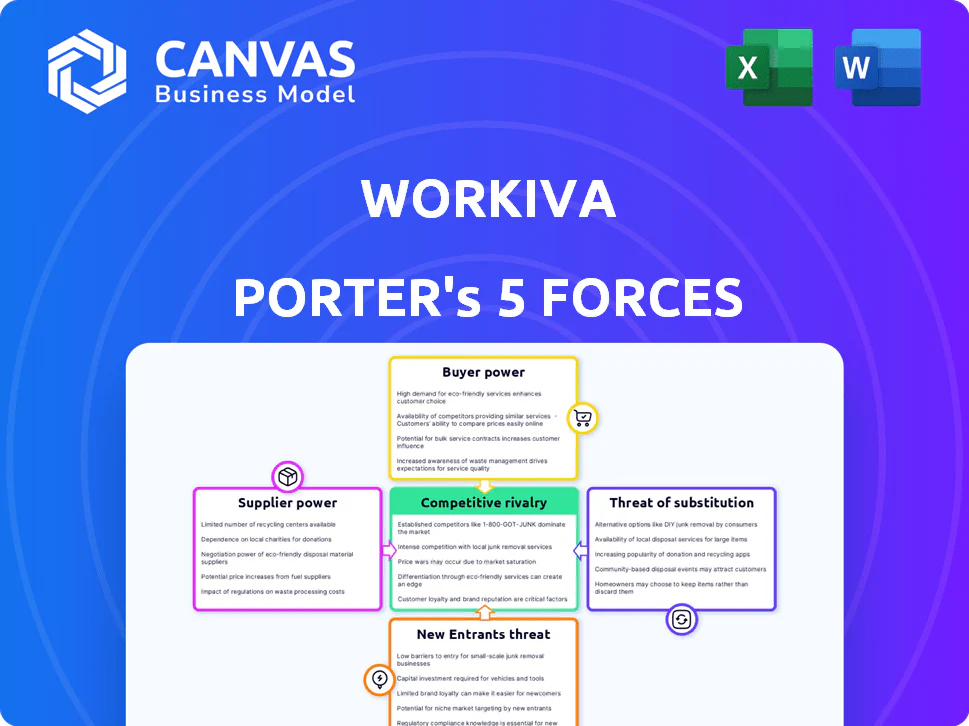
WORKIVA PORTER'S FIVE FORCES TEMPLATE RESEARCH

From Overview to Strategy Blueprint
Workiva operates in a niche with strong buyer expectations and moderate supplier leverage, while cloud incumbents and fintech startups shape competitive intensity-this snapshot highlights key pressures on pricing, margins, and innovation pace. This brief only scratches the surface; unlock the full Porter's Five Forces Analysis for force-by-force ratings, visuals, and actionable strategy to guide investment or corporate decisions.
Suppliers Bargaining Power

Dominance of Hyperscale Cloud Providers
Workiva, a pure‑play SaaS provider, depends on hyperscalers-primarily Amazon Web Services and Google Cloud-for infrastructure; in FY2025 Workiva reported $743.3m revenue, so cloud costs materially affect margins.
Rising demand for AI-driven reporting shifted leverage to hyperscalers by 2026 as AI instance spend grew ~45% year-over-year across enterprise cloud customers.
Workiva can negotiate volume discounts-its 2025 cloud spend estimated ~$40-60m-but migrating Wdesk's large, integrated ecosystem is complex and costly.
That technical lock-in limits Workiva's ability to credibly play suppliers against each other despite some bargaining on price.
Scarcity of Specialized Engineering Talent
Workiva's edge rests on mastery of XBRL tagging and ESG taxonomies; only ~5-10% of software engineers combine enterprise architecture with regulatory taxonomy skills, making them scarce.
In 2026 top-tier talent commands 20-35% higher pay and 60-80% remote flexibility, raising supplier (talent) bargaining power and pressuring Workiva's wage and hiring budgets.

Criticality of Third-Party Data Feed Integrations
Workiva must keep seamless integrations with ERP giants SAP (FY2025 revenue €36.5B), Oracle (FY2025 revenue $58.7B), and ESG vendors; these providers hold leverage because their APIs enable Wdesk's automated data linking, and any restriction or fee hike would reduce platform value.

Dependence on Cybersecurity Service Vendors
Workiva stores pre-filing financials for 3,500+ global entities, so its brand is tied to security; a breach could cost hundreds of millions and destroy trust.
Advanced-encryption, threat-detection, and zero-trust vendors are non-negotiable; they command pricing power because replacement risk is high and specialized talent is scarce.
A 2025 industry estimate shows average breach cost at $4.45M globally and $9.44M in the US, reinforcing suppliers' leverage over Workiva.
- 3,500+ clients; pre-filing data custody
- Specialized security vendors = high switching cost
- Avg breach cost 2025: $4.45M global, $9.44M US
- Reputational damage multiplies direct costs
Influence of Regulatory Standard Setters
Regulatory standard setters like the SEC and EFRAG act as de facto suppliers by setting taxonomies and disclosure rules Workiva must implement, forcing continuous product updates and heavy R&D spend; Workiva reported $118.8M R&D in FY2025 (32% of revenue), reflecting this supply-side pressure.
When taxonomies change, Workiva faces accelerated engineering cycles and integration costs, raising operating leverage and time-to-market risk for new features.
- SEC/EFRAG set specs Workiva must follow
- $118.8M R&D in FY2025 (32% of revenue)
- Frequent taxonomy updates increase implementation costs
- Limits control over product roadmap timing
Workiva Faces High Supplier Power: Heavy Cloud, R&D Costs and Talent-Driven Switching Barriers
Suppliers hold moderate-high power: hyperscalers (AWS/GCP) and security vendors charge premium rates-Workiva's FY2025 revenue $743.3m, estimated cloud spend $40-60m, R&D $118.8m-while scarce XBRL/ESG talent and regulator-set taxonomies (SEC/EFRAG) force continuous costly updates and raise switching costs.
| Item | 2025 Value |
|---|---|
| Revenue | $743.3m |
| Cloud spend (est.) | $40-60m |
| R&D | $118.8m (32% rev) |
| Clients w/ pre-filing data | 3,500+ |
| Avg breach cost | $4.45m (global) |
What is included in the product
 Detailed Word Document
Tailored Porter's Five Forces analysis for Workiva that uncovers key competitive drivers, buyer and supplier influence, entry barriers, substitutes, and emerging threats, with strategic commentary to inform investor and management decisions.

 Customizable Excel Spreadsheet
A compact, one-sheet Porter's Five Forces tool for Workiva that visualizes competitive pressure and lets you immediately adjust scores to model scenarios-ideal for fast strategy calls and slide-ready summaries.
Customers Bargaining Power

High Switching Costs and Workflow Integration
Workiva has embedded Wdesk into finance and compliance workflows, creating high switching costs: migrating a mapped data structure often takes 6-12 months, risks reporting errors, and incurs retraining costs averaging $250-500k for mid-market firms.
This stickiness cut churn to about 7% in FY2025 and gave Workiva leverage in 2026 renewals, reducing customer price sensitivity and lowering negotiated discount rates by an estimated 2-4 percentage points.
Consolidation of the Office of the CFO Tech Stack
Modern CFOs consolidate tech stacks, pushing Workiva to offer integrated ESG, GRC, and financial reporting; in 2025, 60% of Fortune 500 CFOs preferred bundled platforms, raising contract negotiation leverage.
Large enterprise buyers pressured Workiva to expand scope without raising license fees-enterprise renewals in FY2025 saw average ACV (annual contract value) growth of 4% while demanded feature scope rose ~22%.

Price Sensitivity in the Mid-Market Segment
Mid-market buyers show high price sensitivity: with Workiva Inc.'s 2025 ARR near $560 million, mid-market customers-who comprise an estimated ~30% of bookings-push back on annual price hikes and can switch to cheaper alternatives, forcing Workiva to offer modular packages and flexible tiers to curb churn and sustain growth.

Demand for Interoperability and Data Portability
As 2026 data-sovereignty rules mature, buyers force easier data portability; Workiva (FY2025 revenue $688.6M) faces higher churn risk as technical lock-in weakens.
To retain clients, Workiva must prioritize UX, integrations, and open APIs over vendor lock strategies to protect its 16% FY2025 operating margin and subscription net retention near 100%.
- FY2025 revenue $688.6M
- Operating margin 16% (FY2025)
- Subscription net retention ~100% (FY2025)
- Regulatory-driven portability lowers exit costs
The Rise of Professional Procurement Teams
Professional procurement teams now drive software buys, not just accounting, pushing aggressive cost cuts; 68% of enterprise RFPs in 2025 demanded multi-vendor bids, up from 42% in 2020 (Gartner, 2025).
They use benchmarking and SLAs to extract concessions-Workiva reported longer sales cycles and ~4% average annual contract value (ACV) compression in 2025 versus 2020.
This creates a clinical negotiation environment: median procurement-led discounting rose to 22% in 2025, forcing stricter deal governance at Workiva.
- 68% enterprise RFPs 2025
- ACV compression ≈4% vs 2020
- Median procurement discount 22% (2025)
Workiva: Strong retention offsets pricing pressure-mid‑market caps ACV upside
Customer bargaining is moderate: high switching costs and 100% subscription net retention (FY2025) give Workiva leverage, but procurement pressure, 22% median discounts (2025), and data-sovereignty rules raise price sensitivity-mid-market (≈30% bookings) remains most price-sensitive, limiting upsell and ACV growth.
| Metric | FY2025 |
|---|---|
| Revenue | $688.6M |
| ARR | $560M |
| Net retention | ~100% |
| Median discount | 22% |
Preview the Actual Deliverable
Workiva Porter's Five Forces Analysis
This preview shows the exact Workiva Porter's Five Forces analysis you'll receive after purchase-fully formatted, professionally written, and ready to download the moment you buy; no placeholders, no samples, just the complete document you see here.

WORKIVA PORTER'S FIVE FORCES TEMPLATE RESEARCH
From Overview to Strategy Blueprint
Workiva operates in a niche with strong buyer expectations and moderate supplier leverage, while cloud incumbents and fintech startups shape competitive intensity-this snapshot highlights key pressures on pricing, margins, and innovation pace. This brief only scratches the surface; unlock the full Porter's Five Forces Analysis for force-by-force ratings, visuals, and actionable strategy to guide investment or corporate decisions.
Suppliers Bargaining Power
Dominance of Hyperscale Cloud Providers
Workiva, a pure‑play SaaS provider, depends on hyperscalers-primarily Amazon Web Services and Google Cloud-for infrastructure; in FY2025 Workiva reported $743.3m revenue, so cloud costs materially affect margins.
Rising demand for AI-driven reporting shifted leverage to hyperscalers by 2026 as AI instance spend grew ~45% year-over-year across enterprise cloud customers.
Workiva can negotiate volume discounts-its 2025 cloud spend estimated ~$40-60m-but migrating Wdesk's large, integrated ecosystem is complex and costly.
That technical lock-in limits Workiva's ability to credibly play suppliers against each other despite some bargaining on price.
Scarcity of Specialized Engineering Talent
Workiva's edge rests on mastery of XBRL tagging and ESG taxonomies; only ~5-10% of software engineers combine enterprise architecture with regulatory taxonomy skills, making them scarce.
In 2026 top-tier talent commands 20-35% higher pay and 60-80% remote flexibility, raising supplier (talent) bargaining power and pressuring Workiva's wage and hiring budgets.
Criticality of Third-Party Data Feed Integrations
Workiva must keep seamless integrations with ERP giants SAP (FY2025 revenue €36.5B), Oracle (FY2025 revenue $58.7B), and ESG vendors; these providers hold leverage because their APIs enable Wdesk's automated data linking, and any restriction or fee hike would reduce platform value.
Dependence on Cybersecurity Service Vendors
Workiva stores pre-filing financials for 3,500+ global entities, so its brand is tied to security; a breach could cost hundreds of millions and destroy trust.
Advanced-encryption, threat-detection, and zero-trust vendors are non-negotiable; they command pricing power because replacement risk is high and specialized talent is scarce.
A 2025 industry estimate shows average breach cost at $4.45M globally and $9.44M in the US, reinforcing suppliers' leverage over Workiva.
- 3,500+ clients; pre-filing data custody
- Specialized security vendors = high switching cost
- Avg breach cost 2025: $4.45M global, $9.44M US
- Reputational damage multiplies direct costs
Influence of Regulatory Standard Setters
Regulatory standard setters like the SEC and EFRAG act as de facto suppliers by setting taxonomies and disclosure rules Workiva must implement, forcing continuous product updates and heavy R&D spend; Workiva reported $118.8M R&D in FY2025 (32% of revenue), reflecting this supply-side pressure.
When taxonomies change, Workiva faces accelerated engineering cycles and integration costs, raising operating leverage and time-to-market risk for new features.
- SEC/EFRAG set specs Workiva must follow
- $118.8M R&D in FY2025 (32% of revenue)
- Frequent taxonomy updates increase implementation costs
- Limits control over product roadmap timing
Workiva Faces High Supplier Power: Heavy Cloud, R&D Costs and Talent-Driven Switching Barriers
Suppliers hold moderate-high power: hyperscalers (AWS/GCP) and security vendors charge premium rates-Workiva's FY2025 revenue $743.3m, estimated cloud spend $40-60m, R&D $118.8m-while scarce XBRL/ESG talent and regulator-set taxonomies (SEC/EFRAG) force continuous costly updates and raise switching costs.
| Item | 2025 Value |
|---|---|
| Revenue | $743.3m |
| Cloud spend (est.) | $40-60m |
| R&D | $118.8m (32% rev) |
| Clients w/ pre-filing data | 3,500+ |
| Avg breach cost | $4.45m (global) |
What is included in the product
Detailed Word Document
Tailored Porter's Five Forces analysis for Workiva that uncovers key competitive drivers, buyer and supplier influence, entry barriers, substitutes, and emerging threats, with strategic commentary to inform investor and management decisions.
Customizable Excel Spreadsheet
A compact, one-sheet Porter's Five Forces tool for Workiva that visualizes competitive pressure and lets you immediately adjust scores to model scenarios-ideal for fast strategy calls and slide-ready summaries.
Customers Bargaining Power
High Switching Costs and Workflow Integration
Workiva has embedded Wdesk into finance and compliance workflows, creating high switching costs: migrating a mapped data structure often takes 6-12 months, risks reporting errors, and incurs retraining costs averaging $250-500k for mid-market firms.
This stickiness cut churn to about 7% in FY2025 and gave Workiva leverage in 2026 renewals, reducing customer price sensitivity and lowering negotiated discount rates by an estimated 2-4 percentage points.
Consolidation of the Office of the CFO Tech Stack
Modern CFOs consolidate tech stacks, pushing Workiva to offer integrated ESG, GRC, and financial reporting; in 2025, 60% of Fortune 500 CFOs preferred bundled platforms, raising contract negotiation leverage.
Large enterprise buyers pressured Workiva to expand scope without raising license fees-enterprise renewals in FY2025 saw average ACV (annual contract value) growth of 4% while demanded feature scope rose ~22%.
Price Sensitivity in the Mid-Market Segment
Mid-market buyers show high price sensitivity: with Workiva Inc.'s 2025 ARR near $560 million, mid-market customers-who comprise an estimated ~30% of bookings-push back on annual price hikes and can switch to cheaper alternatives, forcing Workiva to offer modular packages and flexible tiers to curb churn and sustain growth.
Demand for Interoperability and Data Portability
As 2026 data-sovereignty rules mature, buyers force easier data portability; Workiva (FY2025 revenue $688.6M) faces higher churn risk as technical lock-in weakens.
To retain clients, Workiva must prioritize UX, integrations, and open APIs over vendor lock strategies to protect its 16% FY2025 operating margin and subscription net retention near 100%.
- FY2025 revenue $688.6M
- Operating margin 16% (FY2025)
- Subscription net retention ~100% (FY2025)
- Regulatory-driven portability lowers exit costs
The Rise of Professional Procurement Teams
Professional procurement teams now drive software buys, not just accounting, pushing aggressive cost cuts; 68% of enterprise RFPs in 2025 demanded multi-vendor bids, up from 42% in 2020 (Gartner, 2025).
They use benchmarking and SLAs to extract concessions-Workiva reported longer sales cycles and ~4% average annual contract value (ACV) compression in 2025 versus 2020.
This creates a clinical negotiation environment: median procurement-led discounting rose to 22% in 2025, forcing stricter deal governance at Workiva.
- 68% enterprise RFPs 2025
- ACV compression ≈4% vs 2020
- Median procurement discount 22% (2025)
Workiva: Strong retention offsets pricing pressure-mid‑market caps ACV upside
Customer bargaining is moderate: high switching costs and 100% subscription net retention (FY2025) give Workiva leverage, but procurement pressure, 22% median discounts (2025), and data-sovereignty rules raise price sensitivity-mid-market (≈30% bookings) remains most price-sensitive, limiting upsell and ACV growth.
| Metric | FY2025 |
|---|---|
| Revenue | $688.6M |
| ARR | $560M |
| Net retention | ~100% |
| Median discount | 22% |
Preview the Actual Deliverable
Workiva Porter's Five Forces Analysis
This preview shows the exact Workiva Porter's Five Forces analysis you'll receive after purchase-fully formatted, professionally written, and ready to download the moment you buy; no placeholders, no samples, just the complete document you see here.
Product Information
Product Information
Shipping & Returns
Shipping & Returns
Description
From Overview to Strategy Blueprint
Workiva operates in a niche with strong buyer expectations and moderate supplier leverage, while cloud incumbents and fintech startups shape competitive intensity-this snapshot highlights key pressures on pricing, margins, and innovation pace. This brief only scratches the surface; unlock the full Porter's Five Forces Analysis for force-by-force ratings, visuals, and actionable strategy to guide investment or corporate decisions.
Suppliers Bargaining Power
Dominance of Hyperscale Cloud Providers
Workiva, a pure‑play SaaS provider, depends on hyperscalers-primarily Amazon Web Services and Google Cloud-for infrastructure; in FY2025 Workiva reported $743.3m revenue, so cloud costs materially affect margins.
Rising demand for AI-driven reporting shifted leverage to hyperscalers by 2026 as AI instance spend grew ~45% year-over-year across enterprise cloud customers.
Workiva can negotiate volume discounts-its 2025 cloud spend estimated ~$40-60m-but migrating Wdesk's large, integrated ecosystem is complex and costly.
That technical lock-in limits Workiva's ability to credibly play suppliers against each other despite some bargaining on price.
Scarcity of Specialized Engineering Talent
Workiva's edge rests on mastery of XBRL tagging and ESG taxonomies; only ~5-10% of software engineers combine enterprise architecture with regulatory taxonomy skills, making them scarce.
In 2026 top-tier talent commands 20-35% higher pay and 60-80% remote flexibility, raising supplier (talent) bargaining power and pressuring Workiva's wage and hiring budgets.
Criticality of Third-Party Data Feed Integrations
Workiva must keep seamless integrations with ERP giants SAP (FY2025 revenue €36.5B), Oracle (FY2025 revenue $58.7B), and ESG vendors; these providers hold leverage because their APIs enable Wdesk's automated data linking, and any restriction or fee hike would reduce platform value.
Dependence on Cybersecurity Service Vendors
Workiva stores pre-filing financials for 3,500+ global entities, so its brand is tied to security; a breach could cost hundreds of millions and destroy trust.
Advanced-encryption, threat-detection, and zero-trust vendors are non-negotiable; they command pricing power because replacement risk is high and specialized talent is scarce.
A 2025 industry estimate shows average breach cost at $4.45M globally and $9.44M in the US, reinforcing suppliers' leverage over Workiva.
- 3,500+ clients; pre-filing data custody
- Specialized security vendors = high switching cost
- Avg breach cost 2025: $4.45M global, $9.44M US
- Reputational damage multiplies direct costs
Influence of Regulatory Standard Setters
Regulatory standard setters like the SEC and EFRAG act as de facto suppliers by setting taxonomies and disclosure rules Workiva must implement, forcing continuous product updates and heavy R&D spend; Workiva reported $118.8M R&D in FY2025 (32% of revenue), reflecting this supply-side pressure.
When taxonomies change, Workiva faces accelerated engineering cycles and integration costs, raising operating leverage and time-to-market risk for new features.
- SEC/EFRAG set specs Workiva must follow
- $118.8M R&D in FY2025 (32% of revenue)
- Frequent taxonomy updates increase implementation costs
- Limits control over product roadmap timing
Workiva Faces High Supplier Power: Heavy Cloud, R&D Costs and Talent-Driven Switching Barriers
Suppliers hold moderate-high power: hyperscalers (AWS/GCP) and security vendors charge premium rates-Workiva's FY2025 revenue $743.3m, estimated cloud spend $40-60m, R&D $118.8m-while scarce XBRL/ESG talent and regulator-set taxonomies (SEC/EFRAG) force continuous costly updates and raise switching costs.
| Item | 2025 Value |
|---|---|
| Revenue | $743.3m |
| Cloud spend (est.) | $40-60m |
| R&D | $118.8m (32% rev) |
| Clients w/ pre-filing data | 3,500+ |
| Avg breach cost | $4.45m (global) |
What is included in the product
Detailed Word Document
Tailored Porter's Five Forces analysis for Workiva that uncovers key competitive drivers, buyer and supplier influence, entry barriers, substitutes, and emerging threats, with strategic commentary to inform investor and management decisions.
Customizable Excel Spreadsheet
A compact, one-sheet Porter's Five Forces tool for Workiva that visualizes competitive pressure and lets you immediately adjust scores to model scenarios-ideal for fast strategy calls and slide-ready summaries.
Customers Bargaining Power
High Switching Costs and Workflow Integration
Workiva has embedded Wdesk into finance and compliance workflows, creating high switching costs: migrating a mapped data structure often takes 6-12 months, risks reporting errors, and incurs retraining costs averaging $250-500k for mid-market firms.
This stickiness cut churn to about 7% in FY2025 and gave Workiva leverage in 2026 renewals, reducing customer price sensitivity and lowering negotiated discount rates by an estimated 2-4 percentage points.
Consolidation of the Office of the CFO Tech Stack
Modern CFOs consolidate tech stacks, pushing Workiva to offer integrated ESG, GRC, and financial reporting; in 2025, 60% of Fortune 500 CFOs preferred bundled platforms, raising contract negotiation leverage.
Large enterprise buyers pressured Workiva to expand scope without raising license fees-enterprise renewals in FY2025 saw average ACV (annual contract value) growth of 4% while demanded feature scope rose ~22%.
Price Sensitivity in the Mid-Market Segment
Mid-market buyers show high price sensitivity: with Workiva Inc.'s 2025 ARR near $560 million, mid-market customers-who comprise an estimated ~30% of bookings-push back on annual price hikes and can switch to cheaper alternatives, forcing Workiva to offer modular packages and flexible tiers to curb churn and sustain growth.
Demand for Interoperability and Data Portability
As 2026 data-sovereignty rules mature, buyers force easier data portability; Workiva (FY2025 revenue $688.6M) faces higher churn risk as technical lock-in weakens.
To retain clients, Workiva must prioritize UX, integrations, and open APIs over vendor lock strategies to protect its 16% FY2025 operating margin and subscription net retention near 100%.
- FY2025 revenue $688.6M
- Operating margin 16% (FY2025)
- Subscription net retention ~100% (FY2025)
- Regulatory-driven portability lowers exit costs
The Rise of Professional Procurement Teams
Professional procurement teams now drive software buys, not just accounting, pushing aggressive cost cuts; 68% of enterprise RFPs in 2025 demanded multi-vendor bids, up from 42% in 2020 (Gartner, 2025).
They use benchmarking and SLAs to extract concessions-Workiva reported longer sales cycles and ~4% average annual contract value (ACV) compression in 2025 versus 2020.
This creates a clinical negotiation environment: median procurement-led discounting rose to 22% in 2025, forcing stricter deal governance at Workiva.
- 68% enterprise RFPs 2025
- ACV compression ≈4% vs 2020
- Median procurement discount 22% (2025)
Workiva: Strong retention offsets pricing pressure-mid‑market caps ACV upside
Customer bargaining is moderate: high switching costs and 100% subscription net retention (FY2025) give Workiva leverage, but procurement pressure, 22% median discounts (2025), and data-sovereignty rules raise price sensitivity-mid-market (≈30% bookings) remains most price-sensitive, limiting upsell and ACV growth.
| Metric | FY2025 |
|---|---|
| Revenue | $688.6M |
| ARR | $560M |
| Net retention | ~100% |
| Median discount | 22% |
Preview the Actual Deliverable
Workiva Porter's Five Forces Analysis
This preview shows the exact Workiva Porter's Five Forces analysis you'll receive after purchase-fully formatted, professionally written, and ready to download the moment you buy; no placeholders, no samples, just the complete document you see here.











