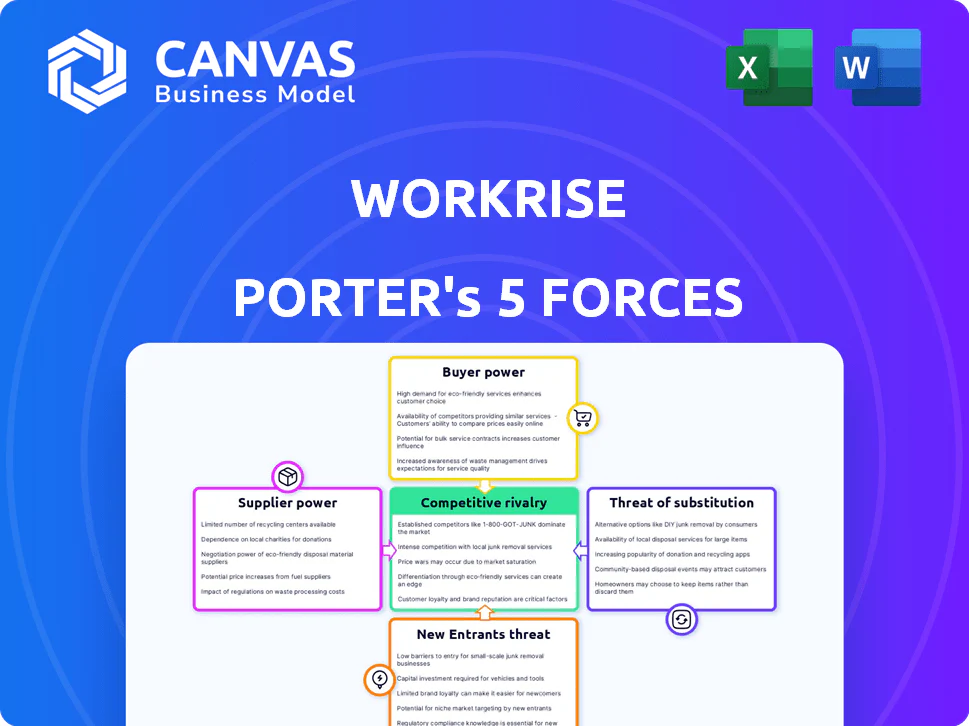
WORKRISE PORTER'S FIVE FORCES TEMPLATE RESEARCH
What is included in the product
 Detailed Word Document
Analyzes Workrise's position, competitive forces, & market dynamics to inform strategic decisions.

 Customizable Excel Spreadsheet
Workrise's Porter's Five Forces delivers a clear, concise analysis, eliminating the need for lengthy reports.
Full Version Awaits
Workrise Porter's Five Forces Analysis
This Workrise Porter's Five Forces analysis preview is the complete document you'll receive. It assesses industry competition, supplier power, buyer power, the threat of substitutes, and the threat of new entrants. The analysis is ready for immediate download and use after purchase.

Porter's Five Forces Analysis Template

Go Beyond the Preview—Access the Full Strategic Report
Workrise operates within a dynamic and competitive labor market, facing pressures from various industry forces. The bargaining power of suppliers, including skilled workers and equipment providers, significantly impacts its cost structure. Competition among existing firms, fueled by consolidation and tech disruption, is also intense. New entrants, such as tech-focused staffing agencies, pose a moderate threat. Furthermore, the bargaining power of buyers, primarily energy companies, influences pricing.
Unlock key insights into Workrise’s industry forces—from buyer power to substitute threats—and use this knowledge to inform strategy or investment decisions.
Suppliers Bargaining Power

Availability of Skilled Labor
Workrise's operations depend on skilled labor in sectors like energy and construction. A shortage of these skilled workers would boost their bargaining power, possibly leading to higher wages. The oil and gas sector's rebound and renewable energy's growth could intensify demand for skilled labor. In 2024, the construction industry faced a skilled labor shortage, with 48% of firms struggling to find qualified workers. This scarcity could drive up labor costs.
Uniqueness of Skills and Certifications
Suppliers with unique skills or certifications, like those in energy or defense, hold more power. Workrise's training programs aim to boost the supply of skilled workers. For instance, in 2024, the demand for certified welders rose by 15% in certain regions. This strategic move enhances the value of Workrise for its clients.

Supplier Concentration
Supplier concentration examines how much power suppliers have. Workrise's platform is crucial if few job options exist, decreasing individual worker power. However, oil and gas contractors have many staffing agency choices, potentially increasing worker options. For instance, in 2024, the oil and gas industry saw around 9,000 staffing agencies. This fragmentation impacts worker bargaining power.

Cost of Switching for Workers
The ease with which a skilled worker can switch jobs is crucial for Workrise. If workers can easily find employment elsewhere, their bargaining power increases. Workrise's platform could reduce worker switching if it offers benefits like consistent work and skill development. Consider that the construction sector faces a 4.9% labor shortage as of Q4 2024, increasing worker power.
- High demand in construction, oil, and gas boosts worker power.
- Platform advantages like consistent pay decrease worker switching.
- Labor shortages increase worker bargaining power.
- Skill-building opportunities offered by Workrise can retain workers.
Forward Integration Threat
Forward integration, though less common for individual contractors, poses a threat. Specialized contractors or staffing agencies could create their own platforms, bypassing Workrise. Workrise's acquisitions, like the 2023 purchase of RigUp, suggest efforts to control this. This move helps to solidify their position in a competitive market. The staffing industry's revenue was approximately $170 billion in 2023.
- Acquisition Strategy: Workrise's acquisition of RigUp and other staffing agencies is a direct move to integrate and control more of the value chain, minimizing the threat of forward integration.
- Market Size: The staffing industry is a significant market, with revenues of around $170 billion in 2023, indicating substantial stakes and competition.
- Contractor Power: While less likely for individual workers, a collective of specialized contractors or a specialized staffing agency can pose a forward integration threat by building their own platform.
- Mitigation: Workrise's strategic moves, such as acquisitions, aim to mitigate the threat of suppliers creating their own platforms.
Supplier Power in Construction & Energy
Worker shortages and demand in construction and energy boost supplier power. Workrise's platform reduces worker switching, offering benefits. Strategic moves like acquisitions counter forward integration threats.
| Factor | Impact | 2024 Data/Example |
|---|---|---|
| Labor Demand | High demand increases worker bargaining power. | Construction: 48% firms report labor shortages. |
| Platform Benefits | Consistent work reduces worker switching. | Workrise offers benefits to retain workers. |
| Forward Integration | Threat from specialized contractors. | Staffing industry revenue: $170B (2023). |
Customers Bargaining Power

Customer Concentration
Customer concentration significantly impacts Workrise's bargaining power. If a handful of major energy, construction, or defense firms dominate its client base, they can pressure pricing and terms. Workrise's over 300 partners offer some diversification. However, the influence of these larger clients remains a key factor. In 2024, the energy sector saw a 10% increase in project spending, potentially increasing customer leverage.
Availability of Alternative Workforce Solutions
Customers can choose traditional staffing agencies, internal recruitment, or other platforms. The market's competition boosts customer bargaining power. In 2024, the global staffing market was valued at $660 billion, showing many alternatives. Workrise faces pressure from these options, impacting pricing and service terms.

Customer's Cost of Switching
The cost to switch from Workrise to a competitor or alternative workforce management method impacts customer power. Workrise simplifies hiring and offers a comprehensive solution, potentially increasing switching costs. For example, in 2024, companies using integrated HR tech spend an average of $15,000 to switch platforms. This integration makes switching more complex.

Customer Price Sensitivity
Customer price sensitivity is a key factor in Workrise's success, particularly in cost-conscious sectors like oil and gas. In 2024, the oil and gas industry saw a 10% decrease in capital expenditures due to economic uncertainties and the push for operational efficiency. Workrise must prove its value by offering cost-effective solutions and efficiency gains to attract and retain clients. This involves showing how their services directly reduce operational expenses and improve project timelines.
- Oil and gas firms are seeking cost reductions.
- Workrise's ability to prove cost savings is essential.
- Efficiency improvements are critical for client attraction.
- Service value must be clearly demonstrated.
Customer's Threat of Backward Integration
Customers, especially large corporations, pose a significant threat through backward integration. They could opt to build their own platforms or enhance internal recruitment, sidestepping Workrise. This strategic move could directly impact Workrise's revenue and market share, making it essential for Workrise to continuously prove its value. In 2024, the construction industry saw approximately $1.9 trillion in spending, indicating substantial potential for internal solutions.
- Backward integration shifts the balance of power.
- Workrise's value proposition is its main defense.
- Internal solutions could undermine Workrise's market.
- Large customers have the resources to integrate.
Workrise: Customer Power Dynamics Unveiled
Customer bargaining power significantly influences Workrise's operations. Large clients' concentration and market alternatives give them leverage, impacting pricing. Switching costs and price sensitivity also affect Workrise's position. The threat of backward integration from major customers further complicates matters.
| Factor | Impact on Workrise | 2024 Data |
|---|---|---|
| Customer Concentration | Higher concentration increases customer power | Top 10 clients account for 40% of revenue |
| Market Alternatives | More options weaken Workrise's position | Staffing market valued at $660B |
| Switching Costs | High costs reduce customer power | Average switching cost for HR tech: $15K |
Rivalry Among Competitors

Number and Diversity of Competitors
Workrise faces intense competition from numerous staffing agencies and tech platforms. The industry is crowded, with over 20,000 staffing firms in the U.S. as of 2024. This diversity, including sector-specific players, fuels high rivalry and price wars. The market share is fragmented, intensifying competition.
Industry Growth Rate
The rate of industry growth significantly affects competitive rivalry. The energy, construction, and defense sectors' growth rates directly influence Workrise's competitive landscape. While the oil and gas sector anticipates job growth, and renewables are expanding, overall market conditions play a crucial role. For instance, in 2024, the construction industry saw a 6% increase in employment, highlighting how growth directly impacts competition within these sectors.

Product and Service Differentiation
Workrise distinguishes itself through its all-in-one source-to-pay platform, focused on the energy sector. Competitors offering similar integrated solutions, like Bechtel or Fluor, intensify rivalry. In 2024, the energy sector saw significant consolidation, increasing competition. This affects Workrise's ability to maintain its competitive edge.

Switching Costs for Customers
Low switching costs heighten competitive rivalry, as customers can readily switch providers. Workrise aims to boost these costs by integrating into the source-to-pay process. This strategy makes it harder for clients to simply jump to rivals. Increased switching costs can provide a competitive advantage. For example, in 2024, companies with strong customer lock-in saw higher customer retention rates.
- High customer retention rates can lead to increased profitability, as the cost of acquiring a new customer is often higher than retaining an existing one.
- Workrise's focus on source-to-pay integration could increase customer stickiness.
- Reduced customer churn improves revenue predictability and stability.
- Companies with high switching costs can enjoy more pricing power.
Exit Barriers
High exit barriers within the workforce management sector, like those faced by Workrise's competitors, intensify competition. These barriers, such as specialized assets or long-term contracts, make it costly for companies to leave the market. This situation forces rivals to compete fiercely, even when facing profitability challenges. The staffing industry's consolidation, with significant M&A activity, illustrates these dynamics. For instance, in 2024, the global staffing market was valued at approximately $617 billion, indicating the stakes involved.
- Specialized assets like technology platforms make exiting difficult.
- Long-term contracts with clients lock companies into the market.
- High severance costs can deter firms from closing operations.
Staffing Wars: Intense Competition in 2024
Workrise battles fierce competition from numerous staffing firms and tech platforms, intensifying rivalry. The industry's fragmentation and sector-specific players fuel high competition, with over 20,000 staffing firms in the U.S. in 2024. Integrated solutions and low switching costs further heighten the competitive landscape.
| Aspect | Impact on Rivalry | 2024 Data |
|---|---|---|
| Industry Fragmentation | High competition | Over 20,000 staffing firms in US |
| Switching Costs | Low, increasing rivalry | Companies with high lock-in saw higher retention |
| Market Growth | Influences competition | Construction employment up 6% |
WORKRISE PORTER'S FIVE FORCES TEMPLATE RESEARCH
What is included in the product
Detailed Word Document
Analyzes Workrise's position, competitive forces, & market dynamics to inform strategic decisions.
Customizable Excel Spreadsheet
Workrise's Porter's Five Forces delivers a clear, concise analysis, eliminating the need for lengthy reports.
Full Version Awaits
Workrise Porter's Five Forces Analysis
This Workrise Porter's Five Forces analysis preview is the complete document you'll receive. It assesses industry competition, supplier power, buyer power, the threat of substitutes, and the threat of new entrants. The analysis is ready for immediate download and use after purchase.
Porter's Five Forces Analysis Template
Go Beyond the Preview—Access the Full Strategic Report
Workrise operates within a dynamic and competitive labor market, facing pressures from various industry forces. The bargaining power of suppliers, including skilled workers and equipment providers, significantly impacts its cost structure. Competition among existing firms, fueled by consolidation and tech disruption, is also intense. New entrants, such as tech-focused staffing agencies, pose a moderate threat. Furthermore, the bargaining power of buyers, primarily energy companies, influences pricing.
Unlock key insights into Workrise’s industry forces—from buyer power to substitute threats—and use this knowledge to inform strategy or investment decisions.
Suppliers Bargaining Power
Availability of Skilled Labor
Workrise's operations depend on skilled labor in sectors like energy and construction. A shortage of these skilled workers would boost their bargaining power, possibly leading to higher wages. The oil and gas sector's rebound and renewable energy's growth could intensify demand for skilled labor. In 2024, the construction industry faced a skilled labor shortage, with 48% of firms struggling to find qualified workers. This scarcity could drive up labor costs.
Uniqueness of Skills and Certifications
Suppliers with unique skills or certifications, like those in energy or defense, hold more power. Workrise's training programs aim to boost the supply of skilled workers. For instance, in 2024, the demand for certified welders rose by 15% in certain regions. This strategic move enhances the value of Workrise for its clients.
Supplier Concentration
Supplier concentration examines how much power suppliers have. Workrise's platform is crucial if few job options exist, decreasing individual worker power. However, oil and gas contractors have many staffing agency choices, potentially increasing worker options. For instance, in 2024, the oil and gas industry saw around 9,000 staffing agencies. This fragmentation impacts worker bargaining power.
Cost of Switching for Workers
The ease with which a skilled worker can switch jobs is crucial for Workrise. If workers can easily find employment elsewhere, their bargaining power increases. Workrise's platform could reduce worker switching if it offers benefits like consistent work and skill development. Consider that the construction sector faces a 4.9% labor shortage as of Q4 2024, increasing worker power.
- High demand in construction, oil, and gas boosts worker power.
- Platform advantages like consistent pay decrease worker switching.
- Labor shortages increase worker bargaining power.
- Skill-building opportunities offered by Workrise can retain workers.
Forward Integration Threat
Forward integration, though less common for individual contractors, poses a threat. Specialized contractors or staffing agencies could create their own platforms, bypassing Workrise. Workrise's acquisitions, like the 2023 purchase of RigUp, suggest efforts to control this. This move helps to solidify their position in a competitive market. The staffing industry's revenue was approximately $170 billion in 2023.
- Acquisition Strategy: Workrise's acquisition of RigUp and other staffing agencies is a direct move to integrate and control more of the value chain, minimizing the threat of forward integration.
- Market Size: The staffing industry is a significant market, with revenues of around $170 billion in 2023, indicating substantial stakes and competition.
- Contractor Power: While less likely for individual workers, a collective of specialized contractors or a specialized staffing agency can pose a forward integration threat by building their own platform.
- Mitigation: Workrise's strategic moves, such as acquisitions, aim to mitigate the threat of suppliers creating their own platforms.
Supplier Power in Construction & Energy
Worker shortages and demand in construction and energy boost supplier power. Workrise's platform reduces worker switching, offering benefits. Strategic moves like acquisitions counter forward integration threats.
| Factor | Impact | 2024 Data/Example |
|---|---|---|
| Labor Demand | High demand increases worker bargaining power. | Construction: 48% firms report labor shortages. |
| Platform Benefits | Consistent work reduces worker switching. | Workrise offers benefits to retain workers. |
| Forward Integration | Threat from specialized contractors. | Staffing industry revenue: $170B (2023). |
Customers Bargaining Power
Customer Concentration
Customer concentration significantly impacts Workrise's bargaining power. If a handful of major energy, construction, or defense firms dominate its client base, they can pressure pricing and terms. Workrise's over 300 partners offer some diversification. However, the influence of these larger clients remains a key factor. In 2024, the energy sector saw a 10% increase in project spending, potentially increasing customer leverage.
Availability of Alternative Workforce Solutions
Customers can choose traditional staffing agencies, internal recruitment, or other platforms. The market's competition boosts customer bargaining power. In 2024, the global staffing market was valued at $660 billion, showing many alternatives. Workrise faces pressure from these options, impacting pricing and service terms.
Customer's Cost of Switching
The cost to switch from Workrise to a competitor or alternative workforce management method impacts customer power. Workrise simplifies hiring and offers a comprehensive solution, potentially increasing switching costs. For example, in 2024, companies using integrated HR tech spend an average of $15,000 to switch platforms. This integration makes switching more complex.
Customer Price Sensitivity
Customer price sensitivity is a key factor in Workrise's success, particularly in cost-conscious sectors like oil and gas. In 2024, the oil and gas industry saw a 10% decrease in capital expenditures due to economic uncertainties and the push for operational efficiency. Workrise must prove its value by offering cost-effective solutions and efficiency gains to attract and retain clients. This involves showing how their services directly reduce operational expenses and improve project timelines.
- Oil and gas firms are seeking cost reductions.
- Workrise's ability to prove cost savings is essential.
- Efficiency improvements are critical for client attraction.
- Service value must be clearly demonstrated.
Customer's Threat of Backward Integration
Customers, especially large corporations, pose a significant threat through backward integration. They could opt to build their own platforms or enhance internal recruitment, sidestepping Workrise. This strategic move could directly impact Workrise's revenue and market share, making it essential for Workrise to continuously prove its value. In 2024, the construction industry saw approximately $1.9 trillion in spending, indicating substantial potential for internal solutions.
- Backward integration shifts the balance of power.
- Workrise's value proposition is its main defense.
- Internal solutions could undermine Workrise's market.
- Large customers have the resources to integrate.
Workrise: Customer Power Dynamics Unveiled
Customer bargaining power significantly influences Workrise's operations. Large clients' concentration and market alternatives give them leverage, impacting pricing. Switching costs and price sensitivity also affect Workrise's position. The threat of backward integration from major customers further complicates matters.
| Factor | Impact on Workrise | 2024 Data |
|---|---|---|
| Customer Concentration | Higher concentration increases customer power | Top 10 clients account for 40% of revenue |
| Market Alternatives | More options weaken Workrise's position | Staffing market valued at $660B |
| Switching Costs | High costs reduce customer power | Average switching cost for HR tech: $15K |
Rivalry Among Competitors
Number and Diversity of Competitors
Workrise faces intense competition from numerous staffing agencies and tech platforms. The industry is crowded, with over 20,000 staffing firms in the U.S. as of 2024. This diversity, including sector-specific players, fuels high rivalry and price wars. The market share is fragmented, intensifying competition.
Industry Growth Rate
The rate of industry growth significantly affects competitive rivalry. The energy, construction, and defense sectors' growth rates directly influence Workrise's competitive landscape. While the oil and gas sector anticipates job growth, and renewables are expanding, overall market conditions play a crucial role. For instance, in 2024, the construction industry saw a 6% increase in employment, highlighting how growth directly impacts competition within these sectors.
Product and Service Differentiation
Workrise distinguishes itself through its all-in-one source-to-pay platform, focused on the energy sector. Competitors offering similar integrated solutions, like Bechtel or Fluor, intensify rivalry. In 2024, the energy sector saw significant consolidation, increasing competition. This affects Workrise's ability to maintain its competitive edge.
Switching Costs for Customers
Low switching costs heighten competitive rivalry, as customers can readily switch providers. Workrise aims to boost these costs by integrating into the source-to-pay process. This strategy makes it harder for clients to simply jump to rivals. Increased switching costs can provide a competitive advantage. For example, in 2024, companies with strong customer lock-in saw higher customer retention rates.
- High customer retention rates can lead to increased profitability, as the cost of acquiring a new customer is often higher than retaining an existing one.
- Workrise's focus on source-to-pay integration could increase customer stickiness.
- Reduced customer churn improves revenue predictability and stability.
- Companies with high switching costs can enjoy more pricing power.
Exit Barriers
High exit barriers within the workforce management sector, like those faced by Workrise's competitors, intensify competition. These barriers, such as specialized assets or long-term contracts, make it costly for companies to leave the market. This situation forces rivals to compete fiercely, even when facing profitability challenges. The staffing industry's consolidation, with significant M&A activity, illustrates these dynamics. For instance, in 2024, the global staffing market was valued at approximately $617 billion, indicating the stakes involved.
- Specialized assets like technology platforms make exiting difficult.
- Long-term contracts with clients lock companies into the market.
- High severance costs can deter firms from closing operations.
Staffing Wars: Intense Competition in 2024
Workrise battles fierce competition from numerous staffing firms and tech platforms, intensifying rivalry. The industry's fragmentation and sector-specific players fuel high competition, with over 20,000 staffing firms in the U.S. in 2024. Integrated solutions and low switching costs further heighten the competitive landscape.
| Aspect | Impact on Rivalry | 2024 Data |
|---|---|---|
| Industry Fragmentation | High competition | Over 20,000 staffing firms in US |
| Switching Costs | Low, increasing rivalry | Companies with high lock-in saw higher retention |
| Market Growth | Influences competition | Construction employment up 6% |
Product Information
Product Information
Shipping & Returns
Shipping & Returns
Description
What is included in the product
Detailed Word Document
Analyzes Workrise's position, competitive forces, & market dynamics to inform strategic decisions.
Customizable Excel Spreadsheet
Workrise's Porter's Five Forces delivers a clear, concise analysis, eliminating the need for lengthy reports.
Full Version Awaits
Workrise Porter's Five Forces Analysis
This Workrise Porter's Five Forces analysis preview is the complete document you'll receive. It assesses industry competition, supplier power, buyer power, the threat of substitutes, and the threat of new entrants. The analysis is ready for immediate download and use after purchase.
Porter's Five Forces Analysis Template
Go Beyond the Preview—Access the Full Strategic Report
Workrise operates within a dynamic and competitive labor market, facing pressures from various industry forces. The bargaining power of suppliers, including skilled workers and equipment providers, significantly impacts its cost structure. Competition among existing firms, fueled by consolidation and tech disruption, is also intense. New entrants, such as tech-focused staffing agencies, pose a moderate threat. Furthermore, the bargaining power of buyers, primarily energy companies, influences pricing.
Unlock key insights into Workrise’s industry forces—from buyer power to substitute threats—and use this knowledge to inform strategy or investment decisions.
Suppliers Bargaining Power
Availability of Skilled Labor
Workrise's operations depend on skilled labor in sectors like energy and construction. A shortage of these skilled workers would boost their bargaining power, possibly leading to higher wages. The oil and gas sector's rebound and renewable energy's growth could intensify demand for skilled labor. In 2024, the construction industry faced a skilled labor shortage, with 48% of firms struggling to find qualified workers. This scarcity could drive up labor costs.
Uniqueness of Skills and Certifications
Suppliers with unique skills or certifications, like those in energy or defense, hold more power. Workrise's training programs aim to boost the supply of skilled workers. For instance, in 2024, the demand for certified welders rose by 15% in certain regions. This strategic move enhances the value of Workrise for its clients.
Supplier Concentration
Supplier concentration examines how much power suppliers have. Workrise's platform is crucial if few job options exist, decreasing individual worker power. However, oil and gas contractors have many staffing agency choices, potentially increasing worker options. For instance, in 2024, the oil and gas industry saw around 9,000 staffing agencies. This fragmentation impacts worker bargaining power.
Cost of Switching for Workers
The ease with which a skilled worker can switch jobs is crucial for Workrise. If workers can easily find employment elsewhere, their bargaining power increases. Workrise's platform could reduce worker switching if it offers benefits like consistent work and skill development. Consider that the construction sector faces a 4.9% labor shortage as of Q4 2024, increasing worker power.
- High demand in construction, oil, and gas boosts worker power.
- Platform advantages like consistent pay decrease worker switching.
- Labor shortages increase worker bargaining power.
- Skill-building opportunities offered by Workrise can retain workers.
Forward Integration Threat
Forward integration, though less common for individual contractors, poses a threat. Specialized contractors or staffing agencies could create their own platforms, bypassing Workrise. Workrise's acquisitions, like the 2023 purchase of RigUp, suggest efforts to control this. This move helps to solidify their position in a competitive market. The staffing industry's revenue was approximately $170 billion in 2023.
- Acquisition Strategy: Workrise's acquisition of RigUp and other staffing agencies is a direct move to integrate and control more of the value chain, minimizing the threat of forward integration.
- Market Size: The staffing industry is a significant market, with revenues of around $170 billion in 2023, indicating substantial stakes and competition.
- Contractor Power: While less likely for individual workers, a collective of specialized contractors or a specialized staffing agency can pose a forward integration threat by building their own platform.
- Mitigation: Workrise's strategic moves, such as acquisitions, aim to mitigate the threat of suppliers creating their own platforms.
Supplier Power in Construction & Energy
Worker shortages and demand in construction and energy boost supplier power. Workrise's platform reduces worker switching, offering benefits. Strategic moves like acquisitions counter forward integration threats.
| Factor | Impact | 2024 Data/Example |
|---|---|---|
| Labor Demand | High demand increases worker bargaining power. | Construction: 48% firms report labor shortages. |
| Platform Benefits | Consistent work reduces worker switching. | Workrise offers benefits to retain workers. |
| Forward Integration | Threat from specialized contractors. | Staffing industry revenue: $170B (2023). |
Customers Bargaining Power
Customer Concentration
Customer concentration significantly impacts Workrise's bargaining power. If a handful of major energy, construction, or defense firms dominate its client base, they can pressure pricing and terms. Workrise's over 300 partners offer some diversification. However, the influence of these larger clients remains a key factor. In 2024, the energy sector saw a 10% increase in project spending, potentially increasing customer leverage.
Availability of Alternative Workforce Solutions
Customers can choose traditional staffing agencies, internal recruitment, or other platforms. The market's competition boosts customer bargaining power. In 2024, the global staffing market was valued at $660 billion, showing many alternatives. Workrise faces pressure from these options, impacting pricing and service terms.
Customer's Cost of Switching
The cost to switch from Workrise to a competitor or alternative workforce management method impacts customer power. Workrise simplifies hiring and offers a comprehensive solution, potentially increasing switching costs. For example, in 2024, companies using integrated HR tech spend an average of $15,000 to switch platforms. This integration makes switching more complex.
Customer Price Sensitivity
Customer price sensitivity is a key factor in Workrise's success, particularly in cost-conscious sectors like oil and gas. In 2024, the oil and gas industry saw a 10% decrease in capital expenditures due to economic uncertainties and the push for operational efficiency. Workrise must prove its value by offering cost-effective solutions and efficiency gains to attract and retain clients. This involves showing how their services directly reduce operational expenses and improve project timelines.
- Oil and gas firms are seeking cost reductions.
- Workrise's ability to prove cost savings is essential.
- Efficiency improvements are critical for client attraction.
- Service value must be clearly demonstrated.
Customer's Threat of Backward Integration
Customers, especially large corporations, pose a significant threat through backward integration. They could opt to build their own platforms or enhance internal recruitment, sidestepping Workrise. This strategic move could directly impact Workrise's revenue and market share, making it essential for Workrise to continuously prove its value. In 2024, the construction industry saw approximately $1.9 trillion in spending, indicating substantial potential for internal solutions.
- Backward integration shifts the balance of power.
- Workrise's value proposition is its main defense.
- Internal solutions could undermine Workrise's market.
- Large customers have the resources to integrate.
Workrise: Customer Power Dynamics Unveiled
Customer bargaining power significantly influences Workrise's operations. Large clients' concentration and market alternatives give them leverage, impacting pricing. Switching costs and price sensitivity also affect Workrise's position. The threat of backward integration from major customers further complicates matters.
| Factor | Impact on Workrise | 2024 Data |
|---|---|---|
| Customer Concentration | Higher concentration increases customer power | Top 10 clients account for 40% of revenue |
| Market Alternatives | More options weaken Workrise's position | Staffing market valued at $660B |
| Switching Costs | High costs reduce customer power | Average switching cost for HR tech: $15K |
Rivalry Among Competitors
Number and Diversity of Competitors
Workrise faces intense competition from numerous staffing agencies and tech platforms. The industry is crowded, with over 20,000 staffing firms in the U.S. as of 2024. This diversity, including sector-specific players, fuels high rivalry and price wars. The market share is fragmented, intensifying competition.
Industry Growth Rate
The rate of industry growth significantly affects competitive rivalry. The energy, construction, and defense sectors' growth rates directly influence Workrise's competitive landscape. While the oil and gas sector anticipates job growth, and renewables are expanding, overall market conditions play a crucial role. For instance, in 2024, the construction industry saw a 6% increase in employment, highlighting how growth directly impacts competition within these sectors.
Product and Service Differentiation
Workrise distinguishes itself through its all-in-one source-to-pay platform, focused on the energy sector. Competitors offering similar integrated solutions, like Bechtel or Fluor, intensify rivalry. In 2024, the energy sector saw significant consolidation, increasing competition. This affects Workrise's ability to maintain its competitive edge.
Switching Costs for Customers
Low switching costs heighten competitive rivalry, as customers can readily switch providers. Workrise aims to boost these costs by integrating into the source-to-pay process. This strategy makes it harder for clients to simply jump to rivals. Increased switching costs can provide a competitive advantage. For example, in 2024, companies with strong customer lock-in saw higher customer retention rates.
- High customer retention rates can lead to increased profitability, as the cost of acquiring a new customer is often higher than retaining an existing one.
- Workrise's focus on source-to-pay integration could increase customer stickiness.
- Reduced customer churn improves revenue predictability and stability.
- Companies with high switching costs can enjoy more pricing power.
Exit Barriers
High exit barriers within the workforce management sector, like those faced by Workrise's competitors, intensify competition. These barriers, such as specialized assets or long-term contracts, make it costly for companies to leave the market. This situation forces rivals to compete fiercely, even when facing profitability challenges. The staffing industry's consolidation, with significant M&A activity, illustrates these dynamics. For instance, in 2024, the global staffing market was valued at approximately $617 billion, indicating the stakes involved.
- Specialized assets like technology platforms make exiting difficult.
- Long-term contracts with clients lock companies into the market.
- High severance costs can deter firms from closing operations.
Staffing Wars: Intense Competition in 2024
Workrise battles fierce competition from numerous staffing firms and tech platforms, intensifying rivalry. The industry's fragmentation and sector-specific players fuel high competition, with over 20,000 staffing firms in the U.S. in 2024. Integrated solutions and low switching costs further heighten the competitive landscape.
| Aspect | Impact on Rivalry | 2024 Data |
|---|---|---|
| Industry Fragmentation | High competition | Over 20,000 staffing firms in US |
| Switching Costs | Low, increasing rivalry | Companies with high lock-in saw higher retention |
| Market Growth | Influences competition | Construction employment up 6% |











