WORLD REMIT PORTER'S FIVE FORCES TEMPLATE RESEARCH
What is included in the product
 Detailed Word Document
Tailored exclusively for World Remit, analyzing its position within its competitive landscape.

 Customizable Excel Spreadsheet
Swap in real-time data to track evolving industry dynamics.
Preview the Actual Deliverable
World Remit Porter's Five Forces Analysis
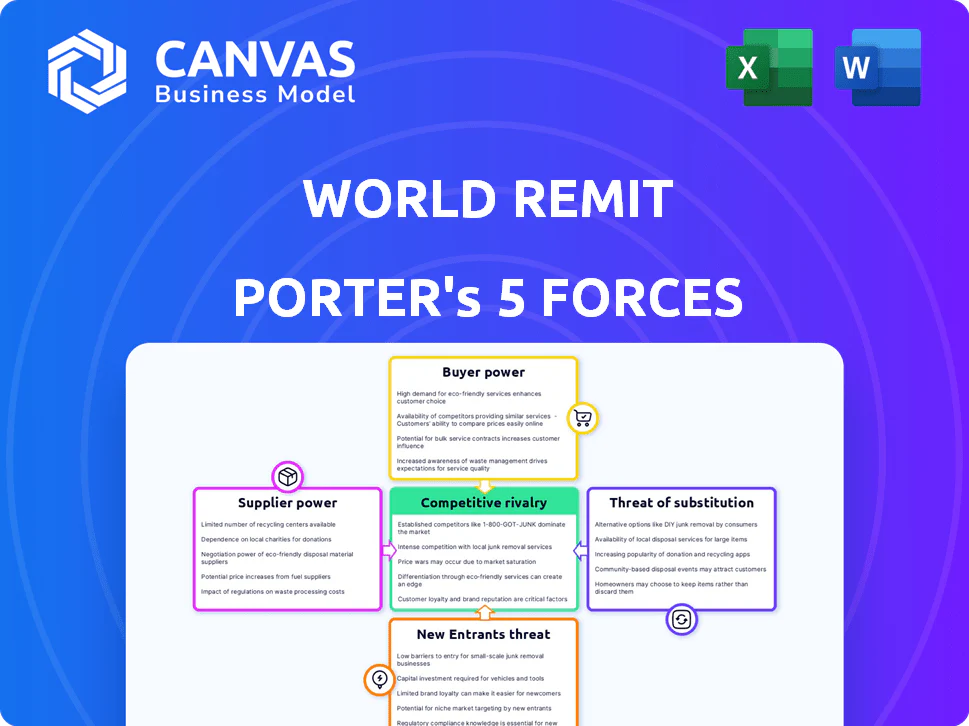
This preview showcases the complete Porter's Five Forces analysis for WorldRemit. It comprehensively examines competitive rivalry, supplier power, buyer power, the threat of substitution, and the threat of new entrants. The document delves into each force, providing a detailed assessment relevant to WorldRemit's industry landscape. This is the complete, ready-to-use analysis file. What you're previewing is what you get—professionally formatted and ready for your needs.

Porter's Five Forces Analysis Template

A Must-Have Tool for Decision-Makers
WorldRemit operates in a competitive remittance market, facing challenges from established players and agile fintech disruptors. Buyer power is moderate due to readily available alternatives and price sensitivity. The threat of new entrants is high, with low barriers to entry and technological advancements. Intense competition from existing players and substitute services like digital wallets further shapes the landscape.
This brief snapshot only scratches the surface. Unlock the full Porter's Five Forces Analysis to explore World Remit’s competitive dynamics, market pressures, and strategic advantages in detail.
Suppliers Bargaining Power

Technology Providers
WorldRemit depends on tech providers for its digital platform. The number of specialized tech suppliers, like payment gateways, is limited. This scarcity gives suppliers negotiation power. In 2024, the global fintech market was valued at $154.8 billion, illustrating the importance and influence of these providers.
Payment Processors and Banks
WorldRemit relies heavily on payment processors and banks for transactions, including payouts via bank deposits and cash pickups. These entities' fees directly affect WorldRemit's operational expenses. In 2024, transaction fees for international money transfers averaged between 1% and 5%, impacting profitability. Higher fees from these suppliers can squeeze WorldRemit's margins.

Mobile Network Operators
WorldRemit heavily relies on mobile network operators (MNOs) for mobile money and airtime top-up services. MNOs' widespread presence gives them considerable bargaining power, especially in markets where they dominate. In 2024, the global mobile money transaction value hit $1.2 trillion, highlighting MNOs' influence. This power can affect WorldRemit's pricing and service terms.

Local Payout Partners
WorldRemit's reliance on local payout partners significantly impacts its operations. These partners, crucial for cash pickup services, hold considerable bargaining power. Their availability and agreement terms directly influence WorldRemit's service delivery and cost structure in specific regions.
- Partners can negotiate rates, affecting WorldRemit's profitability.
- The number and quality of partners vary by region, impacting service coverage.
- Competition among partners can drive more favorable terms for WorldRemit.
- In 2024, WorldRemit processed approximately 150 million transactions.
Regulatory Bodies
Regulatory bodies exert considerable influence over WorldRemit. The company must adhere to diverse licensing rules across various countries, impacting operational costs. Compliance with these regulations affects its ability to expand. WorldRemit's strategic decisions are often shaped by these regulatory demands.
- Licensing costs can be substantial, with fees varying by country.
- Regulatory changes can force operational adjustments, potentially increasing expenses.
- Compliance failures result in penalties, affecting profitability and reputation.
- The regulatory environment significantly influences market entry and growth strategies.
Supplier Power Dynamics Impacting Fintech Costs
WorldRemit faces supplier power from tech, payment, and mobile operators. These suppliers, including payment gateways and MNOs, have negotiation strength. In 2024, the global fintech market was substantial, impacting WorldRemit's costs and operations.
| Supplier Type | Impact on WorldRemit | 2024 Data |
|---|---|---|
| Tech Providers | Platform Dependency | Fintech market: $154.8B |
| Payment Processors | Transaction Costs | Int'l transfer fees: 1-5% |
| MNOs | Mobile Money Services | Mobile money value: $1.2T |
Customers Bargaining Power

Price Sensitivity
Customers in the money transfer market are price-sensitive, always seeking favorable exchange rates and low fees. Online comparison tools make it easy to compare prices, increasing customer bargaining power. In 2024, the average fee for international money transfers was around 5-7% of the amount sent, a key factor for customer decisions.
Availability of Alternatives
Customers of WorldRemit benefit from having numerous alternatives for international money transfers. Competitors include Western Union, Remitly, and Xoom, providing similar services. In 2024, the global remittances market was estimated at over $860 billion. This competition gives customers leverage to negotiate prices and terms.

Low Switching Costs
Customers of WorldRemit and similar services face low switching costs, enhancing their bargaining power. In 2024, the average cost to send money internationally was around 5.2% of the transfer amount, making it easy for customers to compare and switch providers. This ease of movement keeps providers competitive.

Access to Information
Customers wield significant bargaining power due to readily available information. They can effortlessly compare exchange rates, fees, and service reviews across various remittance platforms. This transparency enables informed choices, driving competition and potentially lowering prices for consumers. In 2024, the global remittances market is projected to reach $860 billion, with digital platforms like WorldRemit competing fiercely. This intense competition underscores the power of informed customers.
- Price Comparison: Customers can quickly compare fees and exchange rates.
- Service Reviews: Online reviews influence service provider selection.
- Switching Costs: Low switching costs empower customer mobility.
- Market Dynamics: Competitive pressure impacts pricing strategies.
Diverse Needs and Preferences
Customers wield significant power due to their diverse needs. WorldRemit must adapt to varied preferences for transfer methods, speed, and destination countries. This requires flexibility in offering services like bank transfers, cash pickups, and mobile money. Failing to meet these demands could lead to customer churn and loss of market share.
- Transfer Methods: Bank transfers, cash pickup, mobile money.
- Speed: Instant, same-day, or within a few days.
- Destination Countries: Serving numerous global locations.
- Customer Churn: A major concern in competitive markets.
Money Transfer: Fees & Customer Power
Customers have substantial bargaining power in the money transfer market, driven by price sensitivity and easy comparison. Online tools and reviews empower informed decisions, pressuring providers like WorldRemit. In 2024, the average transfer fee was about 5-7%, influencing customer choices.
| Factor | Impact | 2024 Data |
|---|---|---|
| Price Comparison | Influences provider selection | Avg. Fee: 5-7% |
| Switching Costs | Low, increasing mobility | Global Market: $860B+ |
| Service Reviews | Impacts reputation | Digital Growth: 10%+ |
Rivalry Among Competitors

Numerous Competitors
The digital remittance market is fiercely contested, boasting numerous participants like Western Union and newer fintechs. This crowded field intensifies price wars, squeezing profit margins for all involved. For example, in 2024, the average remittance fee was around 6%, a figure that continues to fluctuate. Continuous innovation is essential to stay competitive.
Presence of Large, Established Players
WorldRemit faces intense competition from established giants. Western Union, for example, generated over $5 billion in revenue in 2024. MoneyGram, another major player, processed $1.3 billion in money transfers during the same year. These firms boast strong brand recognition and vast agent networks, which are tough to compete with. Digital expansion is a key focus for both, intensifying the rivalry.

Growth of Other Digital-First Companies
WorldRemit faces intense rivalry from digital-first firms like Wise and Remitly. These competitors offer similar services and compete fiercely on fees, exchange rates, and speed. Wise reported £848.8 million in revenue for the fiscal year 2024. Remitly processed $28.5 billion in money transfers in 2023, highlighting the scale of competition. This rivalry pressures WorldRemit to innovate and maintain competitive pricing.

Focus on Specific Corridors and Services
Competitive rivalry intensifies when competitors concentrate on specific corridors or services. WorldRemit must defend its market share in key areas. Rivals may undercut pricing or introduce new features to attract customers. Maintaining a robust presence across target markets is crucial for WorldRemit.
- In 2024, the remittance market was highly competitive, with players like Wise and Remitly focusing on specific corridors.
- WorldRemit's revenue in 2023 was around £300 million, indicating a substantial market share to protect.
- Competition in mobile money payouts increased, requiring WorldRemit to innovate in this segment.
- Price wars in popular remittance routes (e.g., the UK to India) are common.
Innovation and Technology
In the competitive world of WorldRemit, innovation is key. Companies are always updating features and user experiences. They also explore new tech, like blockchain. Keeping up with tech is vital to stay competitive. In 2024, the global fintech market was valued at over $150 billion, with blockchain solutions growing rapidly.
- Fintech market size in 2024: Over $150 billion.
- Blockchain solutions: Rapid growth.
- User experience: Constant improvement.
- New technologies: Continuous exploration.
Remittance Wars: Fees, Revenue, and Billions at Stake!
The digital remittance market is fiercely competitive, driving price wars and margin pressure. WorldRemit faces intense rivalry from both established giants and digital-first firms. Continuous innovation in fees and services is crucial for survival, amid a fintech market valued over $150 billion in 2024.
| Aspect | Details |
|---|---|
| Average Remittance Fee (2024) | ~6% |
| Wise Revenue (FY2024) | £848.8M |
| Remitly Transfers (2023) | $28.5B |
WORLD REMIT PORTER'S FIVE FORCES TEMPLATE RESEARCH
What is included in the product
Detailed Word Document
Tailored exclusively for World Remit, analyzing its position within its competitive landscape.
Customizable Excel Spreadsheet
Swap in real-time data to track evolving industry dynamics.
Preview the Actual Deliverable
World Remit Porter's Five Forces Analysis
This preview showcases the complete Porter's Five Forces analysis for WorldRemit. It comprehensively examines competitive rivalry, supplier power, buyer power, the threat of substitution, and the threat of new entrants. The document delves into each force, providing a detailed assessment relevant to WorldRemit's industry landscape. This is the complete, ready-to-use analysis file. What you're previewing is what you get—professionally formatted and ready for your needs.
Porter's Five Forces Analysis Template
A Must-Have Tool for Decision-Makers
WorldRemit operates in a competitive remittance market, facing challenges from established players and agile fintech disruptors. Buyer power is moderate due to readily available alternatives and price sensitivity. The threat of new entrants is high, with low barriers to entry and technological advancements. Intense competition from existing players and substitute services like digital wallets further shapes the landscape.
This brief snapshot only scratches the surface. Unlock the full Porter's Five Forces Analysis to explore World Remit’s competitive dynamics, market pressures, and strategic advantages in detail.
Suppliers Bargaining Power
Technology Providers
WorldRemit depends on tech providers for its digital platform. The number of specialized tech suppliers, like payment gateways, is limited. This scarcity gives suppliers negotiation power. In 2024, the global fintech market was valued at $154.8 billion, illustrating the importance and influence of these providers.
Payment Processors and Banks
WorldRemit relies heavily on payment processors and banks for transactions, including payouts via bank deposits and cash pickups. These entities' fees directly affect WorldRemit's operational expenses. In 2024, transaction fees for international money transfers averaged between 1% and 5%, impacting profitability. Higher fees from these suppliers can squeeze WorldRemit's margins.
Mobile Network Operators
WorldRemit heavily relies on mobile network operators (MNOs) for mobile money and airtime top-up services. MNOs' widespread presence gives them considerable bargaining power, especially in markets where they dominate. In 2024, the global mobile money transaction value hit $1.2 trillion, highlighting MNOs' influence. This power can affect WorldRemit's pricing and service terms.
Local Payout Partners
WorldRemit's reliance on local payout partners significantly impacts its operations. These partners, crucial for cash pickup services, hold considerable bargaining power. Their availability and agreement terms directly influence WorldRemit's service delivery and cost structure in specific regions.
- Partners can negotiate rates, affecting WorldRemit's profitability.
- The number and quality of partners vary by region, impacting service coverage.
- Competition among partners can drive more favorable terms for WorldRemit.
- In 2024, WorldRemit processed approximately 150 million transactions.
Regulatory Bodies
Regulatory bodies exert considerable influence over WorldRemit. The company must adhere to diverse licensing rules across various countries, impacting operational costs. Compliance with these regulations affects its ability to expand. WorldRemit's strategic decisions are often shaped by these regulatory demands.
- Licensing costs can be substantial, with fees varying by country.
- Regulatory changes can force operational adjustments, potentially increasing expenses.
- Compliance failures result in penalties, affecting profitability and reputation.
- The regulatory environment significantly influences market entry and growth strategies.
Supplier Power Dynamics Impacting Fintech Costs
WorldRemit faces supplier power from tech, payment, and mobile operators. These suppliers, including payment gateways and MNOs, have negotiation strength. In 2024, the global fintech market was substantial, impacting WorldRemit's costs and operations.
| Supplier Type | Impact on WorldRemit | 2024 Data |
|---|---|---|
| Tech Providers | Platform Dependency | Fintech market: $154.8B |
| Payment Processors | Transaction Costs | Int'l transfer fees: 1-5% |
| MNOs | Mobile Money Services | Mobile money value: $1.2T |
Customers Bargaining Power
Price Sensitivity
Customers in the money transfer market are price-sensitive, always seeking favorable exchange rates and low fees. Online comparison tools make it easy to compare prices, increasing customer bargaining power. In 2024, the average fee for international money transfers was around 5-7% of the amount sent, a key factor for customer decisions.
Availability of Alternatives
Customers of WorldRemit benefit from having numerous alternatives for international money transfers. Competitors include Western Union, Remitly, and Xoom, providing similar services. In 2024, the global remittances market was estimated at over $860 billion. This competition gives customers leverage to negotiate prices and terms.
Low Switching Costs
Customers of WorldRemit and similar services face low switching costs, enhancing their bargaining power. In 2024, the average cost to send money internationally was around 5.2% of the transfer amount, making it easy for customers to compare and switch providers. This ease of movement keeps providers competitive.
Access to Information
Customers wield significant bargaining power due to readily available information. They can effortlessly compare exchange rates, fees, and service reviews across various remittance platforms. This transparency enables informed choices, driving competition and potentially lowering prices for consumers. In 2024, the global remittances market is projected to reach $860 billion, with digital platforms like WorldRemit competing fiercely. This intense competition underscores the power of informed customers.
- Price Comparison: Customers can quickly compare fees and exchange rates.
- Service Reviews: Online reviews influence service provider selection.
- Switching Costs: Low switching costs empower customer mobility.
- Market Dynamics: Competitive pressure impacts pricing strategies.
Diverse Needs and Preferences
Customers wield significant power due to their diverse needs. WorldRemit must adapt to varied preferences for transfer methods, speed, and destination countries. This requires flexibility in offering services like bank transfers, cash pickups, and mobile money. Failing to meet these demands could lead to customer churn and loss of market share.
- Transfer Methods: Bank transfers, cash pickup, mobile money.
- Speed: Instant, same-day, or within a few days.
- Destination Countries: Serving numerous global locations.
- Customer Churn: A major concern in competitive markets.
Money Transfer: Fees & Customer Power
Customers have substantial bargaining power in the money transfer market, driven by price sensitivity and easy comparison. Online tools and reviews empower informed decisions, pressuring providers like WorldRemit. In 2024, the average transfer fee was about 5-7%, influencing customer choices.
| Factor | Impact | 2024 Data |
|---|---|---|
| Price Comparison | Influences provider selection | Avg. Fee: 5-7% |
| Switching Costs | Low, increasing mobility | Global Market: $860B+ |
| Service Reviews | Impacts reputation | Digital Growth: 10%+ |
Rivalry Among Competitors
Numerous Competitors
The digital remittance market is fiercely contested, boasting numerous participants like Western Union and newer fintechs. This crowded field intensifies price wars, squeezing profit margins for all involved. For example, in 2024, the average remittance fee was around 6%, a figure that continues to fluctuate. Continuous innovation is essential to stay competitive.
Presence of Large, Established Players
WorldRemit faces intense competition from established giants. Western Union, for example, generated over $5 billion in revenue in 2024. MoneyGram, another major player, processed $1.3 billion in money transfers during the same year. These firms boast strong brand recognition and vast agent networks, which are tough to compete with. Digital expansion is a key focus for both, intensifying the rivalry.
Growth of Other Digital-First Companies
WorldRemit faces intense rivalry from digital-first firms like Wise and Remitly. These competitors offer similar services and compete fiercely on fees, exchange rates, and speed. Wise reported £848.8 million in revenue for the fiscal year 2024. Remitly processed $28.5 billion in money transfers in 2023, highlighting the scale of competition. This rivalry pressures WorldRemit to innovate and maintain competitive pricing.
Focus on Specific Corridors and Services
Competitive rivalry intensifies when competitors concentrate on specific corridors or services. WorldRemit must defend its market share in key areas. Rivals may undercut pricing or introduce new features to attract customers. Maintaining a robust presence across target markets is crucial for WorldRemit.
- In 2024, the remittance market was highly competitive, with players like Wise and Remitly focusing on specific corridors.
- WorldRemit's revenue in 2023 was around £300 million, indicating a substantial market share to protect.
- Competition in mobile money payouts increased, requiring WorldRemit to innovate in this segment.
- Price wars in popular remittance routes (e.g., the UK to India) are common.
Innovation and Technology
In the competitive world of WorldRemit, innovation is key. Companies are always updating features and user experiences. They also explore new tech, like blockchain. Keeping up with tech is vital to stay competitive. In 2024, the global fintech market was valued at over $150 billion, with blockchain solutions growing rapidly.
- Fintech market size in 2024: Over $150 billion.
- Blockchain solutions: Rapid growth.
- User experience: Constant improvement.
- New technologies: Continuous exploration.
Remittance Wars: Fees, Revenue, and Billions at Stake!
The digital remittance market is fiercely competitive, driving price wars and margin pressure. WorldRemit faces intense rivalry from both established giants and digital-first firms. Continuous innovation in fees and services is crucial for survival, amid a fintech market valued over $150 billion in 2024.
| Aspect | Details |
|---|---|
| Average Remittance Fee (2024) | ~6% |
| Wise Revenue (FY2024) | £848.8M |
| Remitly Transfers (2023) | $28.5B |
Product Information
Product Information
Shipping & Returns
Shipping & Returns
Description
What is included in the product
Detailed Word Document
Tailored exclusively for World Remit, analyzing its position within its competitive landscape.
Customizable Excel Spreadsheet
Swap in real-time data to track evolving industry dynamics.
Preview the Actual Deliverable
World Remit Porter's Five Forces Analysis
This preview showcases the complete Porter's Five Forces analysis for WorldRemit. It comprehensively examines competitive rivalry, supplier power, buyer power, the threat of substitution, and the threat of new entrants. The document delves into each force, providing a detailed assessment relevant to WorldRemit's industry landscape. This is the complete, ready-to-use analysis file. What you're previewing is what you get—professionally formatted and ready for your needs.
Porter's Five Forces Analysis Template
A Must-Have Tool for Decision-Makers
WorldRemit operates in a competitive remittance market, facing challenges from established players and agile fintech disruptors. Buyer power is moderate due to readily available alternatives and price sensitivity. The threat of new entrants is high, with low barriers to entry and technological advancements. Intense competition from existing players and substitute services like digital wallets further shapes the landscape.
This brief snapshot only scratches the surface. Unlock the full Porter's Five Forces Analysis to explore World Remit’s competitive dynamics, market pressures, and strategic advantages in detail.
Suppliers Bargaining Power
Technology Providers
WorldRemit depends on tech providers for its digital platform. The number of specialized tech suppliers, like payment gateways, is limited. This scarcity gives suppliers negotiation power. In 2024, the global fintech market was valued at $154.8 billion, illustrating the importance and influence of these providers.
Payment Processors and Banks
WorldRemit relies heavily on payment processors and banks for transactions, including payouts via bank deposits and cash pickups. These entities' fees directly affect WorldRemit's operational expenses. In 2024, transaction fees for international money transfers averaged between 1% and 5%, impacting profitability. Higher fees from these suppliers can squeeze WorldRemit's margins.
Mobile Network Operators
WorldRemit heavily relies on mobile network operators (MNOs) for mobile money and airtime top-up services. MNOs' widespread presence gives them considerable bargaining power, especially in markets where they dominate. In 2024, the global mobile money transaction value hit $1.2 trillion, highlighting MNOs' influence. This power can affect WorldRemit's pricing and service terms.
Local Payout Partners
WorldRemit's reliance on local payout partners significantly impacts its operations. These partners, crucial for cash pickup services, hold considerable bargaining power. Their availability and agreement terms directly influence WorldRemit's service delivery and cost structure in specific regions.
- Partners can negotiate rates, affecting WorldRemit's profitability.
- The number and quality of partners vary by region, impacting service coverage.
- Competition among partners can drive more favorable terms for WorldRemit.
- In 2024, WorldRemit processed approximately 150 million transactions.
Regulatory Bodies
Regulatory bodies exert considerable influence over WorldRemit. The company must adhere to diverse licensing rules across various countries, impacting operational costs. Compliance with these regulations affects its ability to expand. WorldRemit's strategic decisions are often shaped by these regulatory demands.
- Licensing costs can be substantial, with fees varying by country.
- Regulatory changes can force operational adjustments, potentially increasing expenses.
- Compliance failures result in penalties, affecting profitability and reputation.
- The regulatory environment significantly influences market entry and growth strategies.
Supplier Power Dynamics Impacting Fintech Costs
WorldRemit faces supplier power from tech, payment, and mobile operators. These suppliers, including payment gateways and MNOs, have negotiation strength. In 2024, the global fintech market was substantial, impacting WorldRemit's costs and operations.
| Supplier Type | Impact on WorldRemit | 2024 Data |
|---|---|---|
| Tech Providers | Platform Dependency | Fintech market: $154.8B |
| Payment Processors | Transaction Costs | Int'l transfer fees: 1-5% |
| MNOs | Mobile Money Services | Mobile money value: $1.2T |
Customers Bargaining Power
Price Sensitivity
Customers in the money transfer market are price-sensitive, always seeking favorable exchange rates and low fees. Online comparison tools make it easy to compare prices, increasing customer bargaining power. In 2024, the average fee for international money transfers was around 5-7% of the amount sent, a key factor for customer decisions.
Availability of Alternatives
Customers of WorldRemit benefit from having numerous alternatives for international money transfers. Competitors include Western Union, Remitly, and Xoom, providing similar services. In 2024, the global remittances market was estimated at over $860 billion. This competition gives customers leverage to negotiate prices and terms.
Low Switching Costs
Customers of WorldRemit and similar services face low switching costs, enhancing their bargaining power. In 2024, the average cost to send money internationally was around 5.2% of the transfer amount, making it easy for customers to compare and switch providers. This ease of movement keeps providers competitive.
Access to Information
Customers wield significant bargaining power due to readily available information. They can effortlessly compare exchange rates, fees, and service reviews across various remittance platforms. This transparency enables informed choices, driving competition and potentially lowering prices for consumers. In 2024, the global remittances market is projected to reach $860 billion, with digital platforms like WorldRemit competing fiercely. This intense competition underscores the power of informed customers.
- Price Comparison: Customers can quickly compare fees and exchange rates.
- Service Reviews: Online reviews influence service provider selection.
- Switching Costs: Low switching costs empower customer mobility.
- Market Dynamics: Competitive pressure impacts pricing strategies.
Diverse Needs and Preferences
Customers wield significant power due to their diverse needs. WorldRemit must adapt to varied preferences for transfer methods, speed, and destination countries. This requires flexibility in offering services like bank transfers, cash pickups, and mobile money. Failing to meet these demands could lead to customer churn and loss of market share.
- Transfer Methods: Bank transfers, cash pickup, mobile money.
- Speed: Instant, same-day, or within a few days.
- Destination Countries: Serving numerous global locations.
- Customer Churn: A major concern in competitive markets.
Money Transfer: Fees & Customer Power
Customers have substantial bargaining power in the money transfer market, driven by price sensitivity and easy comparison. Online tools and reviews empower informed decisions, pressuring providers like WorldRemit. In 2024, the average transfer fee was about 5-7%, influencing customer choices.
| Factor | Impact | 2024 Data |
|---|---|---|
| Price Comparison | Influences provider selection | Avg. Fee: 5-7% |
| Switching Costs | Low, increasing mobility | Global Market: $860B+ |
| Service Reviews | Impacts reputation | Digital Growth: 10%+ |
Rivalry Among Competitors
Numerous Competitors
The digital remittance market is fiercely contested, boasting numerous participants like Western Union and newer fintechs. This crowded field intensifies price wars, squeezing profit margins for all involved. For example, in 2024, the average remittance fee was around 6%, a figure that continues to fluctuate. Continuous innovation is essential to stay competitive.
Presence of Large, Established Players
WorldRemit faces intense competition from established giants. Western Union, for example, generated over $5 billion in revenue in 2024. MoneyGram, another major player, processed $1.3 billion in money transfers during the same year. These firms boast strong brand recognition and vast agent networks, which are tough to compete with. Digital expansion is a key focus for both, intensifying the rivalry.
Growth of Other Digital-First Companies
WorldRemit faces intense rivalry from digital-first firms like Wise and Remitly. These competitors offer similar services and compete fiercely on fees, exchange rates, and speed. Wise reported £848.8 million in revenue for the fiscal year 2024. Remitly processed $28.5 billion in money transfers in 2023, highlighting the scale of competition. This rivalry pressures WorldRemit to innovate and maintain competitive pricing.
Focus on Specific Corridors and Services
Competitive rivalry intensifies when competitors concentrate on specific corridors or services. WorldRemit must defend its market share in key areas. Rivals may undercut pricing or introduce new features to attract customers. Maintaining a robust presence across target markets is crucial for WorldRemit.
- In 2024, the remittance market was highly competitive, with players like Wise and Remitly focusing on specific corridors.
- WorldRemit's revenue in 2023 was around £300 million, indicating a substantial market share to protect.
- Competition in mobile money payouts increased, requiring WorldRemit to innovate in this segment.
- Price wars in popular remittance routes (e.g., the UK to India) are common.
Innovation and Technology
In the competitive world of WorldRemit, innovation is key. Companies are always updating features and user experiences. They also explore new tech, like blockchain. Keeping up with tech is vital to stay competitive. In 2024, the global fintech market was valued at over $150 billion, with blockchain solutions growing rapidly.
- Fintech market size in 2024: Over $150 billion.
- Blockchain solutions: Rapid growth.
- User experience: Constant improvement.
- New technologies: Continuous exploration.
Remittance Wars: Fees, Revenue, and Billions at Stake!
The digital remittance market is fiercely competitive, driving price wars and margin pressure. WorldRemit faces intense rivalry from both established giants and digital-first firms. Continuous innovation in fees and services is crucial for survival, amid a fintech market valued over $150 billion in 2024.
| Aspect | Details |
|---|---|
| Average Remittance Fee (2024) | ~6% |
| Wise Revenue (FY2024) | £848.8M |
| Remitly Transfers (2023) | $28.5B |











