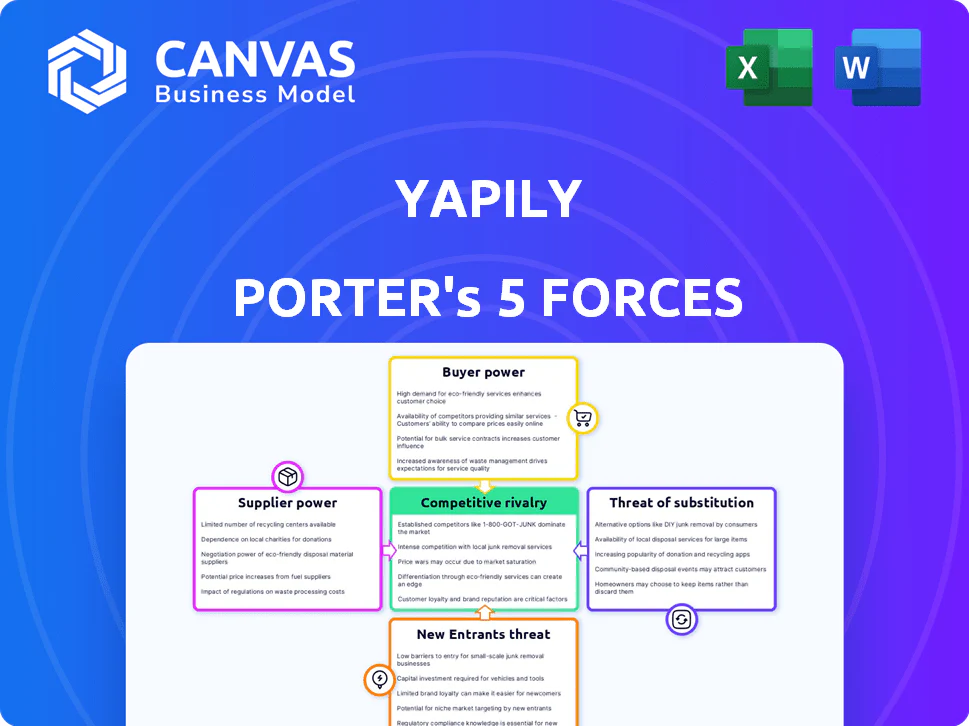
YAPILY PORTER'S FIVE FORCES TEMPLATE RESEARCH
What is included in the product
 Detailed Word Document
Evaluates control held by suppliers and buyers, and their influence on pricing and profitability.

 Customizable Excel Spreadsheet
Quickly highlight crucial insights with customizable visualizations, making complex strategies easier.
Full Version Awaits
Yapily Porter's Five Forces Analysis
This is the complete Five Forces analysis for Yapily. The preview you see here is identical to the document you will download instantly after purchase.

Porter's Five Forces Analysis Template

Elevate Your Analysis with the Complete Porter's Five Forces Analysis
Yapily operates within the dynamic Open Banking landscape, facing unique pressures. The threat of new entrants, fueled by technological advancements, is moderate. Bargaining power of buyers (businesses) is growing. Supplier power (banks) is significant. Competition is increasing. Substitute threats (traditional financial services) are a concern.
This brief snapshot only scratches the surface. Unlock the full Porter's Five Forces Analysis to explore Yapily’s competitive dynamics, market pressures, and strategic advantages in detail.
Suppliers Bargaining Power

Reliance on Bank APIs
Yapily's services depend on bank APIs for data and payment initiation. Banks control these APIs, giving them substantial bargaining power. In 2024, the Open Banking Implementation Entity (OBIE) reported over 6.5 million active users of open banking services in the UK, highlighting the banks' critical role. Banks can adjust API access terms, impacting Yapily's operational costs and service offerings.
API Performance and Standards
The quality and standardization of bank APIs significantly influence Yapily's operations. Inconsistent APIs can elevate costs and restrict service offerings. Yapily's goal is to simplify bank integrations, providing a unified API. In 2024, API performance issues increased operational expenses by 15% for similar firms. Standardized APIs could reduce these costs by 10%.

Regulatory Requirements
Regulations like PSD2 in Europe, which came into full effect by 2019, force banks to share data and allow payment initiation. Banks maintain some power. They influence implementation details, impacting technical needs. For example, in 2024, the Open Banking Implementation Entity (OBIE) in the UK reported 6.8 million successful API calls daily, showing banks' ongoing role.

Concentration of Bank Relationships
Yapily's reliance on its bank relationships is a key factor in supplier bargaining power. If Yapily depends on few banks for substantial services, those banks gain leverage. Yapily's strategy involves extensive bank coverage across different nations to reduce this dependency. In 2024, Yapily expanded its Open Banking coverage to over 2,000 banks.
- Concentration Risk: Reliance on a few banks increases supplier power.
- Yapily's Strategy: Aiming for broad bank coverage reduces this risk.
- 2024 Expansion: Coverage expanded to over 2,000 banks.
Potential for Banks to Offer Direct Services
Banks have the capability to develop their own API solutions. This could allow them to directly offer services to businesses, reducing the need for intermediaries like Yapily. Over the long term, this could increase banks' bargaining power as suppliers. Yapily's advantage lies in offering a unified, user-friendly platform across various banks.
- In 2024, Open Banking is projected to reach $60.3 billion.
- The European Open Banking market is estimated at $14.3 billion in 2024.
- By 2027, the global Open Banking market is projected to reach $120.6 billion.
Banks' Grip on Open Banking: A $14.3B Market
Yapily depends on banks for APIs, giving banks bargaining power. Banks can influence costs and service offerings through API terms. In 2024, the European Open Banking market was valued at $14.3 billion, highlighting bank influence.
| Aspect | Impact | 2024 Data |
|---|---|---|
| API Control | Influences costs and services | Open Banking market: $14.3B |
| API Standardization | Inconsistent APIs increase costs | API performance issues increased expenses by 15% |
| Bank Relationships | Concentration risk if reliant on few banks | Yapily expanded to over 2,000 banks |
Customers Bargaining Power

Diverse Customer Base
Yapily's customer base spans fintech startups and large enterprises in lending, payments, and accounting. A diverse customer base dilutes the impact of any single customer. In 2024, the open banking sector saw a surge in enterprise adoption, with more businesses integrating APIs. This diversification helps Yapily maintain its pricing strategy and service standards. This is a good thing!
Customer Switching Costs
Switching costs for Yapily's customers vary. Replacing Yapily's API involves technical adjustments. The ease of integration and the presence of competitors affect these costs. In 2024, the open banking market saw increased competition. This offered customers more alternatives, potentially lowering switching barriers.

Availability of Alternative Providers
The open banking landscape features numerous platforms and API providers, offering customers choices. This abundance boosts customer bargaining power, allowing them to compare offerings. For example, Yapily competes with Plaid and TrueLayer, intensifying the competition. In 2024, the open banking market's value was estimated at $50 billion, indicating significant choice for customers.

Customer Size and Influence
Customer bargaining power significantly influences Yapily's market position. Larger enterprise customers, managing substantial transaction volumes, often wield more negotiating leverage. For example, in 2024, companies like Klarna and Intuit, which are Yapily's clients, could influence pricing due to their transaction scale. This can impact Yapily's profitability.
- The size of the customer base influences the bargaining power.
- Specific integration needs lead to more negotiations.
- Negotiations may impact Yapily's profitability.
- Klarna and Intuit are Yapily's clients.
Customer Need for Specific Features
Customers seeking specialized features or integrations exert more influence on Yapily. Yapily's focus on features like VRPs and bulk payments, shows this customer-driven approach. In 2024, the demand for customized API solutions has increased by 15% in the FinTech sector. This trend highlights the importance of meeting specific customer needs.
- Customization demand rose 15% in 2024.
- VRPs and bulk payments are customer-driven.
- Specialized needs increase customer power.
Customer Power Dynamics in the Open Banking Arena
Yapily faces moderate customer bargaining power. The diverse customer base, including fintechs and large enterprises, dilutes individual influence. However, switching costs and market competition affect customer leverage. In 2024, the open banking market's value was $50 billion, giving customers choices.
| Aspect | Impact | 2024 Data |
|---|---|---|
| Customer Base | Diversification reduces power | Enterprise adoption increased |
| Switching Costs | Moderate, affected by competition | Market competition intensified |
| Market Size | Offers customer choices | Open banking market: $50B |
Rivalry Among Competitors

Number and Size of Competitors
The open banking API landscape is highly competitive, featuring various players like Yapily, Tink, and TrueLayer, along with fintech giants. This competition is fueled by both established firms and startups vying for market share. In 2024, the open banking market's valuation is estimated at over $40 billion, showcasing intense rivalry. Companies compete on features, pricing, and geographic reach, creating dynamic market conditions.
Market Growth Rate
The fintech market, including open banking, is booming. In 2024, the global fintech market was valued at $152.7 billion. Rapid growth can lessen rivalry initially, as everyone can find a piece of the pie. However, this also draws in new competitors eager to capitalize on the expansion.

Differentiation of Services
Yapily faces competition based on bank connections, API quality, service range, pricing, and support. Yapily highlights its extensive European reach and enterprise-grade setup. Competitors include Tink and TrueLayer. As of 2024, the market is growing, with open banking transactions in Europe rising. For example, in 2023, the UK saw over 10 million open banking payments.

Pricing Pressure
Competitive rivalry can squeeze profit margins through pricing pressure. Yapily's pricing model scales with growth, offering different tiers. This approach might be a response to competitive forces, aiming to attract various business sizes. For instance, in 2024, the fintech sector saw an average profit margin dip of 2% due to aggressive pricing strategies.
- Price wars can erode profitability.
- Yapily's tiered pricing may mitigate this.
- Market competition influences pricing strategies.
- Fintech profit margins face pressure.
Acquisition Activity
Acquisition activity significantly shapes competitive rivalry. Consolidation through mergers and acquisitions alters the competitive landscape, as seen in the fintech sector. Yapily has expanded through acquisitions, including FinAPI, showing strategic moves to strengthen its market position. These acquisitions impact the number and size of competitors, affecting pricing and market share.
- Yapily acquired FinAPI in 2024.
- M&A activity in the fintech sector reached $145.3 billion in 2023.
- Consolidation can reduce the number of competitors.
- Acquisitions can lead to increased market share for the acquiring firm.
Fintech's Fierce Battle: Pricing, Growth, and M&A
Competitive rivalry in Yapily's market is intense, with numerous players vying for market share. Pricing pressures and acquisition activities significantly shape the competitive landscape. The fintech sector saw $145.3 billion in M&A in 2023, affecting Yapily's competitive environment.
| Factor | Impact | 2024 Data |
|---|---|---|
| Market Growth | Attracts new competitors | Open banking market valued at over $40B |
| Pricing Pressure | Erodes profit margins | Fintech profit margins dipped by 2% |
| Acquisitions | Changes competitive landscape | M&A in fintech reached $145.3B in 2023 |
Original: $10.00
-65%$10.00
$3.50YAPILY PORTER'S FIVE FORCES TEMPLATE RESEARCH
What is included in the product
Detailed Word Document
Evaluates control held by suppliers and buyers, and their influence on pricing and profitability.
Customizable Excel Spreadsheet
Quickly highlight crucial insights with customizable visualizations, making complex strategies easier.
Full Version Awaits
Yapily Porter's Five Forces Analysis
This is the complete Five Forces analysis for Yapily. The preview you see here is identical to the document you will download instantly after purchase.
Porter's Five Forces Analysis Template
Elevate Your Analysis with the Complete Porter's Five Forces Analysis
Yapily operates within the dynamic Open Banking landscape, facing unique pressures. The threat of new entrants, fueled by technological advancements, is moderate. Bargaining power of buyers (businesses) is growing. Supplier power (banks) is significant. Competition is increasing. Substitute threats (traditional financial services) are a concern.
This brief snapshot only scratches the surface. Unlock the full Porter's Five Forces Analysis to explore Yapily’s competitive dynamics, market pressures, and strategic advantages in detail.
Suppliers Bargaining Power
Reliance on Bank APIs
Yapily's services depend on bank APIs for data and payment initiation. Banks control these APIs, giving them substantial bargaining power. In 2024, the Open Banking Implementation Entity (OBIE) reported over 6.5 million active users of open banking services in the UK, highlighting the banks' critical role. Banks can adjust API access terms, impacting Yapily's operational costs and service offerings.
API Performance and Standards
The quality and standardization of bank APIs significantly influence Yapily's operations. Inconsistent APIs can elevate costs and restrict service offerings. Yapily's goal is to simplify bank integrations, providing a unified API. In 2024, API performance issues increased operational expenses by 15% for similar firms. Standardized APIs could reduce these costs by 10%.
Regulatory Requirements
Regulations like PSD2 in Europe, which came into full effect by 2019, force banks to share data and allow payment initiation. Banks maintain some power. They influence implementation details, impacting technical needs. For example, in 2024, the Open Banking Implementation Entity (OBIE) in the UK reported 6.8 million successful API calls daily, showing banks' ongoing role.
Concentration of Bank Relationships
Yapily's reliance on its bank relationships is a key factor in supplier bargaining power. If Yapily depends on few banks for substantial services, those banks gain leverage. Yapily's strategy involves extensive bank coverage across different nations to reduce this dependency. In 2024, Yapily expanded its Open Banking coverage to over 2,000 banks.
- Concentration Risk: Reliance on a few banks increases supplier power.
- Yapily's Strategy: Aiming for broad bank coverage reduces this risk.
- 2024 Expansion: Coverage expanded to over 2,000 banks.
Potential for Banks to Offer Direct Services
Banks have the capability to develop their own API solutions. This could allow them to directly offer services to businesses, reducing the need for intermediaries like Yapily. Over the long term, this could increase banks' bargaining power as suppliers. Yapily's advantage lies in offering a unified, user-friendly platform across various banks.
- In 2024, Open Banking is projected to reach $60.3 billion.
- The European Open Banking market is estimated at $14.3 billion in 2024.
- By 2027, the global Open Banking market is projected to reach $120.6 billion.
Banks' Grip on Open Banking: A $14.3B Market
Yapily depends on banks for APIs, giving banks bargaining power. Banks can influence costs and service offerings through API terms. In 2024, the European Open Banking market was valued at $14.3 billion, highlighting bank influence.
| Aspect | Impact | 2024 Data |
|---|---|---|
| API Control | Influences costs and services | Open Banking market: $14.3B |
| API Standardization | Inconsistent APIs increase costs | API performance issues increased expenses by 15% |
| Bank Relationships | Concentration risk if reliant on few banks | Yapily expanded to over 2,000 banks |
Customers Bargaining Power
Diverse Customer Base
Yapily's customer base spans fintech startups and large enterprises in lending, payments, and accounting. A diverse customer base dilutes the impact of any single customer. In 2024, the open banking sector saw a surge in enterprise adoption, with more businesses integrating APIs. This diversification helps Yapily maintain its pricing strategy and service standards. This is a good thing!
Customer Switching Costs
Switching costs for Yapily's customers vary. Replacing Yapily's API involves technical adjustments. The ease of integration and the presence of competitors affect these costs. In 2024, the open banking market saw increased competition. This offered customers more alternatives, potentially lowering switching barriers.
Availability of Alternative Providers
The open banking landscape features numerous platforms and API providers, offering customers choices. This abundance boosts customer bargaining power, allowing them to compare offerings. For example, Yapily competes with Plaid and TrueLayer, intensifying the competition. In 2024, the open banking market's value was estimated at $50 billion, indicating significant choice for customers.
Customer Size and Influence
Customer bargaining power significantly influences Yapily's market position. Larger enterprise customers, managing substantial transaction volumes, often wield more negotiating leverage. For example, in 2024, companies like Klarna and Intuit, which are Yapily's clients, could influence pricing due to their transaction scale. This can impact Yapily's profitability.
- The size of the customer base influences the bargaining power.
- Specific integration needs lead to more negotiations.
- Negotiations may impact Yapily's profitability.
- Klarna and Intuit are Yapily's clients.
Customer Need for Specific Features
Customers seeking specialized features or integrations exert more influence on Yapily. Yapily's focus on features like VRPs and bulk payments, shows this customer-driven approach. In 2024, the demand for customized API solutions has increased by 15% in the FinTech sector. This trend highlights the importance of meeting specific customer needs.
- Customization demand rose 15% in 2024.
- VRPs and bulk payments are customer-driven.
- Specialized needs increase customer power.
Customer Power Dynamics in the Open Banking Arena
Yapily faces moderate customer bargaining power. The diverse customer base, including fintechs and large enterprises, dilutes individual influence. However, switching costs and market competition affect customer leverage. In 2024, the open banking market's value was $50 billion, giving customers choices.
| Aspect | Impact | 2024 Data |
|---|---|---|
| Customer Base | Diversification reduces power | Enterprise adoption increased |
| Switching Costs | Moderate, affected by competition | Market competition intensified |
| Market Size | Offers customer choices | Open banking market: $50B |
Rivalry Among Competitors
Number and Size of Competitors
The open banking API landscape is highly competitive, featuring various players like Yapily, Tink, and TrueLayer, along with fintech giants. This competition is fueled by both established firms and startups vying for market share. In 2024, the open banking market's valuation is estimated at over $40 billion, showcasing intense rivalry. Companies compete on features, pricing, and geographic reach, creating dynamic market conditions.
Market Growth Rate
The fintech market, including open banking, is booming. In 2024, the global fintech market was valued at $152.7 billion. Rapid growth can lessen rivalry initially, as everyone can find a piece of the pie. However, this also draws in new competitors eager to capitalize on the expansion.
Differentiation of Services
Yapily faces competition based on bank connections, API quality, service range, pricing, and support. Yapily highlights its extensive European reach and enterprise-grade setup. Competitors include Tink and TrueLayer. As of 2024, the market is growing, with open banking transactions in Europe rising. For example, in 2023, the UK saw over 10 million open banking payments.
Pricing Pressure
Competitive rivalry can squeeze profit margins through pricing pressure. Yapily's pricing model scales with growth, offering different tiers. This approach might be a response to competitive forces, aiming to attract various business sizes. For instance, in 2024, the fintech sector saw an average profit margin dip of 2% due to aggressive pricing strategies.
- Price wars can erode profitability.
- Yapily's tiered pricing may mitigate this.
- Market competition influences pricing strategies.
- Fintech profit margins face pressure.
Acquisition Activity
Acquisition activity significantly shapes competitive rivalry. Consolidation through mergers and acquisitions alters the competitive landscape, as seen in the fintech sector. Yapily has expanded through acquisitions, including FinAPI, showing strategic moves to strengthen its market position. These acquisitions impact the number and size of competitors, affecting pricing and market share.
- Yapily acquired FinAPI in 2024.
- M&A activity in the fintech sector reached $145.3 billion in 2023.
- Consolidation can reduce the number of competitors.
- Acquisitions can lead to increased market share for the acquiring firm.
Fintech's Fierce Battle: Pricing, Growth, and M&A
Competitive rivalry in Yapily's market is intense, with numerous players vying for market share. Pricing pressures and acquisition activities significantly shape the competitive landscape. The fintech sector saw $145.3 billion in M&A in 2023, affecting Yapily's competitive environment.
| Factor | Impact | 2024 Data |
|---|---|---|
| Market Growth | Attracts new competitors | Open banking market valued at over $40B |
| Pricing Pressure | Erodes profit margins | Fintech profit margins dipped by 2% |
| Acquisitions | Changes competitive landscape | M&A in fintech reached $145.3B in 2023 |
Product Information
Product Information
Shipping & Returns
Shipping & Returns
Description
What is included in the product
Detailed Word Document
Evaluates control held by suppliers and buyers, and their influence on pricing and profitability.
Customizable Excel Spreadsheet
Quickly highlight crucial insights with customizable visualizations, making complex strategies easier.
Full Version Awaits
Yapily Porter's Five Forces Analysis
This is the complete Five Forces analysis for Yapily. The preview you see here is identical to the document you will download instantly after purchase.
Porter's Five Forces Analysis Template
Elevate Your Analysis with the Complete Porter's Five Forces Analysis
Yapily operates within the dynamic Open Banking landscape, facing unique pressures. The threat of new entrants, fueled by technological advancements, is moderate. Bargaining power of buyers (businesses) is growing. Supplier power (banks) is significant. Competition is increasing. Substitute threats (traditional financial services) are a concern.
This brief snapshot only scratches the surface. Unlock the full Porter's Five Forces Analysis to explore Yapily’s competitive dynamics, market pressures, and strategic advantages in detail.
Suppliers Bargaining Power
Reliance on Bank APIs
Yapily's services depend on bank APIs for data and payment initiation. Banks control these APIs, giving them substantial bargaining power. In 2024, the Open Banking Implementation Entity (OBIE) reported over 6.5 million active users of open banking services in the UK, highlighting the banks' critical role. Banks can adjust API access terms, impacting Yapily's operational costs and service offerings.
API Performance and Standards
The quality and standardization of bank APIs significantly influence Yapily's operations. Inconsistent APIs can elevate costs and restrict service offerings. Yapily's goal is to simplify bank integrations, providing a unified API. In 2024, API performance issues increased operational expenses by 15% for similar firms. Standardized APIs could reduce these costs by 10%.
Regulatory Requirements
Regulations like PSD2 in Europe, which came into full effect by 2019, force banks to share data and allow payment initiation. Banks maintain some power. They influence implementation details, impacting technical needs. For example, in 2024, the Open Banking Implementation Entity (OBIE) in the UK reported 6.8 million successful API calls daily, showing banks' ongoing role.
Concentration of Bank Relationships
Yapily's reliance on its bank relationships is a key factor in supplier bargaining power. If Yapily depends on few banks for substantial services, those banks gain leverage. Yapily's strategy involves extensive bank coverage across different nations to reduce this dependency. In 2024, Yapily expanded its Open Banking coverage to over 2,000 banks.
- Concentration Risk: Reliance on a few banks increases supplier power.
- Yapily's Strategy: Aiming for broad bank coverage reduces this risk.
- 2024 Expansion: Coverage expanded to over 2,000 banks.
Potential for Banks to Offer Direct Services
Banks have the capability to develop their own API solutions. This could allow them to directly offer services to businesses, reducing the need for intermediaries like Yapily. Over the long term, this could increase banks' bargaining power as suppliers. Yapily's advantage lies in offering a unified, user-friendly platform across various banks.
- In 2024, Open Banking is projected to reach $60.3 billion.
- The European Open Banking market is estimated at $14.3 billion in 2024.
- By 2027, the global Open Banking market is projected to reach $120.6 billion.
Banks' Grip on Open Banking: A $14.3B Market
Yapily depends on banks for APIs, giving banks bargaining power. Banks can influence costs and service offerings through API terms. In 2024, the European Open Banking market was valued at $14.3 billion, highlighting bank influence.
| Aspect | Impact | 2024 Data |
|---|---|---|
| API Control | Influences costs and services | Open Banking market: $14.3B |
| API Standardization | Inconsistent APIs increase costs | API performance issues increased expenses by 15% |
| Bank Relationships | Concentration risk if reliant on few banks | Yapily expanded to over 2,000 banks |
Customers Bargaining Power
Diverse Customer Base
Yapily's customer base spans fintech startups and large enterprises in lending, payments, and accounting. A diverse customer base dilutes the impact of any single customer. In 2024, the open banking sector saw a surge in enterprise adoption, with more businesses integrating APIs. This diversification helps Yapily maintain its pricing strategy and service standards. This is a good thing!
Customer Switching Costs
Switching costs for Yapily's customers vary. Replacing Yapily's API involves technical adjustments. The ease of integration and the presence of competitors affect these costs. In 2024, the open banking market saw increased competition. This offered customers more alternatives, potentially lowering switching barriers.
Availability of Alternative Providers
The open banking landscape features numerous platforms and API providers, offering customers choices. This abundance boosts customer bargaining power, allowing them to compare offerings. For example, Yapily competes with Plaid and TrueLayer, intensifying the competition. In 2024, the open banking market's value was estimated at $50 billion, indicating significant choice for customers.
Customer Size and Influence
Customer bargaining power significantly influences Yapily's market position. Larger enterprise customers, managing substantial transaction volumes, often wield more negotiating leverage. For example, in 2024, companies like Klarna and Intuit, which are Yapily's clients, could influence pricing due to their transaction scale. This can impact Yapily's profitability.
- The size of the customer base influences the bargaining power.
- Specific integration needs lead to more negotiations.
- Negotiations may impact Yapily's profitability.
- Klarna and Intuit are Yapily's clients.
Customer Need for Specific Features
Customers seeking specialized features or integrations exert more influence on Yapily. Yapily's focus on features like VRPs and bulk payments, shows this customer-driven approach. In 2024, the demand for customized API solutions has increased by 15% in the FinTech sector. This trend highlights the importance of meeting specific customer needs.
- Customization demand rose 15% in 2024.
- VRPs and bulk payments are customer-driven.
- Specialized needs increase customer power.
Customer Power Dynamics in the Open Banking Arena
Yapily faces moderate customer bargaining power. The diverse customer base, including fintechs and large enterprises, dilutes individual influence. However, switching costs and market competition affect customer leverage. In 2024, the open banking market's value was $50 billion, giving customers choices.
| Aspect | Impact | 2024 Data |
|---|---|---|
| Customer Base | Diversification reduces power | Enterprise adoption increased |
| Switching Costs | Moderate, affected by competition | Market competition intensified |
| Market Size | Offers customer choices | Open banking market: $50B |
Rivalry Among Competitors
Number and Size of Competitors
The open banking API landscape is highly competitive, featuring various players like Yapily, Tink, and TrueLayer, along with fintech giants. This competition is fueled by both established firms and startups vying for market share. In 2024, the open banking market's valuation is estimated at over $40 billion, showcasing intense rivalry. Companies compete on features, pricing, and geographic reach, creating dynamic market conditions.
Market Growth Rate
The fintech market, including open banking, is booming. In 2024, the global fintech market was valued at $152.7 billion. Rapid growth can lessen rivalry initially, as everyone can find a piece of the pie. However, this also draws in new competitors eager to capitalize on the expansion.
Differentiation of Services
Yapily faces competition based on bank connections, API quality, service range, pricing, and support. Yapily highlights its extensive European reach and enterprise-grade setup. Competitors include Tink and TrueLayer. As of 2024, the market is growing, with open banking transactions in Europe rising. For example, in 2023, the UK saw over 10 million open banking payments.
Pricing Pressure
Competitive rivalry can squeeze profit margins through pricing pressure. Yapily's pricing model scales with growth, offering different tiers. This approach might be a response to competitive forces, aiming to attract various business sizes. For instance, in 2024, the fintech sector saw an average profit margin dip of 2% due to aggressive pricing strategies.
- Price wars can erode profitability.
- Yapily's tiered pricing may mitigate this.
- Market competition influences pricing strategies.
- Fintech profit margins face pressure.
Acquisition Activity
Acquisition activity significantly shapes competitive rivalry. Consolidation through mergers and acquisitions alters the competitive landscape, as seen in the fintech sector. Yapily has expanded through acquisitions, including FinAPI, showing strategic moves to strengthen its market position. These acquisitions impact the number and size of competitors, affecting pricing and market share.
- Yapily acquired FinAPI in 2024.
- M&A activity in the fintech sector reached $145.3 billion in 2023.
- Consolidation can reduce the number of competitors.
- Acquisitions can lead to increased market share for the acquiring firm.
Fintech's Fierce Battle: Pricing, Growth, and M&A
Competitive rivalry in Yapily's market is intense, with numerous players vying for market share. Pricing pressures and acquisition activities significantly shape the competitive landscape. The fintech sector saw $145.3 billion in M&A in 2023, affecting Yapily's competitive environment.
| Factor | Impact | 2024 Data |
|---|---|---|
| Market Growth | Attracts new competitors | Open banking market valued at over $40B |
| Pricing Pressure | Erodes profit margins | Fintech profit margins dipped by 2% |
| Acquisitions | Changes competitive landscape | M&A in fintech reached $145.3B in 2023 |











