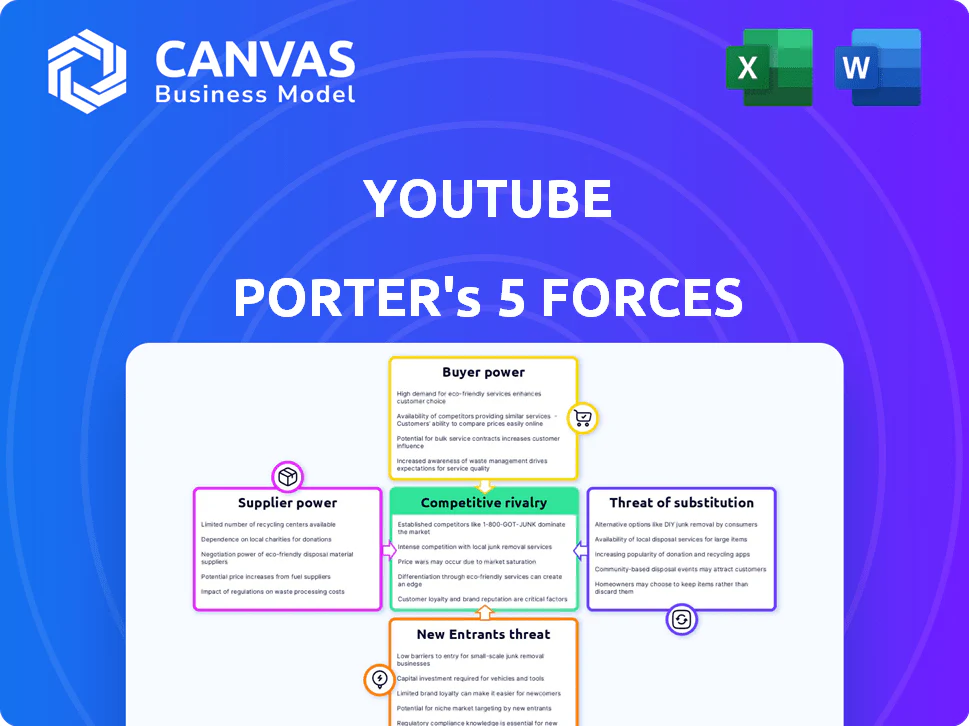
YOUTUBE PORTER'S FIVE FORCES TEMPLATE RESEARCH

Don't Miss the Bigger Picture
This snapshot highlights key tensions shaping YouTube's competitive landscape-network effects, creator bargaining, and substitute threats-but only scratches the surface. Unlock the full Porter's Five Forces Analysis for force-by-force ratings, visuals, and tactical insights to inform investment or strategic decisions.
Suppliers Bargaining Power

Concentrated influence of major music labels
Universal Music Group, Sony Music, and Warner Music Group control ~70-80% of global commercial recordings; their catalogs are essential to YouTube's music streaming and Shorts revenue streams.
As of early 2026 YouTube is negotiating new AI-era licensing; labels can still demand higher royalty floors or withdraw catalogs, pressuring margins and content availability.
Evolution of the creator economy tiering
Top-tier creators-the super-creator class like MrBeast (over 200M subscribers across channels) and PewDiePie-wield strong bargaining power, securing exclusive deals and driving sponsorships worth tens of millions annually, and can shift communities to Patreon/Substack where top creators earn $5-20M/year.
Yet YouTube remains the primary revenue engine for ~50M creators; as the dominant monopsony-like buyer, it sets ad rates and revenue shares, keeping aggregate supplier power moderate despite superstar leverage.

AI-generated content and the 'slop' crisis
By 2026, AI-generated low-quality "slop" surged-Google/YouTube reported automated uploads rising ~120% YoY in 2025, prompting stricter takedowns and disclosure rules that cut visible low-quality content by ~35% in Q4 2025.
YouTube's moderation and ML-filter spend rose to $1.2bn in 2025, reasserting control over automated suppliers and protecting ad yield.
The costly technical barrier-$1.2bn plus proprietary models-cements YouTube as the essential gatekeeper between creators, AI farms, and advertisers.

Licensing for AI training data
Licensing for AI training data raises supplier power as media conglomerates demand data royalties for video/audio used to train Google's Gemini; Warner Bros. Discovery and Disney have signaled valuation of archives, and pooled licensing could add ~1-3% operating cost to ad platforms per analyst estimates in 2025.
Negotiations force Google/YouTube to pay per-GB or revenue-share, complicating margins and increasing barriers for startups; suppliers now capture long-term AI rent from historical content.
- Major owners seek royalties (Disney/Warner/Universal)
- Estimated extra cost to platforms: 1-3% op. margin in 2025
- Per-GB licensing or revenue-share models emerging
- Suppliers gain leverage via irreplaceable archival data
Dependence on high-end semiconductor hardware
YouTube benefits from Google's internal TPU work but still relies on external semiconductors; in 2025 server CPU/GPU spend for Google Cloud (parent Alphabet) rose to about $16.2B, reflecting broader chip dependence.
Massive 2026 AI workloads for real-time effects and deepfake detection pushed peak datacenter GPU hours up ~48% year-over-year, raising supplier leverage over price and lead times.
Chip shortages or price swings can cut YouTube's operating margins and slow feature rollout-Alphabet's capex of $34.0B in 2025 signals how capital-heavy mitigation is.
- Alphabet 2025 capex $34.0B
- Google Cloud semiconductor-related spend ≈ $16.2B (2025)
- GPU hours for AI workloads +48% YoY (2026 peak)
- Supply shocks directly press operating margins, slow releases
YouTube Keeps Gatekeeper Edge as Labels, Super‑Creators and AI Costs Bite
Suppliers (major labels, top creators, chip vendors) exert moderate-to-high power: labels control ~70-80% catalogs; super-creators (e.g., MrBeast 200M+) command $5-20M deals; AI/archive licensing adds ~1-3% op. cost; Alphabet 2025 capex $34.0B, Google Cloud chip spend $16.2B-so YouTube remains gatekeeper but faces rising supplier costs.
| Metric | 2025/2026 |
|---|---|
| Labels' catalog share | 70-80% |
| Top creator deals | $5-20M/yr |
| AI licensing impact | +1-3% op. margin |
| Alphabet capex | $34.0B (2025) |
| Google Cloud chip spend | $16.2B (2025) |
What is included in the product
 Detailed Word Document
Tailored Porter's Five Forces for YouTube: analyzes competitive rivalry, supplier/buyer power, substitutes, and entry barriers to reveal pricing leverage, monetization risks, and strategic defenses against emerging platforms and regulatory pressure.

 Customizable Excel Spreadsheet
Instantly map YouTube's competitive pressures with a concise, one-sheet Porter's Five Forces summary-perfect for fast strategy calls or deck-ready visuals.
Customers Bargaining Power

Advertiser shift toward Connected TV (CTV)
In 2026 advertisers shifted budgets to Connected TV (CTV), giving buyers more leverage as YouTube competes with Netflix and Disney+; global CTV ad spend hit $85B in 2025, with YouTube capturing ~14% of CTV impressions.
Large agencies demand brand suitability, transparency, and better CPMs-YouTube's 2025 ad revenue was $86.0B, so even small pricing pressure meaningfully impacts margins.
Advertisers now treat YouTube as a premium TV pillar, not just social video, increasing bargaining power as they consolidate buys across CTV platforms.
Viewer fragmentation and attention elasticity
Individual viewers hold low bargaining power, but collective attention is elastic: global watch time fell 2% YoY in 2025 while short-form rivals grew 8%, so a rising ad load or weak recommendations can drive mass shifts.

Premium subscriber sensitivity to pricing
With Alphabet reporting over 325 million paid subscriptions across its services by 2026, YouTube Premium is a key revenue stream but faces rising price sensitivity; churn risk rose after 2024 when average ARPU growth slowed to low single digits.

Influence of Gen Z and Alpha consumer habits
Gen Z and Alpha now favor creators over platforms, making them platform-agnostic and shifting indirect power to audiences; 2025 surveys show 68% of Gen Z prefer short-form vertical video and 54% follow creators across apps, pushing YouTube to prioritize Shorts and interactivity.
If YouTube misses these tastes it risks losing the future ad-demographic-ad spend to short-form rivals grew 22% YoY in 2024, and 2025 CPMs for 18-24 dropped 8% on legacy long-form inventory.
- 68% Gen Z prefer short-form vertical (2025 survey)
- 54% follow creators across platforms (2025 data)
- Short-form rival ad spend +22% YoY (2024→2025)
- 18-24 CPMs on long-form down 8% (2025)
Demands for data privacy and AI transparency
By early 2026, users demanded clearer AI transparency and data-privacy controls after surveys showed 62% of US adults worried about AI-trained content; YouTube rolled out synthetic-content labels and expanded opt-outs, reducing addressable data for ad targeting.
Regulatory pressure and consumer advocacy forced policy changes that cut targeted-ad revenue growth, constraining YouTube's ability to monetize user data as freely as in prior decades.
- 62% of US adults worry about AI-trained content (2025-26 surveys)
- YouTube implemented synthetic-content labels and broader opt-outs in 2025
- Opt-outs and labels shrink addressable ad audience, lowering targeting yield
- Regulatory bargaining now caps data-monetization upside vs. 2010s
Ad power shifts: $85B CTV, $86B YouTube - transparency, churn and AI cut targeting
Advertisers' leverage rose as CTV ad spend hit $85B in 2025 and YouTube's ad revenue was $86.0B, so agency demands on CPMs and transparency bite margins; viewers have low individual power but collective churn risk grew after global watch time fell 2% in 2025; regulatory opt-outs and 62% AI concerns cut addressable targeting.
| Metric | 2025/26 |
|---|---|
| CTV ad spend | $85B (2025) |
| YouTube ad rev | $86.0B (2025) |
| Global watch time YoY | -2% (2025) |
| Gen Z pref. short-form | 68% (2025) |
| US AI concern | 62% (2025-26) |
What You See Is What You Get
YouTube Porter's Five Forces Analysis
This preview shows the exact YouTube Porter's Five Forces analysis you'll receive immediately after purchase-no placeholders or samples-fully formatted and ready for download and use the moment you buy.

Original: $10.00
-65%$10.00
$3.50YOUTUBE PORTER'S FIVE FORCES TEMPLATE RESEARCH
Don't Miss the Bigger Picture
This snapshot highlights key tensions shaping YouTube's competitive landscape-network effects, creator bargaining, and substitute threats-but only scratches the surface. Unlock the full Porter's Five Forces Analysis for force-by-force ratings, visuals, and tactical insights to inform investment or strategic decisions.
Suppliers Bargaining Power
Concentrated influence of major music labels
Universal Music Group, Sony Music, and Warner Music Group control ~70-80% of global commercial recordings; their catalogs are essential to YouTube's music streaming and Shorts revenue streams.
As of early 2026 YouTube is negotiating new AI-era licensing; labels can still demand higher royalty floors or withdraw catalogs, pressuring margins and content availability.
Evolution of the creator economy tiering
Top-tier creators-the super-creator class like MrBeast (over 200M subscribers across channels) and PewDiePie-wield strong bargaining power, securing exclusive deals and driving sponsorships worth tens of millions annually, and can shift communities to Patreon/Substack where top creators earn $5-20M/year.
Yet YouTube remains the primary revenue engine for ~50M creators; as the dominant monopsony-like buyer, it sets ad rates and revenue shares, keeping aggregate supplier power moderate despite superstar leverage.
AI-generated content and the 'slop' crisis
By 2026, AI-generated low-quality "slop" surged-Google/YouTube reported automated uploads rising ~120% YoY in 2025, prompting stricter takedowns and disclosure rules that cut visible low-quality content by ~35% in Q4 2025.
YouTube's moderation and ML-filter spend rose to $1.2bn in 2025, reasserting control over automated suppliers and protecting ad yield.
The costly technical barrier-$1.2bn plus proprietary models-cements YouTube as the essential gatekeeper between creators, AI farms, and advertisers.
Licensing for AI training data
Licensing for AI training data raises supplier power as media conglomerates demand data royalties for video/audio used to train Google's Gemini; Warner Bros. Discovery and Disney have signaled valuation of archives, and pooled licensing could add ~1-3% operating cost to ad platforms per analyst estimates in 2025.
Negotiations force Google/YouTube to pay per-GB or revenue-share, complicating margins and increasing barriers for startups; suppliers now capture long-term AI rent from historical content.
- Major owners seek royalties (Disney/Warner/Universal)
- Estimated extra cost to platforms: 1-3% op. margin in 2025
- Per-GB licensing or revenue-share models emerging
- Suppliers gain leverage via irreplaceable archival data
Dependence on high-end semiconductor hardware
YouTube benefits from Google's internal TPU work but still relies on external semiconductors; in 2025 server CPU/GPU spend for Google Cloud (parent Alphabet) rose to about $16.2B, reflecting broader chip dependence.
Massive 2026 AI workloads for real-time effects and deepfake detection pushed peak datacenter GPU hours up ~48% year-over-year, raising supplier leverage over price and lead times.
Chip shortages or price swings can cut YouTube's operating margins and slow feature rollout-Alphabet's capex of $34.0B in 2025 signals how capital-heavy mitigation is.
- Alphabet 2025 capex $34.0B
- Google Cloud semiconductor-related spend ≈ $16.2B (2025)
- GPU hours for AI workloads +48% YoY (2026 peak)
- Supply shocks directly press operating margins, slow releases
YouTube Keeps Gatekeeper Edge as Labels, Super‑Creators and AI Costs Bite
Suppliers (major labels, top creators, chip vendors) exert moderate-to-high power: labels control ~70-80% catalogs; super-creators (e.g., MrBeast 200M+) command $5-20M deals; AI/archive licensing adds ~1-3% op. cost; Alphabet 2025 capex $34.0B, Google Cloud chip spend $16.2B-so YouTube remains gatekeeper but faces rising supplier costs.
| Metric | 2025/2026 |
|---|---|
| Labels' catalog share | 70-80% |
| Top creator deals | $5-20M/yr |
| AI licensing impact | +1-3% op. margin |
| Alphabet capex | $34.0B (2025) |
| Google Cloud chip spend | $16.2B (2025) |
What is included in the product
Detailed Word Document
Tailored Porter's Five Forces for YouTube: analyzes competitive rivalry, supplier/buyer power, substitutes, and entry barriers to reveal pricing leverage, monetization risks, and strategic defenses against emerging platforms and regulatory pressure.
Customizable Excel Spreadsheet
Instantly map YouTube's competitive pressures with a concise, one-sheet Porter's Five Forces summary-perfect for fast strategy calls or deck-ready visuals.
Customers Bargaining Power
Advertiser shift toward Connected TV (CTV)
In 2026 advertisers shifted budgets to Connected TV (CTV), giving buyers more leverage as YouTube competes with Netflix and Disney+; global CTV ad spend hit $85B in 2025, with YouTube capturing ~14% of CTV impressions.
Large agencies demand brand suitability, transparency, and better CPMs-YouTube's 2025 ad revenue was $86.0B, so even small pricing pressure meaningfully impacts margins.
Advertisers now treat YouTube as a premium TV pillar, not just social video, increasing bargaining power as they consolidate buys across CTV platforms.
Viewer fragmentation and attention elasticity
Individual viewers hold low bargaining power, but collective attention is elastic: global watch time fell 2% YoY in 2025 while short-form rivals grew 8%, so a rising ad load or weak recommendations can drive mass shifts.
Premium subscriber sensitivity to pricing
With Alphabet reporting over 325 million paid subscriptions across its services by 2026, YouTube Premium is a key revenue stream but faces rising price sensitivity; churn risk rose after 2024 when average ARPU growth slowed to low single digits.
Influence of Gen Z and Alpha consumer habits
Gen Z and Alpha now favor creators over platforms, making them platform-agnostic and shifting indirect power to audiences; 2025 surveys show 68% of Gen Z prefer short-form vertical video and 54% follow creators across apps, pushing YouTube to prioritize Shorts and interactivity.
If YouTube misses these tastes it risks losing the future ad-demographic-ad spend to short-form rivals grew 22% YoY in 2024, and 2025 CPMs for 18-24 dropped 8% on legacy long-form inventory.
- 68% Gen Z prefer short-form vertical (2025 survey)
- 54% follow creators across platforms (2025 data)
- Short-form rival ad spend +22% YoY (2024→2025)
- 18-24 CPMs on long-form down 8% (2025)
Demands for data privacy and AI transparency
By early 2026, users demanded clearer AI transparency and data-privacy controls after surveys showed 62% of US adults worried about AI-trained content; YouTube rolled out synthetic-content labels and expanded opt-outs, reducing addressable data for ad targeting.
Regulatory pressure and consumer advocacy forced policy changes that cut targeted-ad revenue growth, constraining YouTube's ability to monetize user data as freely as in prior decades.
- 62% of US adults worry about AI-trained content (2025-26 surveys)
- YouTube implemented synthetic-content labels and broader opt-outs in 2025
- Opt-outs and labels shrink addressable ad audience, lowering targeting yield
- Regulatory bargaining now caps data-monetization upside vs. 2010s
Ad power shifts: $85B CTV, $86B YouTube - transparency, churn and AI cut targeting
Advertisers' leverage rose as CTV ad spend hit $85B in 2025 and YouTube's ad revenue was $86.0B, so agency demands on CPMs and transparency bite margins; viewers have low individual power but collective churn risk grew after global watch time fell 2% in 2025; regulatory opt-outs and 62% AI concerns cut addressable targeting.
| Metric | 2025/26 |
|---|---|
| CTV ad spend | $85B (2025) |
| YouTube ad rev | $86.0B (2025) |
| Global watch time YoY | -2% (2025) |
| Gen Z pref. short-form | 68% (2025) |
| US AI concern | 62% (2025-26) |
What You See Is What You Get
YouTube Porter's Five Forces Analysis
This preview shows the exact YouTube Porter's Five Forces analysis you'll receive immediately after purchase-no placeholders or samples-fully formatted and ready for download and use the moment you buy.
Product Information
Product Information
Shipping & Returns
Shipping & Returns
Description
Don't Miss the Bigger Picture
This snapshot highlights key tensions shaping YouTube's competitive landscape-network effects, creator bargaining, and substitute threats-but only scratches the surface. Unlock the full Porter's Five Forces Analysis for force-by-force ratings, visuals, and tactical insights to inform investment or strategic decisions.
Suppliers Bargaining Power
Concentrated influence of major music labels
Universal Music Group, Sony Music, and Warner Music Group control ~70-80% of global commercial recordings; their catalogs are essential to YouTube's music streaming and Shorts revenue streams.
As of early 2026 YouTube is negotiating new AI-era licensing; labels can still demand higher royalty floors or withdraw catalogs, pressuring margins and content availability.
Evolution of the creator economy tiering
Top-tier creators-the super-creator class like MrBeast (over 200M subscribers across channels) and PewDiePie-wield strong bargaining power, securing exclusive deals and driving sponsorships worth tens of millions annually, and can shift communities to Patreon/Substack where top creators earn $5-20M/year.
Yet YouTube remains the primary revenue engine for ~50M creators; as the dominant monopsony-like buyer, it sets ad rates and revenue shares, keeping aggregate supplier power moderate despite superstar leverage.
AI-generated content and the 'slop' crisis
By 2026, AI-generated low-quality "slop" surged-Google/YouTube reported automated uploads rising ~120% YoY in 2025, prompting stricter takedowns and disclosure rules that cut visible low-quality content by ~35% in Q4 2025.
YouTube's moderation and ML-filter spend rose to $1.2bn in 2025, reasserting control over automated suppliers and protecting ad yield.
The costly technical barrier-$1.2bn plus proprietary models-cements YouTube as the essential gatekeeper between creators, AI farms, and advertisers.
Licensing for AI training data
Licensing for AI training data raises supplier power as media conglomerates demand data royalties for video/audio used to train Google's Gemini; Warner Bros. Discovery and Disney have signaled valuation of archives, and pooled licensing could add ~1-3% operating cost to ad platforms per analyst estimates in 2025.
Negotiations force Google/YouTube to pay per-GB or revenue-share, complicating margins and increasing barriers for startups; suppliers now capture long-term AI rent from historical content.
- Major owners seek royalties (Disney/Warner/Universal)
- Estimated extra cost to platforms: 1-3% op. margin in 2025
- Per-GB licensing or revenue-share models emerging
- Suppliers gain leverage via irreplaceable archival data
Dependence on high-end semiconductor hardware
YouTube benefits from Google's internal TPU work but still relies on external semiconductors; in 2025 server CPU/GPU spend for Google Cloud (parent Alphabet) rose to about $16.2B, reflecting broader chip dependence.
Massive 2026 AI workloads for real-time effects and deepfake detection pushed peak datacenter GPU hours up ~48% year-over-year, raising supplier leverage over price and lead times.
Chip shortages or price swings can cut YouTube's operating margins and slow feature rollout-Alphabet's capex of $34.0B in 2025 signals how capital-heavy mitigation is.
- Alphabet 2025 capex $34.0B
- Google Cloud semiconductor-related spend ≈ $16.2B (2025)
- GPU hours for AI workloads +48% YoY (2026 peak)
- Supply shocks directly press operating margins, slow releases
YouTube Keeps Gatekeeper Edge as Labels, Super‑Creators and AI Costs Bite
Suppliers (major labels, top creators, chip vendors) exert moderate-to-high power: labels control ~70-80% catalogs; super-creators (e.g., MrBeast 200M+) command $5-20M deals; AI/archive licensing adds ~1-3% op. cost; Alphabet 2025 capex $34.0B, Google Cloud chip spend $16.2B-so YouTube remains gatekeeper but faces rising supplier costs.
| Metric | 2025/2026 |
|---|---|
| Labels' catalog share | 70-80% |
| Top creator deals | $5-20M/yr |
| AI licensing impact | +1-3% op. margin |
| Alphabet capex | $34.0B (2025) |
| Google Cloud chip spend | $16.2B (2025) |
What is included in the product
Detailed Word Document
Tailored Porter's Five Forces for YouTube: analyzes competitive rivalry, supplier/buyer power, substitutes, and entry barriers to reveal pricing leverage, monetization risks, and strategic defenses against emerging platforms and regulatory pressure.
Customizable Excel Spreadsheet
Instantly map YouTube's competitive pressures with a concise, one-sheet Porter's Five Forces summary-perfect for fast strategy calls or deck-ready visuals.
Customers Bargaining Power
Advertiser shift toward Connected TV (CTV)
In 2026 advertisers shifted budgets to Connected TV (CTV), giving buyers more leverage as YouTube competes with Netflix and Disney+; global CTV ad spend hit $85B in 2025, with YouTube capturing ~14% of CTV impressions.
Large agencies demand brand suitability, transparency, and better CPMs-YouTube's 2025 ad revenue was $86.0B, so even small pricing pressure meaningfully impacts margins.
Advertisers now treat YouTube as a premium TV pillar, not just social video, increasing bargaining power as they consolidate buys across CTV platforms.
Viewer fragmentation and attention elasticity
Individual viewers hold low bargaining power, but collective attention is elastic: global watch time fell 2% YoY in 2025 while short-form rivals grew 8%, so a rising ad load or weak recommendations can drive mass shifts.
Premium subscriber sensitivity to pricing
With Alphabet reporting over 325 million paid subscriptions across its services by 2026, YouTube Premium is a key revenue stream but faces rising price sensitivity; churn risk rose after 2024 when average ARPU growth slowed to low single digits.
Influence of Gen Z and Alpha consumer habits
Gen Z and Alpha now favor creators over platforms, making them platform-agnostic and shifting indirect power to audiences; 2025 surveys show 68% of Gen Z prefer short-form vertical video and 54% follow creators across apps, pushing YouTube to prioritize Shorts and interactivity.
If YouTube misses these tastes it risks losing the future ad-demographic-ad spend to short-form rivals grew 22% YoY in 2024, and 2025 CPMs for 18-24 dropped 8% on legacy long-form inventory.
- 68% Gen Z prefer short-form vertical (2025 survey)
- 54% follow creators across platforms (2025 data)
- Short-form rival ad spend +22% YoY (2024→2025)
- 18-24 CPMs on long-form down 8% (2025)
Demands for data privacy and AI transparency
By early 2026, users demanded clearer AI transparency and data-privacy controls after surveys showed 62% of US adults worried about AI-trained content; YouTube rolled out synthetic-content labels and expanded opt-outs, reducing addressable data for ad targeting.
Regulatory pressure and consumer advocacy forced policy changes that cut targeted-ad revenue growth, constraining YouTube's ability to monetize user data as freely as in prior decades.
- 62% of US adults worry about AI-trained content (2025-26 surveys)
- YouTube implemented synthetic-content labels and broader opt-outs in 2025
- Opt-outs and labels shrink addressable ad audience, lowering targeting yield
- Regulatory bargaining now caps data-monetization upside vs. 2010s
Ad power shifts: $85B CTV, $86B YouTube - transparency, churn and AI cut targeting
Advertisers' leverage rose as CTV ad spend hit $85B in 2025 and YouTube's ad revenue was $86.0B, so agency demands on CPMs and transparency bite margins; viewers have low individual power but collective churn risk grew after global watch time fell 2% in 2025; regulatory opt-outs and 62% AI concerns cut addressable targeting.
| Metric | 2025/26 |
|---|---|
| CTV ad spend | $85B (2025) |
| YouTube ad rev | $86.0B (2025) |
| Global watch time YoY | -2% (2025) |
| Gen Z pref. short-form | 68% (2025) |
| US AI concern | 62% (2025-26) |
What You See Is What You Get
YouTube Porter's Five Forces Analysis
This preview shows the exact YouTube Porter's Five Forces analysis you'll receive immediately after purchase-no placeholders or samples-fully formatted and ready for download and use the moment you buy.











