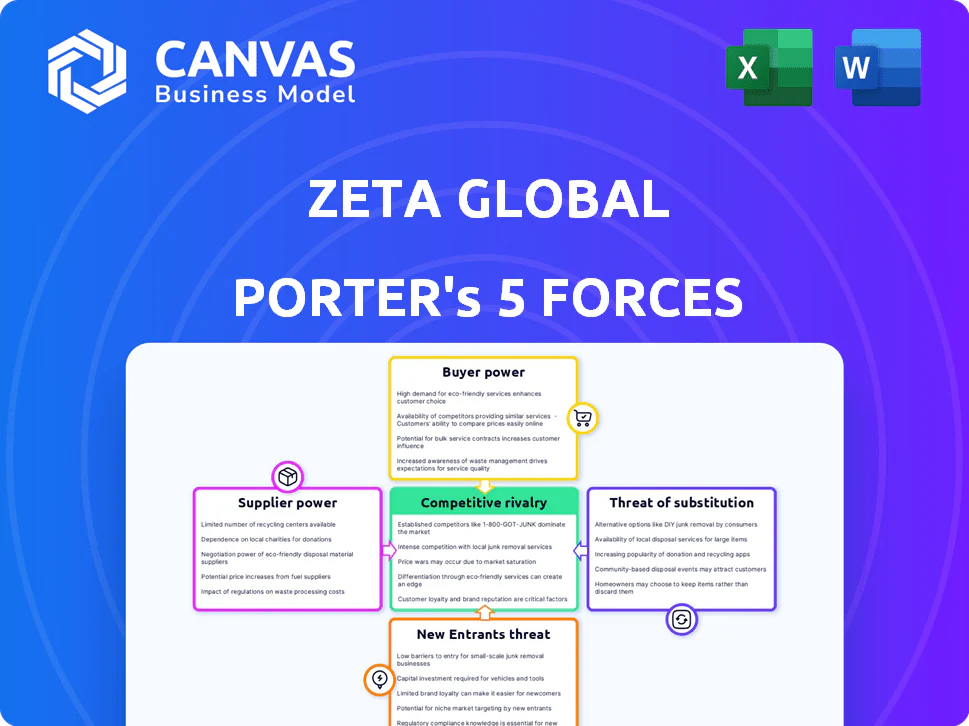
ZETA GLOBAL PORTER'S FIVE FORCES TEMPLATE RESEARCH

From Overview to Strategy Blueprint
Zeta Global faces moderate buyer power and high rivalry amid rapid tech shifts, while supplier and entrant threats are tempered by data moats and scale-yet regulatory and privacy risks could tighten margins. This brief snapshot only scratches the surface. Unlock the full Porter's Five Forces Analysis to explore Zeta Global's competitive dynamics, market pressures, and strategic advantages in detail.
Suppliers Bargaining Power

Cloud Infrastructure Dominance
Zeta Global relies on hyperscalers (AWS, Google Cloud) to run 2025-scale AI workloads; cloud spend totaled about $220M in FY2025, making infrastructure a major fixed cost.
AI Talent and Engineering Scarcity
Specialized engineers maintaining Zeta Global's Zeta Alpha form a high-power supplier group; global demand for top-tier ML talent hit record levels in early 2026, with median US ML engineer total compensation around $350k and top hires exceeding $500k.
For Zeta Global, FY2025 R&D and personnel costs rose materially-R&D was $210M and headcount-led wage inflation pushed gross margin pressure as labor costs grew faster than revenue, risking margin squeeze if talent costs outpace revenue growth.

External Data Feed Dependency
While Zeta Global's Data Cloud drives identity resolution, it still uses niche external feeds-about 12-18% of signals in 2025-letting suppliers press for higher licensing or stricter access under new 2025 privacy rules; Zeta offsets this by growing first-party capture (first-party data rose to 62% of signal volume in FY2025), diversifying vendors, and negotiating multi-year contracts to limit single-vendor risk.

Ad Inventory Gatekeepers
Zeta Global must buy ad inventory from giants like Google and Meta, who together captured roughly 52% of global ad spend in 2025 (~$300B of $580B), making them powerful supplier gatekeepers.
Changes in auction rules, reduced algorithm transparency, or fee increases from these platforms can cut Zeta's campaign ROI and raise client CAC quickly.
- Meta + Google = ~52% global ad spend, 2025 (~$300B)
- Platform fee/auction shifts → direct ROI volatility
- Limited transparency raises client CAC and reporting risk
Specialized Software and Security Vendors
Zeta Global relies on third-party cybersecurity and specialized software to protect customer data and meet GDPR/CCPA; switching costs are high and a breach would risk revenue and a share-price hit-Zeta's market cap fell 22% after a 2024 industry breach case study, so vendor reliability is critical.
Rising vendor fees amid 2024-25 inflation raised IT security spend ~8-12%, making vendor negotiation and continuity vital to operations and compliance.
- High switching costs → vendor power
- Breach risk → severe reputational/market impact
- 2024-25 security spend up 8-12%
- Vendor continuity essential for compliance
Zeta Global under supplier squeeze: $430M tech/R&D, 62% first‑party data, ad duopoly risk
Zeta Global faces high supplier power: FY2025 cloud spend $220M, R&D $210M, first-party data 62% of signals, 12-18% niche feeds, Meta+Google ≈52% ad spend (~$300B of $580B), median US ML pay ~$350k (2026), security spend +8-12% (2024-25).
| Metric | 2024-25/2026 |
|---|---|
| Cloud spend | $220M (FY2025) |
| R&D | $210M (FY2025) |
| First-party data | 62% (FY2025) |
| Niche feeds | 12-18% (FY2025) |
| Meta+Google ad share | ~52% (~$300B of $580B, 2025) |
| Median ML comp | $350K (US, early 2026) |
| Security spend change | +8-12% (2024-25) |
What is included in the product
 Detailed Word Document
Tailored Porter's Five Forces analysis for Zeta Global that uncovers competitive intensity, buyer and supplier power, entry barriers, and substitutes-highlighting disruptive threats, pricing influence, and strategic levers to protect market share.

 Customizable Excel Spreadsheet
Concise Porter's Five Forces snapshot for Zeta Global-clarifies competitive pressure points instantly to speed strategic choices.
Customers Bargaining Power

Enterprise Contract Concentration
Zeta Global targets Fortune 500 and large-enterprise clients that contributed about 68% of 2025 subscription revenue, concentrating bargaining power with buyers.
These customers demand custom integrations, tiered discounts up to 25%, and strict SLAs, raising cost-to-serve and margin pressure.
If a top-10 client (≈12% of ARR each) signals churn, Zeta's quarter can fall 10-15%, giving buyers leverage in renewal talks.
Demand for Quantifiable ROI
CMOs in 2026 force Zeta Global to prove quantifiable ROI: 78% of marketers demand clear attribution and 62% shift budgets if incrementality (lift) trails cheaper options; Zeta must show consistent lift above peers-clients benchmark against CPA and ROAS, and a 10-15% lift shortfall triggers budget reallocation toward experimental channels.

Low Switching Costs for Point Solutions
Zeta Global's 2025 revenue mix shows ~28% from modular marketing products, so customers often pick best-of-breed tools and face low switching costs for point solutions; leaving email automation to rivals like Klaviyo risks churn.
Zeta raises switching costs by embedding identity resolution into clients' CRM and workflows-clients integrating its Real-Time Data Cloud see 30-40% higher retention in 2025 accounts.

Data Portability and Ownership
Modern enterprise buyers demand data ownership and easy portability, cutting Zeta Global's customer lock-in as clients move petabytes across platforms-Gartner notes 58% of enterprises prioritized data portability in 2024.
Zeta shifted to open architectures and APIs; this reduced switching frictions but raised churn risk as rival ecosystems became viable.
- 58% enterprises prioritize portability (Gartner 2024)
- Zeta revenue 2025: $613M; retention pressure up
- Open APIs increase competitive exploration
Consolidation of Marketing Budgets
Consolidation of marketing budgets in 2025-26 lets buyers demand bundled pricing, forcing vendors to add features while cutting aggregate spend; 64% of CMOs surveyed in 2025 said they plan vendor consolidation, raising bargaining power.
Zeta Global must push one‑platform value-its 2025 revenue of $538M helps credibility-but buyers still squeeze margins, pressuring gross margin recovery.
- 64% of CMOs plan consolidation (2025)
- Zeta Global 2025 revenue: $538M
- Buyers seek lower total cost, more features
- Consolidation increases price pressure on vendors
Zeta at Risk: 68% Revenue Concentrated, Top Clients Can Swing Quarters
Large-enterprise clients (≈68% of 2025 subscription revenue) exert strong bargaining power: they demand custom SLAs, up to 25% discounts, and benchmark ROI (78% need clear attribution). Top-10 clients (~12% ARR each) can swing quarters 10-15%. Open APIs and data portability (58% enterprises prioritize, Gartner 2024) lower switching costs despite Zeta's 2025 revenue $613M.
| Metric | 2025 |
|---|---|
| Subscription rev concentration | 68% |
| Total revenue | $613M |
| Top-10 client weight | ≈12% ARR each |
| Enterprises prioritize portability | 58% |
What You See Is What You Get
Zeta Global Porter's Five Forces Analysis
This preview shows the exact Porter's Five Forces analysis of Zeta Global you'll receive-no placeholders, no samples-fully formatted and ready for immediate use after purchase.
The document displayed here is the same comprehensive file available for download the moment you buy, covering rivalry, supplier and buyer power, threats of entry and substitution, and strategic implications.
You're viewing the actual deliverable: a professional, ready-to-use competitive forces assessment with actionable insights and concise conclusions-instantly accessible post-purchase.

Original: $10.00
-65%$10.00
$3.50ZETA GLOBAL PORTER'S FIVE FORCES TEMPLATE RESEARCH
From Overview to Strategy Blueprint
Zeta Global faces moderate buyer power and high rivalry amid rapid tech shifts, while supplier and entrant threats are tempered by data moats and scale-yet regulatory and privacy risks could tighten margins. This brief snapshot only scratches the surface. Unlock the full Porter's Five Forces Analysis to explore Zeta Global's competitive dynamics, market pressures, and strategic advantages in detail.
Suppliers Bargaining Power
Cloud Infrastructure Dominance
Zeta Global relies on hyperscalers (AWS, Google Cloud) to run 2025-scale AI workloads; cloud spend totaled about $220M in FY2025, making infrastructure a major fixed cost.
AI Talent and Engineering Scarcity
Specialized engineers maintaining Zeta Global's Zeta Alpha form a high-power supplier group; global demand for top-tier ML talent hit record levels in early 2026, with median US ML engineer total compensation around $350k and top hires exceeding $500k.
For Zeta Global, FY2025 R&D and personnel costs rose materially-R&D was $210M and headcount-led wage inflation pushed gross margin pressure as labor costs grew faster than revenue, risking margin squeeze if talent costs outpace revenue growth.
External Data Feed Dependency
While Zeta Global's Data Cloud drives identity resolution, it still uses niche external feeds-about 12-18% of signals in 2025-letting suppliers press for higher licensing or stricter access under new 2025 privacy rules; Zeta offsets this by growing first-party capture (first-party data rose to 62% of signal volume in FY2025), diversifying vendors, and negotiating multi-year contracts to limit single-vendor risk.
Ad Inventory Gatekeepers
Zeta Global must buy ad inventory from giants like Google and Meta, who together captured roughly 52% of global ad spend in 2025 (~$300B of $580B), making them powerful supplier gatekeepers.
Changes in auction rules, reduced algorithm transparency, or fee increases from these platforms can cut Zeta's campaign ROI and raise client CAC quickly.
- Meta + Google = ~52% global ad spend, 2025 (~$300B)
- Platform fee/auction shifts → direct ROI volatility
- Limited transparency raises client CAC and reporting risk
Specialized Software and Security Vendors
Zeta Global relies on third-party cybersecurity and specialized software to protect customer data and meet GDPR/CCPA; switching costs are high and a breach would risk revenue and a share-price hit-Zeta's market cap fell 22% after a 2024 industry breach case study, so vendor reliability is critical.
Rising vendor fees amid 2024-25 inflation raised IT security spend ~8-12%, making vendor negotiation and continuity vital to operations and compliance.
- High switching costs → vendor power
- Breach risk → severe reputational/market impact
- 2024-25 security spend up 8-12%
- Vendor continuity essential for compliance
Zeta Global under supplier squeeze: $430M tech/R&D, 62% first‑party data, ad duopoly risk
Zeta Global faces high supplier power: FY2025 cloud spend $220M, R&D $210M, first-party data 62% of signals, 12-18% niche feeds, Meta+Google ≈52% ad spend (~$300B of $580B), median US ML pay ~$350k (2026), security spend +8-12% (2024-25).
| Metric | 2024-25/2026 |
|---|---|
| Cloud spend | $220M (FY2025) |
| R&D | $210M (FY2025) |
| First-party data | 62% (FY2025) |
| Niche feeds | 12-18% (FY2025) |
| Meta+Google ad share | ~52% (~$300B of $580B, 2025) |
| Median ML comp | $350K (US, early 2026) |
| Security spend change | +8-12% (2024-25) |
What is included in the product
Detailed Word Document
Tailored Porter's Five Forces analysis for Zeta Global that uncovers competitive intensity, buyer and supplier power, entry barriers, and substitutes-highlighting disruptive threats, pricing influence, and strategic levers to protect market share.
Customizable Excel Spreadsheet
Concise Porter's Five Forces snapshot for Zeta Global-clarifies competitive pressure points instantly to speed strategic choices.
Customers Bargaining Power
Enterprise Contract Concentration
Zeta Global targets Fortune 500 and large-enterprise clients that contributed about 68% of 2025 subscription revenue, concentrating bargaining power with buyers.
These customers demand custom integrations, tiered discounts up to 25%, and strict SLAs, raising cost-to-serve and margin pressure.
If a top-10 client (≈12% of ARR each) signals churn, Zeta's quarter can fall 10-15%, giving buyers leverage in renewal talks.
Demand for Quantifiable ROI
CMOs in 2026 force Zeta Global to prove quantifiable ROI: 78% of marketers demand clear attribution and 62% shift budgets if incrementality (lift) trails cheaper options; Zeta must show consistent lift above peers-clients benchmark against CPA and ROAS, and a 10-15% lift shortfall triggers budget reallocation toward experimental channels.
Low Switching Costs for Point Solutions
Zeta Global's 2025 revenue mix shows ~28% from modular marketing products, so customers often pick best-of-breed tools and face low switching costs for point solutions; leaving email automation to rivals like Klaviyo risks churn.
Zeta raises switching costs by embedding identity resolution into clients' CRM and workflows-clients integrating its Real-Time Data Cloud see 30-40% higher retention in 2025 accounts.
Data Portability and Ownership
Modern enterprise buyers demand data ownership and easy portability, cutting Zeta Global's customer lock-in as clients move petabytes across platforms-Gartner notes 58% of enterprises prioritized data portability in 2024.
Zeta shifted to open architectures and APIs; this reduced switching frictions but raised churn risk as rival ecosystems became viable.
- 58% enterprises prioritize portability (Gartner 2024)
- Zeta revenue 2025: $613M; retention pressure up
- Open APIs increase competitive exploration
Consolidation of Marketing Budgets
Consolidation of marketing budgets in 2025-26 lets buyers demand bundled pricing, forcing vendors to add features while cutting aggregate spend; 64% of CMOs surveyed in 2025 said they plan vendor consolidation, raising bargaining power.
Zeta Global must push one‑platform value-its 2025 revenue of $538M helps credibility-but buyers still squeeze margins, pressuring gross margin recovery.
- 64% of CMOs plan consolidation (2025)
- Zeta Global 2025 revenue: $538M
- Buyers seek lower total cost, more features
- Consolidation increases price pressure on vendors
Zeta at Risk: 68% Revenue Concentrated, Top Clients Can Swing Quarters
Large-enterprise clients (≈68% of 2025 subscription revenue) exert strong bargaining power: they demand custom SLAs, up to 25% discounts, and benchmark ROI (78% need clear attribution). Top-10 clients (~12% ARR each) can swing quarters 10-15%. Open APIs and data portability (58% enterprises prioritize, Gartner 2024) lower switching costs despite Zeta's 2025 revenue $613M.
| Metric | 2025 |
|---|---|
| Subscription rev concentration | 68% |
| Total revenue | $613M |
| Top-10 client weight | ≈12% ARR each |
| Enterprises prioritize portability | 58% |
What You See Is What You Get
Zeta Global Porter's Five Forces Analysis
This preview shows the exact Porter's Five Forces analysis of Zeta Global you'll receive-no placeholders, no samples-fully formatted and ready for immediate use after purchase.
The document displayed here is the same comprehensive file available for download the moment you buy, covering rivalry, supplier and buyer power, threats of entry and substitution, and strategic implications.
You're viewing the actual deliverable: a professional, ready-to-use competitive forces assessment with actionable insights and concise conclusions-instantly accessible post-purchase.
Product Information
Product Information
Shipping & Returns
Shipping & Returns
Description
From Overview to Strategy Blueprint
Zeta Global faces moderate buyer power and high rivalry amid rapid tech shifts, while supplier and entrant threats are tempered by data moats and scale-yet regulatory and privacy risks could tighten margins. This brief snapshot only scratches the surface. Unlock the full Porter's Five Forces Analysis to explore Zeta Global's competitive dynamics, market pressures, and strategic advantages in detail.
Suppliers Bargaining Power
Cloud Infrastructure Dominance
Zeta Global relies on hyperscalers (AWS, Google Cloud) to run 2025-scale AI workloads; cloud spend totaled about $220M in FY2025, making infrastructure a major fixed cost.
AI Talent and Engineering Scarcity
Specialized engineers maintaining Zeta Global's Zeta Alpha form a high-power supplier group; global demand for top-tier ML talent hit record levels in early 2026, with median US ML engineer total compensation around $350k and top hires exceeding $500k.
For Zeta Global, FY2025 R&D and personnel costs rose materially-R&D was $210M and headcount-led wage inflation pushed gross margin pressure as labor costs grew faster than revenue, risking margin squeeze if talent costs outpace revenue growth.
External Data Feed Dependency
While Zeta Global's Data Cloud drives identity resolution, it still uses niche external feeds-about 12-18% of signals in 2025-letting suppliers press for higher licensing or stricter access under new 2025 privacy rules; Zeta offsets this by growing first-party capture (first-party data rose to 62% of signal volume in FY2025), diversifying vendors, and negotiating multi-year contracts to limit single-vendor risk.
Ad Inventory Gatekeepers
Zeta Global must buy ad inventory from giants like Google and Meta, who together captured roughly 52% of global ad spend in 2025 (~$300B of $580B), making them powerful supplier gatekeepers.
Changes in auction rules, reduced algorithm transparency, or fee increases from these platforms can cut Zeta's campaign ROI and raise client CAC quickly.
- Meta + Google = ~52% global ad spend, 2025 (~$300B)
- Platform fee/auction shifts → direct ROI volatility
- Limited transparency raises client CAC and reporting risk
Specialized Software and Security Vendors
Zeta Global relies on third-party cybersecurity and specialized software to protect customer data and meet GDPR/CCPA; switching costs are high and a breach would risk revenue and a share-price hit-Zeta's market cap fell 22% after a 2024 industry breach case study, so vendor reliability is critical.
Rising vendor fees amid 2024-25 inflation raised IT security spend ~8-12%, making vendor negotiation and continuity vital to operations and compliance.
- High switching costs → vendor power
- Breach risk → severe reputational/market impact
- 2024-25 security spend up 8-12%
- Vendor continuity essential for compliance
Zeta Global under supplier squeeze: $430M tech/R&D, 62% first‑party data, ad duopoly risk
Zeta Global faces high supplier power: FY2025 cloud spend $220M, R&D $210M, first-party data 62% of signals, 12-18% niche feeds, Meta+Google ≈52% ad spend (~$300B of $580B), median US ML pay ~$350k (2026), security spend +8-12% (2024-25).
| Metric | 2024-25/2026 |
|---|---|
| Cloud spend | $220M (FY2025) |
| R&D | $210M (FY2025) |
| First-party data | 62% (FY2025) |
| Niche feeds | 12-18% (FY2025) |
| Meta+Google ad share | ~52% (~$300B of $580B, 2025) |
| Median ML comp | $350K (US, early 2026) |
| Security spend change | +8-12% (2024-25) |
What is included in the product
Detailed Word Document
Tailored Porter's Five Forces analysis for Zeta Global that uncovers competitive intensity, buyer and supplier power, entry barriers, and substitutes-highlighting disruptive threats, pricing influence, and strategic levers to protect market share.
Customizable Excel Spreadsheet
Concise Porter's Five Forces snapshot for Zeta Global-clarifies competitive pressure points instantly to speed strategic choices.
Customers Bargaining Power
Enterprise Contract Concentration
Zeta Global targets Fortune 500 and large-enterprise clients that contributed about 68% of 2025 subscription revenue, concentrating bargaining power with buyers.
These customers demand custom integrations, tiered discounts up to 25%, and strict SLAs, raising cost-to-serve and margin pressure.
If a top-10 client (≈12% of ARR each) signals churn, Zeta's quarter can fall 10-15%, giving buyers leverage in renewal talks.
Demand for Quantifiable ROI
CMOs in 2026 force Zeta Global to prove quantifiable ROI: 78% of marketers demand clear attribution and 62% shift budgets if incrementality (lift) trails cheaper options; Zeta must show consistent lift above peers-clients benchmark against CPA and ROAS, and a 10-15% lift shortfall triggers budget reallocation toward experimental channels.
Low Switching Costs for Point Solutions
Zeta Global's 2025 revenue mix shows ~28% from modular marketing products, so customers often pick best-of-breed tools and face low switching costs for point solutions; leaving email automation to rivals like Klaviyo risks churn.
Zeta raises switching costs by embedding identity resolution into clients' CRM and workflows-clients integrating its Real-Time Data Cloud see 30-40% higher retention in 2025 accounts.
Data Portability and Ownership
Modern enterprise buyers demand data ownership and easy portability, cutting Zeta Global's customer lock-in as clients move petabytes across platforms-Gartner notes 58% of enterprises prioritized data portability in 2024.
Zeta shifted to open architectures and APIs; this reduced switching frictions but raised churn risk as rival ecosystems became viable.
- 58% enterprises prioritize portability (Gartner 2024)
- Zeta revenue 2025: $613M; retention pressure up
- Open APIs increase competitive exploration
Consolidation of Marketing Budgets
Consolidation of marketing budgets in 2025-26 lets buyers demand bundled pricing, forcing vendors to add features while cutting aggregate spend; 64% of CMOs surveyed in 2025 said they plan vendor consolidation, raising bargaining power.
Zeta Global must push one‑platform value-its 2025 revenue of $538M helps credibility-but buyers still squeeze margins, pressuring gross margin recovery.
- 64% of CMOs plan consolidation (2025)
- Zeta Global 2025 revenue: $538M
- Buyers seek lower total cost, more features
- Consolidation increases price pressure on vendors
Zeta at Risk: 68% Revenue Concentrated, Top Clients Can Swing Quarters
Large-enterprise clients (≈68% of 2025 subscription revenue) exert strong bargaining power: they demand custom SLAs, up to 25% discounts, and benchmark ROI (78% need clear attribution). Top-10 clients (~12% ARR each) can swing quarters 10-15%. Open APIs and data portability (58% enterprises prioritize, Gartner 2024) lower switching costs despite Zeta's 2025 revenue $613M.
| Metric | 2025 |
|---|---|
| Subscription rev concentration | 68% |
| Total revenue | $613M |
| Top-10 client weight | ≈12% ARR each |
| Enterprises prioritize portability | 58% |
What You See Is What You Get
Zeta Global Porter's Five Forces Analysis
This preview shows the exact Porter's Five Forces analysis of Zeta Global you'll receive-no placeholders, no samples-fully formatted and ready for immediate use after purchase.
The document displayed here is the same comprehensive file available for download the moment you buy, covering rivalry, supplier and buyer power, threats of entry and substitution, and strategic implications.
You're viewing the actual deliverable: a professional, ready-to-use competitive forces assessment with actionable insights and concise conclusions-instantly accessible post-purchase.











